

Quick Facts
- Time Zone
- Pacific Time (UTC-8 / UTC-7 DST)
- Dialing Code
- +1
- Currency
- US Dollar (USD, $)
- Power Plug
- Type A, B (flat 2-pin, common across North America)
- Language
- English
- Emergency
- 911 (police, fire, ambulance)
- eSIMno Networks
- AT&T, Verizon Wireless
How to Get Your eSIM
- Pick Your Vegas Data Plan
Choose a package that matches your trip length — a long weekend on the Strip, a week-long convention at the LVCC, or an extended road-trip loop through Nevada and beyond. - Install at Home Before Your Flight
Scan the QR code over your home WiFi while packing. The profile loads in under two minutes, and your phone is ready before you leave for the airport. - Keep It Dormant During the Flight
Leave airplane mode on during your flight. The eSIM profile sits inactive, waiting for a live network — no accidental charges at your departure city. - Activate After Landing at Harry Reid
Once your plane taxis to the gate, switch off airplane mode. Your phone picks up AT&T or Verizon within seconds, pulling data before you reach the jet bridge. - Use Data Across the Strip and Nationwide
From Fremont Street to the Forum Shops, from Red Rock Canyon to a Grand Canyon side trip, your plan works everywhere in the US. One activation, full coverage.
Traveler Tips
- The Las Vegas Monorail runs 3.9 miles along the east side of the Strip with 7 stations — Google Maps live timing helps you catch the next departure instead of waiting 12 minutes in the heat.
- Casino floors notoriously block cellular signal in interior corridors; step toward exterior windows or near the main entrance for a stronger connection when calling an Uber.
- Timed-entry tickets for experiences like the High Roller (30-minute rotation, 550 feet above the Strip) arrive as QR codes — have data ready so the PDF loads instantly at the boarding queue.
- Afternoon temperatures regularly hit 105°F (40°C) in summer; use your phone to check real-time Uber surge pricing before walking between casinos in the midday heat.
- The Deuce bus runs 24 hours along the Strip and Fremont Street for $6 per 2-hour pass or $8 for 24 hours — the RTC Transit app shows live arrival times so you skip the long platform waits.
Why Data Matters in Las Vegas
Las Vegas runs on real-time coordination. Your show tickets for O by Cirque du Soleil at the Bellagio arrive as mobile PDFs that gate staff scan from your screen — no signal means fumbling for a screenshot that may not load. Rideshare pickups at T-Mobile Arena after a Golden Knights game flood the Uber app with 20,000 simultaneous requests; the difference between a 4-minute wait and a 45-minute surge is having live data to lock in your ride the moment the final buzzer sounds. Group dinners at Carbone inside the Aria or Bazaar Meat at the SLS require OpenTable or Resy confirmations that text to your phone minutes before seating.
The eSIMno plans for Las Vegas, Nevada, United States connect through AT&T and Verizon, the same networks locals rely on. That means coverage inside the sprawling Venetian convention halls during MAGIC Las Vegas (where 60,000 buyers flood the WiFi), along the Fremont Street Experience pedestrian canopy, and out to the desert trails of Red Rock Canyon National Conservation Area 17 miles west of the Strip. When your crew splits — half at the Forum Shops at Caesars, half at the Neon Museum — iMessage and WhatsApp keep the rendezvous tight without hunting for a Starbucks login.
Beyond the Strip, the same plan handles a day trip to Hoover Dam (30 miles southeast, 45 minutes by car), a sunrise hike at Valley of Fire State Park (50 miles northeast), or a connecting flight through Phoenix or Los Angeles. You buy one eSIM, activate after landing, and your phone stays online across every state you touch — no second card, no carrier swap, no roaming bill waiting at home.
About Las Vegas & What Travelers Come For
Neighborhoods at a Glance
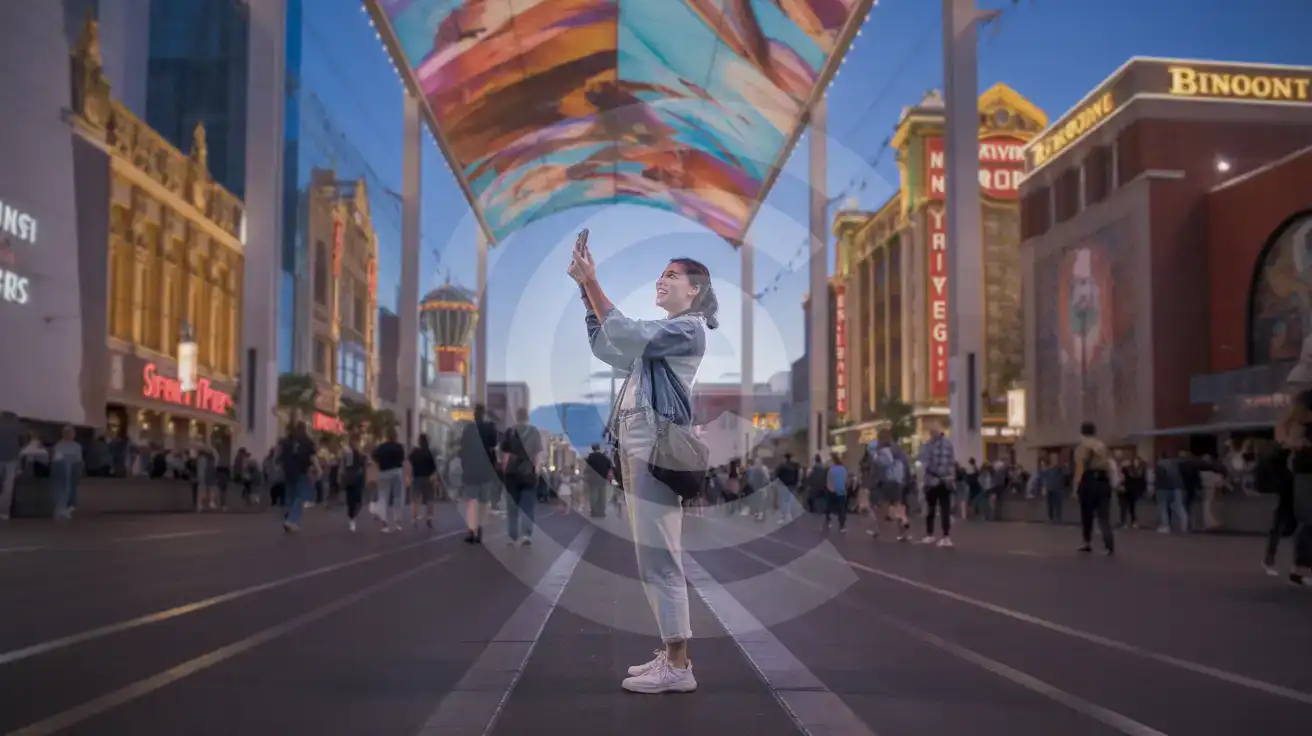
The Las Vegas Strip stretches 4.2 miles from the Welcome sign north to the Stratosphere, packing mega-resorts, theaters, and shopping arcades into a single walkable corridor — though 'walkable' in 110°F heat means most visitors hop the Monorail or rideshare between clusters. Fremont Street Experience anchors downtown's vintage-Vegas revival: a five-block pedestrian canopy lined with neon art, live bands, and cheaper table minimums than the Strip casinos. The Arts District (18b) sits a mile south of Fremont, filling old warehouses with galleries, craft breweries, and First Friday street fairs. Chinatown runs along Spring Mountain Road west of the Strip, offering dim-sum spots and late-night pho joints that locals prefer to hotel restaurants.
Top Things Travelers Come For
World-class shows draw millions annually — Cirque du Soleil operates six resident productions, and residency concerts at venues like the Colosseum at Caesars and Dolby Live at Park MGM rotate A-list acts monthly. The Fountains of Bellagio choreograph 1,200 jets to music every 15-30 minutes after dusk, free to watch from the Strip sidewalk. High-stakes gaming floors, Michelin-starred restaurants, and poolside day clubs round out the entertainment density. Beyond the neon, Red Rock Canyon's 13-mile scenic loop and the sandstone formations of Valley of Fire offer desert escapes within an hour's drive.
When to Visit
Spring (March-May) and fall (September-November) balance comfortable temperatures (70-85°F) with major convention traffic — CES in January and SEMA in November pack hotels and inflate rates. Summer brings extreme heat but deep room discounts; winter holidays see moderate weather and New Year's Eve crowds along the Strip.
Getting Around Las Vegas
Airport Transfers
Harry Reid International Airport sits 2.5 miles south of the Strip's midpoint. Rideshare pickups on Level 2 of Terminal 1 and Terminal 3 run $15-25 to mid-Strip hotels during non-surge hours; the ride takes 10-20 minutes depending on traffic near the convention center. Taxi flat-rate zones simplify pricing: $23-27 to most Strip addresses. The Westgate Las Vegas Resort operates a complimentary shuttle for guests, and several off-Strip properties run scheduled airport loops — check your hotel's app or confirmation email for timing.
Public Transit
The RTC Deuce double-decker bus runs 24 hours along Las Vegas Boulevard from the South Strip Transfer Terminal to Fremont Street, stopping at every major resort cluster. Fares load onto a reusable TAP card or pay via the rideRTC app — $6 for a 2-hour pass, $8 for 24 hours. The Las Vegas Monorail parallels the Strip's east side with 7 stations between MGM Grand and the Sahara; a single ride runs $5, and 24-hour passes cost $13. Free trams connect specific resort pairs: Bellagio-Vdara-Aria, Excalibur-Luxor-Mandalay Bay, and Mirage-Treasure Island.
Walking & Rideshare
Block distances on the Strip deceive newcomers — walking from the Bellagio fountains to the Venetian Grand Canal Shoppes covers 1.2 miles and 25 minutes on foot, longer in summer heat. Uber and Lyft dominate short hops; designated pickup zones sit inside each resort's porte-cochère or parking structure. Surge pricing spikes after arena events and club closings (2-4 AM) — having live data lets you compare ride estimates and lock in before the multiplier climbs.
Fremont Street at Dusk
Compare eSIM Providers in Las Vegas, Nevada
eSIMno | Local SIM / Operator | Roaming | |
|---|---|---|---|
| FEATURES | |||
| Setup time | Few minutes | Store kit, needs activation | Auto |
| No local ID needed | Online checkout | No SSN; passport at carrier stores | Use home account |
| Speed | 4G/LTE on AT&T, T-Mobile and Verizon; 5G in some areas | One carrier only | Partner-dependent |
| Travel support | English support 24/7 | English-language service | Home carrier hours |
| Keep home number | Dual SIM | Replaces it | Same number |
| Cost predictability | Fixed price | Advertised price needs Auto Pay | Bill-shock risk |