

Quick Facts
- Capital
- Abu Dhabi
- Language
- Arabic (عربي)
- Currency
- UAE Dirham (AED, د.إ)
- Time Zone
- Gulf Standard Time (UTC+4)
- Dialing Code
- +971
- Power Plug
- Type G (3-pin rectangular, common in UK and several Asian markets)
- Emergency
- 999 (police), 998 (ambulance), 997 (fire)
- eSIMno Networks
- DU, Etisalat
How to Get Your eSIM
- Pick Your UAE Data Plan
Choose the data allowance that matches your trip length — a 3-day Dubai stopover needs less than a 2-week multi-emirate road trip. Plans range from light browsing to heavy streaming. - Complete Checkout in Under 2 Minutes
Pay with your preferred method and receive the eSIM QR code and activation instructions instantly via email — no shipping, no waiting. - Install Over Home WiFi Before Your Flight
Scan the QR code in your phone's eSIM settings while still connected to your home network. The profile downloads in seconds. Keep it toggled off until arrival. - Activate After Landing at DXB or AUH
Once the aircraft reaches the gate, switch off airplane mode and toggle your eSIM to the primary data line. Your phone connects to DU or Etisalat within moments — no SIM kiosk detour. - Start Navigating Immediately
By the time you're walking through the arrivals concourse toward the metro or rideshare pickup, your maps app is already plotting the fastest route to your hotel.
Traveler Tips
- The Dubai Metro Red Line runs from DXB Terminal 3 to Downtown Dubai in roughly 25 minutes — tap your Nol card at the gate, but use Google Maps with live traffic to compare against Careem surge pricing before committing.
- Timed-entry QR codes are mandatory for Burj Khalifa At The Top and Louvre Abu Dhabi; keep your confirmation email accessible offline or trust your eSIM data to load the ticket at the scanner.
- Desert safari operators send WhatsApp pickup coordinates 2-3 hours before departure — having mobile data ready means you can share your live location with the driver and avoid a missed connection.
- Keep your home SIM active for incoming calls and texts; outgoing voice works best over WhatsApp or FaceTime using your eSIM data to avoid roaming charges.
- Friday afternoons see reduced hours at government offices and some souqs — check live Google listings before heading out so you don't arrive at a shuttered market.
Why Data Matters Across the UAE
The UAE compresses futuristic cities, ancient trading ports, and vast desert expanses into a small but data-hungry footprint. In Dubai, the Red Line metro from Terminal 3 to Burj Khalifa/Dubai Mall station takes 20-25 minutes — but surge pricing on Careem and Uber fluctuates by the minute, and comparing both apps in real time often saves AED 30-50 on a single ride. Inside the Dubai Mall itself, the sheer scale (over 1,200 stores across 500,000+ sqm) makes Google Maps indoor navigation essential unless you enjoy circling the same atrium twice.
Abu Dhabi and Beyond
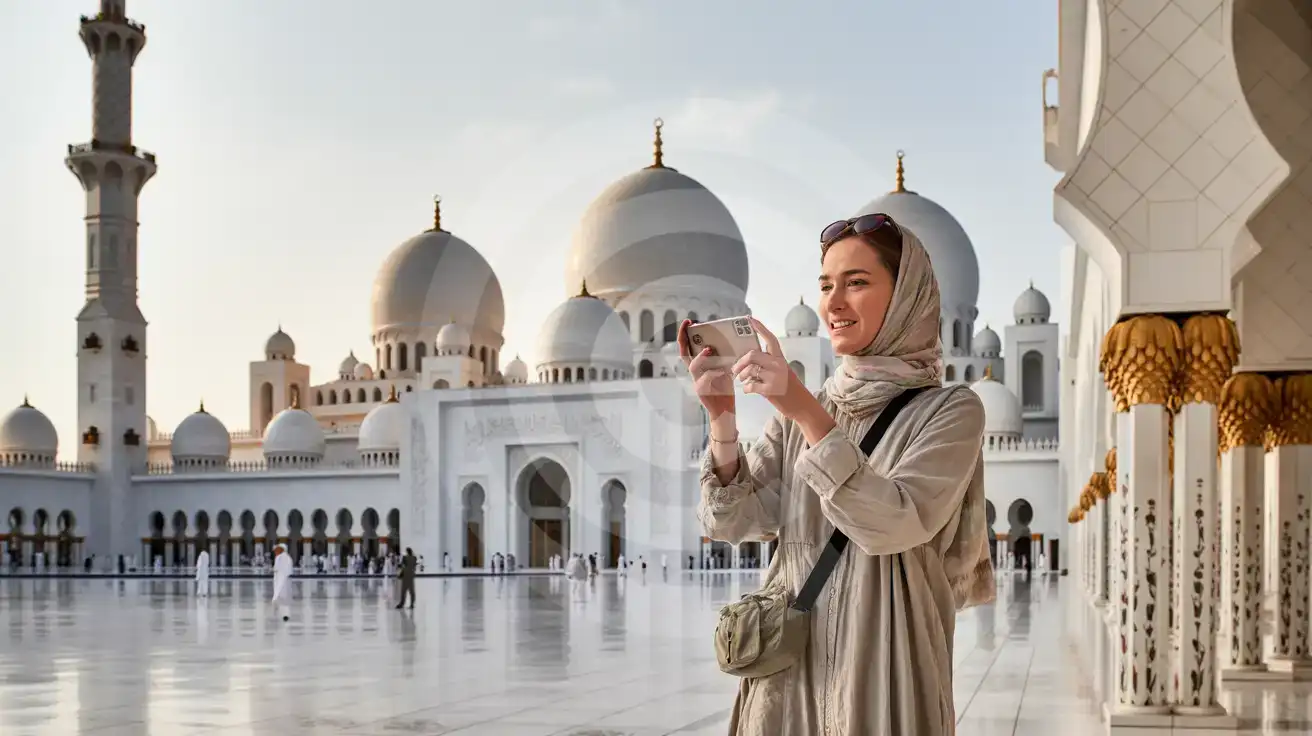
Abu Dhabi sits 130 km southwest of Dubai — roughly 90 minutes by car or 60 minutes via the direct DARB bus service that departs every 30-40 minutes from Ibn Battuta station. The Louvre Abu Dhabi enforces timed-entry tickets with QR codes; showing up without mobile access to your confirmation email means joining the walk-up queue that can stretch 45 minutes on weekend mornings. At the Sheikh Zayed Grand Mosque, dress-code guidelines appear on the official app — pulling them up at the entrance saves an awkward wardrobe adjustment. For travelers venturing to Sharjah's heritage district or Ras Al Khaimah's Jebel Jais mountain road (the UAE's highest peak at 1,934 m), offline maps help but live traffic rerouting around construction zones is what keeps a day trip on schedule.
Translation, Payments, and Group Coordination
Arabic signage dominates outside tourist zones — Google Translate's camera mode turns a confusing pharmacy label or restaurant menu into readable English in under 3 seconds. Contactless payments work almost everywhere, but the UAE's NoL transit card (Dubai) and Hafilat card (Abu Dhabi) require separate top-ups; having mobile data lets you check balances and reload via the RTA Dubai or DARB apps rather than hunting for a kiosk. Group travel across the emirates — a morning in Dubai Marina, afternoon at Ferrari World Abu Dhabi, evening at Sharjah's Al Majaz Waterfront — depends on WhatsApp location sharing and real-time schedule syncing. Your eSIMno plans for United Arab Emirates keep every leg connected without swapping cards or hunting for café WiFi.
About the UAE & What Travelers Come For
Gateway Cities
Dubai International (DXB) handles over 85 million passengers annually, making it the world's busiest for international traffic. Abu Dhabi International (AUH) follows as the capital's primary hub, with a gleaming Midfield Terminal that opened in 2023. Both airports connect to city centers via metro, bus, or rideshare within 30-45 minutes depending on traffic patterns that shift dramatically between weekday mornings and Friday afternoons.
What Travelers Come For
The Burj Khalifa observation decks (At The Top at level 124-125, At The Top Sky at level 148) draw visitors chasing sunset views over the Arabian Gulf. The Sheikh Zayed Grand Mosque in Abu Dhabi — 82 white marble domes, capacity for 40,000 worshippers — ranks among the world's most photographed religious sites. Desert safaris depart daily from Dubai and Sharjah, offering dune bashing, camel rides, and starlit barbecue dinners 45-60 minutes from city limits. Families flock to Ferrari World Abu Dhabi (home to Formula Rossa, the world's fastest roller coaster at 240 km/h) and IMG Worlds of Adventure in Dubai (the world's largest indoor theme park at 1.5 million square feet). The Gold Souq in Deira and the textile stalls of Sharjah's Blue Souq offer bargaining culture that predates the skyscrapers by centuries.
When to Visit
November through March brings mild daytime temperatures (20-28°C) and is peak tourist season. Summer months (June-September) see highs above 45°C; outdoor activities shift to early morning or late evening, and hotel rates drop significantly.
Getting Around the UAE
Airport Transfers
From Dubai International Terminal 3, the Red Line metro reaches Burj Khalifa/Dubai Mall station in 20-25 minutes; buy a Nol Silver card at the station for AED 25 (includes AED 19 credit). Rideshare to Downtown Dubai runs AED 50-80 depending on traffic and surge. From Abu Dhabi International's Midfield Terminal, official Abu Dhabi Taxi operates a flat-rate zone system — expect AED 70-100 to downtown Corniche hotels. The DARB intercity bus connects Abu Dhabi and Dubai in 60-75 minutes for around AED 25 one-way.
Public Transit
Dubai's driverless metro (Red and Green lines) covers major tourist corridors — Palm Jumeirah Monorail connects to the Red Line at Nakheel Harbour station. Abu Dhabi's public bus network (Darb) runs 90+ routes but sees less tourist use; rideshare remains king for cross-city trips. Water taxis (abras) in Dubai Creek cost AED 1 per crossing and operate roughly every 3-5 minutes during daylight hours.
Rideshare and Inter-Emirate Travel
Careem and Uber both operate across Dubai, Abu Dhabi, Sharjah, and Ajman — Careem often edges out on local pricing, while Uber integrates better with international accounts. For trips between emirates (Dubai to Ras Al Khaimah, 100 km; Dubai to Al Ain, 150 km), renting a car from the airport gives flexibility; toll gates (Salik) deduct AED 4 per pass and require a prepaid account linked to your license plate.
Exploring Beyond Dubai's Skyline
Compare eSIM Providers for United Arab Emirates
eSIMno | Local SIM / Operator | Roaming | |
|---|---|---|---|
| FEATURES | |||
| Setup time | Few minutes | Bought in person after you arrive | Auto |
| No local ID needed | Online checkout | Visitors only, 18 and over, tied to your visa | Use home account |
| Speed | 4G/LTE on both UAE networks; 5G in some areas | One network only | Partner-dependent |
| Travel support | English support 24/7 | Operator shops and call centre | Home carrier hours |
| Keep home number | Dual SIM | Replaces it | Same number |
| Cost predictability | Fixed price | Prepaid, but listed prices exclude 5% VAT | Bill-shock risk |