

Quick Facts
- Language
- Japanese (日本語)
- Currency
- Japanese Yen (JPY, ¥)
- Time Zone
- Tokyo Standard Time (UTC+9)
- Dialing Code
- +81
- Power Plug
- Type A (flat 2-pin, common in Japan and North America; voltage is 100V in Japan, lower than the 110-120V of the US)
- Emergency
- 110 (police), 119 (fire / ambulance)
- eSIMno Networks
- KDDI
How to Get Your eSIM
- Pick Your Japan Plan
Choose the data volume that fits your Skytree visit and onward travel — 3GB handles a weekend trip, 10GB+ suits a full week across Tokyo, Kyoto, and Osaka. - Install Over WiFi Before You Fly
Scan the QR code at home or your hotel before departure. The profile sits dormant until you activate — no data charges until you're in Japan. - Activate After Landing
Once your flight taxis to the gate at Haneda or Narita, switch off airplane mode. Your phone connects to KDDI within seconds. - Pull Up Your Skytree Ticket
By the time you exit Oshiage Station and walk toward the fourth-floor entrance, your timed-entry confirmation loads instantly — no searching for lobby WiFi. - Use Everywhere in Japan
The same plan that works at 450 meters on the Tembo Galleria keeps working at sea level in Asakusa, across Shibuya Crossing, or inside the Shinkansen to Kyoto.
Traveler Tips
- Arrive at 10:00 opening or after 20:00 for shorter elevator queues — midday weekends can hit 45-minute waits for the Tembo Deck.
- Winter mornings from December to February offer the clearest Mount Fuji visibility from the 350-meter deck — check the forecast app before booking your slot.
- Keep your home SIM active for incoming calls; use your eSIMno data for WhatsApp, FaceTime, and LINE calls to avoid roaming voice charges.
- Download offline maps for Sumida ward before visiting — the Solamachi basement levels have weaker signal than the observation decks.
- The Glass Floor section on Floor 340 is a photo hotspot; upload to social while you wait rather than fighting the crowd for WiFi afterward.
Why Data Matters at Tokyo Skytree
The Skytree experience runs on data from the moment you leave Oshiage Station. Your timed-entry ticket lives in an email or the official reservation confirmation — pull it up at the fourth-floor gate or risk scrambling for the Solamachi lobby WiFi with a hundred other visitors. The elevator ride to Floor 350 takes about 50 seconds, but the queue to board can stretch 30 minutes on busy weekends; real-time wait updates on the Skytree app save standing in the wrong line.
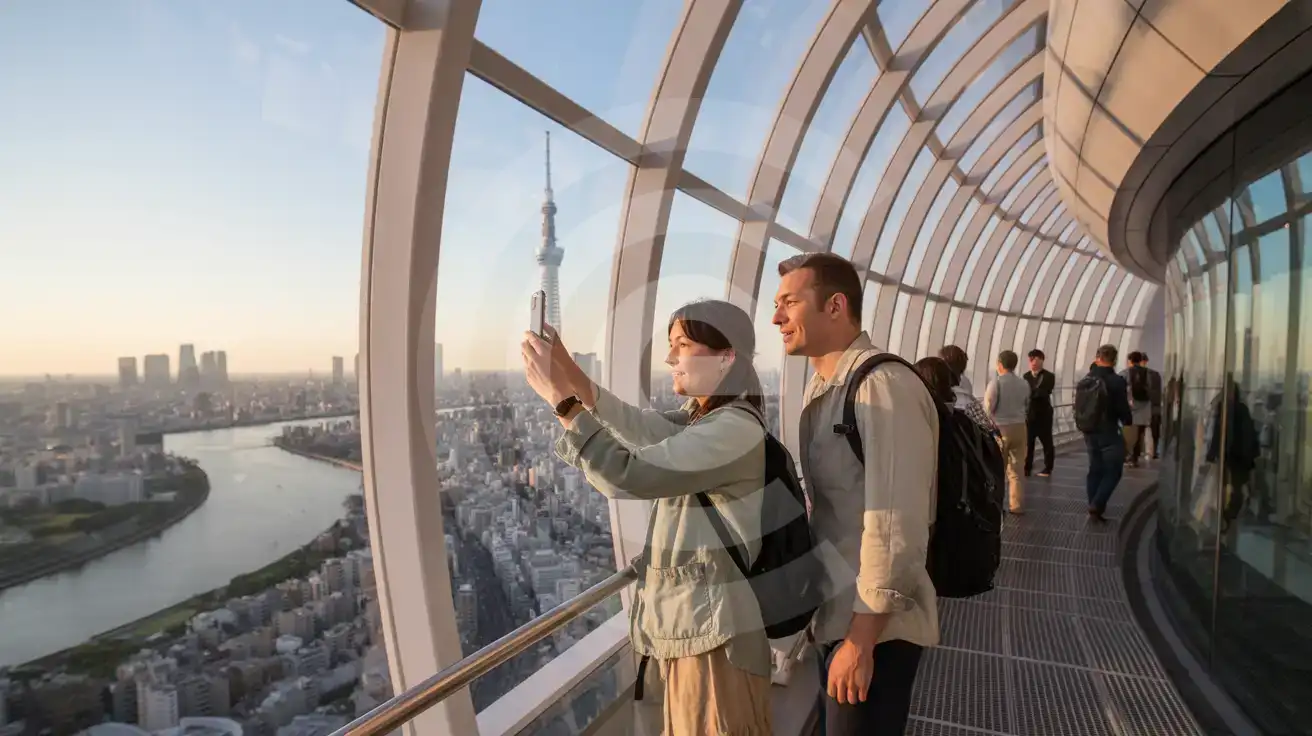
At the Tembo Deck, KDDI signal holds strong across all three floors. The photo opportunity at the Glass Floor section on 340 and the panoramic windows on 350 both demand instant sharing — Instagram, LINE, WhatsApp — while the view is fresh. The upper Tembo Galleria at 450 meters has the same coverage, but the spiral glass-walled air walk creates reflection glare; editing apps like Snapseed or Lightroom Mobile let you fix the shot before descending.
After the observation deck, the data demand shifts to transit. Google Maps or Navitime Japan navigate the Tobu Skytree Line back toward Asakusa (one stop, 2 minutes) or the Hanzomon metro toward Shibuya (direct, 25 minutes). The 15-minute walk across the Sumida River to Senso-ji needs live directions unless you've memorized the Kototoi Bridge route. A rideshare pickup along the Solamachi taxi lane requires DiDi or Uber Japan — both need data to confirm driver ETA. eSIMno plans for Tokyo Skytree, Tokyo, Japan keep every transition seamless from 634 meters down to street level.
Visiting Tokyo Skytree
The observation decks open daily from 10:00 to 22:00, with last admission around 21:00. Elevator service to the upper Tembo Galleria suspends during high winds — check the official site before booking a combined ticket. Foreign passport holders can use the Fast Skytree Ticket counter on the fourth floor for priority boarding at a small premium over standard rates.
Dress comfortably for temperature differences; the upper deck at 450 meters can feel several degrees cooler than the Sumida streets below. Photography is unrestricted, though tripods longer than 50 centimeters and flash toward the windows are prohibited. The Solamachi complex at the tower's base holds restaurants, the Sumida Aquarium, and the Konica Minolta Planetarium — each has its own ticket flow, so plan data for multiple QR scans if you're combining visits.
View From the Tembo Galleria
Compare eSIM Options at Tokyo Skytree
eSIMno | Local SIM / Operator | Roaming | |
|---|---|---|---|
| FEATURES | |||
| Setup time | Few minutes | Counter pickup or pre-order by post | Auto |
| No local ID needed | Online checkout | Passport scan since April 2026 | Use home account |
| Speed | 4G/LTE on KDDI + Softbank; 5G in some areas | Carrier-grade | Partner-dependent |
| Travel support | English support 24/7 | Japanese-language service | Home carrier hours |
| Keep home number | Dual SIM | Data-only: no Japanese number | Same number |
| Cost predictability | Fixed price | Prepaid, fixed term | Bill-shock risk |