

Quick Facts
- Time Zone
- Central European Standard Time (UTC+1)
- Dialing Code
- +39
- Currency
- Euro (EUR, €)
- Power Plug
- Type C, E, F (round 2-pin, common across most of Europe)
- Language
- Italian (Italiano)
- Emergency
- 112
- eSIMno Networks
- Vodafone, Wind Tre
How to Get Your eSIM
- Choose Your Italy Plan
Pick from eSIMno Italy data plans based on your trip length. A week in Siena plus day trips to Chianti and San Gimignano typically runs 3-5 GB; add buffer if you're streaming walking tours through the Duomo complex. - Install Over WiFi at Home
Scan the QR code from your confirmation email while connected to your home WiFi. The profile installs in under 2 minutes — do this before you leave for the airport so there's no stress during layovers. - Keep Your Home SIM Active
Enable dual-SIM mode so incoming calls still reach your home number. Use your eSIMno data line for maps, translations, and internet calls via WhatsApp or FaceTime. Native voice calls through your home SIM while abroad trigger roaming charges — stick to data apps. - Activate After Landing in Italy
Once your plane taxis to the gate at Fiumicino, Pisa, or Florence airport, switch off airplane mode. Your eSIMno line connects to Vodafone or Wind Tre within seconds — by the time you're walking to the regional train platform for Siena, directions are already loading. - Explore Siena and Beyond
Your plan covers all of Italy, not just Siena. The same data works in the Chianti hills, along the Tuscan coast, or in Rome and Venice if your trip extends. No new SIM needed, no roaming surprises.
Traveler Tips
- Book Duomo complex tickets through the Opera della Metropolitana site at least 48 hours ahead — timed-entry QR codes are mandatory and the on-site WiFi inside the cathedral baptistery drops constantly.
- The twice-yearly Palio horse race (July 2 and August 16) floods Siena with visitors; restaurants around Piazza del Campo require reservations weeks in advance, and real-time availability on Google Maps saves walking into fully-booked trattorias.
- Siena's train station sits about 2 km downhill from the historic center — Tiemme city buses run every 10-15 minutes, and live departure boards on the Tiemme app beat guessing at the roadside stop.
- Cellular signal holds strong across the centro storico including inside the Palazzo Pubblico museum and the Museo dell'Opera; underground sections of Santa Maria della Scala hospital-museum can dip briefly but reconnect in the courtyards.
- Day trips to Chianti wineries like Castello di Brolio require advance booking — many cellars accept only online reservations, and your data plan keeps working across the vineyard hills where WiFi is nonexistent.
Why Data Matters in Siena
Siena's medieval street grid defeats static maps. The steep, curving lanes between Piazza del Campo and the Duomo look straightforward on paper but fork unexpectedly beneath brick arches and through narrow sottoporteggi. Google Maps with live GPS keeps you oriented — the blue dot updating in real time as you climb toward the Basilica of San Domenico or descend toward Fontebranda, the city's oldest fountain.
Timed-entry tickets for the Duomo complex — the cathedral floor mosaics, the Piccolomini Library, the rooftop Gate of Heaven tour — require QR codes that staff scan at each checkpoint. The Opera della Metropolitana booking system emails these codes, but the venue WiFi inside the marble interior is unreliable. Having your QR ready on mobile data avoids the awkward shuffle of trying to reload confirmation emails while a queue builds behind you. The same applies to the Museo Civico inside Palazzo Pubblico: online tickets bypass the ground-floor queue and display instantly on a connected phone.
Getting around relies on Tiemme buses for the 2 km climb from Siena Stazione to Piazza Gramsci. The Tiemme app shows live arrivals — the posted schedules at bus stops are approximations at best. From there, the centro storico is walkable but hilly; the steepest climb connects Piazza del Campo to Piazza del Duomo via Via di Città. Real-time route adjustments on Maps help you pick the less punishing path, especially in July heat.
Restaurants in the historic core — along Banchi di Sotto, around Piazza Salimbeni, and tucked behind the Campo — fill quickly during Palio season and summer weekends. OpenTable and Google Maps reservations work here, but many family-run trattorias prefer direct calls. Translation apps bridge the language gap when the host speaks only Italian. eSIMno plans for Siena, Italy keep you connected for all of it — from confirming a Chianti vineyard booking at Castello di Brolio to sharing photos of the Torre del Mangia at sunset.
About Siena & What Travelers Come For
The Heart of Tuscany
Siena sits on three hills in central Tuscany, a walled medieval city whose Gothic architecture has remained largely unchanged since the 14th century. The entire centro storico is a UNESCO World Heritage site, anchored by Piazza del Campo — the distinctive shell-shaped piazza that serves as the city's living room and the stage for the Palio horse race.
Neighborhoods at a Glance
The historic center divides into seventeen contrade, the traditional neighborhoods whose rivalries fuel the Palio. Terzo di Città surrounds the Siena Cathedral and the Pinacoteca art gallery; Terzo di San Martino stretches east toward the university district; Terzo di Camollia runs north toward the Fortezza Medicea and the city walls. Each contrada maintains its own museum, fountain, and social club — exploring them on foot reveals a Siena most day-trippers miss.
What Travelers Come For
The Duomo complex draws crowds for its intricate marble facade, the Piccolomini Library frescoes, and the Gate of Heaven rooftop tour with views across terracotta rooftops to the Tuscan hills. Santa Maria della Scala — the medieval hospital turned museum — houses Renaissance frescoes in underground chambers. The Palazzo Pubblico and its Torre del Mangia offer the city's most iconic silhouette, while the Pinacoteca Nazionale holds Sienese Gothic masterpieces. Beyond the walls, the Chianti wine region and hill towns like San Gimignano and Montepulciano make easy day trips.
Getting Around Siena
Arriving by Train
Siena Stazione sits about 2 km north of the historic center, connected by Tiemme bus routes that run every 10-15 minutes to Piazza Gramsci. Regional trains from Florence Santa Maria Novella take 90 minutes direct or 75 minutes via Empoli; trains from Rome Termini run about 3 hours with a change in Chiusi or Florence. The station has no SIM kiosks — travelers without data activated before arrival face a connectivity gap until reaching the centro.
Navigating the Centro Storico
The walled city is car-free and walkable but built on steep hills. The climb from Piazza del Campo to Piazza del Duomo via Via di Città takes about 10 minutes at a leisurely pace. Escalators near Piazza del Sale ease the ascent from the lower parking areas. Most attractions cluster within a 15-minute walk of the Campo, but the medieval layout means dead ends and unmarked alleyways — GPS navigation helps more here than in grid-planned cities.
Day Trips
Buses from Siena's bus station (below Piazza Gramsci) reach San Gimignano in 75 minutes and Montepulciano in 70 minutes. The Chianti wine route is best explored by rental car from the agencies near the train station, though guided shuttle tours operate from Piazza del Campo. Uber does not operate in Siena; local taxi ranks sit near Piazza Matteotti and the train station, with limited availability outside peak hours.
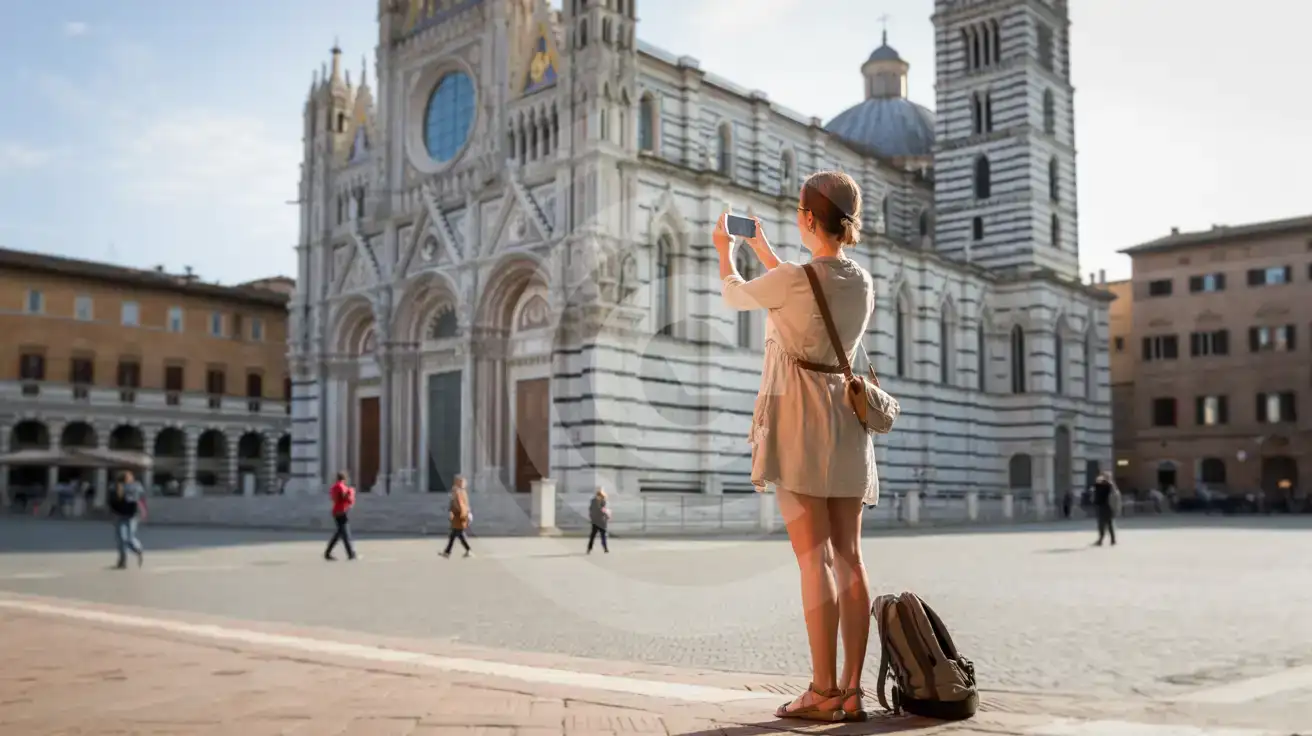
Capturing Siena's Duomo
Compare eSIM Providers in Siena
eSIMno | Local SIM / Operator | Roaming | |
|---|---|---|---|
| FEATURES | |||
| Setup time | Few minutes | Store registration, about ten minutes | Auto |
| No local ID needed | Online checkout | Passport is required by law; some also ask for a tax code | Use home account |
| Speed | 4G/LTE on Vodafone and WindTre; 5G in some areas | One network only | Partner-dependent |
| Travel support | English support 24/7 | Italian-language service | Home carrier hours |
| Keep home number | Dual SIM | Replaces it | Same number |
| Cost predictability | Fixed price | Prepaid, no bill shock | Bill-shock risk |