

Quick Facts
- Language
- Valencian (Español)
- Currency
- Euro (EUR, €)
- Time Zone
- Central European Time (UTC+1 / UTC+2 DST)
- Dialing Code
- +34
- Power Plug
- Type C, E, F (round 2-pin, common across most of Europe)
- Emergency
- 112
- eSIMno Networks
- Movistar, Orange
How to Get Your eSIM
- Pick Your Spain Data Plan
Browse eSIMno plans sized for a weekend pintxos crawl or a two-week Basque coast road trip—data allowances range from light browsing to heavy streaming. - Complete Checkout in Under 3 Minutes
Pay with card or Apple Pay; your eSIM QR code and activation instructions arrive instantly by email. - Install at Home Over WiFi
Scan the QR in Settings → Cellular → Add eSIM (iOS) or Settings → Network → SIMs (Android). Label it 'Spain Travel' so it's easy to toggle later. - Activate After Landing at San Sebastian Airport
Once wheels touch the runway and the captain clears phone use, switch off airplane mode. Your eSIM locks onto Movistar or Orange within seconds—maps, rideshare, and reservations all load before you reach baggage claim. - Keep Your Home SIM for Calls
Dual-SIM mode lets your home number receive calls and texts while eSIMno handles every data task—no call forwarding setup needed.
Traveler Tips
- Parte Vieja pintxos bars don't take reservations—pull up Google Maps walking directions and bar-hop on foot; the old town is 0.6 km end to end, but alleys loop unpredictably without live navigation.
- Book your Arzak or Mugaritz timed slot at least 30 days ahead; the confirmation QR lives in your email, so data at the door beats a screenshot that won't load.
- Euskotren E2 from Amara station to Bilbao-Atxuri takes 2 hr 35 min and costs around €7.50; real-time delay alerts on the Euskotren app save platform-hopping guesswork.
- Monte Igueldo funicular runs every 15 min (€4.25 round trip as of 2024)—check live wait times on Google Maps before hiking up from Ondarreta Beach.
- Rain rolls in fast off the Cantabrian Sea; keep the AEMET weather app open so you can duck into a covered market or call an Uber before the downpour peaks.
- Your eSIMno plan works across all of Spain—no second SIM needed for a day trip to Bilbao's Guggenheim (1 hr by car) or a wine run through La Rioja (90 min south).
Why Data Matters in San Sebastian
San Sebastian packs world-class dining, surf beaches, and Basque heritage into a compact coastal footprint—but navigating it all without data is like showing up to a pintxos crawl without an appetite. Parte Vieja's labyrinth of 15th-century lanes has no visible street signs; Google Maps live directions are the difference between finding Bar Nestor's legendary tortilla (served at 1 PM and 8 PM sharp, first-come-first-served) and circling Calle 31 de Agosto for the third time. Timed-entry QR codes for the Aquarium Donostia-San Sebastián or the summit ride up Monte Igueldo funicular load from your inbox in seconds—no WiFi hunt, no screenshot that refuses to brighten in sunlight.
Transit, Taxis & Rideshare
Euskotren's E2 line connects Amara-Donostia station to Bilbao Airport in 2 hr 35 min for around €7.50; real-time delay alerts on the Euskotren app let you adjust without sprinting across platforms. Uber operates in Donostia, though local taxi apps like PideTaxi fill gaps during peak pintxos hours (8–10 PM) when surge pricing spikes. A sudden Cantabrian downpour can strand you under a portside awning—one tap on Uber or PideTaxi summons a car to your GPS pin instead of waving blindly at passing traffic on Paseo de la Concha.
Reservations & Real-Time Intel
Michelin-starred kitchens like Arzak and Mugaritz release tables 30–60 days out; the confirmation email with your timed-entry slot is your ticket—literally. Casual pintxos joints don't take reservations, so real-time crowd data on Google Maps tells you whether La Cuchara de San Telmo has a 5-minute wait or a 25-minute queue. Surf conditions at Zurriola Beach shift hourly; the Surfline app's live cam feed and swell forecast help you time your session between sets. With eSIMno plans for San Sebastian, Spain, every lookup—restaurant, transit, surf report—happens instantly, not after a frustrating captive-portal login at a café.
About San Sebastian & What Travelers Come For
Neighborhoods at a Glance
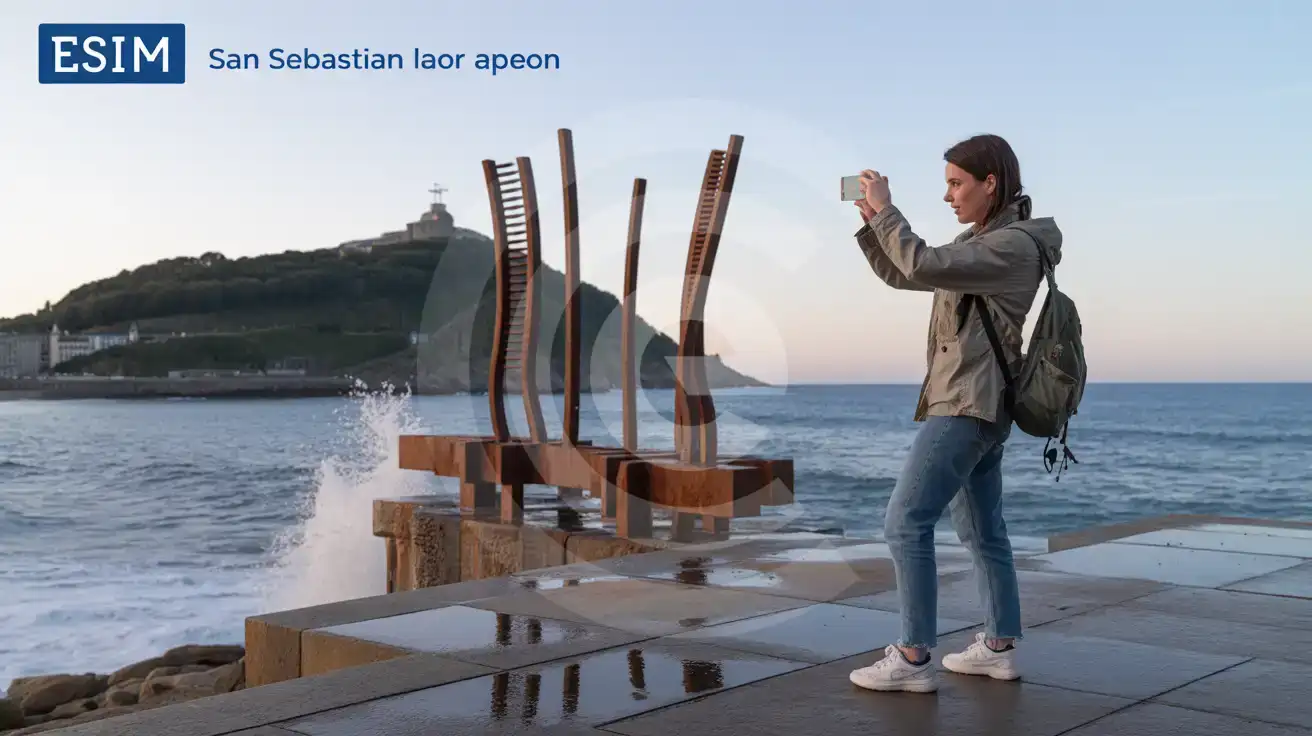
Parte Vieja (the Old Town) is the pintxos epicenter—bar counters stacked with gildas, croquetas, and txuleta slices line Calle Fermín Calbetón and Calle 31 de Agosto. Centro stretches along La Concha Beach, the shell-shaped beach that put Donostia on the Belle Époque tourist map; grand promenades, the Hotel Maria Cristina, and the Victoria Eugenia Theatre anchor this district. Gros sits east of the Urumea River, home to Zurriola Beach's surf break and a younger, more local vibe—coffee roasters, surf shops, and the striking glass cubes of the Kursaal Congress Centre. Antiguo climbs the western hillside toward Monte Igueldo and the Peine del Viento sculptures; it's quieter, residential, and rewards sunset chasers with unobstructed Atlantic views.
Top Things Travelers Come For
San Sebastian holds more Michelin stars per capita than almost any city on Earth—reserve weeks ahead for Arzak, Mugaritz, or Martín Berasategui (11 km south). The pintxos crawl through Parte Vieja is a bucket-list ritual: hop from Bar Nestor (tortilla at 1 PM and 8 PM) to La Cuchara de San Telmo (slow-cooked pig's ear) to Gandarias (txuleta steak). La Concha Beach offers calm swimming in summer; Zurriola Beach draws surfers year-round. Monte Igueldo's funicular (operating since 1912) delivers panoramic bay views and a vintage amusement park at the summit. Eduardo Chillida's Peine del Viento sculpture installation on the western rocks is best visited at high tide when waves crash through the iron combs.
When to Visit
July and August bring peak beach weather (highs around 25°C) and the San Sebastián International Film Festival in late September draws global cinema crowds. Spring (April–June) offers mild temperatures, fewer tourists, and pintxos bars at their least crowded. Winter is cool and rainy but ideal for storm-watching from Peine del Viento and scoring last-minute tables at top restaurants.
Getting Around San Sebastian
Airport Transfers
San Sebastian Airport (EAS) sits 22 km east of the city center near Hondarribia. The E21 bus runs to Gipuzkoa Plaza in about 35 min for around €3; taxis cost €35–45 fixed fare to Centro or Parte Vieja. Many travelers fly into Bilbao Airport (BIO), 100 km west, then take the Lurraldebus A3247 coach (1 hr 20 min, €18) or rent a car for the scenic coastal drive along the BI-631.
Public Transit
Dbus city buses cover the urban core; a single ride is €1.85 (contactless or Mugi card). Euskotren's E2 metro-tram line connects Amara-Donostia station to Bilbao-Atxuri in 2 hr 35 min (€7.50). For day trips, Renfe's regional trains reach Irún (15 min) and connect onward to Hendaye, France, for cross-border exploring.
Walking & Rideshare
Centro, Parte Vieja, and Gros are flat and walkable—La Concha promenade stretches 2 km end to end. Uber operates in Donostia; PideTaxi and local radio-taxi apps fill gaps during pintxos-hour surge. Bike-share stations (dBizi) dot the waterfront; a day pass runs €3 and works for unlimited 30-minute trips.
Peine del Viento at Sunset
Compare eSIM Providers in San Sebastian
eSIMno | Local SIM / Operator | Roaming | |
|---|---|---|---|
| FEATURES | |||
| Setup time | Few minutes | Registered in store before the SIM works | Auto |
| No local ID needed | Online checkout | Photo ID required by law at purchase | Use home account |
| Speed | 4G/LTE on Movistar and Orange; 5G in some areas | One network only | Partner-dependent |
| Travel support | English support 24/7 | Spanish-language service | Home carrier hours |
| Keep home number | Dual SIM | Replaces it | Same number |
| Cost predictability | Fixed price | Prepaid, no bill shock | Bill-shock risk |