

Quick Facts
- Language
- Italian (Italiano)
- Currency
- Euro (EUR, €)
- Time Zone
- Central European Standard Time (UTC+1)
- Dialing Code
- +39
- Power Plug
- Type C, E, F (round 2-pin, common across most of Europe)
- Emergency
- 112
- eSIMno Networks
- Vodafone, Wind Tre
How to Get Your Rome eSIM
- Choose Your Italy Data Plan
Pick from 1GB to 20GB options based on your trip length. A week exploring Rome's centro storico, Vatican City, and day trips to Tivoli runs comfortably on 5-7GB. - Complete the 2-Minute Purchase
Check out with your email address. Your eSIM QR code and installation guide arrive instantly — no physical card ships, no waiting. - Install at Home Over WiFi
Scan the QR code in your phone's settings before you leave for Fiumicino. The profile downloads in under 60 seconds and sits dormant until you activate it. - Activate After Landing in Rome
Once your aircraft reaches the gate at Fiumicino or Ciampino, switch off airplane mode. Your phone connects to Vodafone or Wind Tre within seconds — by the time you reach passport control, Maps is already routing your Termini transfer. - Keep Your Home SIM for Calls
Your phone runs both SIMs simultaneously. The eSIMno plan handles all data (maps, rides, reservations, messaging). Incoming calls still reach your home number — no forwarding setup needed. For outgoing calls, use WhatsApp or FaceTime over your new Italian data.
Traveler Tips for Rome
- Book Vatican Museums tickets online at least 5 days ahead — the QR code on your phone skips the 2-hour general queue at the Viale Vaticano entrance entirely.
- Download the Roma Mobilità app before arrival for real-time Metro Line A and Line B delays; service gaps during afternoon closures (13:30-16:30 on some lines) catch tourists off guard.
- The Free Now and itTaxi apps work across Rome when Uber availability drops — essential during Friday evening rush around Trastevere when street hails disappear.
- Activate your eSIM after landing, not during boarding — activating at your departure airport can burn data before you even leave home.
- Colosseum combo tickets (Colosseum + Roman Forum + Palatine Hill) require the same QR scan at each entrance within 24 hours — keep your phone charged above 20% to avoid gate rejection.
Why Data Matters in Rome
Rome's historic center operates on timed-entry logistics that punish travelers without instant data access. The Vatican Museums require a pre-booked QR code scanned at the Viale Vaticano entrance — show up without one and you'll queue for 2-3 hours behind the walk-up line. The Borghese Gallery and Museum enforces strict reservation windows with zero flexibility; miss your 11:00 slot by 15 minutes and your ticket voids entirely. Even the Colosseum underground tour requires a separate timed-entry confirmation that loads only through the official Parco Colosseo app.
Navigation between Rome's piazzas defeats offline maps the moment you veer off the main tourist spine. The cobblestone alleys connecting Piazza Navona to the Pantheon fork unpredictably — Google Maps live-rerouting catches wrong turns before they cost you 20 minutes of backtracking. Trastevere's restaurant scene clusters along Via del Moro and Vicolo del Cinque, but the specific trattoria your hotel concierge recommended sits three unmarked turns deep, and its name only appears on the OpenTable confirmation you need data to pull up.
Rideshare and taxi apps fill critical gaps the Rome transit network leaves open. Metro Line A and Line B cross at Termini but close early (23:30 weeknights) — Free Now or itTaxi becomes the only practical option for a late dinner return from Testaccio. The Leonardo Express to Fiumicino runs every 15 minutes until 23:23, but checking the real-time departure board via Trenitalia's app saves a panicked sprint when delays push your connection tight. Grab an eSIMno plan for Rome and every timed-entry ticket, every rideshare pickup, and every last-minute restaurant pivot stays one tap away.
About Rome & What Travelers Come For
Neighborhoods at a Glance
Centro Storico anchors most first visits — the dense triangle between Piazza Navona, the Pantheon, and Trevi Fountain packs Renaissance churches, baroque fountains, and espresso bars into a 20-minute walking radius. Trastevere across the Tiber draws evening crowds to its ivy-draped trattorias and aperitivo terraces along Via del Moro. Monti, northeast of the Colosseum, skews younger with vintage shops and wine bars tucked into former artisan workshops. Testaccio, once the city's meatpacking district, now hosts Rome's most authentic Roman cuisine — cacio e pepe and coda alla vaccinara at family-run spots that close by 22:30.
Top Things Travelers Come For
The Colosseum and Roman Forum complex anchors ancient Rome — a combined ticket grants 24-hour access across both sites plus Palatine Hill. Vatican City draws pilgrims and art lovers to St. Peter's Basilica, the Sistine Chapel, and the Vatican Museums' 7km of gallery corridors. The Spanish Steps cascade down from Trinità dei Monti toward Via dei Condotti's designer flagships. Campo de' Fiori's morning market transitions to evening drinks as the piazza fills with students and tourists alike.
When to Visit
April through mid-June and September through October balance mild temperatures (18-24°C) with manageable crowds. July and August bring 35°C heat that empties Romans to the coast but packs Vatican queues with northern European tourists. Winter (December-February) drops visitor numbers dramatically — shorter queues at the Borghese Gallery and cooler 8-12°C days reward layered clothing.
Getting Around Rome
Airport Transfers
Fiumicino (FCO) sits 32km southwest of the centro storico. The Leonardo Express runs nonstop to Roma Termini in 32 minutes, departing every 15 minutes from 06:23 until 23:23. Tickets run around €15 one-way and validate at the platform QR scanner before boarding. Ciampino (CIA), 15km southeast, serves budget carriers — the Terravision shuttle reaches Termini in 40 minutes depending on traffic. Taxi flat fares from Fiumicino to anywhere inside the Aurelian Walls run €50; from Ciampino €31.
Public Transit
Rome's Metro operates two main lines: Line A (orange, Battistini-Anagnina) and Line B (blue, Rebibbia/Jonio-Laurentina), crossing at Termini. Single rides cost around €1.50 with a 100-minute transfer window to buses and trams. The 24-hour Roma24 pass and 72-hour Roma72 pass cover unlimited rides across metro, bus, and tram — purchase via the Tabnet app or at newsstands displaying the ATAC logo. Buses fill gaps the metro misses: the 64 runs Termini to Vatican, the 40 express covers the same route faster.
Walking & Rideshare
Rome's centro storico rewards walking — Piazza Navona to the Colosseum covers 2.2km in about 25 minutes. Cobblestones punish wheeled luggage and require sturdy footwear. Uber operates but availability drops sharply after 22:00 and during rainstorms; Free Now and itTaxi fill the gap with licensed white taxis trackable in-app. Lime e-scooters dot the centro storico but are banned inside the Vatican City perimeter.
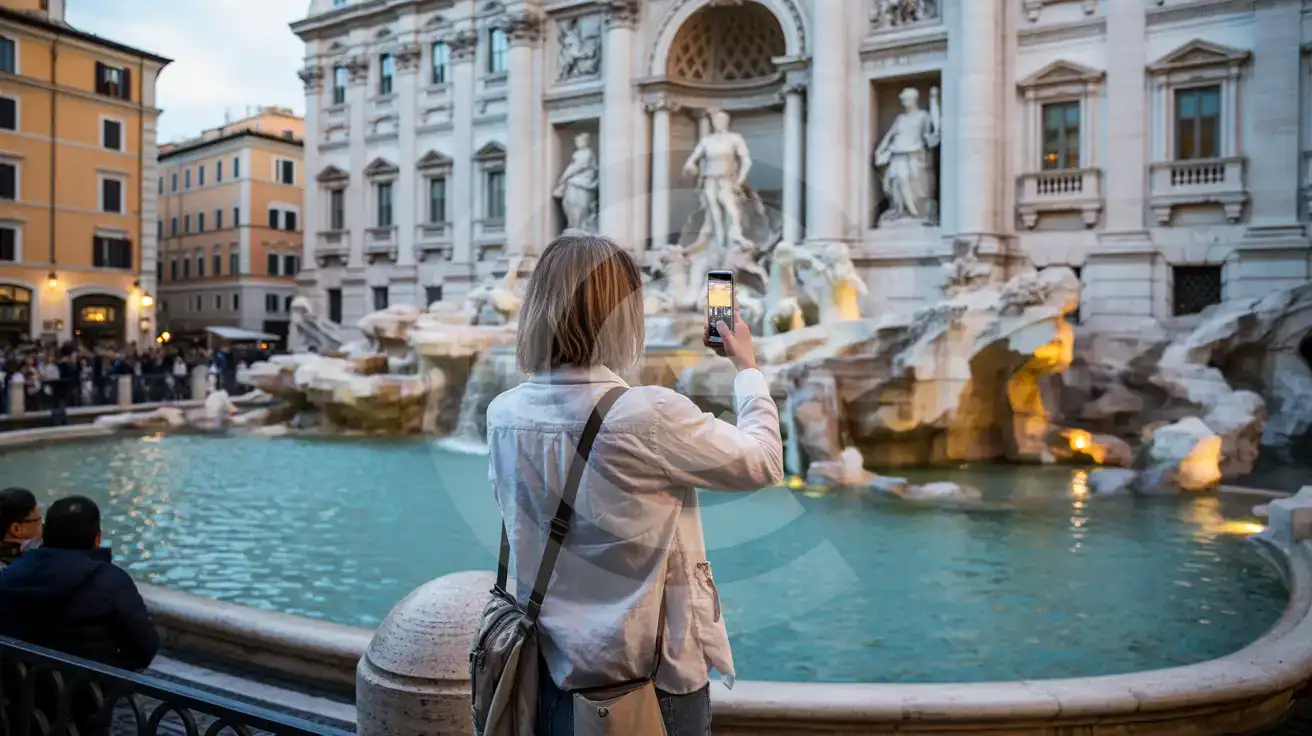
Trevi Fountain at Twilight
Compare eSIM Providers in Rome
eSIMno | Local SIM / Operator | Roaming | |
|---|---|---|---|
| FEATURES | |||
| Setup time | Few minutes | Store registration, about ten minutes | Auto |
| No local ID needed | Online checkout | Passport is required by law; some also ask for a tax code | Use home account |
| Speed | 4G/LTE on Vodafone and WindTre; 5G in some areas | One network only | Partner-dependent |
| Travel support | English support 24/7 | Italian-language service | Home carrier hours |
| Keep home number | Dual SIM | Replaces it | Same number |
| Cost predictability | Fixed price | Prepaid, no bill shock | Bill-shock risk |