

Quick Facts
- Language
- Italian (Italiano)
- Currency
- Euro (EUR, €)
- Time Zone
- Central European Standard Time (UTC+1)
- Dialing Code
- +39
- Power Plug
- Type C, E, F (round 2-pin, common across most of Europe)
- Emergency
- 112
- eSIMno Networks
- Vodafone, Wind Tre
How to Get Your eSIM
- Choose Your Italy Plan Before Travel
Pick your Italy eSIM before you leave home so embarkation day at Port of Venice stays simple. If you are flying into Venice Marco Polo Airport or connecting by train into Venezia Santa Lucia, you do not need to spend arrival time looking for a SIM counter. - Install It Over Stable WiFi
Install the eSIM QR profile at home or at your hotel before cruise day. That gives you time to save your boarding email, passport copy, transfer booking, and terminal address on the same phone you will use at Port of Venice. - Keep It Off Until You Land
Leave the eSIM installed but inactive while you travel. Turn it on after landing in Italy or once you arrive and switch off airplane mode, so the plan starts when you are ready to head toward the port. - Use Data For The Port Transfer
As you move from the airport, Mestre, or Piazzale Roma toward Port of Venice, use your data for Google Maps, driver chat, cruise line emails, and People Mover or vaporetto planning. That is the point where port WiFi is least helpful and timing matters most. - Keep It Running For The Rest Of Italy
Your eSIM is not just for the pier. After embarkation or after you disembark, keep using it for trains, hotels, restaurant bookings, and onward travel across Venice, Rome, Florence, Milan, and the rest of Italy.
Traveler Tips
- If you are boarding at Port of Venice on the same day you land, activate your eSIM after landing and before you start the 20-30 minute transfer from Venice Marco Polo Airport so maps and driver messages work immediately.
- From the city side, many cruise travelers pass through Piazzale Roma and then continue by People Mover or port transfer. Keep your confirmation email and terminal directions loaded before you start moving with luggage.
- Port of Venice days involve a lot of short app checks in a tight window: passport copy, boarding documents, taxi chat, and Google Maps. A small plan can disappear fast if you start uploading video from the pier, so choose data with some margin.
- If your home SIM stays active for voice, incoming calls to your regular number still reach you with no extra setup. For outbound calls around Venice, use WhatsApp, FaceTime, Telegram, or another internet calling app over your eSIM data.
- Venice routes can shift between road transfer, People Mover, vaporetto, and walking segments. Live navigation matters more here than in a standard cruise port because one wrong turn with luggage can cost 15-20 minutes.
Why Data Matters at Port of Venice
Port of Venice is not a walk-off-and-forget-it cruise stop. The real challenge is the handoff between airport, rail, city transport, and cruise terminal, all inside a place where water routes and pedestrian links change the way you move. If you arrive through Venice Marco Polo Airport, you will likely check transfer details before you even leave arrivals. If you come in through Venezia Santa Lucia, you may need to coordinate the last stretch from the station side of Venice. If you are already overnighting near Grand Canal, your phone becomes the tool for live navigation, not just static directions. That is why travelers buy eSIMno plans for Port of Venice, Venice, Italy before the trip instead of depending on terminal WiFi or hotel WiFi once they are already in motion.
Data helps in three concrete ways right away. First, it keeps your embarkation documents accessible: booking emails, boarding windows, passport scans, and transfer confirmations. Second, it keeps your route flexible. Google Maps, ACTV schedules, and driver messaging matter when you are moving between Piazzale Roma, the cruise area, and the lagoon-side transport links with luggage. Third, it keeps your group in sync. Cruise days create a lot of split movement: one person grabbing coffee, another handling bags, another checking in with the cruise line. A working data connection keeps WhatsApp, iMessage, and internet calls alive while everyone converges on the same ship.
The benefit does not end once you clear the port. Venice visitors still need data for restaurant reservations, museum bookings, ticket emails, and onward trains deeper into Italy. If your sailing finishes in Venice and you continue to Rome or Florence the same day, nothing changes on your phone: maps, messages, and booking apps keep working without a physical SIM swap. That is the simplest reason to sort connectivity before the trip starts.
Visiting Port of Venice
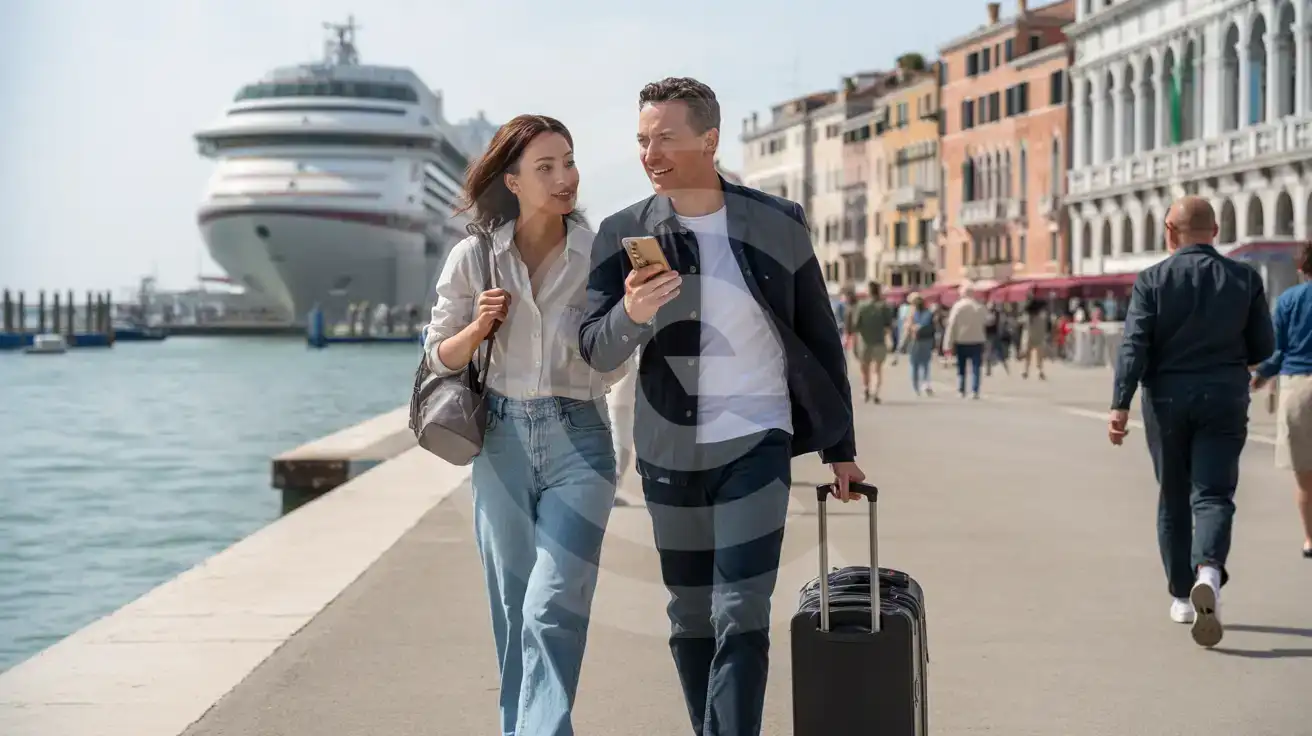
Port of Venice works best when you treat embarkation as a timed logistics window, not a casual arrival. Give yourself room for luggage handoff, identity checks, and terminal finding, especially if you are reaching the port after a same-day flight or train. Venice adds one extra layer compared with a standard road-only cruise port: your route may combine taxi, pedestrian sections, and water-connected city transport depending on where you are staying. That makes screenshot backups of your booking, ship details, and transfer instructions worth having before you leave your hotel.
If you are spending a few hours in Venice before boarding, stay close to practical transit points rather than trying to cover the whole historic center with bags. Portable documents matter here more than sightseeing notes: your passport image, cruise confirmation, hotel checkout receipt, and transport booking should all be easy to reach on your phone. Travelers with a short Venice stop also use their connection for translation, payment verification, and last-minute bookings before they lose city time to terminal routines. The cleaner your digital setup is before you reach Port of Venice, the calmer the whole day feels.
Arrival Flow at the Port
Compare eSIM Options at Port of Venice
eSIMno | Local SIM / Operator | Roaming | |
|---|---|---|---|
| FEATURES | |||
| Setup time | Few minutes | Store registration, about ten minutes | Auto |
| No local ID needed | Online checkout | Passport is required by law; some also ask for a tax code | Use home account |
| Speed | 4G/LTE on Vodafone and WindTre; 5G in some areas | One network only | Partner-dependent |
| Travel support | English support 24/7 | Italian-language service | Home carrier hours |
| Keep home number | Dual SIM | Replaces it | Same number |
| Cost predictability | Fixed price | Prepaid, no bill shock | Bill-shock risk |