

Quick Facts
- Language
- Valencian (Español)
- Currency
- Euro (EUR, €)
- Time Zone
- Central European Time (UTC+1, UTC+2 DST)
- Dialing Code
- +34
- Power Plug
- Type C, E, F (round 2-pin, common across most of Europe)
- Emergency
- 112
- eSIMno Networks
- Movistar, Orange
How to Get Your eSIM
- Choose Your Spain Plan
Pick the data allowance that matches your Barcelona visit — light plans for a weekend of Gaudí walks, larger plans if you're extending to Madrid or the coast. - Install Over WiFi Before Your Flight
Scan the QR code at home or your departure lounge. The profile downloads in under a minute and sits dormant until you activate. - Land at El Prat, Switch Off Airplane Mode
Once the aircraft reaches the gate, disable airplane mode. Your eSIM connects to Movistar or Orange within seconds — no kiosk, no passport scan, no waiting. - Set eSIM as Primary Data Line
In your phone's cellular settings, assign eSIMno for mobile data. Keep your home SIM active for incoming calls and texts on your regular number. - Walk Passeig de Gràcia Connected
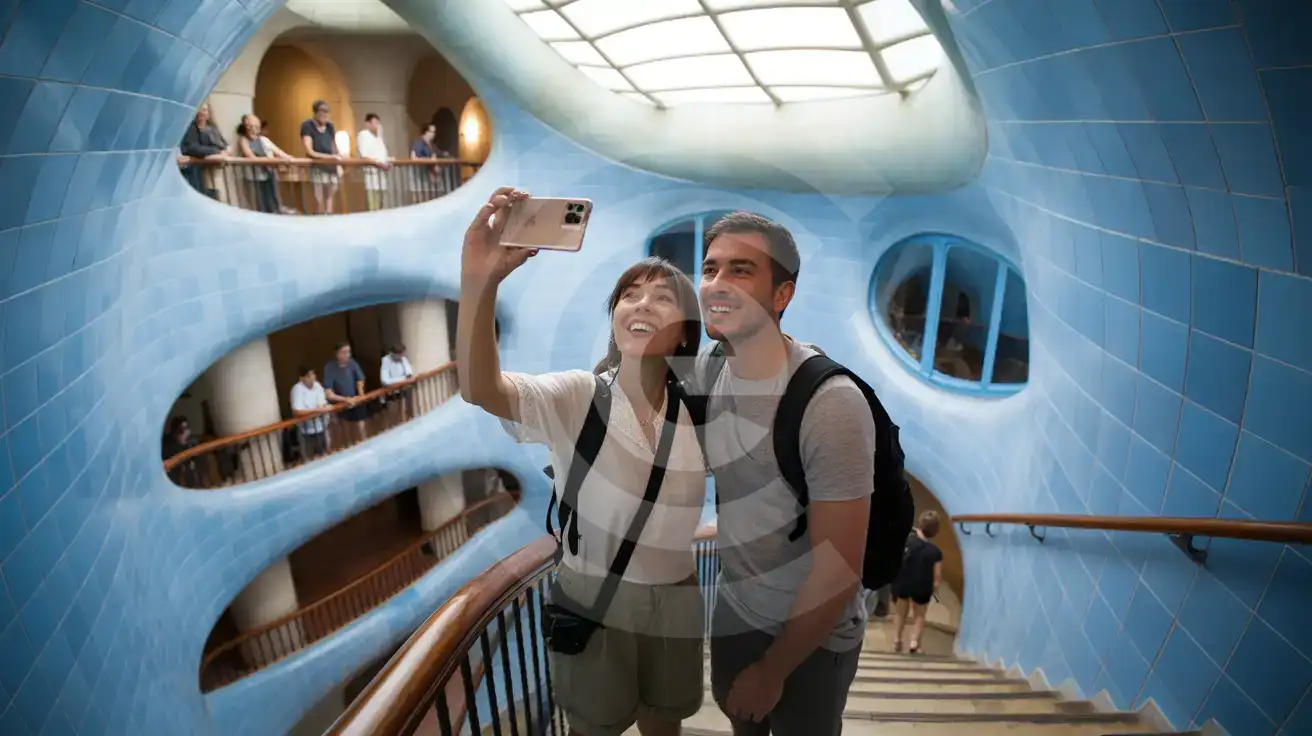
Pull up your Casa Batlló timed-entry ticket, share photos of the dragon-roof tiles, and book a table at a Rambla de Catalunya terrace — all before you reach the Diagonal metro entrance.
Traveler Tips
- Book Casa Batlló and Casa Milà timed-entry tickets online at least 3 days ahead — walk-up queues stretch 45-60 minutes on weekends, and your QR confirmation needs data to load at the door.
- The FGC Provença station (lines L6, L7, S1, S2) sits mid-boulevard and connects directly to Sarrià and Tibidabo; the metro L3/L4 interchange at Passeig de Gràcia station is 200 meters south.
- Activate your eSIM after landing at El Prat — by the time you clear baggage claim and board the Aerobus (€7.75 one-way, 35 minutes to Plaça Catalunya), your phone is already pulling Maps directions.
- Keep your home SIM active for incoming calls; use WhatsApp or FaceTime over your eSIMno data for outbound calls to avoid roaming charges on native voice.
- Peak foot traffic on Passeig de Gràcia runs 11:00-14:00 and 17:00-20:00 — rideshare pickups are faster from side streets like Carrer d'Aragó or Carrer de València.
Why Data Matters on Passeig de Gràcia
Passeig de Gràcia runs 1.3 kilometers from Plaça Catalunya north to Avinguda Diagonal, and every block demands data. The timed-entry tickets for Casa Batlló and Casa Milà arrive as QR codes — no screenshot backup, no offline fallback. The scanner at Casa Batlló's entrance expects a live barcode from your email or the official app; fumbling through archived images while 40 tourists queue behind you is the wrong way to start a €35 visit.
Beyond tickets, the boulevard's dining scene lives on reservation apps. TheFork, Resy, and Google Maps reviews help you distinguish the tourist-trap paella joints from the €18 vermut-and-tapas spots locals actually use. A table at Cervecería Catalana (Carrer de Mallorca, 236 — 150 meters west of La Pedrera) fills up by 13:30 on Saturdays; booking while walking saves the 45-minute wait.
Transit coordination matters too. The L3 green line and L4 yellow line intersect at Passeig de Gràcia station, and the FGC suburban trains stop at Provença 300 meters north. Real-time departure boards exist, but the TMB app shows platform-level crowding and alternative routes when the L3 backs up during rush hour. Rideshare pickups — Cabify and Uber both operate in Barcelona — work best from the perpendicular streets; the boulevard's double-parked delivery vans make curbside stops unpredictable. Data keeps the driver's location live on your screen so you're not guessing which white Seat is yours.
eSIMno plans for Passeig de Gràcia, Barcelona, Spain connect through Movistar and Orange, the same networks locals use. Coverage holds strong inside Casa Batlló's atrium, Casa Milà's rooftop terrace, and the underground metro interchange — no dead zones, no throttling, no captive-portal hoops.
Visiting Passeig de Gràcia
Getting There
From El Prat Airport, the Aerobus (A1 line) drops you at Plaça Catalunya in 35 minutes; Passeig de Gràcia begins 200 meters north up the boulevard. The RENFE R2 Nord train to Passeig de Gràcia station takes 26 minutes and costs around €4.60. Taxis run €39-47 fixed fare to the Eixample depending on time of day.
Hours and Access
The boulevard itself is public 24 hours. Casa Batlló opens 09:00-21:00 (last entry 20:00); Casa Milà / La Pedrera opens 09:00-20:30 with night visits on select evenings. Both require advance booking — walk-up availability is rare during peak season (April-October).
Dress and Comfort
No dress code for the street or the modernist houses. Comfortable walking shoes matter — the hexagonal Gaudí pavement tiles (panots) are uneven in spots, and Casa Milà's rooftop involves stairs. Summer afternoons hit 30°C+; mornings and late afternoons are cooler for extended walks.
Capturing Gaudí's Boulevard
Compare eSIM Options at Passeig de Gràcia
eSIMno | Local SIM / Operator | Roaming | |
|---|---|---|---|
| FEATURES | |||
| Setup time | Few minutes | Registered in store before the SIM works | Auto |
| No local ID needed | Online checkout | Photo ID required by law at purchase | Use home account |
| Speed | 4G/LTE on Movistar and Orange; 5G in some areas | One network only | Partner-dependent |
| Travel support | English support 24/7 | Spanish-language service | Home carrier hours |
| Keep home number | Dual SIM | Replaces it | Same number |
| Cost predictability | Fixed price | Prepaid, no bill shock | Bill-shock risk |