

Quick Facts
- Language
- German (Deutsch)
- Currency
- Euro (EUR, €)
- Time Zone
- Central European Standard Time (UTC+1)
- Dialing Code
- +49
- Power Plug
- Type C, E, F (round 2-pin, common across most of Europe)
- Emergency
- 112 (European emergency line)
- eSIMno Networks
- O2, T-Mobile, Vodafone
How to Get Your Munich eSIM
- Pick Your Germany Data Plan
Choose from 1GB to unlimited options based on your Munich stay length. A week exploring museums, beer halls, and day trips typically needs 3-5GB for maps, translations, and photo uploads. - Install Before Your Flight
Download the eSIM profile at home over WiFi. The QR code arrives instantly by email — scan it in Settings, and your phone stores the German profile alongside your home SIM. - Activate After Landing at MUC
Once your Lufthansa or connecting flight taxis to the gate at Franz Josef Strauss Airport, switch off airplane mode. Your phone connects to O2, T-Mobile, or Vodafone within seconds. - Navigate to Your Hotel
Pull up MVV transit directions from Terminal 2 to Marienplatz. The S1 and S8 trains run every 10 minutes; real-time platform updates load instantly so you catch the next departure. - Explore Munich and Beyond
Your plan works at Viktualienmarkt, inside the Deutsches Museum galleries, at the Allianz Arena, and across all of Germany — same data, no roaming toggle needed.
Munich Traveler Tips
- The Glockenspiel at Marienplatz performs at 11:00, 12:00, and 17:00 (March-October) — set a phone alarm and arrive 10 minutes early to claim a spot in the crowded square.
- FC Bayern match days flood the U6 Fröttmaning station with 75,000 fans post-game. Book your return Uber or Bolt before the 90th minute to avoid surge pricing that can triple within 15 minutes of the final whistle.
- Viktualienmarkt vendors close by 18:00 on weekdays and 15:00 on Saturdays — check Google Maps hours before walking over, and translate the handwritten Bavarian signs for seasonal specials.
- The Deutsches Museum spans 5 floors and 28,000+ exhibits. Download the museum's official app over data to navigate between planetarium show times and aviation hall locations without backtracking.
- Keep your home SIM active for incoming calls — it stays on for voice automatically in dual-SIM mode. Use WhatsApp or FaceTime over your eSIMno data for outgoing calls to avoid roaming charges.
Why Data Matters in Munich
Munich runs on mobile-first logistics that reward the connected traveler. The MVV network covers S-Bahn, U-Bahn, trams, and buses across 8 fare zones — the MVV app calculates your route, tells you which platform at Hauptbahnhof, and alerts you to the 3-minute delay on the S8 that means you can grab a Brezel at the station bakery. Without data, you're squinting at static zone maps and guessing which of the 32 U-Bahn stations connects to your tram line.
Timed-Entry Reality
The Deutsches Museum, Pinakothek der Moderne, and BMW Welt all use timed-entry ticketing during peak season. Your QR code lives on your phone — the scanner at the entrance doesn't care about your printout skills, but it definitely cares whether your screen loads. The Residenz palace complex spans 130 rooms and multiple courtyards; the audio guide syncs to your phone's location, and the map overlay keeps you from circling the Antiquarium twice.
Beer Hall Navigation
Hofbräuhaus seats 3,000 people across three floors. The host's hand gesture toward the back of the Schwemme hall means nothing without Google Translate catching the Bavarian dialect. Augustiner-Keller's beer garden holds 5,000 seats in summer — the OpenTable reservation confirms your spot, and the live waitlist shows whether the 45-minute wait estimate is optimistic. Data bridges the gap between showing up hungry and sitting down with a Maß within 20 minutes.
Stadium and Arena Access
Allianz Arena gates scan mobile tickets exclusively for most FC Bayern matches. The U6 from Marienplatz to Fröttmaning takes 25 minutes; post-match, the return platform fills within 90 seconds of the final whistle. Having eSIMno plans for Munich, Germany means your Uber request goes through before you're crushed in the pedestrian tunnel — the difference between a €15 ride and a €45 surge.
About Munich & What Travelers Come For
Munich anchors Bavaria at the foot of the Alps, a city where Gothic spires share the skyline with BMW headquarters and 400-year-old beer gardens fill on Tuesday afternoons. The Isar River cuts through the eastern districts, and on summer weekends locals surf the standing wave at Eisbach — a scene that surprises first-time visitors expecting only lederhosen and oompah bands.
Neighborhoods at a Glance
Altstadt-Lehel centers on Marienplatz and the twin-towered Frauenkirche, with pedestrianized shopping streets radiating toward the Residenz palace complex. Maxvorstadt holds the university quarter and the Pinakothek museum trio — Alte, Neue, and Moderne — within a 10-minute walk of each other. Schwabing runs north with tree-lined boulevards, vintage shops, and the sprawling English Garden park where locals grill, sunbathe, and paddle rented boats past the Chinese Tower beer garden. Haidhausen across the Isar offers quieter cafes and the Gasteig cultural center. Out northwest, Olympiapark's 1972 stadium and tower still draw visitors for concerts and panoramic views.
What Travelers Come For
Oktoberfest runs late September through early October on the Theresienwiese fairgrounds — 6 million visitors across 16 days, with reservation-only tent seating and a mobile ticketing system that crashes without data. Year-round, Deutsches Museum houses 28,000 science and technology exhibits across an island in the Isar. BMW Welt showcases BMW's engineering heritage in a futuristic silver building, free to enter. Day-trippers head 2 hours southwest to Neuschwanstein Castle, the fairy-tale castle requiring timed-entry tickets booked online. Football fans make the pilgrimage to Allianz Arena for Bayern matches, the stadium's exterior LED panels glowing red on game nights visible from the autobahn approach.
Getting Around Munich
Munich's MVV network integrates S-Bahn commuter rail, U-Bahn metro, trams, and buses under a single fare system spanning 8 concentric zones. Most tourist destinations — Marienplatz, Odeonsplatz, Königsplatz, Hauptbahnhof — fall within the M zone (inner city), where a single ticket costs around €3.50 and day passes run €8-9. The MVV app handles route planning and mobile ticketing; paper tickets require validation at platform machines before boarding.
Airport Transfers
Franz Josef Strauss Airport (MUC) sits 28 km northeast of the city center. The S1 and S8 S-Bahn lines connect Terminal 2 to Marienplatz in 40-45 minutes, departing every 10 minutes from around 04:00 to 01:00. The Lufthansa Express Bus runs to Hauptbahnhof in 45 minutes and costs around €13 one-way. Taxis to Altstadt run €70-90 fixed fare depending on traffic; Uber and Bolt operate but often match taxi pricing during peak hours.
Within the City
The U-Bahn runs 8 lines with stations every 500-800 meters across the center. The U3/U6 interchange at Marienplatz handles heavy tourist traffic toward Olympiazentrum (U3) and Fröttmaning/Allianz Arena (U6). Trams serve the museum district and eastern neighborhoods; the 19 and 21 lines loop through Maxvorstadt and Schwabing. Bike-share docks from MVG Rad scatter across the center — unlock via app, ride between stations, return to any dock. The Englischer Garten stretches 3.7 km north-south and is best explored on two wheels or on foot along the Isar trails.
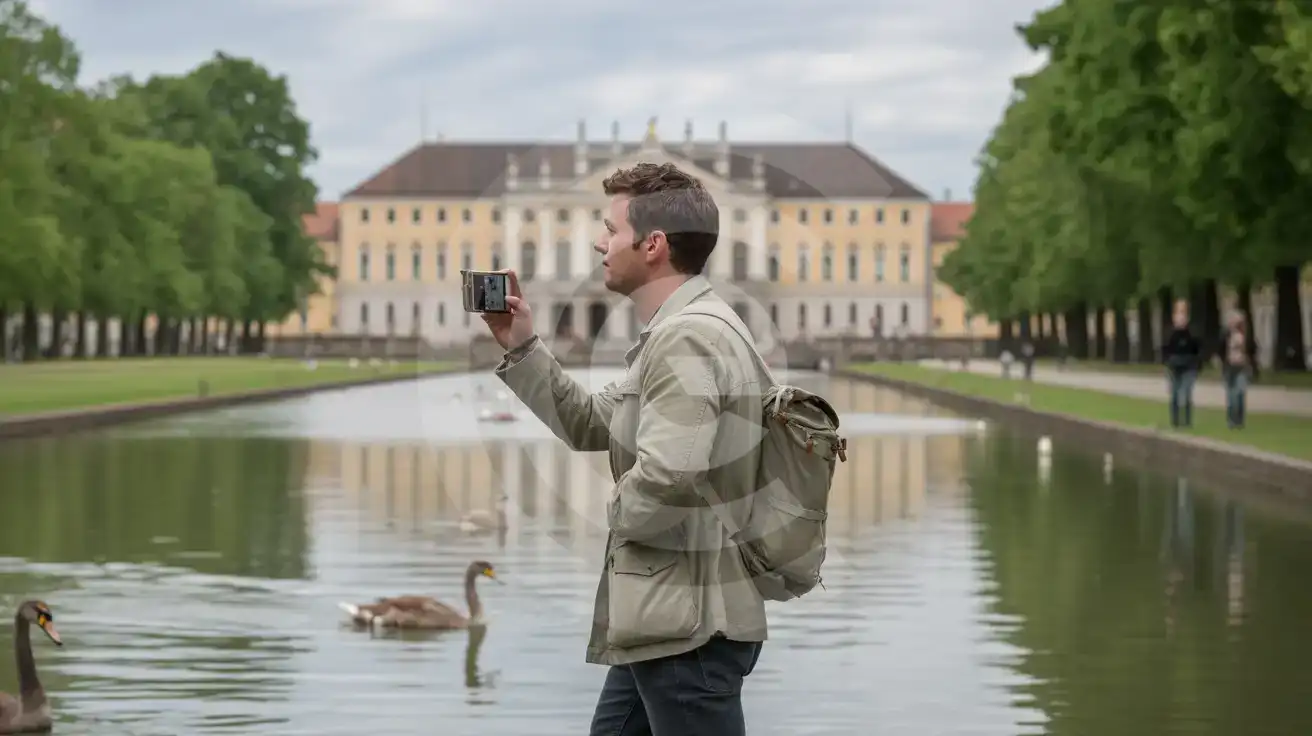
Connected at Nymphenburg Palace
Compare eSIM Providers in Munich
eSIMno | Local SIM / Operator | Roaming | |
|---|---|---|---|
| FEATURES | |||
| Setup time | Few minutes | Verification by video call or post office | Auto |
| No local ID needed | Online checkout | Photo ID check required by law | Use home account |
| Speed | 4G/LTE on Telekom, Vodafone and O2; 5G in some areas | One network only | Partner-dependent |
| Travel support | English support 24/7 | German-language service | Home carrier hours |
| Keep home number | Dual SIM | Replaces it | Same number |
| Cost predictability | Fixed price | Prepaid, fixed monthly | Bill-shock risk |