

Quick Facts
- Capital
- Rabat
- Language
- French (عربي)
- Currency
- Moroccan Dirham (MAD, د.م.)
- Time Zone
- Central European Standard Time (UTC+1)
- Dialing Code
- +212
- Power Plug
- Type C, E, F (round 2-pin, common across most of Europe)
- Emergency
- 19 (police), 15 (ambulance / fire)
- eSIMno Networks
- Orange
How to Get Your eSIM
- Pick Your Morocco Data Plan
Choose a plan size based on your trip length — a week in Marrakech plus a Sahara excursion burns through maps, translations, and photo uploads faster than a city-only stay. - Complete Purchase and Check Email
Your QR code and activation instructions arrive within minutes. Save the email offline or screenshot the QR before you leave home WiFi. - Install Over WiFi Before Your Flight
Add the eSIM profile to your phone while still at home — iPhone users go to Settings → Cellular → Add eSIM; Android varies by manufacturer but the QR scan process takes under two minutes. - Keep the eSIM Line Off Until Landing
Leave the new line toggled off during your flight. Once your plane taxis to the gate at Menara, Mohammed V, or Ibn Battouta, switch off airplane mode and toggle the eSIM line on. - Connect Instantly on Orange
Your phone registers on the Orange network within seconds — pull up your riad directions, confirm your driver's WhatsApp location, and walk past the SIM kiosk queue without a glance.
Traveler Tips
- Download offline Google Maps for Fes medina before arrival — the 9,000-alley maze defeats GPS periodically, and having cached tiles plus live data creates useful redundancy.
- Careem and inDrive work in Casablanca and Marrakech; request rides through the app to lock in metered pricing and avoid negotiation at taxi ranks.
- ONCF train tickets from Casablanca Voyageurs to Marrakech (2 hours 10 minutes on the Al Boraq high-speed line) display as mobile QR — screenshot before boarding since tunnel signal can dip.
- Keep your home SIM active for incoming calls; use WhatsApp or FaceTime over your eSIMno data for outgoing voice to dodge roaming charges.
- Riads in the medina rarely have strong lobby WiFi — your eSIM data handles booking confirmations and translation apps far more reliably than shared guest networks.
- Mosque interiors (except Hassan II in Casablanca) are closed to non-Muslims; modest dress is expected in medina areas regardless of entry rules.
Why Data Matters Across Morocco
Morocco's geography scatters its highlights across hundreds of kilometers — Atlantic surf towns like Essaouira sit 2.5 hours from Marrakech, the blue city of Chefchaouen perches in the Rif Mountains a 4-hour drive from Tangier, and the Sahara dunes near Merzouga require an 8-hour journey from Fes. Coordinating these distances without mobile data means relying on hotel front desks, printed itineraries, and guesswork. With an eSIMno plan for Morocco, your phone becomes the connective tissue: real-time WhatsApp updates from your desert camp driver, Google Translate conversations with Berber guides, Careem hails from the Marrakech train station, and currency conversions at souk stalls.
The medinas of Fes and Marrakech present a specific navigation challenge. Fes el-Bali contains over 9,000 alleyways with no vehicle access — Google Maps live view plus downloaded offline tiles create a safety net when you inevitably take a wrong turn past the tanneries. Marrakech's Djemaa el-Fna square transforms nightly into a food stall labyrinth where pointing and translating menu items requires instant language tools. Data keeps you oriented, fed, and confident.
Beyond the cities, the Al Boraq high-speed train between Casablanca Voyageurs and Tangier Ville (2 hours 10 minutes, mobile QR tickets) and the standard ONCF routes to Fes (4 hours from Casablanca, 7 hours from Marrakech) all accept digital boarding passes scanned at platform gates. Signal holds steady through most of the journey except brief tunnel dips in the Rif foothills. Supratours and CTM intercity buses post live schedules on their apps — checking departure times from your phone beats arriving at the station to discover a 3-hour wait.
About Morocco & What Travelers Come For
Gateway Cities
Casablanca Mohammed V International (CMN) handles the majority of intercontinental arrivals, with direct flights from Paris, London, New York JFK, and Dubai. From CMN, the train station beneath Terminal 1 connects to Casa Voyageurs in 35 minutes, then onward to Marrakech or Rabat. Marrakech Menara (RAK) serves heavy European low-cost traffic — Ryanair, easyJet, Transavia — landing travelers directly at the red city's doorstep, a 15-minute taxi or bus ride from Djemaa el-Fna. Tangier Ibn Battouta (TNG) anchors northern itineraries and ferry connections to Spain's Tarifa (35 minutes by fast ferry) and Algeciras.
What Travelers Come For
The imperial cities anchor most itineraries: Marrakech for its souks, riads, and Jardin Majorelle; Fes for the world's largest car-free urban zone and medieval tanneries; Meknes for its granaries and proximity to the Roman ruins of Volubilis. The Sahara draws desert-camp seekers to Merzouga and M'Hamid, where camel treks and stargazing camps fill Instagram feeds. Coastal travelers split between Essaouira's wind-battered ramparts and Agadir's beach resorts. The Atlas Mountains offer trekking from Imlil village toward North Africa's highest peak, Jebel Toubkal (4,167 meters).
When to Visit
Spring (March-May) and autumn (September-November) balance comfortable temperatures with fewer crowds — ideal for medina exploration and mountain hikes. Summer peaks above 40°C in Marrakech and the interior; coastal Essaouira and Tangier stay cooler. Winter brings snow to the High Atlas passes while desert nights drop near freezing — pack layers.
Getting Around Morocco
Airport Transfers
From Casablanca Mohammed V, the ONCF train departs from beneath Terminal 1 every 60 minutes toward Casa Voyageurs and onward connections. Taxis from CMN to central Casablanca run fixed fares posted at the official stand — confirm the price before loading luggage. From Marrakech Menara, Bus 19 runs to Djemaa el-Fna every 20 minutes; taxis charge posted rates to medina riads. Tangier Ibn Battouta connects to the city center via bus or taxi in 20 minutes.
Public Transit & Trains
ONCF operates Morocco's rail network. The Al Boraq high-speed line links Casablanca and Tangier in 2 hours 10 minutes with stops at Rabat and Kenitra. Standard trains connect Casablanca to Marrakech (2 hours 40 minutes), Fes (4 hours), and Oujda (6 hours). Tickets purchased through the ONCF app display as QR codes — screenshot before boarding since tunnel signal can dip. Supratours and CTM buses fill gaps where rail doesn't reach: Marrakech to Essaouira (2.5 hours), Fes to Chefchaouen (4 hours), Ouarzazate to the Draa Valley.
Rideshare & Taxis
Careem and inDrive operate in Casablanca, Marrakech, Rabat, and Tangier — app-based pricing avoids meter disputes. Petit taxis (within cities) and grand taxis (intercity) remain common; agree on price before departure or insist on the meter. Rental cars suit Atlas Mountain drives and southern oasis routes; major agencies operate from all gateway airports.
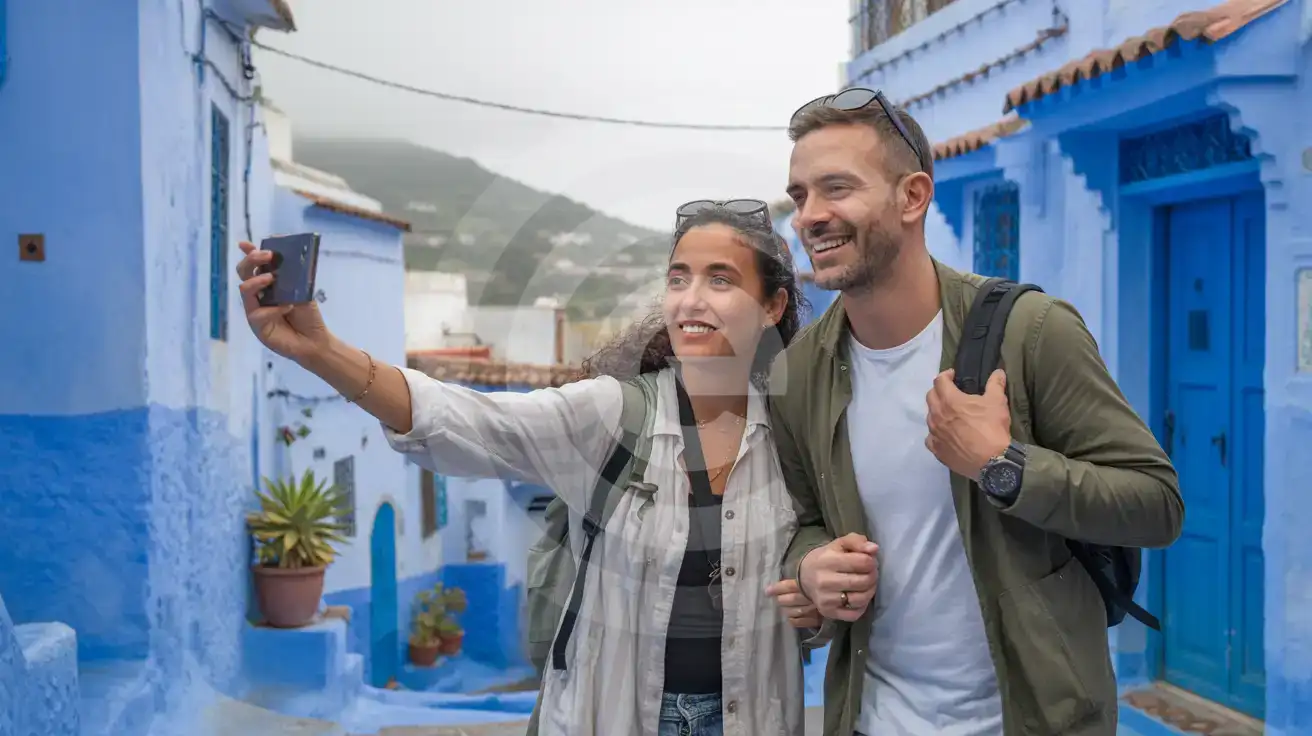
Chefchaouen Blue Streets
Compare eSIM Providers for Morocco
eSIMno | Local SIM / Operator | Roaming | |
|---|---|---|---|
| FEATURES | |||
| Setup time | Few minutes | Store visit + paperwork | Auto |
| No local ID needed | Online checkout | Local ID required | Use home account |
| Speed | 4G/LTE; 5G in some areas | Carrier-grade | Partner-dependent |
| Travel support | English support 24/7 | Operator shops and call centre | Home carrier hours |
| Keep home number | Dual SIM | Replaces it | Same number |
| Cost predictability | Fixed price | Bills can spike | Bill-shock risk |