

Quick Facts
- Language
- Italian (Italiano)
- Currency
- Euro (EUR, €)
- Time Zone
- Central European Standard Time (UTC+1)
- Dialing Code
- +39
- Power Plug
- Type C, E, F (round 2-pin, common across most of Europe)
- Emergency
- 112
- eSIMno Networks
- Vodafone, Wind Tre
How to Get Your eSIM
- Pick Your Italy Data Plan
Choose from 1GB to 20GB options based on your Milan stay — a long weekend exploring the Quadrilatero and Navigli needs less than a two-week fashion week trip with Lake Como extensions. - Install Over WiFi at Home
Scan the QR code or tap the direct-install link while still on your home network. The profile sits dormant until you're ready — no charges, no countdown yet. - Board Your Flight to Malpensa
Your eSIM is loaded and waiting. Keep your home SIM active for any last-minute calls before takeoff; the data plan won't wake until Italian towers appear. - Activate After Landing
Once the aircraft reaches the gate, switch off airplane mode. Your phone finds Vodafone or Wind Tre within seconds — by the time you're walking toward the Malpensa Express platform, Maps is already calculating your route. - Stay Connected Across Italy
Your plan works beyond Milan. Train to Venice, drive to Cinque Terre, fly onward to Rome — same eSIM, same coverage, no extra setup.
Traveler Tips
- The Malpensa Express departs every 30 minutes and takes 52 minutes to Milano Centrale — your mobile ticket QR saves the paper-kiosk queue.
- Santa Maria delle Grazie requires timed-entry tickets for The Last Supper, booked weeks ahead online. Keep your confirmation QR accessible on your phone; screenshots work if signal dips inside the refectory.
- Milan's Metro closes around 00:30 on weekdays and 01:30 on weekends. After that, Uber and FREE NOW are your fallbacks — have data ready for surge-pricing checks.
- The Navigli canals come alive for Thursday-night aperitivo. Reservations via TheFork or Google Maps fill fast; walk-ins risk a 45-minute wait.
- Duomo rooftop terrace tickets cost €14-22 depending on stairs vs elevator. Book online, load the QR, and skip the cathedral-side queue that stretches 30+ minutes at midday.
Why Data Matters in Milan
Milan's transit network runs smoother when your phone is online. The ATM Milano app shows live Metro departures across all five lines — M1 red, M2 green, M3 yellow, M4 blue, M5 lilac — plus surface trams and buses. Navigating from Cadorna to San Siro for a match at the 75,879-seat stadium means checking real-time service alerts, not guessing which platform the M5 train departs from. Rideshare apps like Uber, FREE NOW, and Wetaxi fill the gaps when rain floods the Quadrilatero della Moda and taxis cluster elsewhere; without data, you're standing outside Armani Silos watching empty cabs pass.
The city's top attractions demand QR codes. Santa Maria delle Grazie admits only 30 visitors every 15 minutes to see The Last Supper — your timed-entry confirmation must load when the guard scans it. The Duomo rooftop terraces, Pinacoteca di Brera, and Leonardo3 Museum all sell timed slots online; the Brera alone caps daily entries and emails a dynamic QR that won't print cleanly. Keeping your phone on local data means these tickets work instantly, not after hunting for café WiFi on Via Brera.
Dining in Milan runs on apps. The Navigli district's canal-side restaurants fill by 20:00 on weekends; TheFork and Google reservations let you lock a table while walking from Porta Genova Metro. Near Corso Como, rooftop bars require bookings that confirm via SMS or app notification. Translation apps handle menus at traditional trattorias in the Porta Romana neighborhood where English is scarce. With an eSIMno plan for Milan, Italy, your phone handles every reservation, translation, and last-minute itinerary pivot from Brera galleries to Navigli cocktails.
About Milan & What Travelers Come For
Neighborhoods at a Glance
Centro Storico clusters around the Duomo di Milano and Galleria Vittorio Emanuele II, where fashion flagships line the Galleria's mosaic floors and the cathedral's 135 spires pierce the skyline. Brera sits a 10-minute walk north — galleries, antique shops, and the Pinacoteca's Raphael and Caravaggio collections anchor the district. The Navigli District canals spread southwest of Porta Genova, where aperitivo bars spill onto towpaths and vintage markets take over Saturdays. Porta Nuova rises as the modern counterweight: the Bosco Verticale towers, Piazza Gae Aulenti's circular plaza, and rooftop cocktail bars with skyline views.
Top Things Travelers Come For
The Last Supper at Santa Maria delle Grazie draws art pilgrims who book 60 days ahead for a 15-minute viewing slot. The Duomo rooftop terraces offer 360-degree views across the Po Valley to the Alps on clear days — the climb via 250 stairs or elevator rewards around 14:00 when light softens. San Siro Stadium hosts AC Milan and Inter matches with combined attendance often exceeding 70,000; match-day Metro M5 to San Siro Stadio runs extended hours. Fashion week in February and September floods the Quadrilatero della Moda with buyers, editors, and street-style photographers.
When to Visit
Spring (April-May) and autumn (September-October) balance mild weather with thinner crowds outside fashion-week surges. Summer pushes above 30°C and empties the city as Milanese head to Liguria or the lakes; many neighborhood restaurants shutter for August. Winter brings Christmas markets in Piazza Duomo and La Scala's opera season — December premieres sell out months ahead.
Getting Around Milan
Airport Transfers
Malpensa Airport sits 50 km northwest of the city center. The Malpensa Express train runs every 30 minutes to Milano Centrale (52 minutes) and Milano Cadorna (43 minutes); fares run €13-15 one way. Shuttle buses from Autostradale and Terravision depart for Stazione Centrale every 20-30 minutes, taking 50-70 minutes depending on traffic, at around €10. Taxis charge a flat €95 into the city; Uber operates but airport pickups require meeting at designated zones. Linate Airport, 7 km east, connects via M4 blue line directly to the city center in under 15 minutes — the newest Metro line opened in 2024.
Public Transit
The ATM network covers five Metro lines, 19 tram routes, and over 100 bus lines. A single urban ticket costs around €2.20 and lasts 90 minutes; 24-hour and 48-hour passes run €7.60 and €13.80. Metro hours extend until 00:30 weekdays and 01:30 weekends. Tram Line 1E loops the city center past Cadorna, the Castello Sforzesco, and Teatro alla Scala — a scenic route when weather cooperates. Surface trams and buses accept contactless payment at validators onboard.
Walking & Rideshare
The historic core walks comfortably in 20-30 minutes end to end — Duomo to Brera takes 12 minutes, Brera to Porta Nuova another 10. The Navigli canals stretch 3 km southwest and reward evening strolls but sit outside easy walking distance from Centro Storico; Metro M2 to Porta Genova or a quick Uber fills the gap. Uber, FREE NOW, and local taxi apps operate citywide. BikeMi stations dot the center with around 280 docking points; e-bikes cost €0.30 per minute after unlocking via the app.
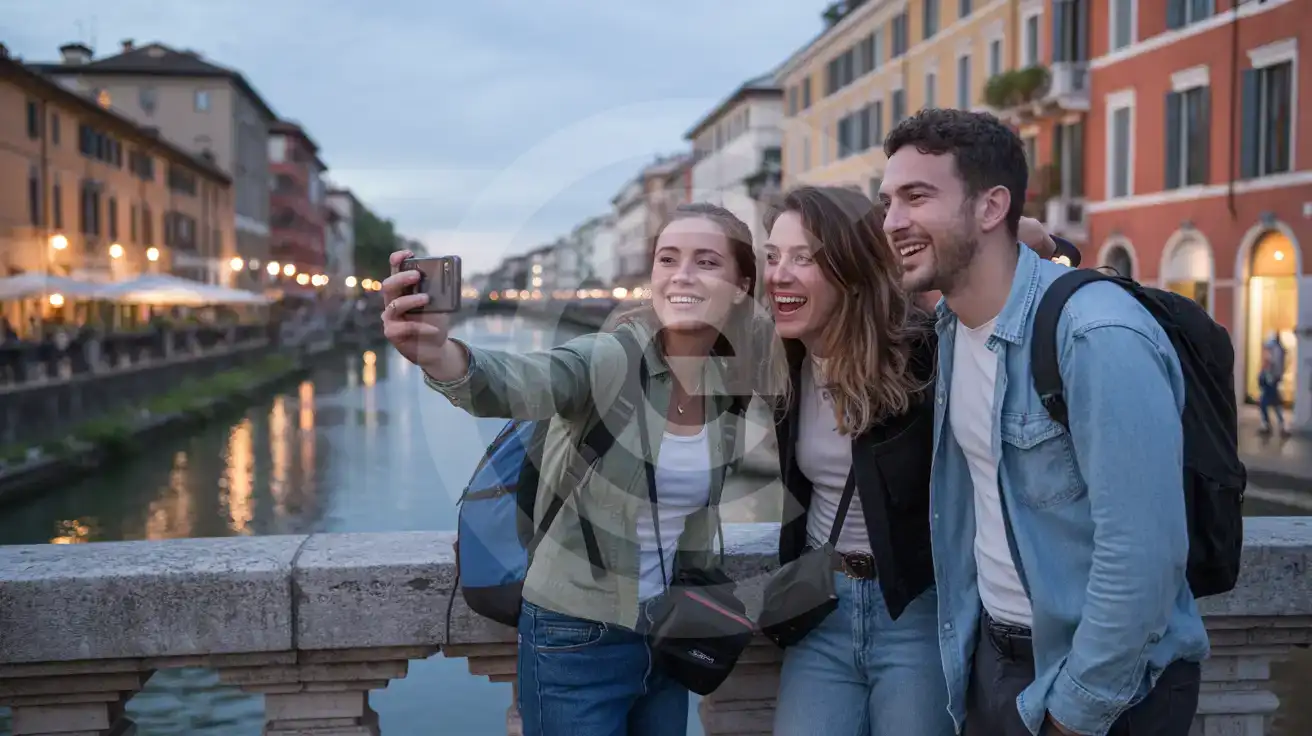
Navigli Canals at Dusk
Compare eSIM Providers in Milan
eSIMno | Local SIM / Operator | Roaming | |
|---|---|---|---|
| FEATURES | |||
| Setup time | Few minutes | Store registration, about ten minutes | Auto |
| No local ID needed | Online checkout | Passport is required by law; some also ask for a tax code | Use home account |
| Speed | 4G/LTE on Vodafone and WindTre; 5G in some areas | One network only | Partner-dependent |
| Travel support | English support 24/7 | Italian-language service | Home carrier hours |
| Keep home number | Dual SIM | Replaces it | Same number |
| Cost predictability | Fixed price | Prepaid, no bill shock | Bill-shock risk |