

Quick Facts
- Capital
- Kuala Lumpur
- Language
- English (Bahasa Melayu)
- Currency
- Malaysian Ringgit (MYR, RM)
- Time Zone
- Malaysia Time (UTC+8)
- Dialing Code
- +60
- Power Plug
- Type G (3-pin rectangular, common in UK and several Asian markets)
- Emergency
- 999 (general); 112 from mobile
- eSIMno Networks
- Celcom, Digi
How to Get Your Malaysia eSIM
- Pick your Malaysia data plan
Choose a package based on your trip length — a week in KL and Penang needs different data than a month-long Borneo expedition. Plans range from 1GB quick-stops to unlimited options for heavy streaming. - Install at home before your flight
Add the eSIM profile over your home WiFi while you're still packing. The whole process takes under 5 minutes on iPhone or Android — no physical card, no tools required. - Keep your home SIM active for calls
Your phone runs both SIMs simultaneously. The eSIMno plan handles all data (maps, Grab, WhatsApp); your home number stays reachable for incoming calls without roaming charges eating your balance. - Activate after landing at KLIA
Once your flight taxis to the gate, switch off airplane mode. Your phone connects to Celcom or Digi automatically — by the time you're walking toward immigration, Google Maps is already loading the KLIA Ekspres platform directions. - Travel the whole country on one plan
From Kuala Lumpur to Langkawi, Penang to Kota Kinabalu, your eSIM works nationwide. No SIM swaps between islands, no re-registration at regional airports — just continuous coverage wherever Malaysia takes you.
Traveler Tips
- Download offline Google Maps for your specific Malaysian regions before departure — Sabah and Sarawak rainforest lodges occasionally hit signal gaps where cached maps save the hike.
- Grab dominates Malaysian rideshare with surge pricing around KLCC during evening rush (5-8 PM weekdays) — real-time fare comparison on your phone beats negotiating with taxi drivers.
- Batu Caves draws enormous crowds during Thaipusam (January-February) and regular weekends — pulling up live crowd reports or booking sunrise slots requires data on the approach.
- Dress modestly for mosque visits (Masjid Negara, Masjid Jamek) with covered knees and shoulders — checking dress-code requirements loads faster than asking at the entrance.
- Malaysian hawker centers increasingly accept Touch 'n Go e-wallet QR payments — the app needs data to generate your payment code at Jalan Alor or Gurney Drive stalls.
- For WhatsApp calls back home, use your eSIM data rather than placing native voice calls through your home SIM — avoids roaming charges entirely while keeping call quality strong.
Why Data Matters Across Malaysia
Malaysia runs on mobile connectivity in ways that catch first-time visitors off guard. Grab isn't just popular — it's the default transport layer for Kuala Lumpur, Penang, and Johor Bahru, with taxi alternatives either scarce or overpriced. Booking a Grab from KLIA Terminal 1 to Bukit Bintang takes 90 seconds on a working data connection; without it, you're joining the physical taxi queue and negotiating a fixed fare that runs RM75-95 versus the Grab estimate of RM65-80 for the same 55km route.
Beyond rideshare, Malaysian cities increasingly operate on QR infrastructure. The KL Monorail and RapidKL LRT accept Touch 'n Go cards — but topping up that card via the app requires data. Hawker centers at Jalan Alor, Gurney Drive in Penang, and Jonker Street in Malacca display QR codes for e-wallet payment alongside cash. The Petronas Twin Towers observation deck runs timed-entry ticketing through an online portal where walk-up availability shows on your phone in real time. Each interaction assumes you're connected.
Translation fills the gaps where English signage thins out. Bus station announcements in smaller towns default to Bahasa Melayu; market vendors in Kelantan and Terengganu speak dialects that Google Translate handles better than hand gestures. Menu translations at local kopitiams (coffee shops) outside tourist zones turn mysterious dishes into informed choices. The eSIMno plans for Malaysia keep these tools live whether you're navigating KL Sentral's interchange levels or comparing ferry schedules from Kuala Perlis to Langkawi.
About Malaysia & What Travelers Come For
Gateway Cities
Kuala Lumpur anchors most itineraries — the Petronas Twin Towers, Batu Caves, and the food streets of Bukit Bintang sit within 15km of KLIA. Penang draws architecture buffs and food pilgrims to George Town's UNESCO heritage zone, where 19th-century shophouses line streets like Lebuh Armenian and Lebuh Chulia. Langkawi offers duty-free beaches, the Langkawi Cable Car ascending 708 meters to the Skybridge, and island-hopping boat tours departing from Pantai Cenang.
What Travelers Come For
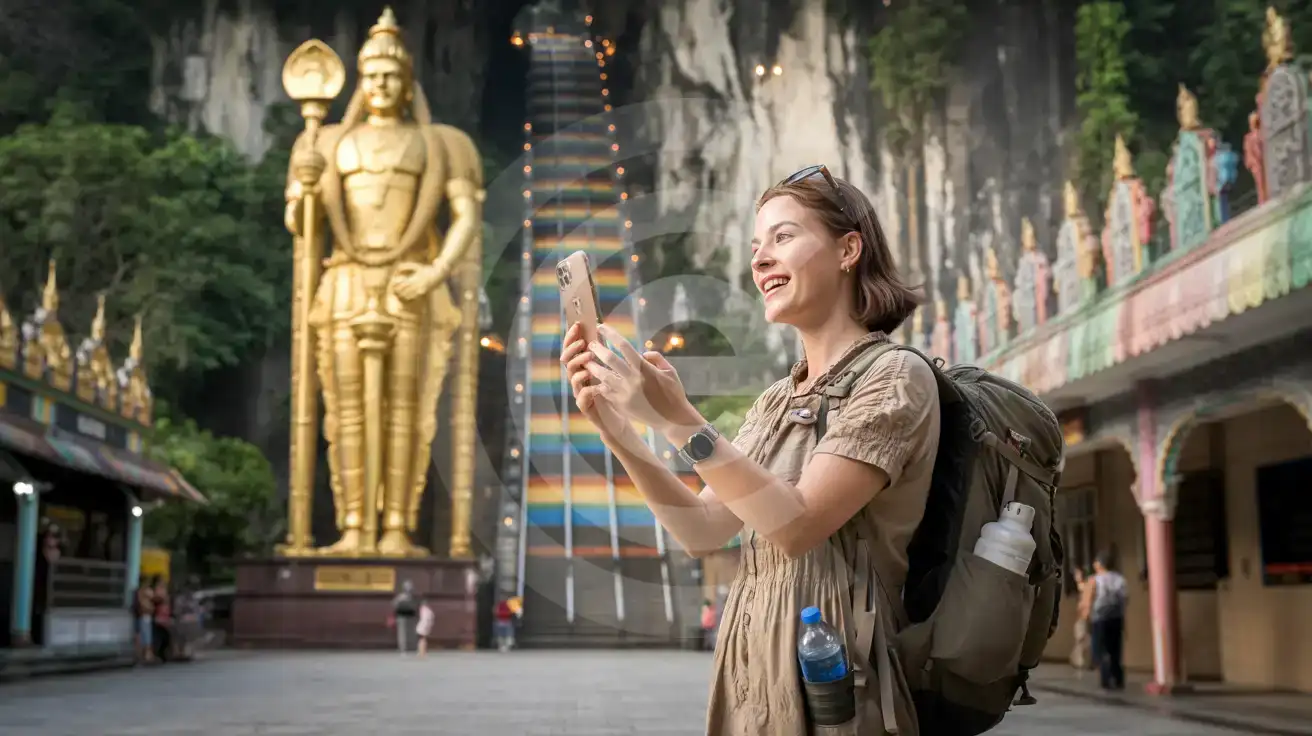
The Petronas Twin Towers remain the signature image — 452 meters of steel and glass with a Skybridge observation deck at levels 41-42 and a higher deck at level 86. Batu Caves pulls Hindu pilgrims and tourists to its 272-step climb beneath towering limestone formations. Taman Negara National Park offers one of the world's oldest rainforests with canopy walkways and river cruises. Malaysian Borneo — Sabah and Sarawak — delivers orangutan sanctuaries at Sepilok, Mount Kinabalu's 4,095-meter summit, and diving at Sipadan Island ranked among the planet's top sites.
When to Visit
Malaysia splits into west coast (November-February wet season) and east coast (November-March monsoon closures) patterns. Peninsular west-coast destinations like KL and Penang stay accessible year-round with afternoon thunderstorms that clear within an hour. East-coast islands (Perhentian, Redang) close resorts during monsoon months. Sabah and Sarawak maintain drier conditions from March through October — ideal for Kinabalu climbs and wildlife lodges.
Getting Around Malaysia
Airport Transfers
Kuala Lumpur International Airport (KLIA) sits 55km south of the city center. The KLIA Ekspres train reaches KL Sentral in 28 minutes with departures every 15-20 minutes; fares run RM55 one-way for adults. KLIA Transit makes intermediate stops and takes 35 minutes at RM55. Grab rides to Bukit Bintang take 45-70 minutes depending on traffic at RM65-95. Penang International Airport connects to George Town via Grab (20 minutes, RM25-35) or public bus 401E (45 minutes). Langkawi International Airport sits 20 minutes from Pantai Cenang by Grab (RM15-25).
Public Transit
Kuala Lumpur operates an integrated network: the KL Monorail loops through Bukit Bintang and KL Sentral; the LRT Kelana Jaya and Ampang lines reach KLCC and Pasar Seni; the MRT Kajang Line extends to Sungai Buloh. Fares range RM1.20-6.40 depending on distance. Touch 'n Go cards (available at stations, RM10 card fee) simplify payment — but topping up requires the app and data. George Town relies on the RapidPenang bus network plus cycling and walking through the compact heritage core.
Inter-City & Islands
Domestic flights connect KL to Penang (55 minutes), Langkawi (70 minutes), Kota Kinabalu (2.5 hours), and Kuching (1.5 hours) via AirAsia, Malaysia Airlines, and Firefly. Ferry services link Kuala Perlis and Kuala Kedah to Langkawi (75-90 minutes, RM23 one-way); Butterworth to Penang Island (15 minutes); and Mersing to Tioman Island (2 hours). Long-distance buses operate from TBS (Terminal Bersepadu Selatan) in KL to Malacca (2 hours), Cameron Highlands (4 hours), and Singapore (5 hours).
Batu Caves at Golden Hour
Compare eSIM Providers for Malaysia
eSIMno | Local SIM / Operator | Roaming | |
|---|---|---|---|
| FEATURES | |||
| Setup time | Few minutes | Store visit + paperwork | Auto |
| No local ID needed | Online checkout | Local ID required | Use home account |
| Speed | 4G/LTE; 5G in some areas | Carrier-grade | Partner-dependent |
| Travel support | English support 24/7 | Operator shops and call centre | Home carrier hours |
| Keep home number | Dual SIM | Replaces it | Same number |
| Cost predictability | Fixed price | Bills can spike | Bill-shock risk |