

Quick Facts
- Time Zone
- Pacific Time (UTC-8 / UTC-7 DST)
- Dialing Code
- +1
- Currency
- US Dollar (USD, $)
- Power Plug
- Type A, B (flat 2-pin, common across North America)
- Language
- English
- Emergency
- 911 (police, fire, ambulance)
- eSIMno Networks
- AT&T, Verizon Wireless
How to Get Your LA eSIM
- Pick Your Data Plan
Choose from plans sized for a weekend in Hollywood or a month-long California road trip. Data works across all 50 states, not just LA. - Install Before Your Flight
Scan the QR code at home over WiFi — takes 90 seconds. Your LAX arrival goes smoother when the eSIM is already loaded. - Activate After Landing
Switch off airplane mode once the captain clears phone use. Your phone connects to AT&T or Verizon before you reach the jet bridge. - Set eSIMno as Mobile Data
Keep your home SIM active for calls and texts. Toggle eSIMno to handle all data — Maps, Uber, Instagram, everything. - Explore LA and Beyond
Your plan works from Venice boardwalk to Vegas strip. Same data, same networks, no roaming surprises.
Traveler Tips
- LAX terminals are spread across 9 buildings — check your airline's terminal on the FlyLAX app before arranging pickup, as rideshare zones shifted to the LAX-it lot requiring a shuttle transfer.
- The Metro K Line connects LAX/Metro Transit Center to Crenshaw and the E Line in about 15 minutes — have your TAP card loaded via the app before boarding.
- Universal Studios Hollywood enforces timed-entry for Virtual Line rides — data ensures you can book return times while walking between attractions.
- Griffith Observatory parking fills by 10 AM on weekends; the DASH Observatory shuttle from the Vermont/Sunset Metro station runs every 20 minutes and requires mobile fare payment.
- Keep your home SIM active for incoming calls — your eSIM handles all data while your original number stays reachable without roaming charges.
Why Data Matters Across Los Angeles
Los Angeles operates on a scale that defeats walking and rewards real-time navigation. The 12-mile drive from LAX to Hollywood can take 25 minutes or 90 depending on the 101/405 interchange — Waze and Google Maps with live traffic aren't luxuries here, they're the difference between making your dinner reservation at Bestia or losing it to the next party on the waitlist.
Getting Out of LAX
Rideshare pickup moved to the LAX-it lot in 2019, requiring a shuttle from your terminal. The Uber and Lyft apps need data to summon your ride, track the shuttle, and coordinate the pickup zone assignment. The Metro K Line now connects the LAX/Metro Transit Center to the E Line at Expo/Crenshaw — a 15-minute ride that puts you on track toward Santa Monica or downtown, but only if you've got the TAP app loaded to calculate fares and plan transfers.
Neighborhood Navigation
Hollywood, Silver Lake, and Los Feliz cluster in the eastern hills where residential streets twist without grid logic. Google Maps routing keeps you oriented through the one-way maze near Sunset Junction. Downtown LA's Arts District sits 4 miles east of the financial core — walking looks short on paper but crosses the concrete channel of the LA River and industrial blocks better suited to rideshare. Data keeps the Lyft ETA accurate and surge pricing visible so you don't overpay during DTLA gallery-walk nights.
Tickets, Reservations, and the Queue
The Getty Center requires timed-entry parking reservations ($20, book via Getty app); the tram from the lot won't run without a confirmed slot. eSIMno plans for Los Angeles, California, United States keep that confirmation QR accessible when the museum's internal WiFi buckles under weekend crowds. Dodger Stadium gates scan mobile tickets from the MLB Ballpark app — 56,000 fans flooding Vin Scully Avenue means cell towers strain, but AT&T and Verizon macro coverage across Chavez Ravine holds where smaller carriers drop.
About Los Angeles & What Travelers Come For
Los Angeles sprawls from the Pacific coastline to the San Gabriel Mountains, a metro area of nearly 13 million people spread across distinct neighborhoods that function like separate cities. The geography defies easy touring — 26 miles separate Santa Monica Pier from Pasadena's Rose Bowl, and the freeways connecting them define daily life here.
Neighborhoods at a Glance
Hollywood & West Hollywood — the entertainment-industry core where the Walk of Fame stretches 15 blocks along Hollywood Boulevard, and WeHo's Santa Monica Boulevard anchors nightlife. Santa Monica & Venice — the coastal strip where the Santa Monica Pier Ferris wheel and Venice Beach boardwalk draw beachgoers and street performers. Downtown LA — the revitalized urban center where the Broad museum sits steps from The Broad and Grand Central Market, with the Arts District warehouse galleries a short walk east. Koreatown — the densest neighborhood in LA, packed with 24-hour BBQ joints, karaoke rooms, and the Wilshire/Vermont Metro hub.
What Travelers Come For
Theme parks pull millions annually — Universal Studios Hollywood in the Hollywood Hills and Disneyland Park 35 miles south in Anaheim. Film history lives at Paramount Pictures studio tours, the TCL Chinese Theatre handprints, and the Academy Museum on Miracle Mile. Natural escapes include Runyon Canyon's hiking trails above Hollywood and the Griffith Observatory's telescope nights overlooking the city grid. The food scene runs from Jonathan Gold–approved strip-mall Thai in East Hollywood to the tasting-menu temples of Beverly Hills.
When to Visit
May through October delivers reliably dry weather and beach-friendly temperatures. June mornings often start with marine-layer fog that burns off by noon — locals call it "June Gloom." Award-season events cluster January through March, tightening hotel availability near Hollywood and Beverly Hills.
Getting Around Los Angeles
LA's car-centric reputation is earned, but Metro expansion has added real transit options for visitors willing to navigate the system.
Airport Transfers
LAX sits 18 miles southwest of Hollywood. Rideshare to central hotels runs $35-$55 depending on traffic and destination — the LAX-it shuttle adds 10-15 minutes to pickup time. The Metro K Line opened a direct rail connection from LAX/Metro Transit Center; transfer at Expo/Crenshaw to the E Line for Santa Monica (total ~45 minutes) or take the A Line toward downtown Union Station. FlyAway buses run direct to Union Station ($9.75, 35-50 minutes) and Van Nuys ($9.75, 45-75 minutes).
Public Transit
Metro Rail operates 6 lines covering 105 stations across the basin. The B Line (Red) runs from Union Station through Hollywood to North Hollywood; the D Line (Purple) extends west toward Wilshire/La Cienega with Century City extension underway. TAP cards work across Metro Rail and buses — load fare via the TAP app before boarding. Single rides start around $1.75; a day cap limits spending regardless of transfers.
Rideshare & Driving
Uber and Lyft dominate local transport. Surge pricing spikes after major events at SoFi Stadium, Crypto.com Arena, and the Hollywood Bowl — checking both apps simultaneously saves $10-$20 on post-concert rides. Rental cars make sense for day trips to Malibu, Joshua Tree, or San Diego, but parking in Hollywood and Santa Monica runs $20-$40 daily at structures.
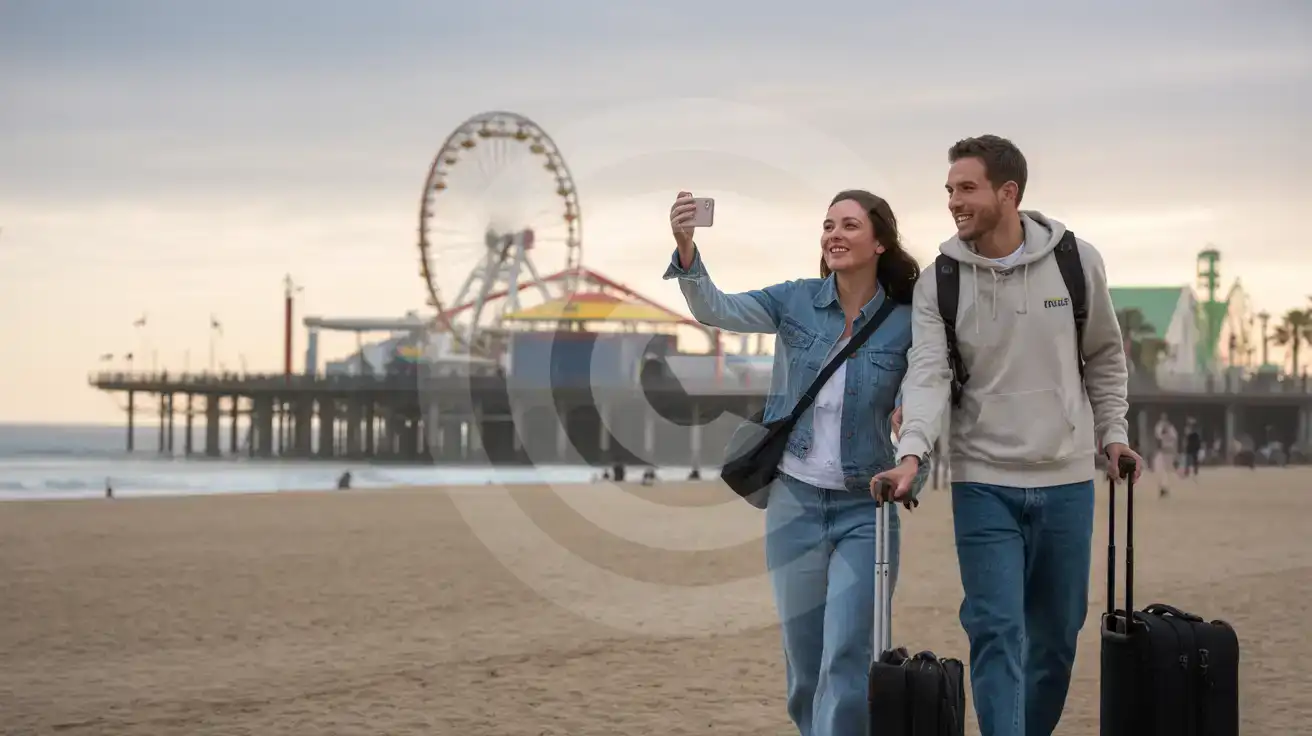
Santa Monica Pier
Compare eSIM Providers in Los Angeles, California
eSIMno | Local SIM / Operator | Roaming | |
|---|---|---|---|
| FEATURES | |||
| Setup time | Few minutes | Store kit, needs activation | Auto |
| No local ID needed | Online checkout | No SSN; passport at carrier stores | Use home account |
| Speed | 4G/LTE on AT&T, T-Mobile and Verizon; 5G in some areas | One carrier only | Partner-dependent |
| Travel support | English support 24/7 | English-language service | Home carrier hours |
| Keep home number | Dual SIM | Replaces it | Same number |
| Cost predictability | Fixed price | Advertised price needs Auto Pay | Bill-shock risk |