

Quick Facts
- Language
- Japanese (日本語)
- Currency
- Japanese Yen (JPY, ¥)
- Time Zone
- Tokyo Standard Time (UTC+9)
- Dialing Code
- +81
- Power Plug
- Type A (flat 2-pin, common in Japan and North America; voltage is 100V in Japan, lower than the 110-120V of the US)
- Emergency
- 110 (police), 119 (fire / ambulance)
- eSIMno Networks
- KDDI
How to Get Your eSIM
- Buy Your Japan Plan Before You Fly
Purchase your eSIMno Japan data plan at home over WiFi. You'll receive a QR code by email — no physical card ships, no pickup needed. - Install During Your Pre-Trip Prep
Scan the QR code in your phone's Settings → Cellular → Add eSIM. Label it 'Japan Travel' so you can toggle it easily alongside your home SIM. - Activate After Landing at Kansai International
Once your flight taxis to the gate, switch off airplane mode. Your eSIM connects to KDDI within seconds — skip the SIM kiosk crowds in the arrivals hall entirely. - Confirm Data on the JR Haruka or Airport Bus
Open Google Maps or the Kyoto City Bus app during your transfer to Kyoto Station. If directions load, you're set for the full Higashiyama temple circuit. - Keep Your Home SIM for Calls
Your eSIMno plan is data-only. Incoming calls reach your home number normally. For outgoing calls, use WhatsApp, FaceTime, or LINE over your Japan data — avoid native dialing to skip roaming charges.
Traveler Tips
- Arrive at Kiyomizu-dera right at 6:00 AM opening to photograph the main stage without tour-group crowds — the temple fills heavily by 9:00 AM.
- City Bus routes 100 and 206 from Kyoto Station take 15-20 minutes to Gojo-zaka or Kiyomizu-michi stops; real-time tracking on the Kyoto Bus app beats guessing at the queue.
- The Otowa Waterfall queue moves slowly during peak hours — use the wait time to upload photos over your eSIM data rather than draining battery hunting for WiFi.
- Jishu Shrine's love-stone walk is popular with couples; if you're coordinating meetup times via LINE or WhatsApp, steady data keeps the group chat synced.
- Download offline Kyoto maps before your visit as backup, but live data lets you pivot to Kodai-ji or Yasaka Shrine if Kiyomizu crowds spike unexpectedly.
Why Data Matters at Kiyomizu-dera
Kiyomizu-dera sits a 10-minute uphill walk from the nearest bus stop, with no direct rail station — your phone becomes the navigation hub the moment you step off City Bus 100 or 206. Google Maps walking directions guide you through the Kiyomizu-zaka shopping street, past the ceramic shops and yatsuhashi sweet vendors, up the stone steps to the Nio-mon gate. Without data, you're relying on paper maps that don't show real-time detours or temple-hour changes.
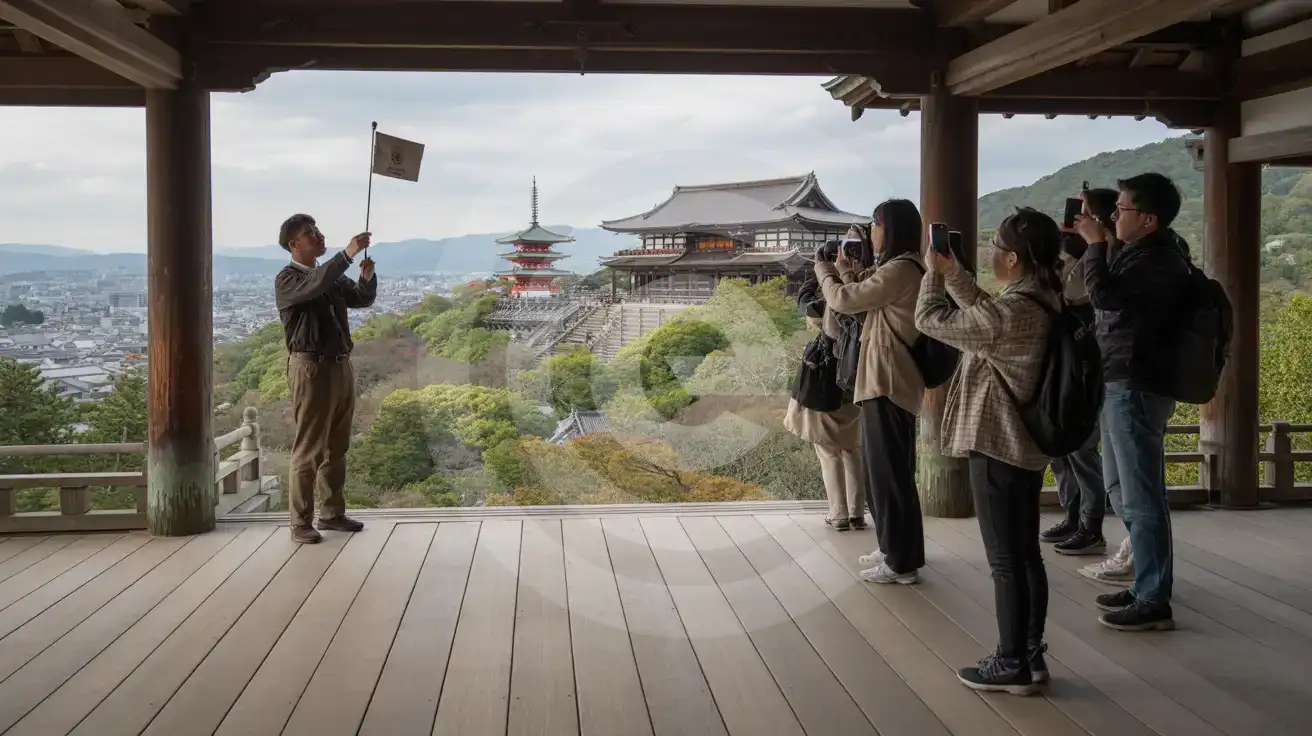
Once inside the grounds, data shifts from navigation to experience capture. The wooden stage view demands immediate sharing — photos of the valley, the pagoda framed by maple branches, the Otowa Waterfall queue. Group chats on LINE or WhatsApp coordinate where to meet after the love-stone walk at Jishu Shrine. Translation apps help decode the blessing streams at Otowa (longevity, success, love) so you choose correctly.
The descent through Sannenzaka and Ninenzaka leads to spontaneous decisions: a matcha stop at one of the preserved machiya tea houses, a detour to photograph Yasaka Pagoda, a dinner reservation at a kaiseki spot in Gion that you book via Tabelog or OpenTable while walking. Your eSIMno plans for Kiyomizu-dera, Kyoto, Japan keep every pivot smooth — one data plan covering the temple hillside, the Gion evening, and the Shinkansen ride to Tokyo the next morning.
Visiting Kiyomizu-dera
The temple opens daily at 6:00 AM with closing between 6:00 PM and 6:30 PM depending on season. Special evening illuminations during cherry blossom (late March–early April) and autumn foliage (mid-November–early December) extend access until 9:00 PM — these require separate timed tickets that sell out days ahead, so booking online before your trip locks in your slot.
Getting There
From Kyoto Station, take City Bus 100 or 206 to Gojo-zaka or Kiyomizu-michi (15-20 minutes, fare around ¥230). From Kiyomizu-Gojo Station on the Keihan Line, it's a 20-minute uphill walk. Taxis can drop you at the lower end of Kiyomizu-zaka but cannot enter the pedestrian approach — expect a ¥1,500-2,000 fare from the station area.
Practical Notes
Photography is permitted throughout the outdoor grounds including the main stage and pagoda. Inside the Hondo near the principal Kannon altar, photography is prohibited — signs are clearly posted. Wear comfortable walking shoes for the steep stone steps and uneven paths. There's no formal dress code, but modest clothing respects the temple's active Buddhist practice.
Connected at the Temple
Compare eSIM Options at Kiyomizu-dera
eSIMno | Local SIM / Operator | Roaming | |
|---|---|---|---|
| FEATURES | |||
| Setup time | Few minutes | Counter pickup or pre-order by post | Auto |
| No local ID needed | Online checkout | Passport scan since April 2026 | Use home account |
| Speed | 4G/LTE on KDDI + Softbank; 5G in some areas | Carrier-grade | Partner-dependent |
| Travel support | English support 24/7 | Japanese-language service | Home carrier hours |
| Keep home number | Dual SIM | Data-only: no Japanese number | Same number |
| Cost predictability | Fixed price | Prepaid, fixed term | Bill-shock risk |