

Quick Facts
- Capital
- Dublin
- Language
- English
- Currency
- Euro (EUR, €)
- Time Zone
- Irish Standard Time (UTC+0 / UTC+1 DST)
- Dialing Code
- +353
- Power Plug
- Type G (3-pin rectangular, common in UK and several Asian markets)
- Emergency
- 112 (general European emergency line); 999 also works
- eSIMno Networks
- Meteor, Three, Vodafone
How to Get Your eSIM
- Pick Your Ireland Data Plan
Choose from 1GB to unlimited packages based on your trip length — a week exploring Dublin and Galway typically needs 3-5GB for maps, ride apps, and photo uploads. - Buy Before Your Flight
Complete checkout at home with any payment method. Your eSIM QR code arrives by email within minutes, ready to install over your home WiFi. - Install the eSIM Profile
Scan the QR code in your phone's settings (iPhone: Settings → Cellular → Add eSIM; Android: Settings → Network → SIMs). The profile installs in under two minutes and sits dormant until activation. - Activate After Landing at Dublin Airport
Once your Aer Lingus or Ryanair flight reaches the gate, switch off airplane mode. Your phone detects Meteor, Three, or Vodafone within seconds — data is live before you reach passport control. - Keep Your Home SIM for Calls
Your existing number stays active for incoming calls and texts. Use WhatsApp, FaceTime, or Google Meet over your eSIMno data for outgoing calls — skip carrier roaming charges entirely.
Traveler Tips
- Download offline Google Maps for County Kerry and the Wild Atlantic Way before leaving Dublin — stretches between Killarney and Kenmare have patchy coverage in deep valleys.
- Dublin Bus and Irish Rail accept contactless payment via Leap Card or tap-to-pay; real-time arrivals on the Transport for Ireland app require data to refresh.
- Book Cliffs of Moher timed-entry tickets online at least 48 hours ahead during summer — the QR code on your phone scans faster than the paper-ticket queue.
- FREE NOW (formerly MyTaxi) handles Dublin and Cork taxi bookings; surge pricing spikes after Temple Bar pub closing time around 2:30 AM on weekends.
- Irish weather shifts hourly — Met Éireann radar on your phone beats guessing whether to pack the rain jacket for that Howth cliff walk.
Why Data Matters Across Ireland
Ireland packs UNESCO sites, wild coastline, and lively cities into a country you can cross in four hours — but rural roads, unpredictable weather, and dispersed attractions make reliable mobile data essential from the moment you land.
Airport to City Center
Dublin Airport sits 10 kilometers north of the city center. The Airlink Express 747 bus departs every 10-15 minutes from outside Terminal 1 arrivals, reaching O'Connell Street in 30-40 minutes for around €7-8 one-way. Real-time departure boards inside the terminal show the next bus, but confirming your hotel's nearest stop requires the Transport for Ireland app — and that needs data. FREE NOW taxi booking from arrivals to Grafton Street runs €25-35 depending on traffic; the app's fare estimate and driver tracking beat haggling at the rank.
Navigating Beyond Dublin
The Ring of Kerry's 179-kilometer loop through Killarney National Park has single-lane stretches where oncoming tour coaches force reversals. Google Maps live traffic reroutes you via the Ballaghbeama Gap when the main N70 backs up at Ladies View. The Wild Atlantic Way from Kinsale to Malin Head spans 2,500 kilometers of coastal roads — offline maps cached over your eSIMno plans for Ireland data cover dead zones near the Beara Peninsula and Loop Head while live navigation handles the rest.
Booking and Entry
The Guinness Storehouse sells timed-entry tickets that fill days ahead during peak season; the QR code on your phone scans at the Gravity Bar entrance. Blarney Castle's online booking skips the ticket-office queue. Aran Islands ferries from Rossaveal require advance booking through Aran Island Ferries — confirmation emails load to your phone as you board. Even traditional music sessions in Doolin pubs get posted on social media hours before showtime; checking the set list requires a quick scroll on data.
About Ireland & What Travelers Come For
Ireland occupies an island of 84,421 square kilometers off Europe's northwestern coast, split between the Republic of Ireland (26 counties) and Northern Ireland (part of the UK). The Republic uses the Euro, drives on the left, and speaks English with Irish Gaelic on official signage.
Gateway Cities
Dublin dominates international arrivals, with Dublin Airport (DUB) handling over 32 million passengers annually and direct flights from North America, Europe, and the Middle East. Shannon Airport (SNN) serves the west coast, landing travelers within 30 minutes of the Cliffs of Moher and 90 minutes of Galway. Cork Airport (ORK) anchors the south, feeding the coastal towns of Kinsale, Cobh, and the Beara Peninsula.
What Travelers Come For
The Cliffs of Moher draw over 1.5 million visitors annually to their 214-meter drops above the Atlantic. The Ring of Kerry loops through Killarney National Park's lakes and mountains. Galway's Latin Quarter hosts trad music sessions in Tigh Coili and Tig Cóilí pubs. Dublin's Trinity College displays the Book of Kells (9th-century illuminated manuscript). The Giant's Causeway in Northern Ireland (accessible via day trip from Dublin or Belfast) features 40,000 interlocking basalt columns.
When to Visit
Peak season runs May through September, when daylight stretches past 10 PM and outdoor festivals (Galway Arts Festival in July, Dublin Fringe in September) pack city streets. Shoulder months (April, October) offer lower hotel rates and thinner crowds at the Cliffs of Moher. Winter brings short days but atmospheric pub sessions and Christmas markets in Dublin's Henry Street.
Getting Around Ireland
Ireland's compact size and well-maintained road network make it driveable in a week, but public transit, coaches, and ferries connect major hubs for travelers who skip the rental car.
Airport Transfers
Dublin Airport's Airlink Express 747 reaches O'Connell Street in 30-40 minutes; the 757 route serves Heuston Station for onward rail connections. Taxis from Terminal 1 arrivals to city center cost €25-35 (metered, no surge). Shannon Airport's Bus Éireann 51 reaches Galway in 90 minutes; Cork Airport's 226A bus reaches Cork city center in 20 minutes.
Public Transit
Dublin Bus, Luas tram (Red and Green lines), and DART suburban rail cover the capital. Leap Cards offer capped daily fares and work across all Dublin transport; tap-to-pay via contactless bank card is also accepted. Irish Rail (Iarnród Éireann) connects Dublin Heuston to Cork (2 hours 40 minutes), Galway (2 hours 20 minutes), and Limerick (2 hours). Booking via the Irish Rail app shows live seat availability.
Driving and Coaches
Car rental unlocks the Ring of Kerry, Connemara, and the Wild Atlantic Way — routes where bus service is infrequent. Drive on the left; speed limits are in kilometers per hour (120 km/h on motorways, 80 km/h on regional roads). GoBus and Bus Éireann coaches cover Dublin–Galway (3 hours, from €15 each way) and Dublin–Cork (3 hours 30 minutes). Ferries from Rossaveal to the Aran Islands take 40 minutes; book ahead in summer.
Dublin's Georgian Heart
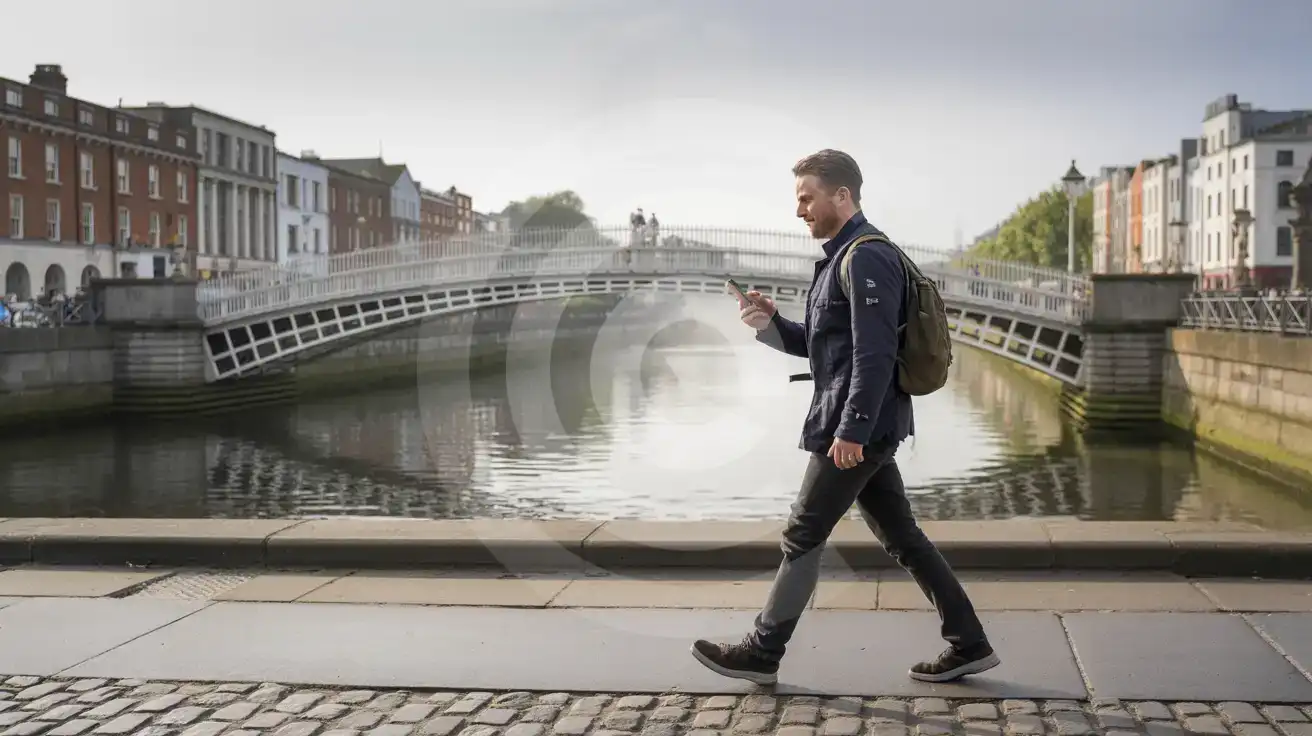
Compare eSIM Providers for Ireland
eSIMno | Local SIM / Operator | Roaming | |
|---|---|---|---|
| FEATURES | |||
| Setup time | Few minutes | Store visit + paperwork | Auto |
| No local ID needed | Online checkout | Local ID required | Use home account |
| Speed | 4G/LTE; 5G in some areas | Carrier-grade | Partner-dependent |
| Travel support | English support 24/7 | Operator shops and call centre | Home carrier hours |
| Keep home number | Dual SIM | Replaces it | Same number |
| Cost predictability | Fixed price | Bills can spike | Bill-shock risk |