

Quick Facts
- Language
- German (Deutsch)
- Currency
- Euro (EUR, €)
- Time Zone
- Central European Standard Time (UTC+1)
- Dialing Code
- +43
- Power Plug
- Type C, E, F (round 2-pin, common across most of Europe)
- Emergency
- 112
- eSIMno Networks
- A1, H3G, T-Mobile
How to Get Your eSIM
- Pick your Austria data plan
Choose from 1GB to unlimited options based on your Innsbruck trip length—a weekend in the Old Town needs less than a week of skiing plus Vienna extension. - Install at home before your flight
Scan the QR code over your home WiFi. The profile downloads in under 2 minutes and sits dormant until you activate it in Austria. - Board your flight with data ready
Your eSIM waits silently through the flight. No fumbling with plastic trays or nano-SIM tools while jet-lagged. - Activate after landing at INN
Switch off airplane mode as the aircraft taxis to the gate. Your phone connects to A1, H3G, or T-Mobile before you reach passport control. - Navigate Innsbruck immediately
Pull up IVB bus schedules, confirm your cable car reservation, and message your hotel—all before leaving the arrivals hall.
Traveler Tips
- The Nordkette cable car from Hungerburg to Hafelekar summit takes 20 minutes each way—download your timed-entry QR and have offline maps cached before ascending, as summit signal can dip near the viewing platforms.
- IVB single tickets cost around €2.50-€3.00 and expire 60 minutes after validation; buy a 24-hour pass for €5.80 if you're hitting the Bergisel Ski Jump, Ambras Castle, and Old Town in one day.
- Keep your home SIM active for incoming calls—your number reaches you normally while eSIMno handles all data. Use WhatsApp or FaceTime for outgoing calls to avoid roaming charges on your home line.
- Innsbruck Hauptbahnhof has ÖBB ticket machines with English interfaces, but the ÖBB app shows real-time platform changes and lets you buy Seefeld or Brenner corridor tickets without queuing.
- The Sillpark shopping center near Hauptbahnhof has public WiFi, but the mall's captive portal adds friction—your eSIM skips the registration entirely while you grab last-minute gear.
Why Data Matters in Innsbruck
Innsbruck compresses 800 years of Habsburg history and world-class Alpine access into a city you can walk end-to-end in 25 minutes—but the logistics behind that compact charm demand constant connectivity. The Nordkette cable car from Congress station to Hafelekar summit (2,334m) operates on timed-entry slots during peak season; your phone holds the QR code, checks the 8-minute Hungerburgbahn departure board, and confirms whether the summit station café is open before you commit to the ride. Without data, you're guessing at schedules posted in German and hoping the ticket window accepts your card.
Ground-level transit runs on the IVB network—trams, buses, and the S-Bahn linking to Hall in Tirol and Wattens. The IVB Live app shows real-time arrivals for every stop, but it needs signal to refresh. Line J to the Bergisel Ski Jump runs every 10 minutes on weekdays but drops to every 20 minutes on Sundays; arriving at a stop without live data means standing in Alpine cold wondering if you just missed the bus. Rideshare coverage exists via Bolt, but availability thins outside the Hauptbahnhof and Maria-Theresien-Straße corridor—having the app open with live driver positions beats walking to the taxi rank and hoping.
Beyond transit, Innsbruck's attractions increasingly require digital tickets. eSIMno plans for Innsbruck, Austria keep your Ambras Castle timed-entry confirmation, your Tyrolean State Museum audio-guide download, and your restaurant reservation at Stiftskeller accessible from one device. The Old Town's narrow lanes and thick medieval walls create signal shadows near Hofkirche and the Imperial Palace courtyard—Austrian networks A1, H3G, and T-Mobile maintain macro coverage that punches through where tourist-crowd WiFi collapses. When your group scatters across the Christmas markets on Marktplatz and Maria-Theresien-Straße, WhatsApp location-sharing brings everyone back together faster than shouting across the Glühwein stalls.
About Innsbruck & What Travelers Come For
Neighborhoods at a Glance
The Altstadt (Old Town) clusters around Herzog-Friedrich-Strasse, where the Golden Roof anchors a pedestrian zone of painted Gothic facades, the Imperial Palace (Hofburg), and the Court Church housing Maximilian I's cenotaph. North across the Inn River, Mariahilf and St. Nikolaus offer quieter residential streets with views back toward the Nordkette ridgeline. Wilten, south of the Hauptbahnhof, holds the Bergisel Ski Jump and the Basilica, while Pradl to the east serves as the local shopping and transit hub—Line 3 tram connects Pradl directly to Maria-Theresien-Straße in 8 minutes.
What Travelers Come For
Winter visitors arrive for the Olympia SkiWorld Innsbruck pass covering nine ski areas within 30 minutes of the city center—Axamer Lizum, Patscherkofel, and Kühtai among them. Summer brings hikers to the Nordkette Panorama Trail, mountain bikers to the Mutters downhill tracks, and culture seekers to the Tyrolean State Museum Ferdinandeum for Tyrolean art spanning five centuries. The Ambras Castle Innsbruck, a Renaissance castle 3km east of the Old Town, draws visitors for its armor collection and Spanish Hall. Day-trippers extend to Swarovski Kristallwelten in Wattens (15 minutes by S-Bahn), the medieval town of Hall in Tirol (10 minutes), or the Brenner Pass toward Italy.
When to Visit
December through March packs ski crowds and Christmas market visitors; book Nordkette cable car slots and Old Town hotels weeks ahead. June through September offers hiking weather and the Innsbruck Festival of Early Music at Innsbruck State Theatre. Shoulder months—April, May, October—thin the crowds at Ambras Castle and let you walk the Altstadt without navigating tour-group clusters.
Getting Around Innsbruck
Airport Transfers
Innsbruck Airport (INN) sits 4km west of the city center. The F bus runs every 15 minutes to Hauptbahnhof (12 minutes, around €2.50 single fare), or a taxi covers the distance in 10 minutes for approximately €15-€20. Rental car desks cluster in the arrivals hall—useful if your itinerary includes the Stubai Glacier or the Ötztal valley beyond IVB's reach.
Public Transit
IVB operates trams, buses, and the Hungerburgbahn funicular. Tram lines 1, 3, and 6 connect Hauptbahnhof to the Altstadt, Pradl, and Igls. The Stubaitalbahn light rail runs south from the Hauptbahnhof to Fulpmes in 55 minutes (around €7 single)—a scenic corridor to the Stubai hiking and ski zone. Single tickets valid 60 minutes cost €2.50-€3.00; day passes cover unlimited rides for €5.80.
Walking & Cable Cars
The Altstadt is entirely walkable—Golden Roof to the Imperial Palace takes 3 minutes on foot. The Nordkette access chain begins at Congress station: Hungerburgbahn funicular to Hungerburg (8 minutes), then Seegrubenbahn and Hafelekarbahn cable cars to the summit (20 minutes total). Round-trip tickets run approximately €40 and sell out on clear-weather weekends—book online and keep the QR on your phone.
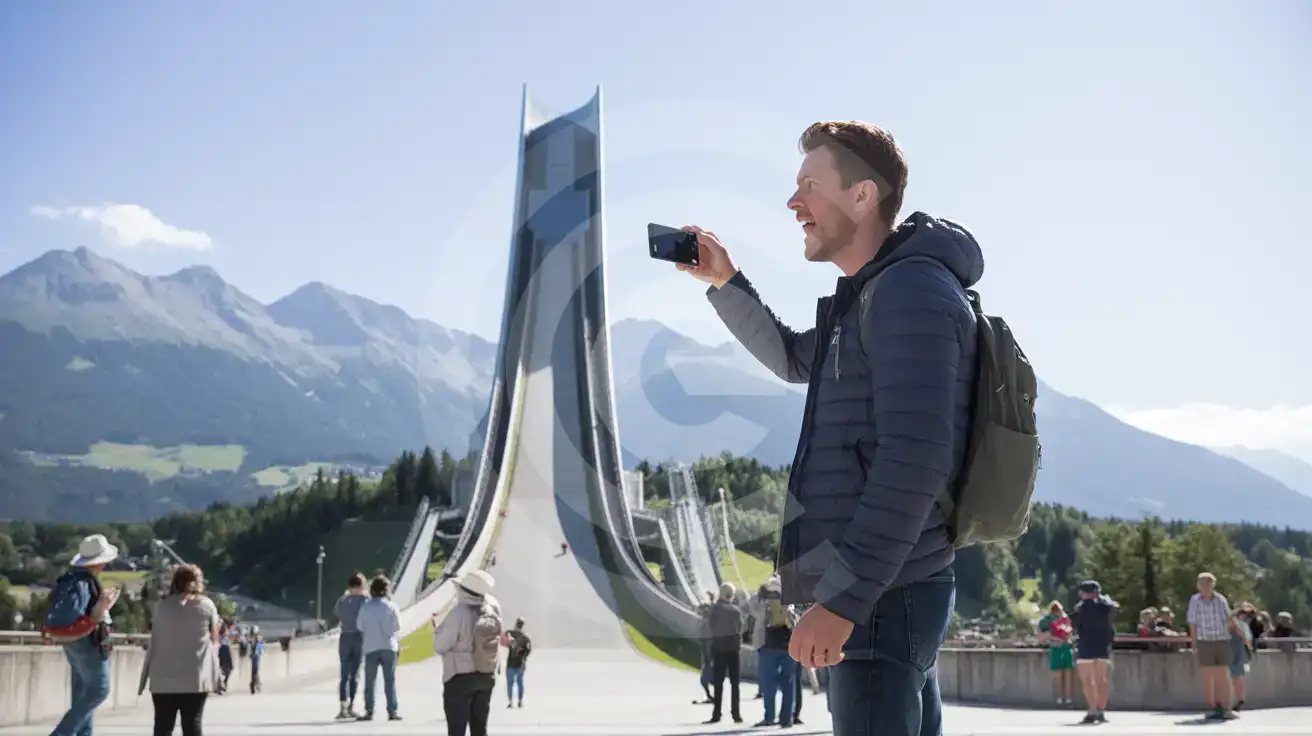
Bergisel Ski Jump
Compare eSIM Providers in Innsbruck
eSIMno | Local SIM / Operator | Roaming | |
|---|---|---|---|
| FEATURES | |||
| Setup time | Few minutes | Only emergency calls work until it is registered | Auto |
| No local ID needed | Online checkout | Official photo ID required to register | Use home account |
| Speed | 4G/LTE on all three Austrian networks; 5G in some areas | One network only | Partner-dependent |
| Travel support | English support 24/7 | German-language service | Home carrier hours |
| Keep home number | Dual SIM | Replaces it | Same number |
| Cost predictability | Fixed price | Prepaid, no bill shock | Bill-shock risk |