

Quick Facts
- Time Zone
- Pacific Time (UTC-8 / UTC-7 DST)
- Dialing Code
- +1
- Currency
- US Dollar (USD, $)
- Power Plug
- Type A, B (flat 2-pin, common across North America)
- Language
- English
- Emergency
- 911 (police, fire, ambulance)
- eSIMno Networks
- AT&T, Verizon Wireless
How to Get Your eSIM
- Pick Your USA Data Plan
Choose a plan size that matches your trip length — a weekend on the Strip needs less data than a two-week cross-country road trip. All plans work nationwide on AT&T and Verizon networks. - Install at Home Before Your Flight
Scan the QR code over your home WiFi and save the eSIM profile. Installation takes under 2 minutes and doesn't activate your data yet — you're just preloading the profile. - Board Your Flight to LAS
Your phone stays in airplane mode during the flight. The eSIM sits dormant until you're ready to use it, so no data charges tick while you're in the air. - Activate After Landing at Harry Reid
Once the aircraft reaches the gate at Terminal 1 or Terminal 3, switch off airplane mode. Your phone connects to AT&T or Verizon within seconds — Uber and Google Maps are ready before you reach the jet bridge. - Use Across the Entire USA
Your data plan isn't limited to Las Vegas. Head to the Grand Canyon, fly onward to Los Angeles, or drive to Death Valley — the same eSIM keeps working everywhere in the country.
Traveler Tips
- Rideshare pickup at LAS is on Level 2M of the parking garage — Terminal 1 and Terminal 3 each have separate zones. Have the Uber or Lyft app open with data ready before you exit baggage claim to avoid circling the garage looking for signage.
- The inter-terminal shuttle between Terminal 1 and Terminal 3 runs every 10-15 minutes and takes 7-10 minutes. If you're connecting between terminals, allow 90 minutes minimum — you'll exit security, shuttle, and re-screen through TSA.
- Keep your home SIM active for incoming calls. eSIMno is data-only, so WhatsApp, FaceTime, or Google Meet handle outgoing calls over data while your home number receives calls normally.
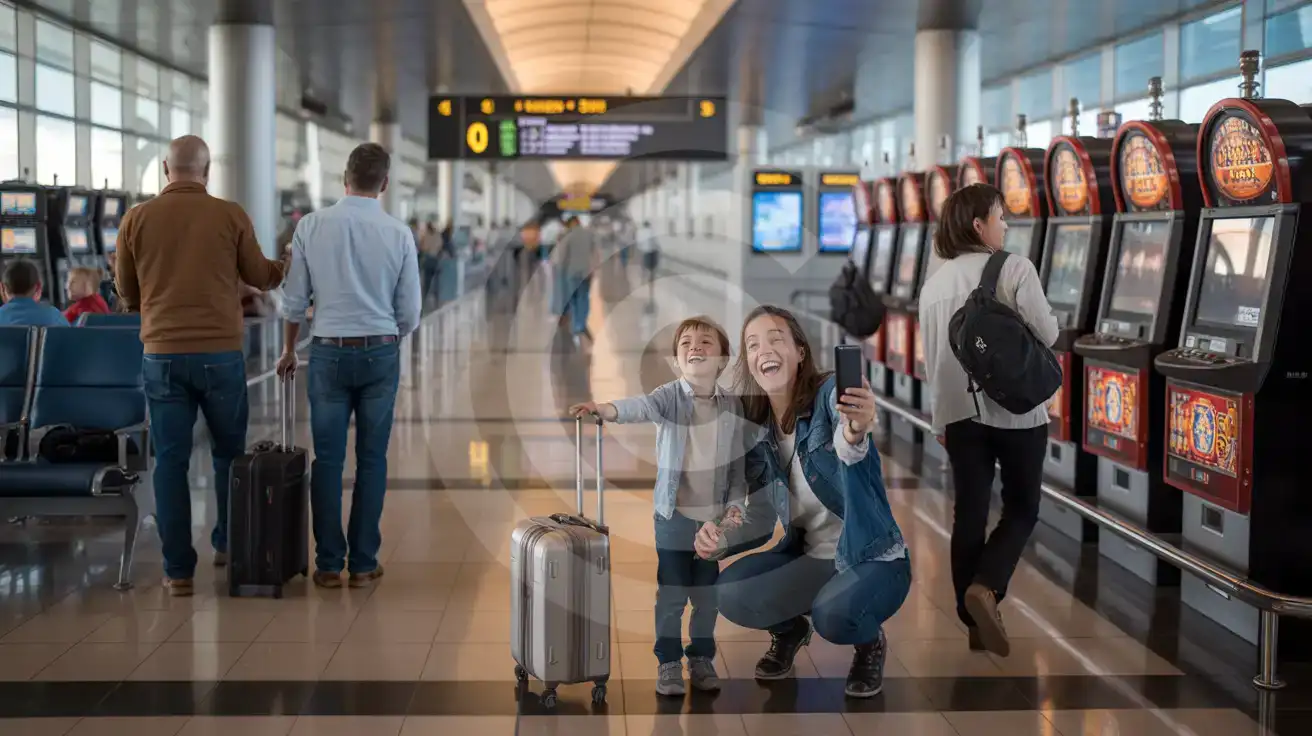
- Slot machines line the terminal corridors — over 1,300 of them. If you're waiting for baggage and want to check current gaming minimums at your hotel, having data beats the terminal WiFi which slows to a crawl during peak arrival banks.
- The Rent-A-Car Center is 5 km from the terminals with a free shuttle every 5-10 minutes. Pull up your reservation confirmation and driver's license photo before boarding the shuttle so pickup is instant.
Why You Need an eSIM at LAS
Harry Reid International Airport — still known to locals by its former name McCarran — processes arrival banks that can put 2,000+ passengers into the terminal within a 30-minute window. Convention crowds from CES, MAGIC, and NAB stack onto weekend leisure traffic, and the free terminal WiFi buckles under the load. Captive-portal signup asks for an email, throttles speed after a few minutes, and drops connections when you walk between concourses. An eSIM bypasses all of that: your phone connects to AT&T or Verizon cell towers the moment you switch off airplane mode, and the signal stays strong whether you're in the A Gates, the C Gates tram, or the baggage carousel.
The Rideshare Pickup Flow
Uber and Lyft pickups at LAS happen on Level 2M of the parking garages — a location that confuses first-time visitors who expect curbside pickup. With working data, you can check the app's map overlay showing the exact walking path from baggage claim, confirm your driver's ETA, and message them if you're delayed at the carousel. Surge pricing spikes during major convention closings and post-midnight flight banks; real-time fare comparison across Uber, Lyft, and taxi apps requires data that airport WiFi can't reliably deliver.
Beyond the Terminal
Your eSIMno plans for Harry Reid International Airport, Las Vegas, Nevada, United States keep working long after you leave the airport. Pull up Google Maps for the drive to the Las Vegas Strip, check mobile tickets for the High Roller observation wheel, message your group about dinner reservations at the Grand Canal Shoppes, or book a last-minute day trip to Red Rock Canyon. The same data plan that connected you at LAS covers every mile of your Vegas trip — and every mile beyond if you extend to California, Arizona, or anywhere else in the country.
Visiting Harry Reid International Airport
LAS operates two passenger terminals that are not connected airside. Terminal 1 houses Southwest Airlines across the A and B Gates, plus budget carriers (Allegiant, Frontier, Spirit) in the C Gates. Terminal 3 handles Delta, American, United, and all international arrivals through the D Gates. If your itinerary involves a connection between terminals, plan for at least 90 minutes: you'll exit security, take the inter-terminal shuttle (7-10 minutes), and clear TSA screening again.
International arrivals clear U.S. Customs and Border Protection at Terminal 3's E Gates. Global Entry kiosks and Mobile Passport Control are available, but immigration queue times during peak hours can stretch to 45-60 minutes. Having data means you can message whoever's meeting you with real-time updates on your queue position — or pull up your connecting gate information if you're transiting onward.
The airport sits 8 km south of the Las Vegas Strip. Taxi flat fares to most Strip resorts run $20-30 plus a $2 airport surcharge. Rideshare fares fluctuate with demand but average $15-25 to mid-Strip hotels during non-surge windows. RTC bus Route 109 connects Terminal 1 to downtown Las Vegas in 45-60 minutes for around $4-8 depending on pass type — real-time arrival info loads on the RTC app if you have data.
Inside Harry Reid International Airport
Compare eSIM Options at Harry Reid International Airport
eSIMno | Local SIM / Operator | Roaming | |
|---|---|---|---|
| FEATURES | |||
| Setup time | Few minutes | Store kit, needs activation | Auto |
| No local ID needed | Online checkout | No SSN; passport at carrier stores | Use home account |
| Speed | 4G/LTE on AT&T, T-Mobile and Verizon; 5G in some areas | One carrier only | Partner-dependent |
| Travel support | English support 24/7 | English-language service | Home carrier hours |
| Keep home number | Dual SIM | Replaces it | Same number |
| Cost predictability | Fixed price | Advertised price needs Auto Pay | Bill-shock risk |