

Quick Facts
- Language
- German (Deutsch)
- Currency
- Euro (EUR, €)
- Time Zone
- Central European Standard Time (UTC+1)
- Dialing Code
- +49
- Power Plug
- Type C, E, F (round 2-pin, common across most of Europe)
- Emergency
- 112 (European emergency line)
- eSIMno Networks
- O2, T-Mobile, Vodafone
How to Get Your eSIM
- Pick Your Germany Data Plan
Choose from 1GB to unlimited options based on your Frankfurt stay length. Business travelers streaming video calls from the Messe convention district need more than weekend museum-hoppers. - Complete the 2-Minute Checkout
Pay with any major card or digital wallet. Your eSIM QR code arrives instantly via email — no shipping, no waiting for a physical card to reach your home address. - Install Over WiFi Before Your Flight
Scan the QR in your phone's settings while still on home WiFi. iPhone: Settings → Cellular → Add eSIM. Android: Settings → Network → SIMs → Add eSIM. The profile installs in under 60 seconds. - Activate After Landing at FRA
Once your Lufthansa or connecting flight reaches the gate, switch off airplane mode. Your phone connects to O2, T-Mobile, or Vodafone within seconds — S-Bahn schedules and terminal maps load before you reach passport control. - Keep Your Home SIM for Calls
Your phone runs both SIMs simultaneously. eSIMno handles all data (maps, rides, translations, browsing). Your home number stays active for incoming calls — no call forwarding setup required.
Traveler Tips
- Download the RMV app before landing — it shows real-time S-Bahn and U-Bahn delays across Frankfurt's entire transit network, but only works with mobile data outside station WiFi zones.
- FRA Terminal 1 arrivals exit into the Fernbahnhof long-distance rail station; Terminal 2 arrivals need the SkyLine people-mover to reach S-Bahn platforms — check which terminal your flight lands at before queuing for the wrong train.
- Sachsenhausen apple wine taverns rarely appear on Google Maps with accurate hours; call ahead via WhatsApp or check their Instagram stories for same-day closures.
- The Städel Museum enforces timed-entry windows during special exhibitions — your QR code won't scan if you arrive outside your 30-minute slot, and rebooking from the lobby requires data.
- Uber and FreeNow both operate in Frankfurt, but FreeNow tends to have shorter wait times in the Bahnhofsviertel district after 10 PM when Uber surge pricing kicks in.
Why Data Matters in Frankfurt
Frankfurt compresses a financial capital's infrastructure into a walkable city center — and that compression means your phone toggles between transit apps, restaurant bookings, and museum tickets constantly. The S-Bahn S8 and S9 lines from FRA Airport to Hauptwache take 11-12 minutes, but delays ripple through the system during morning rush (7:30-9:00 AM) and evening peak (5:00-7:00 PM). The RMV app shows real-time platform changes and connection alternatives the station boards don't display.
Between meetings in the Bankenviertel financial district and dinners across the river in Sachsenhausen, you'll hit connectivity gaps that public WiFi can't bridge. The Zeil pedestrian shopping strip has patchy café WiFi that throttles after 15 minutes; the Kleinmarkthalle food hall has no public network at all. eSIMno plans for Frankfurt, Germany keep Google Translate running when you're deciphering Handkäs mit Musik menu descriptions and OpenTable syncing when you're rebooking a reservation from the U-Bahn platform.
Day trips expose the same pattern. The 45-minute S-Bahn ride to Wiesbaden's thermal baths or the 90-minute regional train to Heidelberg both pass through coverage dead zones in the Taunus hills. Your eSIM maintains connection through the gaps, pulling up castle opening hours and return schedules while offline-only travelers wait for the next station's WiFi. The Alte Oper concert hall, the Palmengarten botanical gardens, and the Senckenberg Natural History Museum all use digital ticketing — arrive without data, and you're asking the box office to reprint a paper ticket while the queue builds behind you.
About Frankfurt & What Travelers Come For
Neighborhoods at a Glance
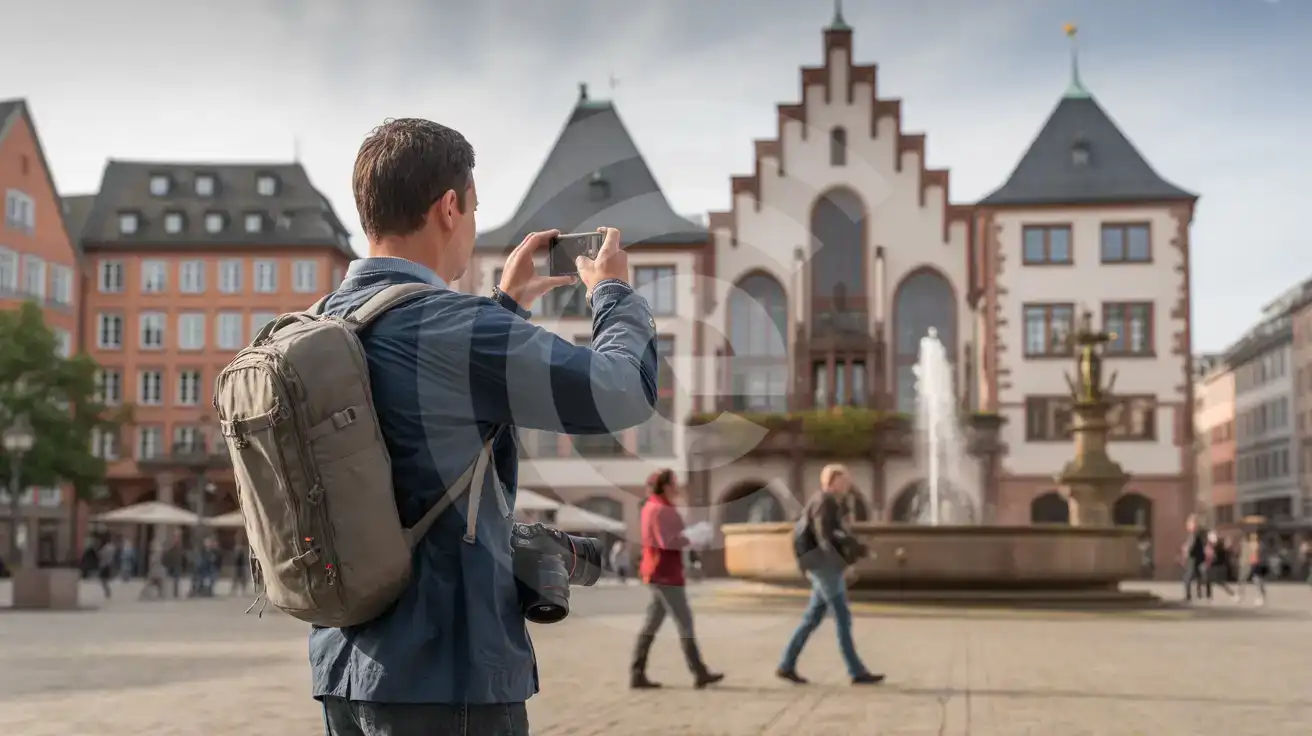
The Altstadt-Römerberg historic core clusters around the reconstructed medieval square, with Römer city hall anchoring photo ops and the Dom-Römer quarter's half-timbered facades drawing walking tours. The Bankenviertel financial district rises immediately north — the Main Tower observation deck (200 meters up, €9 adult admission) offers 360-degree views across both zones. Across the Main River, Sachsenhausen splits between the touristy Schweizer Strasse apple wine taverns and the quieter Alt-Sachsenhausen lanes where locals drink Ebbelwoi in ceramic jugs.
Top Things Travelers Come For
The Museumsufer riverbank lines up world-class institutions: the Städel Museum for Old Masters and German Expressionism, the Liebieghaus for ancient sculpture, the Museum für Kommunikation for design and technology. Timed-entry slots control peak-hour access at the Städel during special exhibitions. Beyond museums, the Palmengarten botanical garden spreads 22 hectares of tropical greenhouses and outdoor gardens — the palm house alone takes 45 minutes to walk at a steady pace. Business travelers fill the Messe convention grounds during trade fairs like Light + Building (March 2026) and ACHEMA (June 2027), when hotel rates spike 40-60% above baseline.
When to Visit
Spring (April-May) and fall (September-October) offer mild temperatures (12-18°C) and manageable crowds. Summer brings the Museumsuferfest (late August), when 3 million visitors pack both riverbanks over a single weekend — transit apps become essential for navigating diverted bus routes and extended U-Bahn hours. Winter sees the Weihnachtsmarkt Christmas markets around the Römerberg from late November through December 22, drawing evening foot traffic that fills Sachsenhausen's taverns by 7 PM.
Getting Around Frankfurt
Airport Transfers
Frankfurt Airport (FRA) sits 12 km southwest of the city center. The S-Bahn S8 and S9 lines run every 15 minutes from the Regionalbahnhof station beneath Terminal 1, reaching Hauptwache in 11-12 minutes and Frankfurt Hauptbahnhof in 13 minutes. Tickets cost around €5.35 for a single adult fare within the Frankfurt zone — buy via the RMV app or tap contactless at the platform validators. Terminal 2 arrivals connect to Terminal 1 via the free SkyLine people-mover (2-minute ride, every 2-3 minutes). Taxis to the Innenstadt run €35-45; Uber and FreeNow quote €30-40 depending on traffic and time of day.
Public Transit
The RMV network combines U-Bahn (underground metro), S-Bahn (suburban rail), trams, and buses under a single ticketing system. The U4 and U5 lines connect Hauptbahnhof to the Messe convention grounds; the U1, U2, U3, and U8 fan out to residential districts. Day passes (Tageskarte) cost around €5.80-7.80 depending on zone coverage and beat single-ride fares after 2-3 trips. Real-time departure boards exist at major stations, but the RMV app shows systemwide delays and platform changes that static boards miss.
Walking & Rideshare
The Altstadt-Römerberg to Bankenviertel walk takes 10-12 minutes. Crossing the Eiserner Steg footbridge to Sachsenhausen adds another 5 minutes. Most visitor itineraries stay within a 2 km radius of the Hauptwache — walkable in any weather with the right shoes. For trips beyond the center (Palmengarten, Senckenberg Museum, Höchst old town), Uber and FreeNow both operate; FreeNow tends to show more availability during evening hours when Uber drivers cluster around the Hauptbahnhof taxi rank.
Römerberg Square
Compare eSIM Providers in Frankfurt
eSIMno | Local SIM / Operator | Roaming | |
|---|---|---|---|
| FEATURES | |||
| Setup time | Few minutes | Verification by video call or post office | Auto |
| No local ID needed | Online checkout | Photo ID check required by law | Use home account |
| Speed | 4G/LTE on Telekom, Vodafone and O2; 5G in some areas | One network only | Partner-dependent |
| Travel support | English support 24/7 | German-language service | Home carrier hours |
| Keep home number | Dual SIM | Replaces it | Same number |
| Cost predictability | Fixed price | Prepaid, fixed monthly | Bill-shock risk |