

Quick Facts
- Language
- Italian (Italiano)
- Currency
- Euro (EUR, €)
- Time Zone
- Central European Standard Time (UTC+1)
- Dialing Code
- +39
- Power Plug
- Type C, E, F (round 2-pin, common across most of Europe)
- Emergency
- 112
- eSIMno Networks
- Vodafone, Wind Tre
How to Get Your eSIM
- Pick Your Italy Data Plan
Choose from 1 GB for a weekend art crawl or 10 GB+ for a full Tuscan road trip. All plans connect through Vodafone or Wind Tre with nationwide coverage. - Install at Home Before Your Flight
Scan the QR code over your home WiFi — takes 2 minutes. Label the profile 'Italy Travel' so it's easy to find in Settings. - Keep Your Home SIM Active for Calls
Your iPhone or Android runs both SIMs simultaneously. Incoming calls reach your home number; outgoing calls go through WhatsApp or FaceTime over eSIMno data. - Activate After Landing at Peretola
Switch off airplane mode once the captain clears devices. By the time you're walking toward the T2 exit, your phone is pulling Google Maps directions to your Oltrarno hotel. - Use Data Across All of Italy
The same plan works on a day trip to Siena's Piazza del Campo, a Frecciarossa dash to Rome, or a Chianti vineyard tour — no roaming toggle, no extra fee.
Traveler Tips
- Book Uffizi and Accademia tickets online at least 3 days ahead — the QR confirmation on your phone skips the 90-minute walk-up queue on Piazzale degli Uffizi.
- ATAF bus line C1 loops the centro storico every 8-10 minutes; tap your contactless card or buy a €1.70 ticket via the Tabnet app — paper tickets from tabacchi shops require exact change.
- The Duomo cupola climb (463 steps) requires a separate timed-entry slot booked through the Opera del Duomo site — screenshot the QR before you ascend because signal dips inside the dome stairwell.
- IT Taxi and FreeNow apps work reliably for pickups near Santa Maria Novella station; surge pricing spikes during rain and after 11 PM when taxis thin out.
- Free WiFi at Firenze SMN station caps at 30 minutes and requires email registration — your eSIM bypasses the captive portal entirely.
Why Data Matters in Florence
Florence rewards travelers who book ahead and navigate precisely. The Uffizi Gallery releases timed-entry slots in 15-minute windows; your phone stores the QR confirmation and displays it at the Via della Ninna entrance in under 2 seconds — no paper printout, no frantic email search. The Accademia, home to Michelangelo's David, runs the same system, and the walk between the two museums is a 12-minute route Google Maps optimizes around pedestrian-only zones that confuse paper maps.
Transportation in the centro storico mixes walking, electric minibuses, and taxis in ways that shift by time of day. The C1, C2, and C3 ATAF lines thread through streets too narrow for full-size buses; the Moovit app shows real-time arrivals at stops like Piazza San Marco and Via dei Calzaiuoli. When a summer thunderstorm empties the Piazza della Signoria in 4 minutes flat, the IT Taxi app locates the nearest available car while you shelter under the Loggia dei Lanzi — but the app needs data to refresh driver positions. FreeNow works as a backup, pulling from the same taxi pool with surge pricing displayed before you confirm.
Neighborhoods outside the tourist core demand different planning. Santo Spirito and San Frediano in the Oltrarno district hold the city's best artisan workshops and trattorias, but restaurant reservations through TheFork or OpenTable fill by 6 PM for prime 8 PM seatings. Sending a WhatsApp message to a recommended enoteca — standard practice in Florence — requires data the moment inspiration strikes. Near the Mercato Centrale at San Lorenzo, vendors accept card payments but the stall-by-stall comparison works faster when you can translate menu boards with Google Lens on the spot. With eSIMno plans for Florence, Italy, your phone handles every reservation ping, every transit refresh, and every rain-triggered taxi call from the Ponte Vecchio to the Boboli Gardens.
About Florence & What Travelers Come For
Neighborhoods at a Glance
The centro storico packs the Duomo, Uffizi Gallery, and Piazza della Signoria into a 20-minute walking radius. Santa Croce to the east holds the basilica where Michelangelo, Galileo, and Machiavelli are buried, plus leather workshops lining Via dei Neri. The Oltrarno on the south bank of the Arno — anchored by Pitti Palace and the artisan lanes of Santo Spirito — feels calmer after dark, with wine bars spilling onto Piazza Santo Spirito until midnight. San Lorenzo north of the Duomo centers on the Mercato Centrale food hall and the Medici Chapels, while the university quarter near Piazza San Marco draws a younger crowd to aperitivo spots along Via degli Alfani.
Top Things Travelers Come For
Botticelli's Birth of Venus and Primavera hang in the Uffizi alongside works by Caravaggio and Titian — a single gallery visit can stretch 4 hours. The Accademia exists for one reason: Michelangelo's David, standing 5.17 meters tall at the end of the Tribune hall. Ponte Vecchio lines its medieval span with gold and silver shops unchanged in layout since the 16th century. The Duomo complex — cathedral, baptistery, campanile, and cupola — offers separate ticketed climbs; Brunelleschi's dome rewards the 463-step ascent with a 360-degree view of terracotta rooftops and Tuscan hills. Piazzale Michelangelo delivers the same panorama at sunset without the climb, a 25-minute uphill walk from Ponte alle Grazie.
When to Visit
April-May and September-October balance mild weather (18-24°C) with thinner crowds than the July-August peak when temperatures hit 35°C and museum queues double. Winter brings lower hotel rates and the chance to photograph the Duomo without tour groups, though some hilltop viewpoints like San Miniato close earlier.
Getting Around Florence
Airport Transfers
Florence Airport Peretola (FLR) sits 5 km northwest of the centro storico. The Volainbus shuttle runs every 30 minutes to Santa Maria Novella station, taking 20 minutes and costing around €6 one-way — buy tickets via the ATAF app or from the driver with contactless payment. Taxis queue outside arrivals with a flat fare to the historic center. Pisa International (PSA), 80 km west, handles more long-haul and low-cost traffic; the PisaMover monorail connects to Pisa Centrale station, then a 50-minute Trenitalia regional train reaches Firenze SMN for under €10.
Public Transit
Florence's tram Line T1 links Santa Maria Novella to Scandicci in the southwest, with Line T2 running to the airport (service launched 2024). The ATAF bus network covers routes the tram misses; the C1, C2, and C3 electric minibuses loop the centro storico where full-size vehicles can't fit. Single rides cost around €1.70, valid 90 minutes with transfers — tap contactless or buy via the Tabnet app. The Firenze Card (€85 for 72 hours) bundles museum entry and unlimited transit.
Walking & Rideshare
The historic core is a ZTL (limited traffic zone) where private cars are banned most hours; walking dominates. Distances deceive — the Duomo to Palazzo Pitti via the Ponte Vecchio is a 15-minute stroll on flat ground, but the climb to Piazzale Michelangelo adds 25 minutes and 100 meters of elevation. IT Taxi and FreeNow handle rideshare bookings; Uber operates in limited form (Uber Black only, pricier than local taxis). Lime e-scooters dot the riverbanks but can't enter the ZTL core.
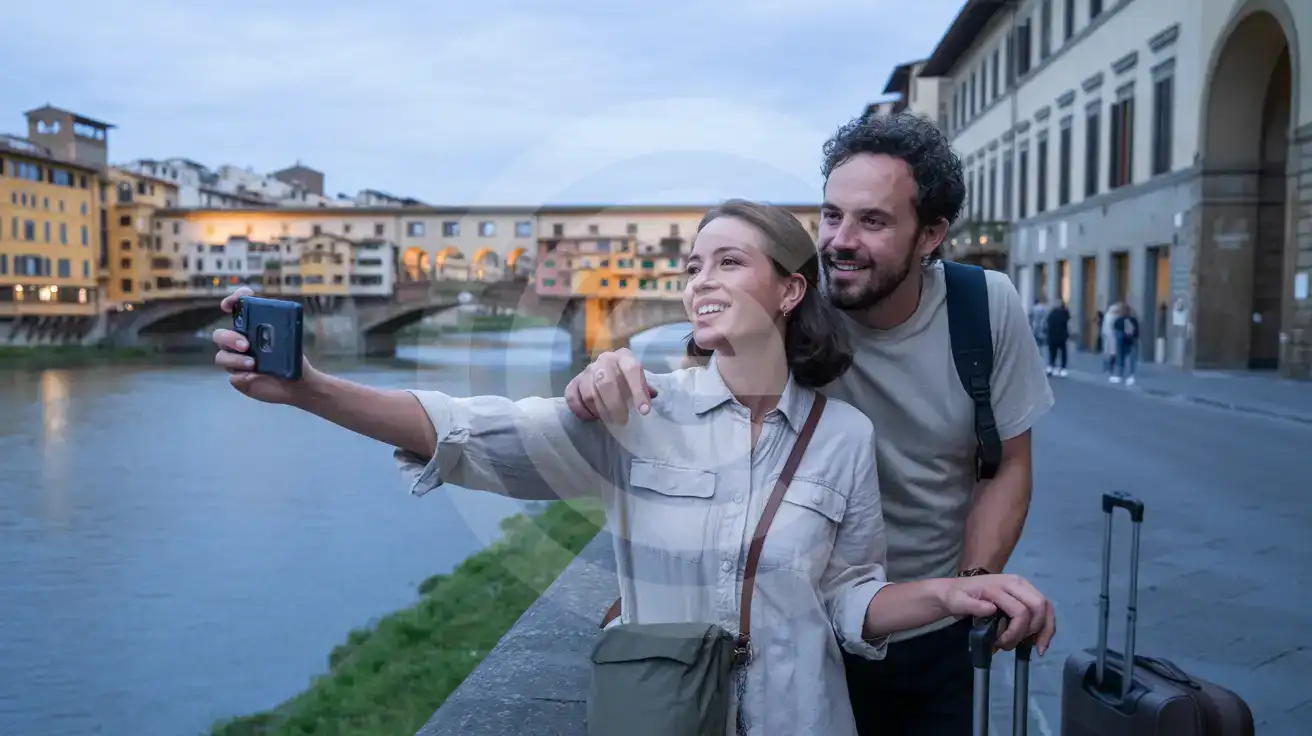
Ponte Vecchio at Blue Hour
Compare eSIM Providers in Florence
eSIMno | Local SIM / Operator | Roaming | |
|---|---|---|---|
| FEATURES | |||
| Setup time | Few minutes | Store registration, about ten minutes | Auto |
| No local ID needed | Online checkout | Passport is required by law; some also ask for a tax code | Use home account |
| Speed | 4G/LTE on Vodafone and WindTre; 5G in some areas | One network only | Partner-dependent |
| Travel support | English support 24/7 | Italian-language service | Home carrier hours |
| Keep home number | Dual SIM | Replaces it | Same number |
| Cost predictability | Fixed price | Prepaid, no bill shock | Bill-shock risk |