

Quick Facts
- Capital
- Sarajevo
- Language
- Serbian (Cyrillic)
- Currency
- KM (KM)
- Time Zone
- Central European Standard Time (UTC+1)
- Dialing Code
- +387
- Power Plug
- Type C, E, F (round 2-pin, common across most of Europe)
- Emergency
- 112
- eSIMno Networks
- BH Telecom, HT Eronet
How to Get Your eSIM
- Choose Your Data Plan
Pick the data allowance that matches your trip length — 7-day plans work for Sarajevo-only stays, 15- or 30-day plans suit multi-city routes through Mostar, Banja Luka, and Trebinje. - Install Over Home WiFi
Scan the QR code from your confirmation email while still at home. The eSIM profile downloads in under three minutes and sits dormant until you're ready. - Board Your Flight
Keep airplane mode on during the journey. The eSIM waits patiently — no battery drain, no accidental activation at a layover hub. - Activate After Landing
Once your aircraft reaches the gate at Sarajevo International, switch off airplane mode. Your phone connects to BH Telecom or HT Eronet within seconds. - Start Exploring Immediately
Pull up taxi directions to your hotel, translate the Cyrillic signage, and message your host — all before you reach the baggage carousel.
Traveler Tips
- Sarajevo International (SJJ) has a single compact terminal — the walk from gate to taxi rank outside Door 1 takes 8-10 minutes with no data dead zones along the route.
- The Baščaršija bazaar area in Sarajevo has strong 4G coverage even inside the narrow covered passages; camera-translate menus for ćevapi and burek stalls on the spot.
- Inter-city buses between Sarajevo and Mostar depart from the main bus station (Autobuska Stanica) every 60-90 minutes; check live departure boards via the station app or Google Maps.
- Keep your home SIM active for incoming calls — your eSIMno plan handles all data, while voice calls ring through on your original number automatically.
- Currency exchange kiosks cluster around Ferhadija Street in Sarajevo; use your phone's XE or Wise app to compare rates before committing.
- Mostar's Old Bridge area has steep cobblestone descents — pull up the route on Google Maps before you start so you're not fumbling mid-climb.
Why Data Matters Across Bosnia and Herzegovina
Bosnia and Herzegovina rewards travelers who arrive connected. Sarajevo's Old Town unfolds across a compact 1.2 km stretch from the Sebilj fountain to the Latin Bridge — but the side alleys zigzag uphill through unmarked residential lanes where a wrong turn adds 20 minutes of backtracking. Real-time Google Maps directions beat asking for help in a language you may not speak.
Translation and Menus
Restaurant menus in Baščaršija often appear only in Bosnian with Cyrillic script. Google Lens camera-translate decodes the difference between ćevapi (grilled minced meat) and burek (filled pastry) in seconds. The same tool handles street signs, pharmacy labels, and the bus timetable posted inside the main station.
Transit and Rideshare
Uber doesn't operate here. Local taxi apps like Crveni Taxi and Gold Taxi require a working phone number and data connection to request a ride. Negotiate directly with drivers outside the airport arrivals hall, but cross-check the quoted fare against the live map estimate on your phone — the 8 km ride from SJJ to Baščaršija should run 15-25 KM depending on traffic.
Multi-City Coverage
Mostar, Banja Luka, and Trebinje all fall under the same BH Telecom and HT Eronet footprint your eSIMno plans for Bosnia and Herzegovina connect through. The 130 km bus ride from Sarajevo to Mostar crosses entity boundaries with no roaming toggle — your data keeps working through the Herzegovina river valleys, inside the Blagaj Tekke monastery, and along the Stari Most bridge promenade. The same plan covers Republika Srpska's Banja Luka (220 km northwest) and the coastal-adjacent Trebinje near the Montenegro border.
About Bosnia and Herzegovina & What Travelers Come For
Bosnia and Herzegovina sits at the crossroads of Central and Southeastern Europe, bordered by Croatia, Serbia, and Montenegro with a sliver of Adriatic coastline near Neum. The country's landscape shifts from Alpine peaks in the Dinaric ranges to river canyons carved by the Neretva, Una, and Vrbas. Two political entities — the Federation of Bosnia and Herzegovina and Republika Srpska — share the territory, but travelers move freely between them.
Gateway Cities
Sarajevo serves as the primary international gateway, with direct flights from Istanbul (IST), Vienna (VIE), Munich (MUC), and seasonal routes from Middle Eastern hubs. The city's single-runway airport (SJJ) sits 8 km southwest of the Old Town. Mostar draws the second-largest visitor flow — the UNESCO-listed Stari Most bridge and Ottoman old quarter attract day-trippers and overnight guests alike. Banja Luka, the Republika Srpska administrative center, appeals to travelers heading toward the Una National Park waterfalls.
What Travelers Come For
The Stari Most bridge dive tradition, where local divers leap 24 meters into the Neretva, draws summer crowds. Sarajevo's layered history — Ottoman bazaars, Austro-Hungarian architecture, and 1990s war memorials — rewards walkers who explore on foot. The Tunnel of Hope museum on the city's outskirts requires a 20-minute taxi ride. Religious sites include the Gazi Husrev-beg Mosque in Baščaršija, the Serbian Orthodox Cathedral on Mula Mustafe Bašeskije Street, and the Blagaj Tekke dervish monastery built into a cliff face 12 km south of Mostar.
When to Visit
Late spring (May-June) and early autumn (September-October) bring mild temperatures and thinner crowds at major sites. Summer peaks in July-August see Mostar temperatures exceeding 35°C and Stari Most jumping competitions drawing thousands. Winter skiing at Jahorina and Bjelašnica — venues from the 1984 Sarajevo Winter Olympics — runs December through March.
Getting Around Bosnia and Herzegovina
Bosnia and Herzegovina's transport network relies on buses, taxis, and a limited rail system rather than metro lines or widespread rideshare apps.
Airport Transfers
Sarajevo International Airport (SJJ) sits 8 km from Baščaršija. Taxis line up outside the arrivals hall — expect 15-25 KM for the 20-minute ride to the Old Town depending on traffic. No rail link exists; the airport bus (Centrotrans) departs every 30 minutes to the main bus station for a lower fixed fare. Mostar's small airport (OMO) handles seasonal charters but most travelers arrive overland from Sarajevo or Dubrovnik.
Inter-City Buses
Buses connect Sarajevo to Mostar (130 km, 2.5 hours), Banja Luka (220 km, 4 hours), and Trebinje (170 km, 3.5 hours) via the main Autobuska Stanica terminal. Departures run every 60-90 minutes on the Mostar route. Tickets sell at the station counter or through the operator's website — having data lets you check live schedules and buy in advance.
Trains
The Sarajevo-Mostar railway follows the Neretva canyon on a scenic 2-hour route with departures twice daily. Reservations aren't required but checking timetables online beats arriving at the station blind.
Taxis and Local Apps
Uber and Bolt don't operate here. Use local apps like Crveni Taxi and Gold Taxi in Sarajevo — both require a data connection to request rides. In smaller towns, hail cabs directly from marked stands near central squares.
Driving
Rental cars open access to Una National Park, the Sutjeska primeval forest, and Herzegovina's wine region around Čitluk. Mountain roads demand caution; GPS navigation keeps you on paved routes rather than dirt tracks. Fuel stations accept card payments but carry some KM cash for rural stretches.
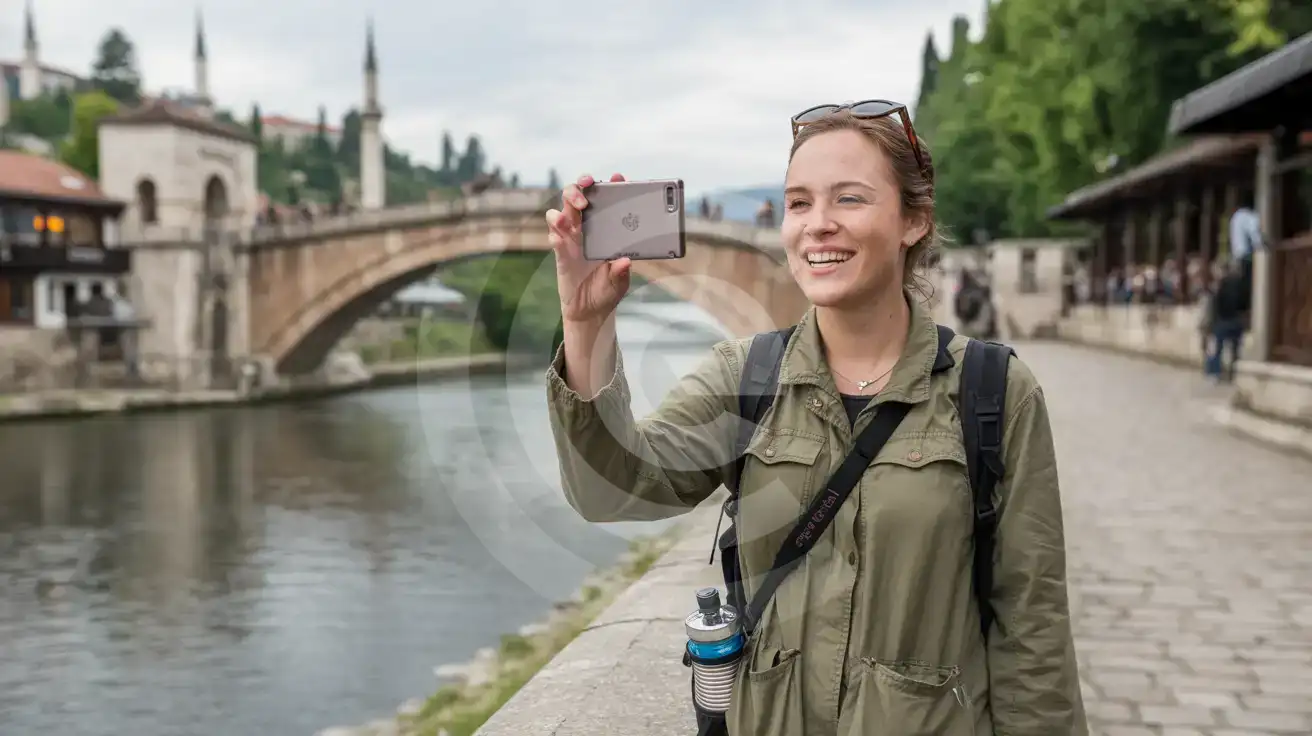
Connected in Sarajevo
Compare eSIM Providers for Bosnia and Herzegovina
eSIMno | Local SIM / Operator | Roaming | |
|---|---|---|---|
| FEATURES | |||
| Setup time | Few minutes | Store visit + paperwork | Auto |
| No local ID needed | Online checkout | Local ID required | Use home account |
| Speed | 4G/LTE; 5G in some areas | Carrier-grade | Partner-dependent |
| Travel support | English support 24/7 | Operator shops and call centre | Home carrier hours |
| Keep home number | Dual SIM | Replaces it | Same number |
| Cost predictability | Fixed price | Bills can spike | Bill-shock risk |