

Quick Facts
- Language
- Turkish (Türkçe)
- Currency
- Turkish Lira (TL, ₺)
- Time Zone
- Turkey Standard Time (UTC+3)
- Dialing Code
- +90
- Power Plug
- Type C, E, F (round 2-pin, common across most of Europe)
- Emergency
- 112 (general European emergency line)
- eSIMno Networks
- Türk Telekom, Vodafone
How to Get Your eSIM
- Choose Your Turkey Plan
Pick a data package that covers your Istanbul visit and any onward travel — eSIMno plans work nationwide, from the Basilica Cistern to Cappadocia balloon rides. - Install Before Your Flight
Scan the QR code at home over WiFi. The profile sits dormant until you activate it, so there's no charge until you land. - Activate After Touchdown
Once your plane reaches the gate at Istanbul Airport, switch off airplane mode. Your phone connects to Türk Telekom or Vodafone within seconds. - Navigate to Sultanahmet
Use data on the M11 metro and T1 tram ride into the city. Pull up walking directions from the Sultanahmet stop to the cistern entrance on Yerebatan Caddesi — about 5 minutes on foot. - Enter the Cistern Ready
Your timed-entry QR loads instantly, audio guide downloads work underground, and your phone stays connected as you climb back up into the Sultanahmet crowds.
Traveler Tips
- Book timed-entry tickets online at least 24 hours ahead — the queue at the Yerebatan Caddesi entrance can stretch 30-45 minutes during midday peaks.
- The cistern interior stays around 15°C year-round; bring a light layer even in August and wear non-slip shoes for the damp walkways.
- Download any audio guide content before descending — cellular signal weakens among the columns, though it holds near the entrance and exit.
- Evening sessions (after 19:00) run later and draw smaller crowds; the dramatic lighting is also stronger after dark.
- Keep your home SIM active for incoming calls — your eSIM handles data, your home number rings through normally in dual-SIM mode.
- Top up an Istanbulkart at any metro station kiosk for the T1 tram ride to Sultanahmet — tap-on, tap-off, no cash fumbling.
Why Data Matters at the Basilica Cistern
The Basilica Cistern visit is tightly scheduled — timed-entry tickets, downloaded audio guides, and post-visit navigation all depend on data. Your confirmation email contains a QR code that the gate scanner reads directly from your phone screen; lose signal in the Sultanahmet crowds and you're stuck refreshing while the queue builds behind you.
Before You Descend
From the T1 tram stop at Sultanahmet, walking directions keep you on track through the maze of carpet shops and tour-group clusters along Divanyolu Caddesi. The cistern entrance sits on Yerebatan Caddesi, roughly 300 meters from Hagia Sophia — easy to overshoot without live maps. Pull up the route, confirm your ticket time, and check the current wait on Google Maps crowd data before joining the line.
Inside the Cistern
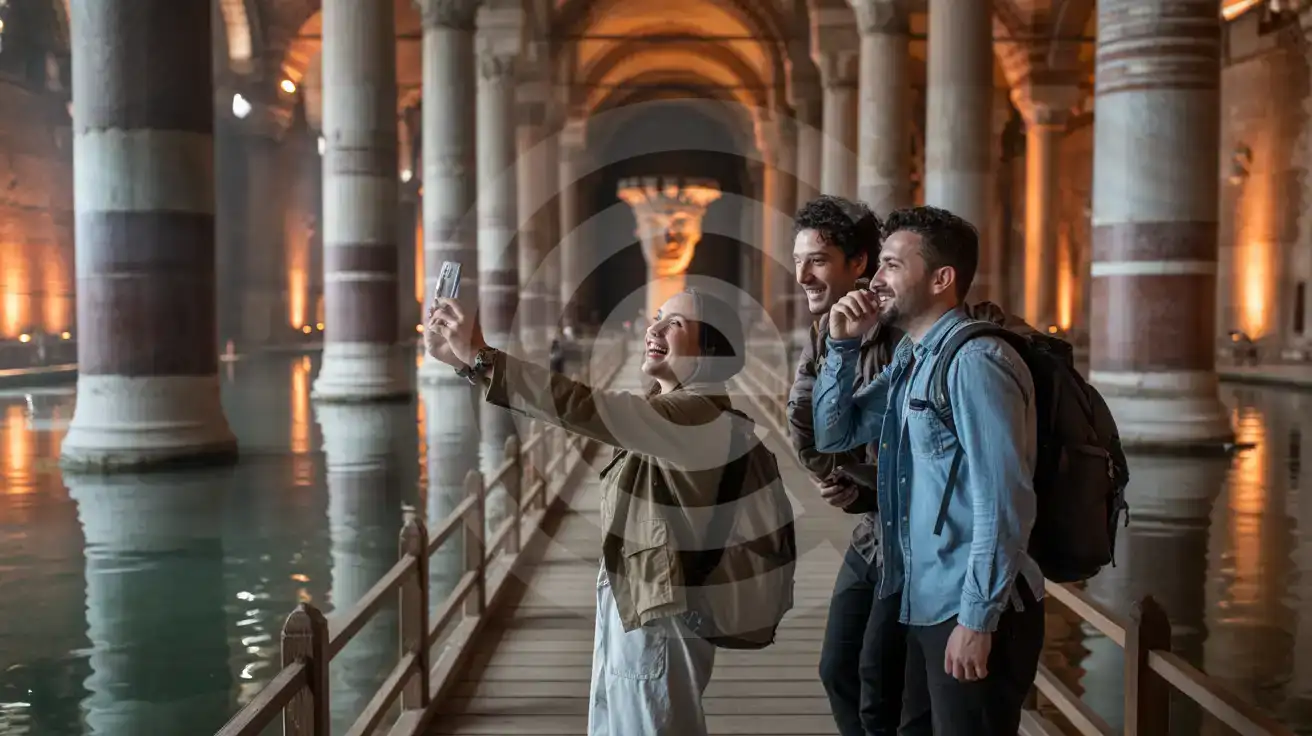
Signal dips among the 336 columns but holds enough near the walkway edges for WhatsApp messages and photo uploads. The Medusa heads in the northwest corner are the crowd magnet — share the shot to your group chat while you're still underground, or queue the upload for the moment you surface. Audio guide apps like izi.TRAVEL and Rick Steves Audio Europe work offline once downloaded, but the download itself needs data before entry.
After You Surface
The cistern exit drops you back into one of Istanbul's densest tourist corridors. BiTaksi shows live taxi positions if you're heading to Karaköy for lunch; Google Maps transit directions handle the T1 tram back to Eminönü or the walk to the Hippodrome. Restaurant reservations at places like Matbah Ottoman Palace Cuisine or Deraliye Ottoman Kitchen confirm over data — no WiFi hunting required. An eSIMno plan for Basilica Cistern, Istanbul, Turkey keeps you connected from the underground columns to the rooftop terraces of Sultanahmet.
Visiting the Basilica Cistern
The cistern opens daily, with daytime sessions running from around 09:00 and a separate evening slot extending past 22:00. Evening tickets cost more but draw thinner crowds and stronger atmospheric lighting. Foreign-visitor admission sits in the €25-35 equivalent range; the Müzekart museum pass is not valid here since the site is municipality-operated rather than Ministry of Culture.
Getting There
The T1 tram to Sultanahmet is the standard approach from Kabataş, Karaköy, or Eminönü. From Istanbul Airport, the M11 metro runs to Kağıthane (~25 min), then transfer to the M7 toward Yenikapı and switch to the T1 at the marked interchange — total journey roughly 70-80 minutes depending on transfer timing. Taxi apps like BiTaksi show flat-fare estimates in the ₺400-600 range from the airport to Sultanahmet depending on traffic.
What to Expect Inside
The visit takes 45-60 minutes along raised walkways above shallow water. Photography without flash or tripod is permitted. Contemporary art installations rotate periodically among the columns. The Medusa heads and Hen's Eye Column sit in the northwest section — follow the walkway to the end and loop back. Temperatures stay cool; the humidity is noticeable. Dress is secular — no religious requirements — but sturdy, non-slip footwear matters on the damp surfaces.
Underground Columns at the Basilica Cistern
Compare Connectivity Options at Basilica Cistern
eSIMno | Local SIM / Operator | Roaming | |
|---|---|---|---|
| FEATURES | |||
| IMEI registration | Never required | Blocked after 120 days | Never required |
| Setup time | Few minutes | Store queue + passport | Auto |
| No local ID needed | Online checkout | Passport tied to the SIM | Use home account |
| Speed | 4G/LTE on Turk Telekom + Vodafone; 5G in some areas | Carrier-grade | Partner-dependent |
| Travel support | English support 24/7 | Turkish-language service | Home carrier hours |
| Keep home number | Dual SIM | Replaces it | Same number |
| Cost predictability | Fixed price | IMEI fee risk: ~1,213 USD | Outside EU roaming |