
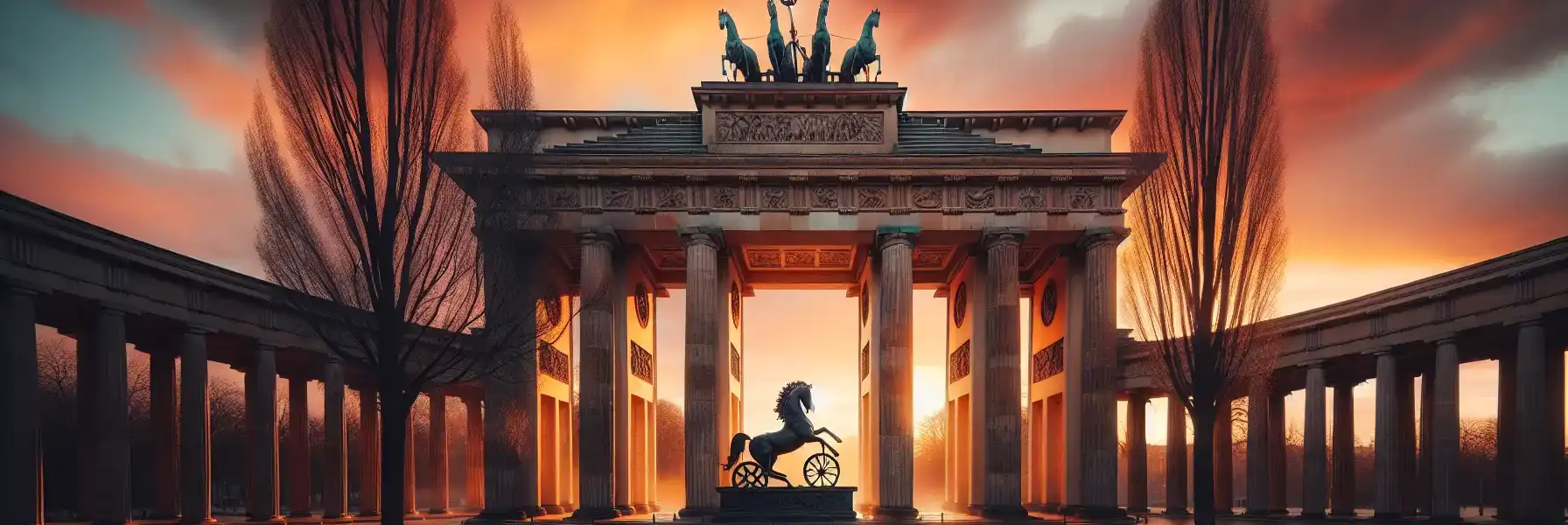
Quick Facts
- Address
- Pariser Platz, 10117 Berlin, Mitte district
- Hours
- 24/7 outdoor access; Room of Silence approx. 11:00-17:00 daily
- Admission
- Free — open-air monument with no ticketed entry
- Nearest Station
- Brandenburger Tor (U5, S1, S2, S25, S26)
- Bus Lines
- 100 and 300 on Unter den Linden
- Walk to Reichstag
- 7 minutes north
- Walk to Holocaust Memorial
- 5 minutes south
- Official Website
- visitberlin.de
- Photography
- Permitted 24/7, tripods allowed, drones restricted
- eSIMno Networks
- O2, T-Mobile, Vodafone
About Brandenburg Gate
The Brandenburg Gate rises at the western terminus of Unter den Linden boulevard, where the grand ceremonial axis of old Berlin once met the road to the town of Brandenburg an der Havel. Prussian King Frederick William II commissioned the structure in 1788 as a symbol of peace following the brief Batavian campaign, and by 1791 the neoclassical arch stood complete — twelve Doric columns arranged in two rows of six, creating five passageways beneath a substantial attic crowned by sculptor Johann Gottfried Schadow's bronze Quadriga.
Architect Carl Gotthard Langhans modeled the gate on the Propylaea, the monumental gateway to the Acropolis in Athens, though he adapted Greek proportions to Prussian scale. The gate measures approximately 26 metres in height, 65 metres in width, and 11 metres in depth. Each column rises 15 metres, supporting a structure built from Silesian sandstone that has weathered two centuries of Berlin winters and the catastrophic damage of World War II.
The Quadriga itself has lived multiple lives. Napoleon seized it as a war trophy in 1806 after defeating Prussia at Jena-Auerstedt, shipping the bronze ensemble to Paris. After his final defeat in 1814, a Prussian cavalry unit escorted the chariot home, and the goddess Victoria received a new iron cross and Prussian eagle to mark the victory. The original Quadriga was largely destroyed during the Second World War; today's version is a 1958 recasting from Schadow's surviving plaster molds, with the iron cross and eagle restored in 1991 following German reunification.
Throughout the twentieth century, the gate accumulated layers of political meaning that no architect could have anticipated. Nazi torchlight processions passed beneath it; Soviet soldiers raised their flag atop its ruins in May 1945. When the Berlin Wall went up in August 1961, the gate found itself marooned in the death strip — visible from both sides but accessible to neither. For 28 years it remained a symbol of division, captured in countless photographs showing armed guards patrolling an empty Pariser Platz. When President Ronald Reagan stood on the western side in June 1987 and demanded that Mikhail Gorbachev tear down the wall, the gate loomed directly behind him.
On December 22, 1989, the gate reopened. West German Chancellor Helmut Kohl walked through to meet East German Prime Minister Hans Modrow, and tens of thousands of Berliners celebrated what had seemed unimaginable just weeks earlier. Since then, the Brandenburg Gate has served as Germany's primary stage for national events — from World Cup victory celebrations to New Year's Eve parties drawing over a million people to the commemorations marking the fall of the Wall's anniversaries. It is not merely a tourist attraction but a living civic space where history continues to unfold.
Highlights & Must-See
The Quadriga
Johann Gottfried Schadow's bronze sculpture group commands attention from every angle on Pariser Platz. Victoria, Roman goddess of victory, drives a four-horse chariot eastward toward the city centre — a directional choice that has inspired debate ever since Napoleon briefly reversed the ensemble's orientation. The horses strain forward with remarkable anatomical detail, their muscular tension captured in bronze despite the sculpture's 5-metre height above the attic level. The best ground-level views come from directly beneath the central passageway looking up, or from the eastern edge of Pariser Platz where the full ensemble appears silhouetted against the sky. For elevated perspectives, several rooftop bars and hotel lounges along Unter den Linden offer views where the Quadriga appears at eye level against the Berlin skyline.
Pariser Platz
The square framing the gate's eastern face takes its name from the 1814 return of the Quadriga following Napoleon's defeat at Paris. Today's reconstructed plaza hosts some of Berlin's most architecturally significant modern buildings. The Hotel Adlon Kempinski anchors the southern edge, a faithful reconstruction of the original 1907 grand hotel where celebrities from Marlene Dietrich to Charlie Chaplin once stayed. The DZ Bank building on the northern side conceals a remarkable Frank Gehry-designed interior — a swooping stainless steel conference room visible through the atrium that most visitors walk past without noticing. The French Embassy and the rebuilt American Embassy complete the diplomatic presence, while the Akademie der Künste provides exhibition space for contemporary art.
The Doric Columns and Reliefs
Langhans's twelve Doric columns deserve close examination. Unlike the fluted columns of Greek originals, these are smooth-shafted — a design choice that gives the gate a heavier, more martial appearance suited to Prussian aesthetics. The central passageway historically served as the royal route; commoners and carriages used the outer passages. Metope reliefs in the attic level depict scenes from Greek mythology, including the labors of Hercules, though weathering and wartime damage have eroded much of the original detail. The sandstone itself shows considerable variation in colour and texture — evidence of multiple restoration campaigns using stone from different Silesian quarries.
The Raum der Stille (Room of Silence)
The northern gatehouse contains one of Berlin's most overlooked contemplative spaces. Opened in 1994 by the Evangelical Church, the Room of Silence is intentionally non-denominational — a small chamber with minimal furnishing where visitors of any faith or none can pause for reflection on the gate's complex history. The room typically opens from around 11:00 to 17:00 daily, with shorter hours in winter. Entry is free, and the atmosphere contrasts sharply with the constant tourist activity on Pariser Platz outside. It's particularly worth visiting during the afternoon tourist rush, when the quiet interior provides genuine respite.
The Cobblestone Line of the Berlin Wall
A double row of cobblestones embedded in the pavement traces the Wall's former path along Ebertstraße, just west of the gate. This unassuming ground-level memorial marks where the death strip once ran — the fortified no-man's land where guards had orders to shoot anyone attempting to cross. The line continues north toward the Reichstag and south past the Holocaust Memorial, allowing visitors to walk the Wall's entire central-Berlin route. At night, small brass plaques embedded near the cobblestones reflect light, creating a subtle but powerful reminder of division.
The Northern and Southern Gatehouses
The two small structures flanking the gate's wings serve different functions today. The northern gatehouse houses the Room of Silence, while the southern gatehouse contains a Berlin Tourist Info point where visitors can pick up free maps, purchase transit tickets, and book walking tours. Both gatehouses were severely damaged in World War II and rebuilt during the 1950s restoration effort — one of the few joint East-West German projects during the Cold War.
Night Illumination
The gate is illuminated every evening from dusk until approximately midnight, with special lighting effects during the annual Festival of Lights each October. The standard illumination bathes the sandstone in warm white light that emphasizes the columns' shadows and the Quadriga's bronze gleam. During major events — including New Year's Eve, the anniversary of the Wall's fall, and German national holidays — projections and colored lighting transform the gate into a dynamic visual display.
The View Westward into the Tiergarten
Looking west through the gate's central passageway offers a perspective often overlooked by visitors focused on Pariser Platz. The Straße des 17. Juni stretches toward the Victory Column (Siegessäule), framed by the Tiergarten's mature trees on either side. This is the processional route used for major parades and victory celebrations, and the view — particularly at sunset when light streams directly through the gate — recalls the ceremonial function Langhans originally intended.
Visit Strategy
Best Time to Visit
Early morning delivers the Brandenburg Gate at its quietest. Arriving before 8:00, particularly on weekdays, means you'll share Pariser Platz with only a handful of joggers and dedicated photographers rather than the tour groups that begin arriving around 10:00. The light at this hour is soft and directional, entering from the east and illuminating the gate's western face with a warmth that disappears by mid-morning.
Late afternoon and early evening offer the gate's most dramatic illumination. From roughly 17:00 in winter or 20:00 in summer, the setting sun catches the Quadriga and the upper columns in golden light while Pariser Platz falls into shadow. The blue hour immediately after sunset — approximately 30 minutes of deep blue sky before full darkness — creates the conditions that professional photographers prize for architectural shots.
Weekdays throughout the year are noticeably less crowded than weekends. January through March sees the lightest tourist traffic, though Berlin's continental climate means temperatures often hover around freezing. April through June and September through October balance pleasant weather with manageable crowds. July and August bring both summer heat and peak tourist numbers.
What to Avoid
New Year's Eve transforms Pariser Platz into the venue for Berlin's official Silvester celebration, drawing up to a million revelers. Access becomes restricted and ticketed, and the atmosphere bears no resemblance to a normal visit. Unless you specifically want the party experience, avoid the area entirely from December 30 through January 1.
Major events can close Pariser Platz with little advance notice — state visits, political demonstrations, and marathon finish lines all periodically transform the square. Check visitberlin.de and local news before planning a visit during spring marathon season (typically April) or around significant political dates.
Recommended Duration
The gate itself requires perhaps 15 to 20 minutes to photograph and appreciate, but the surrounding area rewards a longer visit. Allow 30 minutes if you want to explore both gatehouses, trace the cobblestone Wall line, and examine the Pariser Platz architecture. If you're continuing to nearby attractions — the Reichstag, the Holocaust Memorial, or the Tiergarten — plan for a full morning or afternoon in the government quarter.
Photography Rules and Practicalities
Tripods are permitted on Pariser Platz at all hours, making the gate one of Berlin's most accessible sites for serious architectural photography. Drone operations fall under Berlin's strict central-airspace restrictions and generally require permits that are difficult to obtain. The costumed performers (usually dressed as Cold War soldiers or historical figures) who pose with tourists for tips are officially discouraged by the Berlin Senate — engaging with them is optional, and polite refusal is perfectly acceptable.
Transit and Arrival
The Brandenburger Tor station serves both U-Bahn line U5 and S-Bahn lines S1, S2, S25, and S26, with exits depositing you directly onto Pariser Platz. This is the most efficient arrival method from almost anywhere in Berlin. From Berlin Hauptbahnhof (Central Station), the S-Bahn journey takes approximately 3 minutes. From Alexanderplatz, U5 reaches the gate in about 6 minutes. Bus lines 100 and 300 stop on Unter den Linden, useful if you're combining the gate with Museum Island or other sites along Berlin's central axis.
Accessibility
Pariser Platz is fully accessible, with level paving and no steps. The passageways beneath the gate itself are step-free. The Room of Silence in the northern gatehouse is accessible via a ramp. Wheelchair users should note that the cobblestone paving can be somewhat uneven, though navigable.
Best Time to Visit & Photographer's Guide
Month-by-Month Crowd & Weather
January–February: Berlin's coldest months, with average highs around 3°C and frequent gray skies. Tourist numbers drop to their annual low, making these ideal months for uncrowded morning visits. Snow occasionally dusts the Quadriga, creating dramatic photographic opportunities. Dress for temperatures that can drop below -5°C.
March–April: Spring arrives unevenly, with temperatures climbing from 8°C to 15°C by late April. Cherry blossoms in the nearby Tiergarten begin appearing in late March. Easter weekend and the Berlin Half Marathon (typically early April) bring localized crowds, but weekday mornings remain calm.
May–June: Perhaps the best balance of weather and crowds. Temperatures reach 20-22°C, daylight extends past 21:00, and school holidays haven't yet begun. The gate's eastern orientation means morning light hits Pariser Platz beautifully during these long-day months.
July–August: Peak tourist season coincides with school holidays across Europe. Temperatures occasionally exceed 30°C, and Pariser Platz becomes genuinely crowded by mid-morning. Early arrivals (before 7:30) and late-evening visits (after 21:00) remain viable for photography.
September–October: Tourist numbers decline as European schools resume. The October Festival of Lights projects images onto the gate for several evenings, drawing photography enthusiasts from across Europe. Temperatures remain pleasant at 15-18°C through most of September.
November–December: Gray skies predominate, but the Christmas market season (late November through December 23) brings festive atmosphere to nearby Gendarmenmarkt. The gate's night illumination becomes the primary photographic opportunity as daylight dwindles.
Best Time of Day
Sunrise (6:00-7:30 summer, 7:30-8:30 winter): The sun rises over Pariser Platz to the east, meaning dawn light illuminates the gate's western (Tiergarten) face. This is actually less dramatic than sunset for the classic Pariser Platz shot, but offers extraordinary conditions for capturing the gate from the Tiergarten side looking east.
Golden Hour (1-2 hours before sunset): The sun moves into position to illuminate the gate's eastern face directly through the passageways. This is the premier time for the iconic front-facade photograph, with warm light catching the sandstone columns and the Quadriga gleaming bronze above.
Blue Hour (20-40 minutes after sunset): The gate's artificial illumination activates as natural light fades, creating the deep blue sky backdrop that defines Berlin's most published architectural photographs. The 20-minute window when artificial and natural light balance produces images impossible to replicate at any other time.
Night (full darkness): The illuminated gate against a black sky creates a theatrical effect, though the lack of sky gradient produces a flatter image than blue hour. Late-night visits (after 23:00) offer near-solitude for long exposures.
Best Photo Spots
Centre of Pariser Platz: The obvious shot, but obvious for good reason. Position yourself on the central axis approximately 40-50 metres east of the gate for a symmetrical composition that includes the full Quadriga against sky.
Hotel Adlon Kempinski balcony/terrace: The hotel's upper-floor restaurant and some suites offer elevated perspectives where the Quadriga appears roughly at eye level. Worth the cost of a drink for serious photographers.
Ebertstraße side (northwest corner): Shooting from the cobblestone Wall line creates a composition that includes both the gate and the embedded memorial markers — a historically layered image impossible to capture from Pariser Platz itself.
Tiergarten entrance (west side): Standing on the Straße des 17. Juni just west of the gate, looking east through the central passageway toward Unter den Linden. At sunset, light streams directly through the arch.
Reichstag roof terrace: The dome's upper viewing platform offers a distant but elevated perspective of the gate in context with the Tiergarten and government quarter. Free admission with advance booking.
DZ Bank interior: If you can access the atrium during business hours (occasionally possible for architecture tours), the Gehry conference room provides a unique framing of the gate through glass walls.
Memorial to the Murdered Jews of Europe: Standing among the stelae on the memorial's northern edge, approximately 200 metres south, offers a composition that places the gate in its historical context with powerful emotional resonance.
Drone & Tripod Rules
Tripods are fully permitted throughout Pariser Platz and the surrounding streets at all hours. No permits or fees apply. Drone operations fall under Germany's strict Luftverkehrs-Ordnung regulations, and the Brandenburg Gate lies within Berlin's central restricted airspace (Flugverbotszone). Commercial drone photography requires permits from the Luftfahrt-Bundesamt that are difficult to obtain; recreational drone flights are effectively prohibited within several kilometres of the government quarter.
Hidden Sub-Spots Most Tourists Miss
The northern colonnade interior: Step into the covered passageway on the gate's northern wing (left side when facing from Pariser Platz). The coffered ceiling above the columns creates dramatic shadow patterns in morning light that few visitors notice.
The Wall line at night: After dark, small brass markers embedded near the cobblestones catch streetlight and glow subtly — a detail invisible during daylight hours and profoundly atmospheric in long-exposure photographs.
The Akademie der Künste reflection: The academy's glass facade on Pariser Platz's northern edge reflects the gate beautifully in late-afternoon light, creating a layered composition most visitors walk past without noticing.
The Room of Silence doorway: The entrance to the contemplative space in the northern gatehouse frames a small slice of the gate's column base — an intimate detail shot that contrasts with the usual grand perspectives.
The U5 station escalator: Ascending from the Brandenburger Tor U-Bahn platform, the gate appears suddenly above you through the station's glass canopy — a transitional moment worth pausing on if you're traveling light enough to stop on the escalator.
Nearby Attractions & Logistics
The Reichstag Building
Walk north along Ebertstraße for approximately 7 minutes to reach the seat of the German Bundestag. Norman Foster's 1999 glass dome offers panoramic views over the Tiergarten and government quarter, and entrance is free — but advance online registration through bundestag.de is mandatory. Book at least 3-4 days ahead during summer months; same-day availability sometimes opens for the café terrace even when dome slots are full. The building's graffiti-covered interior walls, left by Soviet soldiers in 1945, are visible on guided tours.
Memorial to the Murdered Jews of Europe
Five minutes south on Ebertstraße lies Peter Eisenman's 2005 memorial — 2,711 concrete stelae of varying heights covering 19,000 square metres. The field of pillars is accessible 24 hours daily with no admission fee, creating an immersive experience that shifts dramatically from the perimeter to the sunken centre. The underground Ort der Information (Information Centre) documents individual Holocaust victims and is free, but closes on Mondays and typically by 19:00 other days. Allow at least 45 minutes if you plan to explore both the outdoor memorial and the exhibition below.
Tiergarten and the Soviet War Memorial
The gate opens directly onto Berlin's largest inner-city park — 210 hectares of mature trees, winding paths, and scattered monuments. Walk 5 minutes west and you'll reach the Soviet War Memorial, flanked by two T-34 tanks, commemorating the 80,000 Red Army soldiers who died in the Battle of Berlin. Continue another 20 minutes to reach the Victory Column (Siegessäule), where 285 steps climb to an observation platform with views back toward the gate.
Unter den Linden and Bebelplatz
Walking east from the gate along Unter den Linden takes you past the Russian Embassy, Humboldt University, and the Neue Wache (a small memorial designed by Schinkel, now containing a Käthe Kollwitz sculpture) within 15 minutes. At Bebelplatz — the site of the 1933 Nazi book burning — look for Micha Ullman's underground 'Empty Library' memorial, visible through a glass panel set into the cobblestones. The square lies directly adjacent to the Staatsoper Unter den Linden and about 20 minutes on foot from the gate.
Museum Island
Continue another 10 minutes past Bebelplatz to reach the UNESCO-listed Museum Island, where the Pergamon Museum (currently partially closed for renovation), the Neues Museum (housing the bust of Nefertiti), the Altes Museum, the Alte Nationalgalerie, and the Bode Museum cluster along the Spree. A day pass covering all five museums costs approximately €22 and is worthwhile if you plan to visit more than two.
Suggested Itinerary
Start at 8:00 at the Brandenburg Gate for early-morning photography and minimal crowds. Walk north to the Reichstag and visit the dome (book the 9:00 or 9:30 slot in advance). Return south past the gate by 11:00 to spend an hour at the Holocaust Memorial and its Information Centre. Have lunch at one of the cafés on Pariser Platz or in the Tiergarten — the Café am Neuen See, about 15 minutes into the park, offers beer-garden seating beside a lake. In the afternoon, stroll east along Unter den Linden toward Museum Island, stopping at Bebelplatz and the Neue Wache memorial, and finish the day at the Neues Museum or Alte Nationalgalerie before returning to the gate for sunset photography.
Food and Coffee Near the Gate
The Hotel Adlon Kempinski's Quarré Brasserie offers upscale dining directly on Pariser Platz, but expect prices to match the location. For better value, walk 5 minutes north to the Bundeskantine café near the Reichstag (open to the public) or 10 minutes east along Unter den Linden to the traditional German options around Gendarmenmarkt. Curry 36, one of Berlin's beloved currywurst stands, has a branch at Bahnhof Zoo about 15 minutes west by S-Bahn — worth the detour for a genuine Berlin street-food experience.
Why Data Matters at Brandenburg Gate
The Brandenburg Gate sits at the centre of Berlin's most photographed square, which means you'll want your phone ready for more than just snapshots. Real-time crowd data from Google Maps helps you identify the 15-minute windows when Pariser Platz clears enough for clean compositions. Translation apps prove invaluable at the Room of Silence (explanatory materials are primarily in German) and for decoding the historical plaques embedded along the cobblestone Wall line.
Navigation matters more than you might expect in this area. The Reichstag dome requires timed-entry tickets that you'll book and display digitally; the Holocaust Memorial's Information Centre often has queues that Google updates can help you time around. Ride-hailing apps like Uber and FREE NOW work throughout central Berlin, useful when afternoon sightseeing leaves you too tired for the walk back to your hotel.
An eSIMno data plan connects you to O2, T-Mobile, or Vodafone's German networks the moment you land at Berlin Brandenburg Airport, no physical SIM swap required. That means maps, translations, and real-time transit updates from your first step through arrivals — exactly when Berlin's efficient but complex S-Bahn and U-Bahn network can feel most overwhelming.
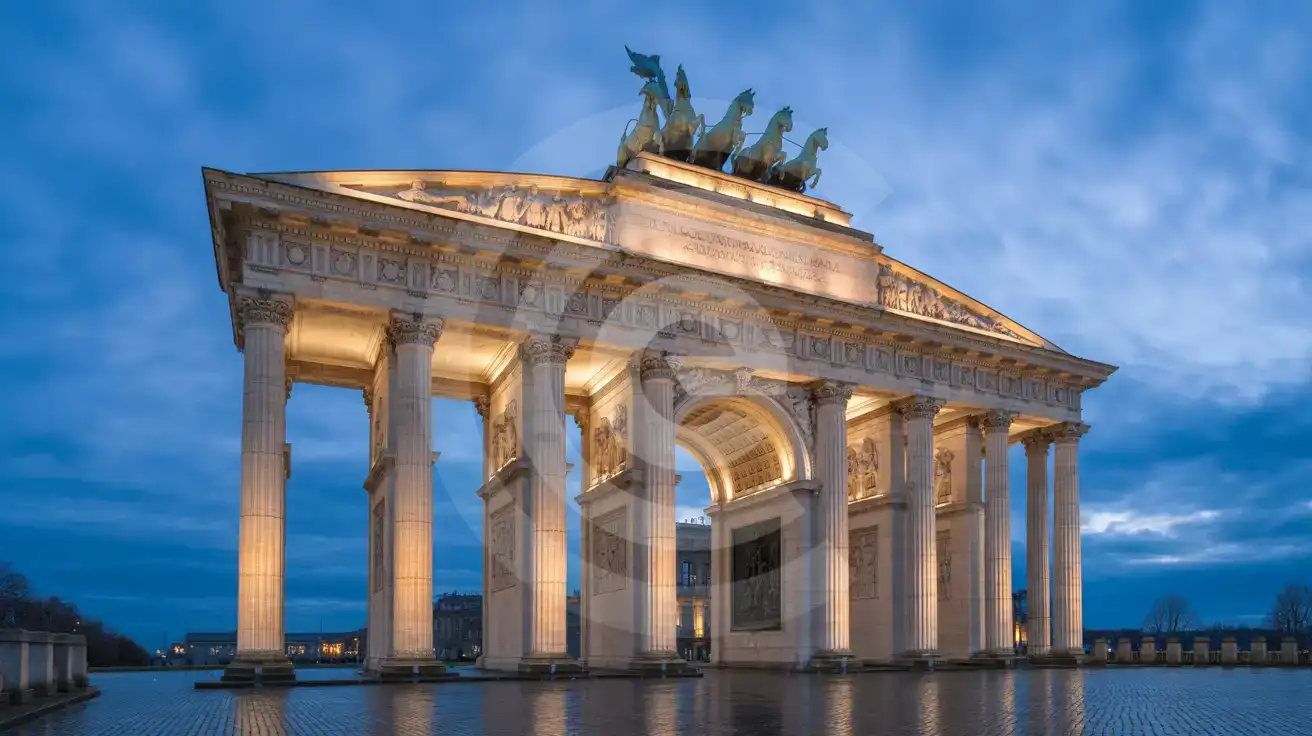
Brandenburg Gate at Blue Hour
Compare WiFi Options at Brandenburg Gate
 Recommended Recommended | Local SIM / Operator | Roaming | |
|---|---|---|---|
| FEATURES | |||
| Setup time | Few minutes | Store visit + paperwork | Auto |
| No local ID needed | Online checkout | Local ID required | Use home account |
| Speed | 4G/LTE; 5G in some areas | Carrier-grade | Partner-dependent |
| Travel support | English support 24/7 | Operator shops and call centre | Home carrier hours |
| Keep home number | Dual SIM | Replaces it | Same number |
| Cost predictability | Fixed price | Bills can spike | Bill-shock risk |
| PRICING | |||
Typical pricing | See plans below | — | — |
PRICING — PICK YOUR ESIMNO PLAN
Featured eSIM plans
German Mobile

German Mobile
German Mobile
German Mobile
German Mobile
German Mobile
German Mobile
German Mobile


