
Quick Facts
- Address
- Bernauer Strasse 111-119, 13355 Berlin
- Visitor Center Hours
- Tue–Sun 10:00–18:00, closed Mondays
- Documentation Center
- Tue–Sun 10:00–18:00, observation tower included
- Outdoor Grounds
- Open 24 hours daily, always accessible
- Admission
- Free (all areas including tower)
- Guided Tours
- €3–5 per person, booking recommended
- Audio Guide
- Available for rental at Visitor Center
- Nearest S-Bahn
- Nordbahnhof (S1, S2, S25, S26)
- Nearest U-Bahn
- Bernauer Strasse (U8)
- Tram Lines
- M10, 12 — stops along Bernauer Strasse
- Memorial Length
- 1.4 kilometres along Bernauer Strasse
- Official Website
- berliner-mauer-gedenkstaette.de
- eSIMno Networks
- O2, T-Mobile, Vodafone
About the Berlin Wall Memorial
The Berlin Wall Memorial — Gedenkstätte Berliner Mauer in German — stands as the central German memorial site dedicated to the division of Berlin and the victims of communist tyranny. It stretches along approximately 1.4 kilometres of Bernauer Strasse in the Mitte and Wedding districts, occupying what was once the most dramatic section of the border between East and West Berlin. This is not a reconstruction. This is where the Wall actually stood, where people actually died, and where the border fortifications remain in their original configuration.
The Wall's Construction and Bernauer Strasse's Significance
The Berlin Wall went up beginning on August 13, 1961, when East German forces sealed off West Berlin from surrounding East Germany with barbed wire and armed guards. Within days, concrete blocks began replacing the wire. The division would last 28 years, two months, and 27 days.
Bernauer Strasse became instantly iconic. The street itself lay in West Berlin, but the apartment buildings on its southern side belonged to the East. This peculiarity of post-war administrative boundaries meant that East Berliners could — for a brief, terrifying window — escape simply by jumping from their windows onto the western pavement below. The photographs of those early days are searing: elderly women lowered on ropes by firefighters, families leaping into nets held by West Berlin fire brigades, a young man named Conrad Schumann vaulting over barbed wire in what became one of the Cold War's defining images.
The East German regime responded by bricking up the windows, then evacuating the buildings entirely, then demolishing them to create a clear firing zone. The death strip was born.
Deaths at the Wall
Ida Siekmann became the first confirmed fatality at the Berlin Wall on August 22, 1961, just nine days after construction began. She jumped from her third-floor apartment at Bernauer Strasse 48 and died from her injuries. Over the following decades, at least 140 people would die attempting to cross the Berlin Wall — shot by border guards, drowned in waterways, fallen from heights, or killed in other escape attempts. The exact number remains disputed, with some researchers counting additional deaths from related causes.
Bernauer Strasse witnessed some of the most audacious escape attempts. Tunnel 57, dug in 1964, ran from a disused bakery in the West to a courtyard privy in the East and successfully brought 57 people to freedom before being discovered. Tunnel 29, completed in 1962, was famously documented by NBC camera crews who filmed refugees emerging into the basement at Bernauer Strasse 78.
The Memorial's Establishment
After the Wall fell on November 9, 1989, most of its 155 kilometres were demolished with remarkable speed — Berliners attacked it with hammers, and construction crews finished the job. But a coalition of historians, politicians, and citizens recognized that some authentic sections needed preservation.
The memorial complex was officially established in 1998. Stuttgart-based architects Kohlhoff & Kohlhoff designed the central Monument to the Memory of the Divided City and the Victims of Communist Tyranny, which was inaugurated that year. The Documentation Center followed in 1999. Between 2009 and 2014, timed to the 20th and 25th anniversaries of the Wall's fall, the open-air exhibition underwent significant expansion to its current form.
Today, the Berlin Wall Memorial is administered by the Berlin Wall Foundation (Stiftung Berliner Mauer) and holds the designation of a national memorial of the Federal Republic of Germany. It receives approximately one million visitors annually — not as many as the Reichstag or Brandenburg Gate, but far more than any other authentic Cold War site in the city.
Highlights and Must-See Sites
The Berlin Wall Memorial unfolds along Bernauer Strasse in four thematic sections, each with distinct structures, exhibitions, and commemorative elements. Walking the full 1.4 kilometres takes you from abstract monument to visceral evidence of the border's human cost.
The Monument at Bernauer Strasse (Kohlhoff & Kohlhoff)
Located between Ackerstrasse and Bergstrasse, this is the memorial's symbolic centerpiece. Two polished steel walls, 70 metres long and several metres high, frame a preserved section of the original border strip. The steel is mirrored on the inside, preventing visitors from seeing past the segment — you cannot look through to the other side, evoking the impossibility of crossing that defined the Wall's existence. The narrow corridor between the steel walls feels deliberately claustrophobic. Many visitors find it the most emotionally affecting point on the site, despite — or because of — its abstraction.
The Window of Remembrance (Fenster des Gedenkens)
Near the Chapel of Reconciliation, a weathering steel wall displays small portrait photographs of those who died at the Berlin Wall. Each portrait measures roughly the size of a passport photo, each name accompanied by birth and death dates. The images include young men shot while swimming across canals, families who died in escape vehicles, and individuals whose deaths remained unacknowledged by the East German state for decades. The German inscriptions are brief, but the cumulative effect of seeing face after face is overwhelming. This is where visitors often linger longest.
The Documentation Center and Observation Tower
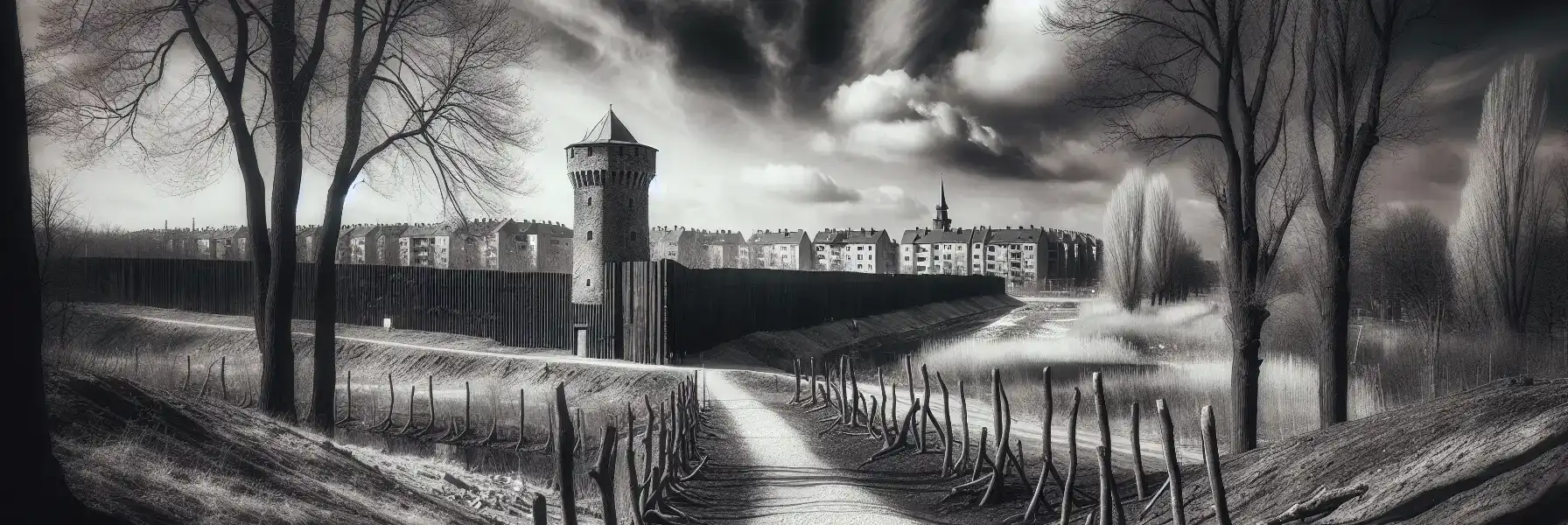
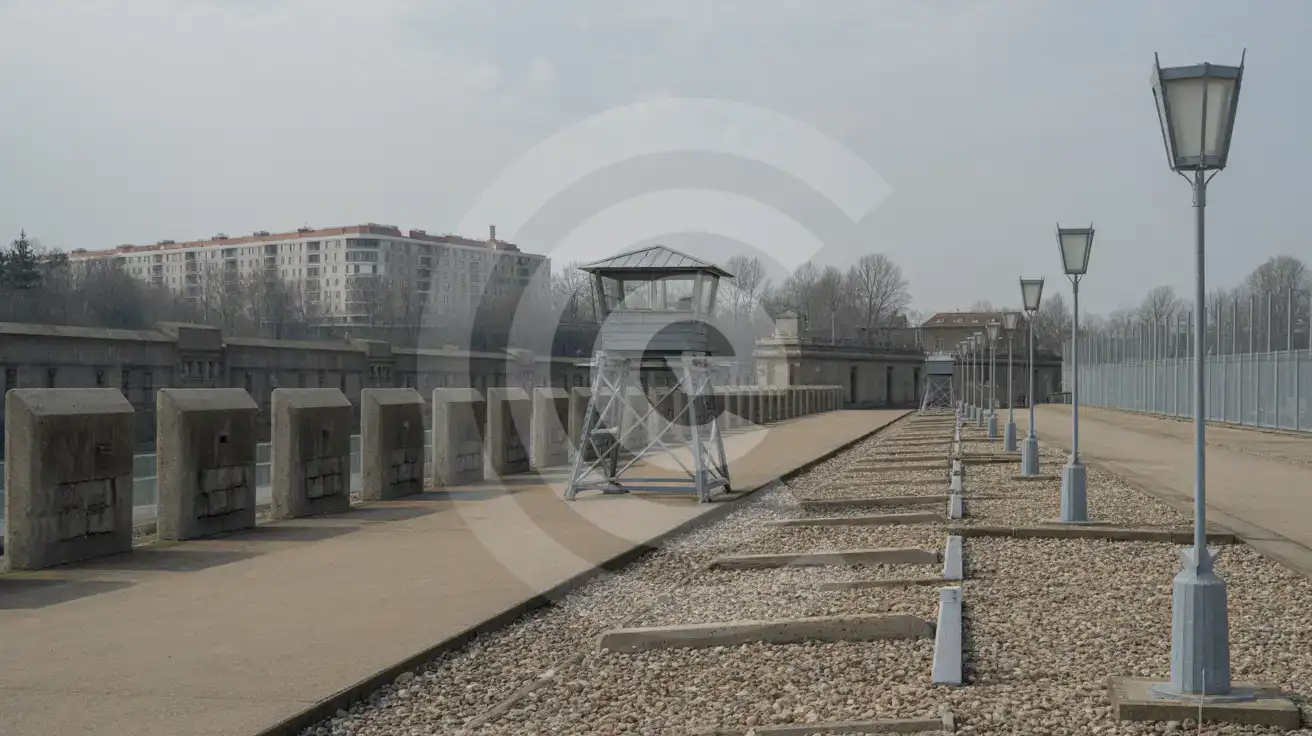
At Bernauer Strasse 119, directly opposite the preserved border strip, the Documentation Center houses the memorial's permanent exhibition across multiple floors. The displays combine archival photographs, documents, personal objects, and filmed testimonies with clear English translations throughout. But the building's most powerful feature is its rooftop observation platform — the only elevated public vantage point that looks directly down into a complete section of the death strip. From here, you see the outer wall, the patrol road, the lamp posts, the raked sand designed to show footprints, and the surviving GDR watchtower. The perspective makes visceral what ground-level walking cannot: the depth of the fortifications, the calculated impossibility of crossing unseen.
The Chapel of Reconciliation (Kapelle der Versöhnung)
The original Church of Reconciliation, a 19th-century neo-Gothic structure, stood in what became the death strip after 1961. For 24 years, it remained trapped in no-man's-land — visible to both sides, accessible to neither, its bells silenced. In January 1985, the East German regime demolished it with explosives, citing it as an obstacle to border security. The act was broadcast on West German television.
The present Chapel of Reconciliation, completed in 2000 by architects Reitermann and Sassenroth, stands on the original church's foundations. Built of rammed earth — layers of clay compressed between wooden forms — it is an oval structure of deliberate simplicity. The original church bells hang in a freestanding wooden tower beside it. Services are held regularly, and a short daily prayer commemorates victims of the Wall by name. Even for secular visitors, the space carries weight.
The Preserved Border Strip
The memorial preserves the only remaining section of the Berlin Wall that retains the full depth of the border fortifications as they existed in the 1980s. This includes:
- The outer wall — the concrete segments topped with pipe (Grenzmauer 75 type) that faced West Berlin
- The death strip — the cleared zone of raked sand and patrol road
- The signal fence — which triggered alarms if touched
- The lamp posts — designed to illuminate the strip at night
- The watchtower — a preserved GDR Beobachtungsturm from which guards monitored the zone
- Traces of the inner wall — which faced East Berlin
Walking through this section, you are literally standing in the former death strip. The ground markers indicate the footprints of demolished buildings.
The Open-Air Exhibition
A continuous outdoor exhibition runs the length of Bernauer Strasse, divided into four thematic areas: the construction of the Wall, the destruction of the city, the building of the border fortifications, and everyday life with the Wall. Steel information panels, listening stations with archived audio, ground-level markings showing the outlines of demolished houses, and archival photographs mounted at eye level create a walking timeline of the division. Notable stops include the marked locations of Tunnel 57 and Tunnel 29, escape tunnel shafts visible through glass panels set into the pavement.
The Visitor Center
At Bernauer Strasse 119, the Visitor Center serves as the orientation point for most arrivals. Two short documentary films — "The Berlin Wall" and "Walled In!" — screen on rotation in multiple languages. A bookshop stocks historical texts, memoirs, and photographic collections. Information desks can arrange guided tours and answer questions about specific individuals commemorated at the site. This is also where audio guides are available for rental.
The Nordbahnhof Ghost Station Exhibition
Technically part of the memorial complex, the small exhibition inside Nordbahnhof S-Bahn station documents the phenomenon of "ghost stations" — East Berlin stations that western trains passed through without stopping during the division. Nordbahnhof itself was one of these Geisterbahnhöfe. Photographs show the platforms sealed off, guards patrolling to prevent escapes, and the eerie sight of Western passengers glimpsing the abandoned stations through train windows. The exhibition is free and accessible during station operating hours.
Visit Strategy
The Berlin Wall Memorial rewards thoughtful planning. Its 1.4-kilometre length, outdoor exposure, and multiple buildings mean that a rushed visit misses much of what makes this site significant.
Recommended Duration
Plan for a minimum of two hours if you intend to walk the full memorial, visit the Documentation Center and observation tower, and pause at the Window of Remembrance and Chapel of Reconciliation. Three hours allows time to watch the introductory films at the Visitor Center, use the listening stations throughout the open-air exhibition, and sit in the chapel during a commemorative prayer. Half a day is appropriate for visitors with deep interest in Cold War history who want to read every panel, listen to every audio station, and explore the Nordbahnhof ghost station exhibition.
Best Time to Visit
Early morning, around 10:00 when the Documentation Center opens, brings the smallest crowds — particularly on weekdays outside of German school holidays. The observation tower is most powerful with few other visitors; the silence above the death strip carries meaning.
Late afternoon light, especially in autumn and spring, creates excellent conditions for photography. The steel monument reflects warm tones beautifully, and the watchtower casts long shadows across the patrol road.
Two dates bring significant crowds: November 9 (anniversary of the Wall's fall, 1989) and August 13 (anniversary of construction, 1961). Commemorative ceremonies are held on these days, often attended by survivors, victims' families, and political figures. The atmosphere is solemn and meaningful, but expect limited access to certain areas and longer waits at the Documentation Center.
Weather Considerations
The memorial is almost entirely outdoors. Berlin winters can be bitterly cold, with temperatures regularly dropping below freezing from December through February. Wind whips along the exposed streetscape. Dress in layers, wear sturdy shoes, and be prepared for grey skies. Summer brings warmth but also peak tourist season and occasional afternoon thunderstorms.
Spring (April–May) and early autumn (September–October) offer the most comfortable conditions: moderate temperatures, manageable crowds, and foliage that softens the industrial edges of the site.
Ticket Strategy
There is no ticket to buy. Everything — the outdoor memorial, the Documentation Center, the observation tower, the Visitor Center films, the Chapel of Reconciliation — is free of charge. This is a deliberate policy; the Berlin Wall Foundation believes that access to this history should have no financial barrier.
Guided tours in German and English are offered for €3–5 per person and should be booked in advance through the memorial's official website, especially for groups or during peak season. Audio guides are available for rental at the Visitor Center for a small fee and provide deeper context at numbered stops along the route.
Accessibility
The outdoor memorial is fully wheelchair accessible, with paved paths running the length of Bernauer Strasse. The Documentation Center has an elevator to the observation platform. The Chapel of Reconciliation is accessible at ground level. Listening stations are at varying heights, and the permanent exhibition includes tactile elements for visitors with visual impairments.
Photography Rules
Photography is permitted throughout the outdoor grounds and inside the Documentation Center. Visitors are asked to be respectful at the Window of Remembrance — this is a place of mourning, not a selfie backdrop. Inside the Chapel of Reconciliation, photography is discouraged during services; check the posted schedule.
Tripods are generally permitted on the outdoor grounds but may be restricted during special events or ceremonies. Drone photography is prohibited.
Crowd Avoidance
The memorial sees its highest visitor numbers between 11:00 and 15:00, when organized tour groups arrive. The observation tower can feel crowded during this window. If you visit in the afternoon, consider starting at the western end (Bernauer Strasse U-Bahn station) and walking east against the typical flow; most visitors begin at Nordbahnhof.
The Chapel of Reconciliation is quietest during the first hour after the Documentation Center opens. The commemorative prayer service held daily at noon draws a small, reverent crowd — attending adds meaning, but the chapel is less contemplative during this time.
Site Walk-Through and Photographer's Guide
Walking the Berlin Wall Memorial benefits from a deliberate sequence — one that accounts for crowd patterns, lighting conditions, and the emotional arc the site architects intended.
Recommended Walk Sequence
Begin at Nordbahnhof S-Bahn station (S1, S2, S25, S26). Before exiting to the street, explore the ghost station exhibition in the station hall — it sets historical context for what you're about to see. The photographs of sealed platforms and patrolling guards prepare you for the physical remnants outside.
Exit onto Bernauer Strasse and turn right (west). The memorial unfolds in four sections over the next 1.4 kilometres:
- Section A (eastern end): The Wall and Death Strip — this is where the most complete preserved fortifications stand, visible from street level and from the Documentation Center above
- Section B: The Destruction of the City — ground markers indicate demolished buildings, with photographs showing what stood before
- Section C: The Building of the Wall — focusing on the fortification system's evolution from wire to concrete
- Section D (western end): Everyday Life with the Wall — including escape tunnels and personal stories
This east-to-west sequence follows the memorial's intended narrative flow. It also means you climb the observation tower early, when morning light illuminates the death strip from the east and crowds are thinnest.
Key Structures to Spend Time At
1. The Documentation Center observation platform: This is the single most important vantage point on the site. Take the elevator to the rooftop and stand at the railing. Below you is the death strip in its full depth — outer wall, patrol road, lamp posts, watchtower. No photograph fully captures the scale; you need to see it from above. Spend at least 10 minutes here.
2. The Kohlhoff & Kohlhoff steel monument: Walk between the mirrored steel walls slowly. The reflection creates disorientation; you cannot see through to the other side. The architects designed this to evoke the psychological experience of the Wall, not just its physical presence.
3. The Window of Remembrance: Approach slowly. Read the names. Look at the faces. These are not abstractions. Egon Schultz was 21 when he was shot — likely by friendly fire during a tunnel escape operation. Chris Gueffroy was 20 when he became the last person shot at the Wall, in February 1989, just nine months before it fell.
4. The Chapel of Reconciliation: Sit in the pews. The rammed-earth walls have a particular quality of silence. Even if you're not religious, the space rewards stillness. The original church bells are visible in the wooden tower outside — they survived the 1985 demolition because they had already been removed.
5. The escape tunnel markers: In Section D, glass panels set into the pavement reveal the shafts of Tunnel 57 and Tunnel 29. The tunnels themselves are filled, but the markers show their entry points. Standing above them, knowing 57 people crawled through darkness below your feet, carries weight.
6. The preserved watchtower: The GDR Beobachtungsturm is one of very few surviving watchtowers in Berlin. You cannot enter it, but you can stand directly beneath it and imagine the perspective of the guards — trained to shoot anyone in the death strip.
Best Photo Spots and Lighting Times
Morning (golden hour to 11:00): The observation platform catches eastern light beautifully. The death strip's textures — concrete, gravel, rusted metal — photograph best in soft, directional light. The steel monument's reflections are least harsh.
Late afternoon (16:00–sunset): The watchtower casts long shadows across the patrol road. The Window of Remembrance's portraits are front-lit and easier to photograph without glare. The Chapel of Reconciliation's rammed-earth walls glow warm amber.
Overcast days: Actually excellent for documentary-style photography. The site's grey tones — concrete, steel, weathered wood — harmonize with flat light. Harsh shadows disappear, making the information panels easier to read in photographs.
Specific compositions worth seeking:
- From the observation platform: wide shot down the full length of the preserved death strip, watchtower in frame
- At the steel monument: the narrow corridor between the two walls, shooting toward the light
- The Chapel of Reconciliation: exterior shot with the wooden bell tower, afternoon light
- Tunnel markers: low-angle shot through the glass panels, showing depth
Restoration and Excavation Status
The memorial undergoes continuous conservation work, though closures are rare and usually limited to specific structures. The concrete segments of the Grenzmauer 75 outer wall receive periodic weathering treatment to prevent further deterioration. The watchtower has been stabilized but is not open to the public due to structural concerns.
Archaeological work occasionally occurs in Section D, where tunnel shafts and building foundations are documented. These excavations are typically fenced off but visible from the walking path. The Berlin Wall Foundation maintains an active research program, and new findings occasionally lead to updated exhibition panels.
Souvenirs and On-Site Shopping
The Visitor Center bookshop at Bernauer Strasse 119 stocks a thoughtful selection:
Worth buying:
- Historical photograph collections — especially those focusing on Bernauer Strasse specifically
- Academic texts on the border regime — the Foundation publishes several
- Memoirs of survivors and escapees — available in German and English
- The memorial's official guidebook — excellent for reference after your visit
Skip:
- Generic "Berlin Wall" merchandise with pieces of concrete — authenticity is impossible to verify, and the kitschification of this site undermines its purpose
- Cheap postcards and keychains — these are available cheaper elsewhere in Berlin
The memorial's approach to commerce is restrained. There are no vendors along Bernauer Strasse, no food stalls, no souvenir hawkers. This is intentional. The site is not Checkpoint Charlie.
Nearby Attractions and Logistics
The Berlin Wall Memorial sits in a part of the city where Cold War history, contemporary urban life, and creative energy overlap. Several significant sites lie within easy walking distance.
Mauerpark
About 10 minutes' walk east along Bernauer Strasse, Mauerpark occupies a former section of the death strip. The name means "Wall Park." A surviving stretch of the inner wall runs along its western edge, now serving as a legal graffiti surface — a deliberate contrast to the preserved, protected sections at the memorial.
On Sundays, Mauerpark hosts one of Berlin's largest flea markets, sprawling across the hillside with vintage clothing, vinyl records, antiques, and food stalls. The Bearpit amphitheater (Bearpit Karaoke) draws crowds for open-air karaoke sessions in summer — visitors grab a microphone and perform for hundreds of strangers. It's joyful and chaotic, a striking tonal shift from the memorial's solemnity.
Nordbahnhof Ghost Station Exhibition
At the eastern end of the memorial, inside the S-Bahn station itself. The permanent display documents the "ghost stations" phenomenon: East Berlin stations that Western trains passed through without stopping during the division. Photographs show sealed platforms, armed guards, and the eerie experience of Western passengers glimpsing forbidden territory through train windows. Free admission, accessible during station hours.
Museum für Naturkunde (Natural History Museum)
A 10–15 minute walk south on Invalidenstrasse. Home to the world's tallest mounted dinosaur skeleton — a Brachiosaurus brancai standing over 13 metres high — and the Berlin specimen of Archaeopteryx, one of the most important fossils in paleontological history. The museum's collection spans geology, zoology, and mineralogy. An excellent complement to the memorial for visitors traveling with children or seeking variety.
Hamburger Bahnhof – Nationalgalerie der Gegenwart
About 15 minutes' walk south, near the Hauptbahnhof. Berlin's primary contemporary art museum occupies a former railway terminus built in 1846. The permanent collection includes major works by Joseph Beuys, Anselm Kiefer, Andy Warhol, and Robert Rauschenberg. Temporary exhibitions rotate frequently. The building itself — a neoclassical station hall converted to white-walled gallery space — rewards architecture enthusiasts.
Suggested Day Itinerary
Begin at Nordbahnhof around 9:30 to view the ghost station exhibition before the memorial's indoor facilities open. Walk the full length of Bernauer Strasse westward, ascending the Documentation Center observation tower, pausing at the Window of Remembrance, and sitting briefly in the Chapel of Reconciliation. Allow 2–3 hours.
Continue to Mauerpark for lunch at one of the cafes along Eberswalder Strasse — or, on a Sunday, browse the flea market and catch the karaoke. In the afternoon, walk south to the Museum für Naturkunde or Hamburger Bahnhof depending on interest.
Finish the day with dinner in the lively Rosenthaler Platz or Kastanienallee area, both accessible by tram M1. These neighborhoods offer everything from traditional German restaurants to Vietnamese pho shops to natural wine bars.
Transit Connections
From Hauptbahnhof (Central Station): 15-minute walk, or S-Bahn S1/S2 one stop to Nordbahnhof.
From Alexanderplatz: U8 direct to Bernauer Strasse station (western end of memorial), approximately 8 minutes.
From Brandenburg Gate: S1 from Brandenburger Tor to Nordbahnhof, approximately 10 minutes.
From Potsdamer Platz: S1 to Nordbahnhof, approximately 12 minutes.
Tram lines M10 and 12 run directly along Bernauer Strasse with stops at Wolliner Strasse and Gedenkstätte Berliner Mauer.
Why Data Matters at the Berlin Wall Memorial
The Berlin Wall Memorial is built for contemplation, but mobile data transforms a meaningful visit into a deeply informed one. The memorial's audio guide app — available for download before you arrive — provides narration at numbered stops throughout the 1.4-kilometre route, including survivor testimonies and historical audio that the physical panels cannot deliver. Without data, you're limited to what you can read in person; with it, the voices of those who lived through the division walk alongside you.
Translation apps prove essential for visitors who don't read German fluently. While major exhibition texts include English, many smaller information panels, historical documents, and the names at the Window of Remembrance appear only in German. Real-time translation lets you understand what you're seeing without guesswork.
Navigation matters more than you might expect. The memorial spans 1.4 kilometres with no single entrance — visitors often arrive at Nordbahnhof, walk west, then need to find their way to Mauerpark, the Natural History Museum, or back to central Berlin. Offline maps work, but live transit data helps you catch the M10 tram at the right stop rather than walking an extra 500 metres.
An eSIMno plan connecting through O2, T-Mobile, or Vodafone gives you reliable coverage along the entire Bernauer Strasse corridor. You can activate it before your flight, skip the SIM card queues at Berlin airports, and have working data the moment you step off the S-Bahn at Nordbahnhof.
The Memorial at Bernauer Strasse
Compare WiFi Options at Berlin Wall Memorial
 Recommended Recommended | Local SIM / Operator | Roaming | |
|---|---|---|---|
| FEATURES | |||
| Setup time | Few minutes | Store visit + paperwork | Auto |
| No local ID needed | Online checkout | Local ID required | Use home account |
| Speed | 4G/LTE; 5G in some areas | Carrier-grade | Partner-dependent |
| Travel support | English support 24/7 | Operator shops and call centre | Home carrier hours |
| Keep home number | Dual SIM | Replaces it | Same number |
| Cost predictability | Fixed price | Bills can spike | Bill-shock risk |
| PRICING | |||
Typical pricing | See plans below | — | — |
PRICING — PICK YOUR ESIMNO PLAN
Featured eSIM plans
German Mobile

German Mobile
German Mobile
German Mobile
German Mobile
German Mobile
German Mobile
German Mobile


