
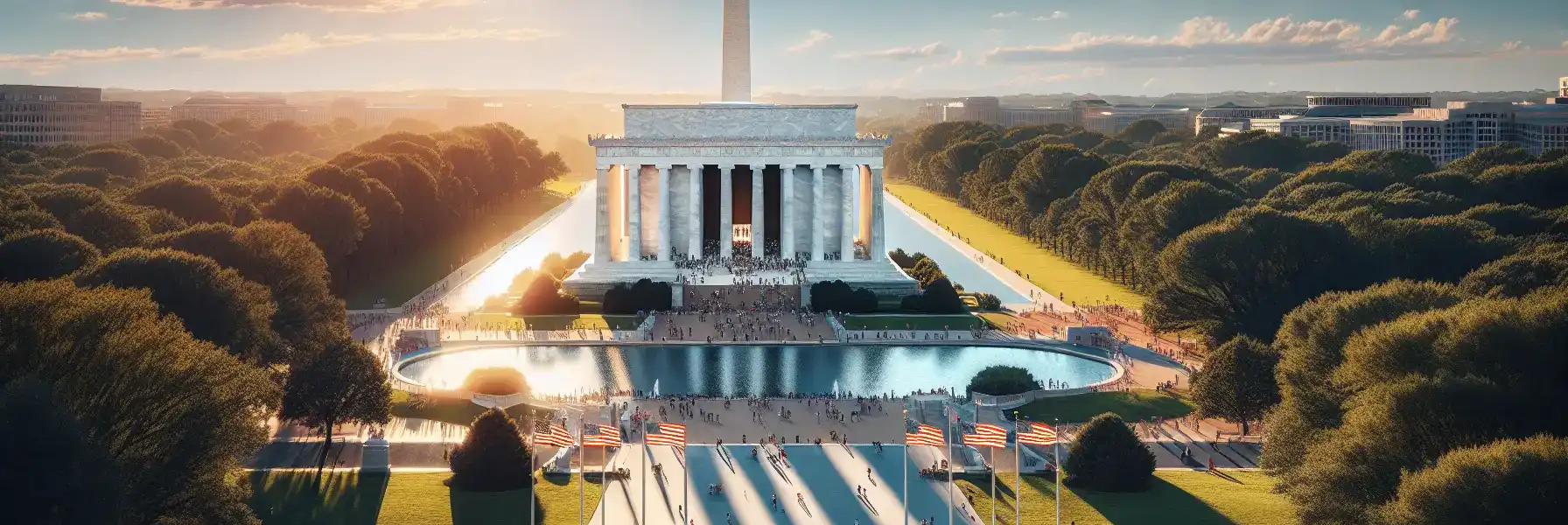
Quick Facts
- Address
- 2 15th St NW, Washington, DC 20024
- Hours
- 9:00 AM - 5:00 PM daily (extended summer hours)
- Admission
- Free (timed ticket required, $1 service fee online)
- Height
- 555 feet (169 meters)
- Nearest Metro
- Smithsonian Station (Blue, Orange, Silver lines)
- Elevator Ride
- 70 seconds to observation deck
- Closed
- Thanksgiving, Christmas, July 4th
- Official Site
- nps.gov/wamo
- Ticket Reservations
- Recreation.gov
- eSIMno Networks
- AT&T, T-Mobile, Verizon
About the Washington Monument
The Washington Monument stands as the world's tallest obelisk and the defining vertical element of the American capital's skyline — a 555-foot marble spire that took 36 years to complete and bears the visible scars of political turmoil, civil war, and financial collapse in its very stone.
Construction began on July 4, 1848, with a cornerstone ceremony attended by President James K. Polk, Speaker of the House Robert C. Winthrop, and a crowd of 20,000 spectators. The Washington National Monument Society, a private organization formed in 1833, had commissioned architect Robert Mills to design a fitting tribute to the first president. Mills' original vision was far more elaborate than what stands today: a 600-foot obelisk rising from a colonnaded circular building featuring a toga-clad statue of Washington driving a chariot. Budget constraints and engineering concerns stripped away the theatrical base, leaving only the pure Egyptian-inspired obelisk form.
The project crawled forward until 1854, when construction halted abruptly at the 150-foot mark. The causes were multiple: the anti-Catholic Know-Nothing Party had seized control of the Monument Society, donations dried up amid controversy, and the nation lurched toward civil war. For 23 years, the unfinished stump stood on the Mall — an embarrassment that Mark Twain described as looking like a 'factory chimney with the top broken off.'
Work resumed in 1877 under the U.S. Army Corps of Engineers, led by Lieutenant Colonel Thomas Lincoln Casey. The federal government took over funding, and Casey faced an immediate problem: the original Maryland marble quarry had been exhausted. New stone from a Massachusetts quarry was briefly used before Casey settled on marble from a different Maryland source. The result is permanently visible on the monument's exterior — a distinct color change approximately 150 feet up the shaft where the pale original marble gives way to slightly darker post-war stone. This geological seam has become one of the monument's most distinctive features, a literal timeline of American history carved into the structure itself.
The capstone was set on December 6, 1884, topped with a 100-ounce aluminum pyramid that was, at the time, more valuable than silver. The monument was dedicated on February 21, 1885 — George Washington's birthday — and opened to the public in 1888. At 555 feet 5⅛ inches, it was the tallest structure in the world until the Eiffel Tower surpassed it in 1889.
The National Park Service has administered the monument since 1933 as part of the National Mall and Memorial Parks. It holds National Historic Landmark status and remains the tallest structure in Washington, D.C., protected by the Height of Buildings Act of 1910, which ensures no building in the capital can challenge its dominance of the skyline. The monument has survived earthquakes (most significantly the 5.8-magnitude Virginia earthquake of August 2011, which caused 150 cracks and required three years of restoration), lightning strikes, and the weathering of over 130 Washington winters.
Highlights & Must-See Features
The Observation Level at 500 Feet
The elevator deposits visitors at the 500-foot observation level after a 70-second ascent that covers the monument's interior height in near-silence. Eight small windows — two facing each cardinal direction — frame views that extend up to 30 miles on clear days. The eastern windows look directly down the Mall's central axis toward the U.S. Capitol dome, with the Smithsonian museums lining both sides of the greensward. The western view captures the full length of the Reflecting Pool leading to the Lincoln Memorial, with Arlington National Cemetery's hillside visible beyond. North-facing windows frame the White House and Ellipse, while southern views sweep across the Tidal Basin to the Jefferson Memorial, with the Potomac River and Reagan National Airport's runways in the distance.
The Marble Color Change
No feature of the Washington Monument tells its story more eloquently than the visible color shift approximately one-third of the way up the shaft. Stand at the base and look up — or photograph from across the Reflecting Pool — and the transition is unmistakable. The lower section, built between 1848 and 1854, glows slightly warmer and lighter than the upper two-thirds completed between 1877 and 1884. This isn't weathering or staining; it's the geological fingerprint of two different quarries separated by a generation of American history. The original stone came from the Texas quarry in Baltimore County, Maryland. When construction resumed, that source was depleted, leading to a brief experiment with Lee marble from Massachusetts (visible as a slightly different band) before engineers settled on Cockeysville marble from a different Maryland deposit.
The 194 Commemorative Stones
Embedded in the interior walls of the monument are 194 memorial stones donated during the original construction period by U.S. states, foreign nations, cities, fraternal organizations, and private groups. Alabama's stone was the first installed, in 1849. Contributions came from the Cherokee Nation, the Swiss canton of Geneva, the Sultan of Turkey, and dozens of American cities and states. The Vatican's donated stone — a marble block from the Temple of Concord in Rome — was stolen in 1854 by Know-Nothing Party members and allegedly thrown into the Potomac River, an act that contributed to the construction halt. A replacement stone from Pope Pius IX was installed in 1982. While the slow-descent elevator ride that once allowed viewing of these stones is no longer offered, interpretive displays at the 490-foot museum level highlight several notable contributions.
The Aluminum Apex and Pyramidion
The monument's pointed top, called the pyramidion, terminates in a 100-ounce aluminum cap inscribed with the words 'Laus Deo' (Praise be to God) on its east face. In 1884, aluminum was a semi-precious metal — more expensive per ounce than silver — making this the largest single piece of cast aluminum in the world at that time. Before installation, the cap was displayed at Tiffany & Co. in New York City, where visitors could step over it and claim they had 'stepped over the top of the Washington Monument.' The cap also functions as a lightning rod, connected to grounding cables that run down the monument's interior.
The Museum Level at 490 Feet
Just below the observation deck, a small interpretive area displays historical artifacts and information about the monument's construction. Exhibits cover the engineering challenges of building on the Mall's marshy soil (the foundation extends 36 feet below ground level and contains 36,000 tons of stone), the competition between different marble sources, and the political upheaval that interrupted construction. A replica of the aluminum cap allows visitors to see the inscriptions that are impossible to view on the actual apex.
The Monument Grounds and Flag Circle
Fifty American flags encircle the monument's base, representing the fifty states. The flag circle provides some of the most accessible photography angles, particularly in morning light when the rising sun illuminates the monument's eastern face. The grounds also contain the Jefferson Pier marker stone (the original survey point intended as the monument's location before George Washington shifted it to more stable ground) and the Sylvan Theater, an outdoor performance space active during summer months.
Night Illumination
After sunset, the monument transforms under artificial lighting that creates a golden glow against the night sky. The illumination, maintained from dusk until 11:00 PM nightly, provides dramatically different photography opportunities than daytime visits. The Reflecting Pool doubles the visual effect on calm evenings, with the monument and its reflection creating a perfect vertical axis that photographers prize. Night visits don't allow observation deck access (the monument closes at 5:00 PM most of the year), but the exterior experience after dark rivals the interior experience during the day.
Visit Strategy: Timing, Tickets & Crowd Navigation
The Timed-Entry Ticket System
Entry to the Washington Monument is free, but access to the elevator and observation deck requires a timed-entry ticket. This system exists because the monument can only accommodate limited visitor flow — the elevator runs continuously, but the observation level has finite capacity. Two methods exist for obtaining tickets: advance online reservations and same-day distribution.
Advance tickets release through Recreation.gov approximately 30 days before the visit date, usually at 10:00 AM Eastern Time. During peak season (March through August) and around major holidays, tickets for popular time slots disappear within hours of release. A $1 service fee applies per ticket. The system allows reservations for specific 30-minute entry windows, and visitors must arrive within that window or forfeit their spot.
Same-day tickets are distributed at the Washington Monument Lodge, a small building near 15th Street NW, beginning at 8:45 AM daily. The supply is limited — typically a few hundred tickets for the entire day — and during peak season, visitors begin lining up before 7:00 AM. By 9:30 AM, same-day tickets are frequently exhausted. This option works best in winter months when visitor numbers drop significantly.
Best Time Slots
The first time slot of the day (usually 9:00 AM) offers the shortest interior wait times and the clearest air for distant views. Morning light also illuminates the eastern-facing windows most dramatically. Late afternoon slots (3:00-4:00 PM) catch warm golden light but tend to have longer waits as the day's visitors accumulate.
Avoid midday slots (11:00 AM - 2:00 PM) if possible — these see the heaviest traffic and the harshest lighting for photography. The observation windows face glare-heavy directions during peak sun hours.
Seasonal Considerations
Spring brings the National Cherry Blossom Festival (late March through mid-April), which increases National Mall visitor numbers by several hundred percent. The monument remains open during the festival, but advance tickets become essential — same-day distribution cannot accommodate festival crowds. The compensation is that Tidal Basin cherry trees are visible from the southern observation windows, creating a unique pink-rimmed view unavailable during other seasons.
Summer combines high tourist volume with Washington's notorious humidity. Haze reduces visibility from the observation deck; on particularly humid days, the Capitol dome appears gauzy rather than crisp. Extended evening hours (often until 10:00 PM during peak summer weeks) provide an alternative to midday crowds and occasionally coincide with clearer atmospheric conditions.
Fall delivers the most reliable combination of manageable crowds, comfortable weather, and clear views. October and November see significantly fewer visitors than summer months while maintaining full operating hours.
Winter offers the shortest lines and easiest same-day ticket access but carries higher risk of weather-related closures. High winds (sustained speeds over 30 mph or gusts over 45 mph) trigger closure of the observation deck. Snow and ice can close the monument grounds entirely. January and February are the quietest months.
Security Screening
All visitors pass through airport-style security screening at the monument's base before elevator access. Prohibited items include food, beverages (water bottles must be empty), large bags, backpacks exceeding 18x14x8 inches, and tripods. Small camera bags and purses are permitted. The security line moves efficiently under normal conditions (5-10 minutes) but can extend significantly during peak hours.
Photography Rules
Handheld photography and video recording are permitted both outside and from the observation level. Tripods are prohibited inside the monument. The small observation windows present challenges for wide-angle photography; smartphone cameras often perform better than larger cameras with wide lenses that struggle to get close enough to the glass. Window reflections can be minimized by cupping hands around the lens and pressing gently against the window surface.
Recommended Duration
Plan 45 minutes to one hour for the complete monument experience: security screening (10-15 minutes), elevator ascent (2 minutes), observation level viewing (20-30 minutes), museum level (5-10 minutes), and elevator descent (2 minutes). Add additional time for photographing the exterior and flag circle before or after your timed entry.
Site Walk-Through & Photographer's Guide
Recommended Walk Sequence
Approach the monument from the east, walking west along the National Mall from the Smithsonian Metro station. This route delivers the full ceremonial experience: the Capitol dome at your back, the Monument growing larger with each step, and the Lincoln Memorial visible in the distance beyond. Enter the monument grounds at 15th Street NW, where the Washington Monument Lodge (ticket kiosk) and security checkpoint are located on the north side of the grounds.
After your observation deck visit, exit and circle the monument clockwise. This sequence positions you for optimal afternoon light on the monument's western and southern faces, which photograph best from 2:00 PM onward. Continue south toward the World War II Memorial and Reflecting Pool for the most iconic distant shot — the monument reflected in the pool's surface with the Capitol dome behind it.
Key Structures to Spend Time At
The Flag Circle: Fifty flags create natural framing opportunities. Morning visitors find the eastern flags backlit; afternoon visitors get even illumination on the western arc. Stand inside the circle looking up for a vertigo-inducing perspective shot.
The Jefferson Pier Marker: This small stone marker south of the monument indicates the original intended location. The actual monument was shifted 390 feet east and 120 feet south because the original spot proved too marshy. The marker provides scale reference in wide shots.
The Sylvan Theater Site: The open lawn southwest of the monument hosts summer concerts and provides unobstructed southern views of the monument against open sky.
The World War II Memorial Plaza: Walk five minutes west to find the memorial's raised platform, which offers elevated views back toward the monument with the memorial's fountains in the foreground.
The Reflecting Pool Eastern End: The classic postcard shot. On windless mornings, the pool creates a near-perfect mirror reflection of the monument. Position yourself at the pool's eastern edge, centered on the monument, during the first two hours after sunrise.
Best Photo Spots & Lighting Times
Sunrise (6:00-7:30 AM): The Reflecting Pool delivers its best reflections in early morning calm before wind picks up. The monument's eastern face catches warm light while the western face remains in shadow, creating dimensional contrast.
Mid-Morning (9:00-10:30 AM): The flag circle photographs well with even lighting. The marble color change is most visible under diffused morning light from the northeast.
Golden Hour (5:30-7:00 PM summer, 4:00-5:30 PM winter): Warm light on the monument's western face creates the most dramatic color. Position yourself east of the monument, near Constitution Avenue, for direct golden illumination.
Blue Hour (30 minutes after sunset): The monument's illumination switches on at dusk. The 20-minute window when artificial light balances with fading natural light produces rich blue skies behind the lit monument.
Night (after 9:00 PM): Full darkness allows long-exposure photography of the illuminated monument. The Reflecting Pool shots require a tripod (permitted on the Mall grounds, just not inside the monument).
Restoration & Excavation Status
The monument underwent major restoration from 2011 to 2014 following earthquake damage, and again from 2016 to 2019 for elevator modernization. As of current operations, no major exterior work is ongoing, and the full monument is accessible. Periodic maintenance closures occur with short notice, particularly for elevator servicing — the single elevator serves as the only public access to the observation deck, so any mechanical issues result in full closure. Check the National Park Service website (nps.gov/wamo) on the morning of your visit to confirm operational status.
Souvenirs & On-Site Shopping
The Washington Monument Lodge contains a small National Park Service gift shop offering monument-specific merchandise: scale replica models (the better ones are pewter, around $25-40), commemorative coins, historical books about the construction, and standard NPS items like patches and pins. The shop also stocks the National Mall passport stamp for collectors. For broader D.C. souvenir shopping, the Smithsonian museum shops along the Mall offer significantly larger selections — the National Museum of American History gift shop, a 10-minute walk northeast, carries presidential and monument-themed items alongside its broader Americana collection. Skip the vendor carts on the Mall itself; quality is inconsistent and prices are inflated.
Nearby Attractions & Logistics
National Mall Memorials
The Washington Monument occupies the geographic center of the western Mall's memorial corridor. Walking west along the Reflecting Pool (20 minutes) brings you to the Lincoln Memorial, with the Korean War Veterans Memorial and Vietnam Veterans Memorial positioned along the southern edge of that route. The World War II Memorial sits at the Reflecting Pool's eastern end, a 5-minute walk from the monument grounds, featuring 56 granite pillars, twin Atlantic and Pacific pavilions, and the Freedom Wall's 4,048 gold stars.
South of the monument, the Tidal Basin (15-minute walk) hosts a concentration of presidential memorials: the Thomas Jefferson Memorial on the southern shore, the Franklin Delano Roosevelt Memorial on the western shore, and the Martin Luther King Jr. Memorial on the northwestern edge. During cherry blossom season, this loop becomes the most photographed stretch of the National Mall.
The White House & President's Park
A 10-minute walk north along 15th Street reaches the Ellipse and President's Park, with views of the White House South Lawn. The White House Visitor Center on Pennsylvania Avenue provides historical context without requiring the advance-reservation public tour. The National Christmas Tree stands on the Ellipse each December.
Smithsonian Museums
The National Mall's museum row extends east of the monument along both sides of the greensward. The National Museum of American History (10-minute walk) houses the original Star-Spangled Banner, presidential artifacts, and Julia Child's kitchen. The National Museum of Natural History (12-minute walk) anchors the north side with the Hope Diamond and dinosaur halls. The National Air and Space Museum (15-minute walk) reopened its west wing after renovation, featuring the Wright Flyer and Apollo 11 command module. All Smithsonian museums offer free admission.
Transit Options
Metro: Smithsonian Station (Blue, Orange, Silver lines) exits directly onto the Mall, a 10-minute walk to the monument. Federal Triangle Station (same lines) serves the north side of the Mall. During peak hours, trains run every 4-6 minutes.
DC Circulator: The National Mall route stops near the monument and connects major Mall sites with Union Station and Georgetown.
Walking Distances from the Monument: Lincoln Memorial (20 minutes), U.S. Capitol (25 minutes), White House (10 minutes), Jefferson Memorial (15 minutes), National Museum of American History (10 minutes).
Food & Dining
The immediate monument area lacks substantial dining options — a refreshment stand near the monument lodge sells drinks and packaged snacks. For proper meals, the Smithsonian museums contain cafeterias with varied options (the National Museum of the American Indian's Mitsitam Café, a 15-minute walk east, serves Native American cuisine from multiple tribal traditions). The Ronald Reagan Building food court (10-minute walk north) offers quick-service variety. For sit-down dining, the Penn Quarter neighborhood (15-minute walk northeast) clusters restaurants near the National Archives.
Suggested Day Itinerary
Start with a 9:00 AM timed entry to the Washington Monument for optimal visibility and minimal crowds. Descend and walk west to the World War II Memorial and Lincoln Memorial (allow 90 minutes total). Return via the Tidal Basin's southern path, visiting the Jefferson, FDR, and MLK memorials. Break for lunch at the National Museum of the American Indian. Afternoon: explore the National Museum of American History or National Air and Space Museum. Return to the monument grounds for golden-hour exterior photography before heading to dinner in Penn Quarter.
Why Data Matters at the Washington Monument
The National Mall stretches two miles between the Capitol and the Lincoln Memorial, and navigating it efficiently depends on mobile access at almost every step. Your Recreation.gov timed-entry ticket lives on your phone. Metro arrival times update in real-time through the WMATA app. The National Park Service website confirms whether today's high winds have closed the observation deck. And when you're standing at the Reflecting Pool trying to figure out whether the Jefferson Memorial or the World War II Memorial makes more sense as your next stop, a quick map check saves thirty minutes of backtracking.
Museum hours vary — the Smithsonians don't all open and close at the same time, and special exhibitions sometimes require timed passes that you'll want to check before walking twenty minutes in the wrong direction. Ride-share pickup points on the Mall are counterintuitive (Constitution Avenue access differs from Independence Avenue), and getting the location wrong means waiting in the sun while your driver circles the block.
An eSIMno plan for the United States connects through AT&T or T-Mobile — both networks provide strong coverage across the Mall and inside the monument's observation level. Activate before your flight lands at Dulles or Reagan National, and you step off the Metro at Smithsonian Station already connected, tickets loaded, and route mapped.
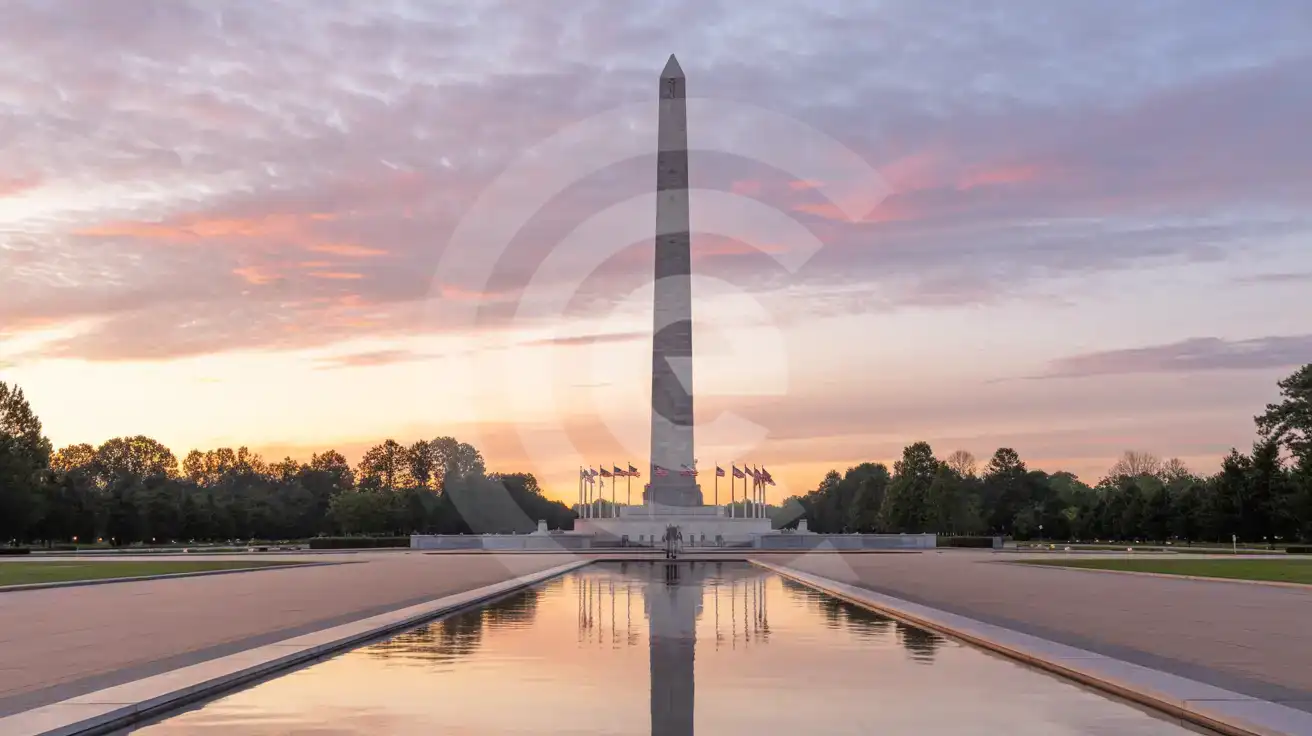
The Monument at Dawn
Compare WiFi Options at Washington Monument
 Recommended Recommended | Local SIM / Operator | Roaming | |
|---|---|---|---|
| FEATURES | |||
| Setup time | Few minutes | Store visit + paperwork | Auto |
| No local ID needed | Online checkout | Local ID required | Use home account |
| Speed | 4G/LTE; 5G in some areas | Carrier-grade | Partner-dependent |
| Travel support | English support 24/7 | Operator shops and call centre | Home carrier hours |
| Keep home number | Dual SIM | Replaces it | Same number |
| Cost predictability | Fixed price | Bills can spike | Bill-shock risk |
| PRICING | |||
Typical pricing | See plans below | — | — |
PRICING — PICK YOUR ESIMNO PLAN
Featured eSIM plans
American Mobile

American Mobile
American Mobile
American Mobile
American Mobile
American Mobile


