
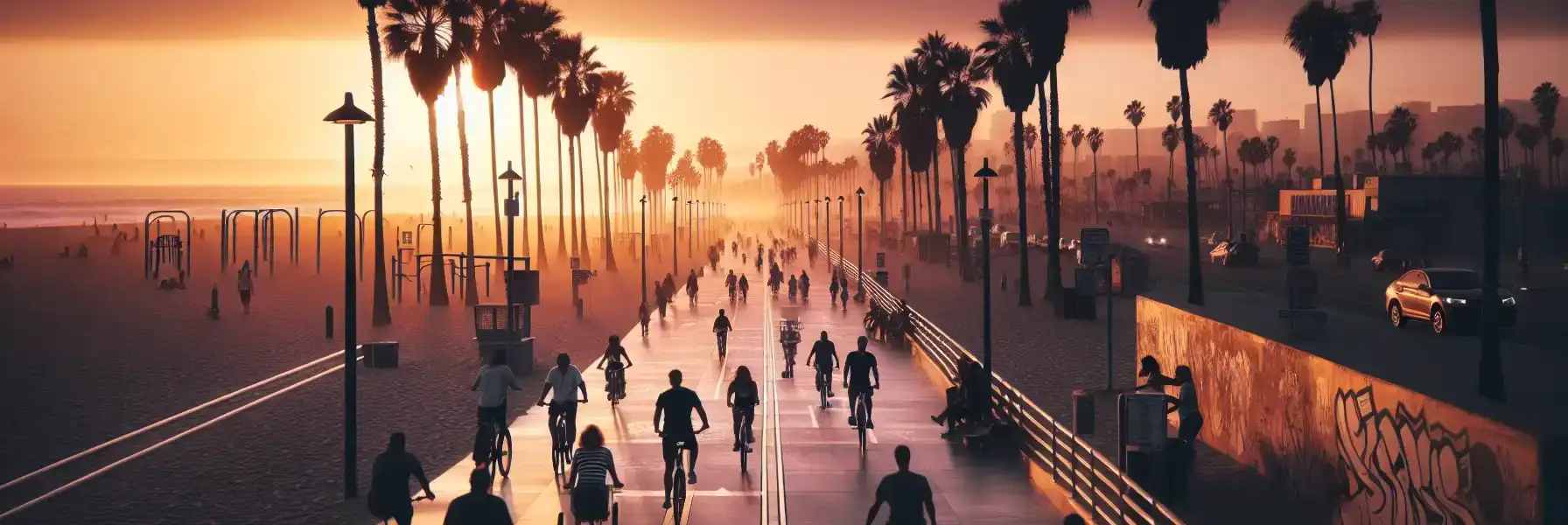
Quick Facts
- Location
- 15 miles west of Downtown LA, 6 miles south of Santa Monica
- Beach & Boardwalk Hours
- Daily 5:00 AM – midnight
- Admission
- Free (beach, boardwalk, skatepark, canals)
- Parking
- $10–20/day in lots; metered street parking available
- Nearest Metro Station
- Downtown Santa Monica (E Line) – 30-min walk or Bus 1
- Lifeguard Coverage
- Year-round; peak staffing Memorial Day – Labor Day
- Muscle Beach Day Pass
- ~$10
- Official Website
- beaches.lacounty.gov
- eSIMno Networks
- AT&T, T-Mobile, Verizon
About Venice Beach
Venice Beach exists because a tobacco millionaire named Abbot Kinney had a vision of recreating Italy on the Pacific. In 1905, he broke ground on what he called the 'Venice of America' — a planned community complete with 16 miles of gondola-navigated canals, Venetian colonnades along Windward Avenue, a pleasure pier, and imported Italian-style architecture designed to evoke the Adriatic on the edge of Los Angeles. For a few years, his vision flourished. Gondoliers in striped shirts poled tourists along canals while orchestras played on the pier.
Then came the automobile. By 1929, most of the canals had been paved over to make room for roads, and the neighborhood entered decades of transition. The remaining six waterways — Howland, Sherman, Linnie, Carroll, and the broader Eastern and Grand Canals — survived, eventually earning a spot on the National Register of Historic Places in 1982. The colonnades crumbled. The pier burned. And Venice, no longer a theme-park fantasy, became something more interesting: a refuge for artists, writers, surfers, and anyone who didn't fit the manicured Southern California mold.
The counterculture arrived in force during the 1950s and 60s, when beatniks and bohemians settled into cheap beachfront housing that real estate developers hadn't yet discovered. By the 1970s, Arnold Schwarzenegger and Lou Ferrigno were pumping iron at the outdoor weight pen at 1800 Ocean Front Walk — a gym-on-the-sand that had relocated from its original Santa Monica site in 1951 and would cement Venice's reputation as a bodybuilding mecca. The documentary Pumping Iron made the location famous worldwide.
Skateboarding emerged from the same concrete and asphalt landscape. The Zephyr Competition Team — better known as the Z-Boys — transformed empty swimming pools and sloped schoolyards into proving grounds for vertical skating, founding the Dogtown movement that spread globally. Venice's DNA is baked into skateboarding culture, and the 2009 opening of the Venice Skatepark at the foot of Windward Avenue brought that history full circle: two bowls, a snake run, and a street section built directly on the sand with the Pacific as backdrop.
Today, Venice operates under split jurisdiction. The beach itself falls under the Los Angeles County Department of Beaches and Harbors, while the boardwalk and adjacent parks belong to Los Angeles Recreation and Parks. The arrangement creates occasional bureaucratic quirks, but visitors experience a continuous 2.5-mile stretch of coastline: wide sandy beach, palm-lined bike paths, the signature boardwalk spectacle, and the Venice Pier at the southern end marking the Washington Boulevard boundary. Santa Monica Pier is visible to the north, and the Marvin Braude Bike Trail connects them along the Strand.
The boardwalk culture is what draws most first-time visitors. Ocean Front Walk runs 1.5 miles between Navy Street and Washington Boulevard, a pedestrian promenade where vendors sell everything from sunglasses to original artwork, street performers range from acrobats to the legendary Harry Perry (the turbaned electric guitarist on roller skates who has played here since the 1970s), and the Venice Public Art Walls display rotating graffiti murals that function as an open-air gallery. The energy is chaotic, occasionally uncomfortable, and utterly unlike any other beach experience in America.
Highlights & Must-See Spots
Ocean Front Walk (The Boardwalk)
This is the main event: 1.5 miles of pedestrian promenade running parallel to the sand between Navy Street and Washington Boulevard. The northern section near Windward Avenue concentrates the densest performer activity — chainsaw jugglers, breakdancers, musicians working for tips, and fortune tellers in makeshift booths. Vendors line both sides selling henna tattoos, handmade jewelry, vintage T-shirts, and artwork that ranges from tourist kitsch to genuinely impressive original pieces. The experience intensifies on weekends, particularly Saturday afternoons from 11:00 AM onward when the performer lineup hits full strength.
Muscle Beach Venice
The outdoor weight pen at 1800 Ocean Front Walk is where golden-era bodybuilding happened. Schwarzenegger, Ferrigno, Franco Columbu, and dozens of other competitors trained here through the 1970s and 80s, and the facility remains active today. LA Recreation and Parks operates the site, offering day passes for approximately $10 that let you lift alongside locals and visiting fitness enthusiasts under the open California sky. The adjacent viewing area lets spectators watch without paying — and on weekend afternoons, serious lifters put on impromptu shows that draw crowds. The equipment is dated, the setting is iconic, and the vibe feels like stepping into a documentary.
Venice Skatepark
Opened in 2009 after years of community advocacy, the 16,000-square-foot concrete park sits directly on the sand at the foot of Windward Avenue. The design includes two bowls (one shallow, one deep), a snake run, and a street section with rails and ledges. It's free, operates during beach hours, and consistently ranks among the most photogenic skateparks in the world — sunset sessions with the Pacific as backdrop have appeared in countless skateboard videos and Instagram feeds. Skill levels range from beginners on weekday mornings to professionals filming parts on weekend evenings. Non-skaters should know that the viewing areas offer excellent vantage points for photography.
Venice Public Art Walls
Legal graffiti has covered these beachfront walls since 1961, making them one of the longest-running outdoor street art galleries in the country. Located between Windward Avenue and 19th Avenue, the walls display rotating murals that change weekly — artists must register with Venice Public Art to secure space, and the quality ranges from amateur tags to museum-worthy pieces. The best photography happens during morning golden hour when side light picks up the texture of the concrete, or at sunset when warm light saturates the colors.
Venice Canals
Walk three blocks inland from the boardwalk chaos and you'll enter a different world entirely. The Venice Canal Historic District preserves six of Abbot Kinney's original waterways: Howland, Sherman, Linnie, Carroll, Eastern, and Grand Canals. Pedestrian paths line both banks, crossing via arched footbridges that have become popular photography spots. The residential cottages range from preserved craftsman bungalows to modern architectural statements, all reflected in the still water. The neighborhood is quiet and explicitly residential — no commercial vendors, no performers, no beachfront energy. December brings the annual holiday boat parade when residents decorate kayaks and paddleboards with lights. The walk from the boardwalk takes about 10 minutes; most visitors circuit the canals in 30-45 minutes.
Abbot Kinney Boulevard
One block inland from the beach, this mile-long stretch between Venice Boulevard and Main Street has evolved into one of LA's most distinctive shopping and dining corridors. GQ famously called it 'the coolest block in America,' and while that kind of hype invites skepticism, the concentration of independent businesses remains genuinely impressive. Gjelina at 1429 Abbot Kinney pioneered the farm-to-table approach that now dominates LA dining. Salt & Straw serves artisanal ice cream in flavors that rotate seasonally. Intelligentsia Coffee anchors the caffeine end. Boutiques like Burro, A+R, and General Admission stock curated goods that reflect local design sensibilities. The street works best as a late-morning or afternoon destination — shops typically open around 10:00 AM, and the brunch crowd peaks around 11:00 AM on weekends.
Venice Pier
The 1,310-foot concrete pier at the foot of Washington Boulevard marks the southern boundary of Venice Beach and offers fishing access (no license required), unobstructed sunset views, and a perspective on the coastline that most visitors miss. The original pier built during Abbot Kinney's era burned in 1920; the current structure dates to 1965. It's free, open during beach hours, and significantly less crowded than Santa Monica Pier to the north. Bring a jacket — ocean breezes intensify at the end of the pier, particularly after sunset.
The Drum Circle
Every Saturday and Sunday afternoon, weather permitting, an informal drum circle materializes near the intersection of Ocean Front Walk and Brooks Avenue. No formal organization exists — locals simply show up with djembes, congas, and percussion instruments, and the rhythm builds organically through the afternoon. Dancers join, spectators gather, and by sunset the scene can draw hundreds of participants and observers. The energy peaks around 5:00-7:00 PM in summer months.
Visit Strategy
Best Time to Visit
Venice Beach operates year-round, but the experience varies dramatically by season and hour. Late spring through early fall delivers the warmest weather and fullest boardwalk activity — lifeguard coverage peaks between Memorial Day and Labor Day, water temperatures reach the high 60s°F by midsummer, and the performer lineup hits maximum density. June brings 'June Gloom,' the marine layer that blankets coastal LA in morning fog, typically burning off by noon. July through September offers the clearest skies and longest days.
Winter months see lighter crowds but reduced vendor and performer presence. Water temperatures drop to the low 50s°F, making swimming uncomfortable for most visitors. The canals and Abbot Kinney Boulevard, however, work well year-round.
Time of Day
Golden hour photography — roughly 6:30-7:30 PM in summer, earlier in winter — delivers the best light for the graffiti walls, skatepark, and boardwalk portraits. Morning visits (before 10:00 AM) offer empty beaches, running and cycling without crowd navigation, and parking spaces that vanish by midday. The boardwalk spectacle builds through the afternoon and peaks on weekend days between 2:00 PM and sunset.
For swimming, midday hours offer the warmest water and fullest lifeguard coverage. For avoiding crowds entirely, weekday mornings between Tuesday and Thursday provide the quietest experience.
How Long to Spend
A thorough Venice Beach visit — boardwalk walk, skatepark viewing, canal circuit, Abbot Kinney lunch, pier sunset — takes 4-6 hours. Visitors focused primarily on the beach and boardwalk can accomplish a satisfying experience in 2-3 hours. Adding Marina del Rey or extending the bike trail to Santa Monica requires a full day.
Photography Rules
The beach, boardwalk, skatepark, and public art walls are all open for photography without restrictions. Street performers generally welcome documentation — they're working for tips and visibility — but asking before extended close-up shots is courteous. The canals are residential; photographing homes from public paths is legal, but entering private property or photographing through windows is not. Drone photography requires FAA clearance and is prohibited within 5 miles of LAX, which encompasses most of Venice Beach.
Ticket Strategy
Venice Beach is free. No tickets required for beach access, boardwalk walking, skatepark viewing, canal walks, or pier access. The only paid element is Muscle Beach, where a day pass runs approximately $10 through LA Recreation and Parks. Bike rentals along the boardwalk average $10-15 per hour; surfboard and paddleboard rentals run $20-30 per hour at beach-adjacent shops.
Crowd Avoidance
Summer weekends between 11:00 AM and 5:00 PM bring the densest crowds and worst parking. If visiting during this window, arrive before 9:00 AM to secure parking and experience the morning lull before the rush. Alternatively, arrive after 4:00 PM when the first wave of beachgoers departs but the sunset crowd hasn't yet materialized. Weekdays year-round offer dramatically lighter foot traffic — Tuesday and Wednesday mornings are particularly quiet. The canals remain calm regardless of boardwalk conditions; they're residential and rarely crowded.
Activities, Safety & Best Times
Water Activities
Venice Beach offers swimming, surfing, bodyboarding, paddleboarding, and kayaking along its 2.5-mile stretch. The surf break is beginner-friendly compared to more powerful Southern California spots — waves typically run 2-4 feet, with occasional larger swells during winter months. The sandy bottom and gradual slope make it relatively safe for novice surfers, though rip currents occur and deserve attention. Surfboard rentals run $20-30 per hour at shops along Windward Avenue and Washington Boulevard; paddleboard rentals average $25-35 per hour. Jay's Rentals and Venice Beach Surf & Skate are among the established operators.
The designated swimming zones sit between lifeguard towers, marked by flags during peak season. Water temperatures range from the low 50s°F in winter to the high 60s°F in summer — wetsuits are common even in July. Snorkeling exists but isn't particularly rewarding; visibility varies and marine life density doesn't compare to Southern California's kelp forest sites.
Kayak and paddleboard launching is easiest from the beach near the Venice Pier or from Marina del Rey's calmer waters immediately south. Jet ski rentals are not available directly at Venice Beach — Marina del Rey operators like Marina Boat Rentals offer jet ski access with hourly rates around $100-150.
Beach Clubs & Restaurants
Venice Beach lacks the formal beach club infrastructure found in Mediterranean or Caribbean destinations. The closest equivalent is High Rooftop Lounge at Hotel Erwin (1697 Pacific Avenue), which offers Pacific views, cocktails, and a rooftop scene that functions as an informal gathering spot for sunset drinks. The Waterfront at Venice Beach (205 Ocean Front Walk) serves American pub fare directly on the boardwalk. The Cow's End Café (34 Washington Boulevard) near the pier anchors the southern end with coffee and breakfast.
For serious dining, move one block inland to Abbot Kinney Boulevard. Gjelina (1429 Abbot Kinney) serves wood-fired pizzas and seasonal California cuisine in a rustic-industrial space — reservations recommended, particularly for dinner. Felix Trattoria (1023 Abbot Kinney) brings Roman-style pasta and natural wines. Salt & Straw handles dessert with rotating ice cream flavors that reflect seasonal California ingredients.
Best Time of Day & Year
Water temperature peaks in August and September, when afternoon readings occasionally touch 70°F. Morning swims are coldest due to overnight cooling. The clearest water typically follows periods of offshore winds (Santa Ana conditions), which push surface debris seaward and improve visibility.
Jellyfish are not a significant concern at Venice Beach — unlike East Coast or Gulf beaches, stinging jellies are rare along this stretch of Pacific coastline. Occasional moon jellies appear but don't deliver painful stings.
Crowd peaks occur Saturday and Sunday from 11:00 AM to 5:00 PM between Memorial Day and Labor Day. The boardwalk remains active through sunset during these periods, with performer energy concentrated in late afternoon. Weekday mornings offer the emptiest beach conditions. December through February sees the lightest overall visitation, though the boardwalk culture thins considerably during winter.
Lifeguard, Flag System & Safety
Los Angeles County Lifeguards staff towers along Venice Beach year-round, with expanded coverage from Memorial Day through Labor Day. Tower locations are spaced approximately every 500 feet along the active swimming zones. Flag systems indicate conditions: green flags mark calm water, yellow flags indicate moderate conditions requiring caution, and red flags warn of hazardous conditions where swimming is discouraged.
Rip currents are the primary water hazard. They typically form near structures (the pier, jetties) and in gaps between sandbars. If caught in a rip, swim parallel to shore rather than fighting the current directly. Lifeguards perform regular rescues during summer months — follow posted warnings and swim near staffed towers.
Sun exposure requires attention. Southern California UV intensity peaks between 10:00 AM and 4:00 PM, and the reflective sand amplifies exposure. Apply sunscreen before arrival and reapply after swimming. Shade structures are limited; bring your own umbrella if planning extended beach time.
Petty theft and property crime are realities at Venice Beach. Don't leave valuables unattended on the sand while swimming — use a waterproof pouch or designate a trusted companion to watch belongings. The boardwalk north of Windward Avenue has historically concentrated homeless encampments and occasional aggressive panhandling, though conditions fluctuate based on city enforcement cycles. Keep aware of your surroundings, particularly after dark; the LAPD Pacific Division patrols the area but nighttime boardwalk visits are not recommended.
Getting There & Parking
Venice Beach sits 15 miles west of Downtown LA and 6 miles south of Santa Monica. By car, take I-10 west to the Lincoln Boulevard exit, then follow Lincoln south to Venice Boulevard or Washington Boulevard for beach access.
Paid parking lots along Pacific Avenue and at Venice Boulevard charge approximately $10-20 for full-day parking. The lot at the intersection of Pacific and Venice Boulevard fills by 11:00 AM on summer weekends. Metered street parking exists throughout the residential streets east of Pacific Avenue — rates run $2-4 per hour with 2-hour limits in many zones. Bring quarters or download the ParkMobile app.
From LAX, the beach is approximately 6 miles north. Taxi or rideshare runs $20-30 and takes 15-25 minutes depending on traffic. Rideshare drop-off works best along Pacific Avenue rather than attempting to navigate the boardwalk-adjacent streets.
Public transit options include the Metro E Line (light rail) to Downtown Santa Monica station, then a 30-minute walk south along the Marvin Braude Bike Trail or Metro Bus 1 down Main Street. Base Metro fare is $1.75. Big Blue Bus Route 1 from Santa Monica also serves Venice directly with stops along Main Street.
Cyclists can access Venice via the Marvin Braude Bike Trail (the Strand), which connects the beach to Santa Monica, Manhattan Beach, and Redondo Beach in a continuous paved path. Bike rentals along the boardwalk run approximately $10-15 per hour.
Nearby Attractions & Logistics
Santa Monica Pier & Pacific Park
The landmark pier sits 1.5 miles north of Venice Beach along the continuous boardwalk path. Walk or bike via the Marvin Braude Trail in approximately 20-25 minutes. The 1922 carousel still operates, the solar-powered Pacific Wheel offers aerial views, and the western terminus of Route 66 is marked at the pier entrance. Pacific Park's rides and games add a classic American pier atmosphere. Crowds concentrate on weekends; weekday mornings offer quieter access.
Marina del Rey
Immediately south of Venice Beach past the Venice Pier and Ballona Channel, Marina del Rey holds the largest man-made small-craft harbor in North America with over 5,000 boat slips. Burton Chace Park offers green space with harbor views and hosts summer concert series. Fisherman's Village provides a waterfront promenade with restaurants and boutique shopping. Mother's Beach, located inside the marina, offers calmer, warmer water suited to families with small children — no surf, no rip currents, gentle entry. Sailing charters and harbor cruises depart from multiple marina locations.
Venice Canals to Abbot Kinney Connection
The canal district sits roughly three blocks inland from the boardwalk. After walking the pedestrian paths along Howland, Sherman, Linnie, and Carroll Canals, exit via Dell Avenue and walk north to Venice Boulevard, then east one block to reach the southern end of Abbot Kinney Boulevard. The full loop — boardwalk to canals to Abbot Kinney and back — takes approximately 2-3 hours at a leisurely pace with stops.
Transportation Logistics
Skip driving on summer weekends if possible. Parking lots fill by mid-morning, street meters require constant attention, and the Lincoln Boulevard / Washington Boulevard intersections gridlock during peak beach hours. Rideshare provides flexibility without parking hassle — drop-off zones along Pacific Avenue function smoothly. If driving, arrive before 9:00 AM or after 4:00 PM to improve lot availability.
The Metro E Line's Downtown Santa Monica terminus is the closest rail station. From there, Big Blue Bus Route 1 or Metro Bus 1 head south along Main Street with Venice stops. Alternatively, rent a bike at the Santa Monica station and ride the beachfront trail — the journey is flat, scenic, and takes approximately 15-20 minutes.
Dining Beyond the Boardwalk
The boardwalk itself offers limited food quality — hot dogs, churros, and forgettable fast food dominate the vendor scene. For actual meals, walk to Abbot Kinney Boulevard (Gjelina, Felix Trattoria, Gjusta bakery), Rose Avenue (The Butcher's Daughter, Great White), or Washington Boulevard near the pier (The Cow's End Café, Canal Club). Cash is useful for boardwalk vendors and street performers — many accept only cash or Venmo, and boardwalk ATMs charge fees of $5 or more.
Why Data Matters at Venice Beach
Venice Beach runs on spontaneity — the drum circle starts when enough drummers show up, the best street performer might be three blocks from where you're standing, and that taco truck everyone mentioned just moved to a different corner. Having working data means you can check real-time crowd reports, pull up the walking route from the boardwalk to the canals without wandering into residential dead ends, and summon a rideshare from Pacific Avenue when parking lot gridlock makes driving out impossible.
An eSIMno plan connects you to AT&T or T-Mobile towers the moment you land at LAX, six miles south. No hunting for WiFi at a boardwalk coffee shop, no paying $5 ATM fees to get cash for a vendor who doesn't take cards but does take Venmo. Your phone works for directions to Gjelina when the line is too long at your first choice, for translating with the henna artist from Morocco, and for posting that golden-hour skatepark shot before the light disappears.
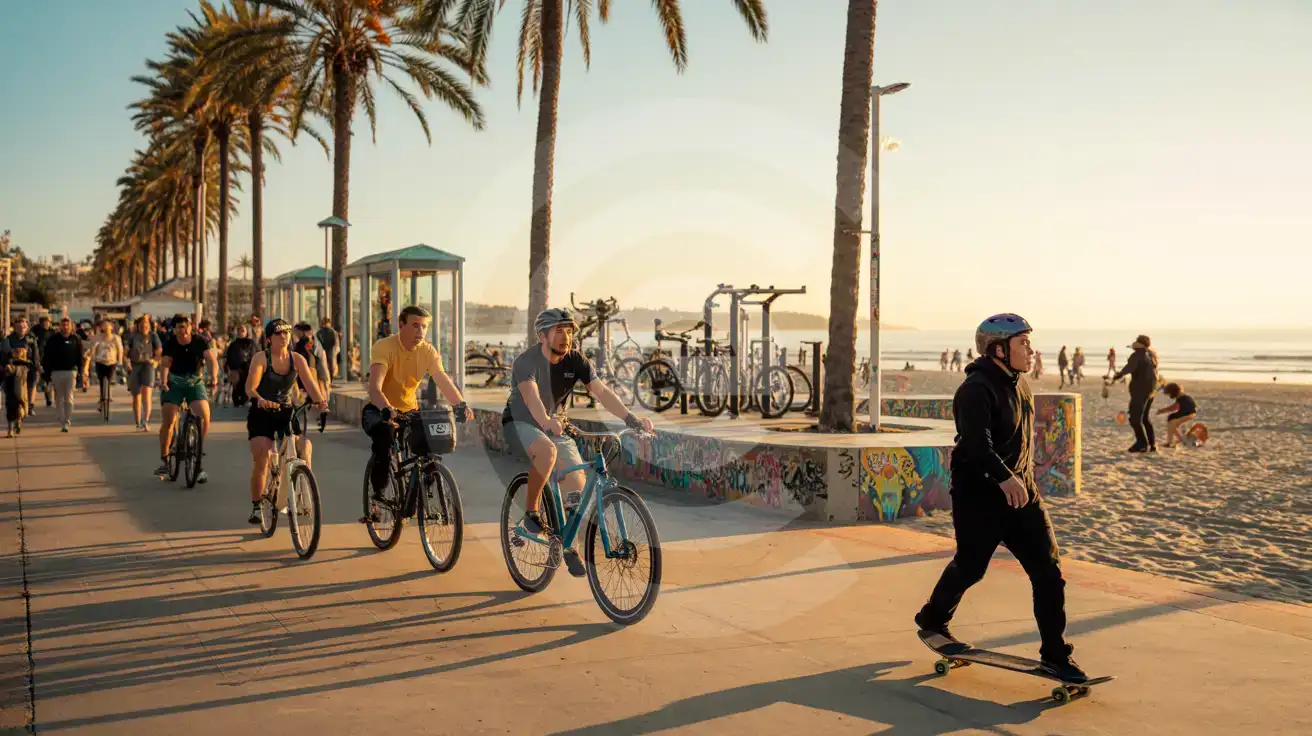
Venice Beach Boardwalk Scene
Compare WiFi Options at Venice Beach
 Recommended Recommended | Local SIM / Operator | Roaming | |
|---|---|---|---|
| FEATURES | |||
| Setup time | Few minutes | Store visit + paperwork | Auto |
| No local ID needed | Online checkout | Local ID required | Use home account |
| Speed | 4G/LTE; 5G in some areas | Carrier-grade | Partner-dependent |
| Travel support | English support 24/7 | Operator shops and call centre | Home carrier hours |
| Keep home number | Dual SIM | Replaces it | Same number |
| Cost predictability | Fixed price | Bills can spike | Bill-shock risk |
| PRICING | |||
Typical pricing | See plans below | — | — |
PRICING — PICK YOUR ESIMNO PLAN
Featured eSIM plans
American Mobile

American Mobile
American Mobile
American Mobile
American Mobile
American Mobile


