
Quick Facts
- Address
- Viale Vaticano, 00165 Vatican City
- Hours
- Mon-Sat 8:00-19:00 (last entry 17:00)
- Closed
- Sundays (except last Sunday of month), major Catholic holidays
- Standard Ticket
- €20 adult / €8 reduced
- Online Booking Fee
- ~€5 (strongly recommended)
- Nearest Metro
- Ottaviano-San Pietro (Line A)
- Walk from Metro
- 10 minutes
- Annual Visitors
- 6+ million
- Galleries
- 54
- Works on Display
- ~20,000 of 70,000 total
- Official Website
- museivaticani.va
- eSIMno Networks
- Vodafone, Wind Tre
About the Vatican Museums
The Vatican Museums trace their founding to a single acquisition: Pope Julius II's purchase of the Laocoön and His Sons in January 1506, mere weeks after the Hellenistic marble group emerged from a vineyard near Santa Maria Maggiore. The pope paid 4,040 ducats for the sculpture — roughly equivalent to a cardinal's annual income — and installed it in the Octagonal Court of the Belvedere Palace, where it remains today. That decision to display papal property for public view established the principle that would guide five centuries of collecting.
Julius II was building more than a collection. He had commissioned Michelangelo to paint the Sistine Chapel ceiling just two years later and hired Raphael to fresco his private apartments beginning in 1508. The artistic patronage that defines the Vatican Museums' holdings emerged from a single decade of papal ambition, concentrated between 1506 and 1520, when both Raphael and Julius II died within a year of each other.
Subsequent popes expanded the collections along different axes. Clement XIV and Pius VI created the Museo Pio-Clementino in the late 18th century, the neoclassical galleries that still house the Vatican's Greek and Roman antiquities. Gregory XVI established the Etruscan and Egyptian museums in the 1830s. Pius XI built the Pinacoteca in 1932 to display the painting collection separately from the archaeological holdings. The current entrance on Viale Vaticano, a spiral ramp designed to handle Jubilee Year crowds, opened in 2000.
The institutional complexity matters for understanding what you're visiting. The Vatican Museums are administered by the Holy See — the ecclesiastical jurisdiction of the Catholic Church in Rome — within Vatican City, the 44-hectare sovereign state established by the Lateran Treaty of 1929. The entire territory, including the museums, became a UNESCO World Heritage Site in 1984. The collections serve dual purposes: public museum and steward of papal ceremonial patrimony. The Sistine Chapel, the visit's traditional endpoint, remains an active liturgical space where the College of Cardinals elects new popes.
Scale makes navigation challenging. The standard visitor route covers approximately 7 kilometers of galleries, moving from the entrance atrium through classical sculpture, Egyptian and Etruscan antiquities, the Gallery of Tapestries, the Gallery of Maps, the Raphael Rooms, and finally the Sistine Chapel before exiting via Giuseppe Momo's 1932 double-helix staircase. At walking pace without stops, this takes roughly 90 minutes. With proper attention to major works, three to four hours represents a reasonable minimum.
Highlights and Must-See Works
The Sistine Chapel
Michelangelo's ceiling frescoes, painted between 1508 and 1512, cover approximately 5,000 square feet above a chapel built for Pope Sixtus IV in the 1470s. Nine scenes from Genesis run down the center, from the Separation of Light from Darkness above the altar to the Drunkenness of Noah near the entrance. The most famous panel — the Creation of Adam, where God's finger nearly touches Adam's — occupies a relatively small section near the center. Michelangelo returned 25 years later to paint the Last Judgment on the altar wall, completing it in 1541. Photography and conversation are forbidden inside; guards enforce silence with periodic announcements. The chapel functions as a transition point rather than a destination for lingering — most visitors spend 15 to 20 minutes before being directed toward the exit.
The Raphael Rooms (Stanze di Raffaello)
Four interconnected rooms on the second floor of the Apostolic Palace, frescoed by Raphael and his workshop between 1508 and 1524 for Pope Julius II. The Stanza della Segnatura, originally Julius's private library, contains the two works that established Raphael's reputation: The School of Athens on the east wall, depicting Plato, Aristotle, and 50 other philosophers beneath a barrel-vaulted Roman architecture, and the Disputation of the Holy Sacrament opposite, representing the Church Triumphant. The room's program — philosophy, theology, poetry, and law on four walls — exemplifies Renaissance humanism's synthesis of classical and Christian thought. The subsequent rooms show increasing workshop involvement as Raphael took on additional papal commissions before his death in 1520 at age 37.
The Laocoön Group
Displayed in the Octagonal Court of the Museo Pio-Clementino, exactly where Julius II placed it in 1506. The Hellenistic marble depicts the Trojan priest Laocoön and his sons being strangled by sea serpents sent by the gods — a scene described by Virgil in the Aeneid. The sculpture's twisted poses and agonized expressions directly influenced Michelangelo's figures on the Sistine ceiling and remained a touchstone for Baroque artists seeking to represent extreme emotional states. Pliny the Elder, writing in the 1st century AD, called it 'a work to be preferred to all that the arts of painting and sculpture have produced.'
The Apollo Belvedere
Housed near the Laocoön in the Octagonal Court, this Roman marble copy of a lost Greek bronze became the defining image of classical male beauty for Neoclassical artists. Johann Joachim Winckelmann, whose writings founded art history as a discipline, declared it 'the highest ideal of art among all the works of antiquity that have escaped destruction.' The statue shows Apollo immediately after releasing an arrow — a moment of calm following action that 18th-century aestheticians considered the apex of classical restraint.
The Gallery of Maps (Galleria delle Carte Geografiche)
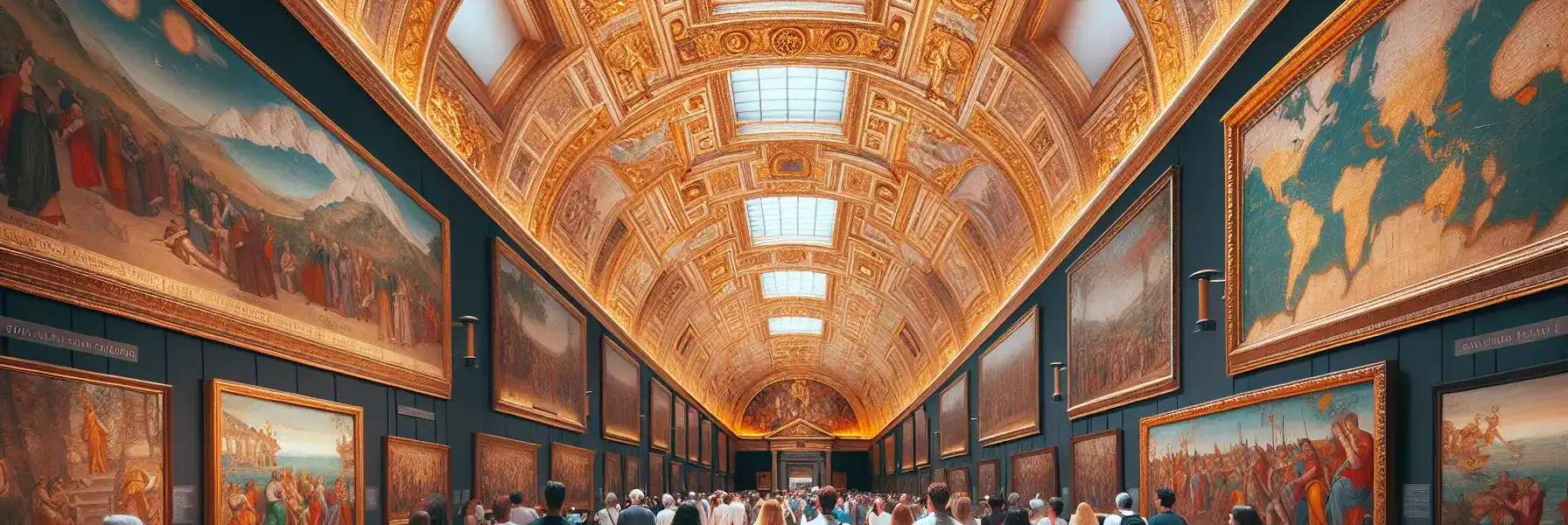
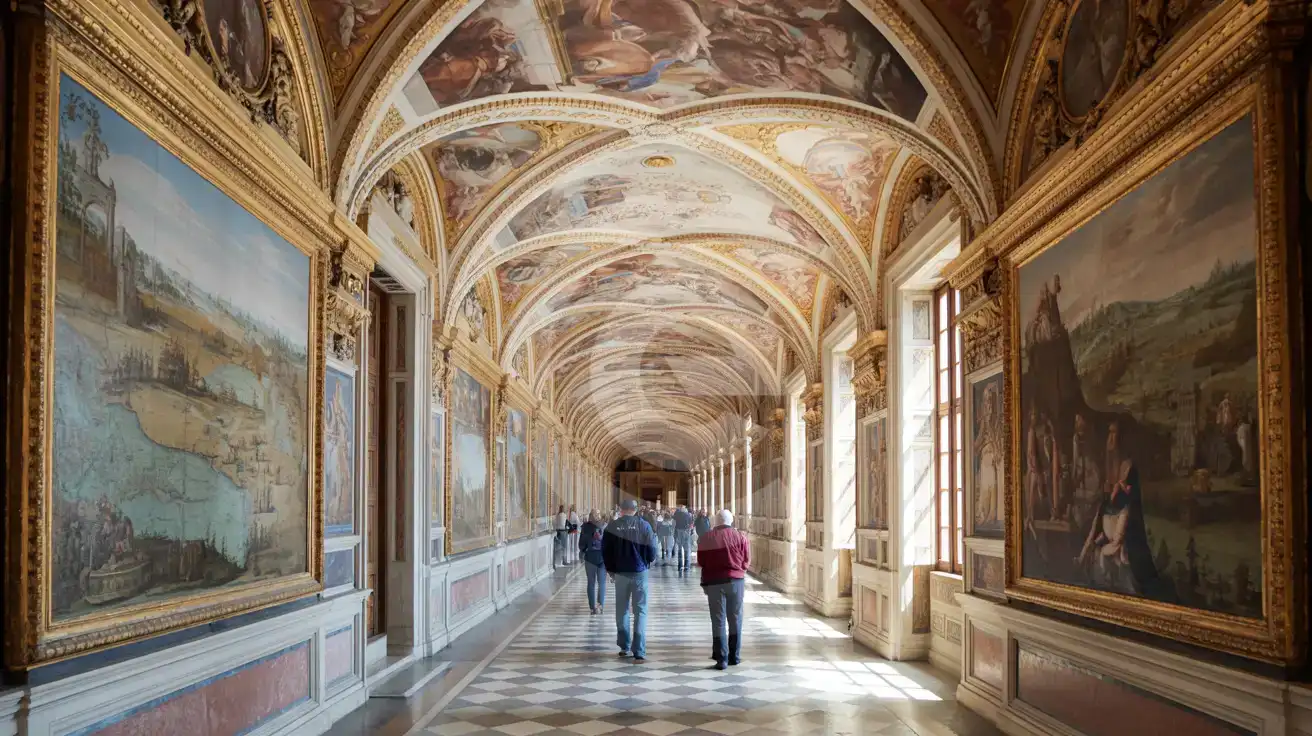
A 120-meter corridor connecting the Belvedere Palace to the Apostolic Palace, frescoed between 1580 and 1583 under Pope Gregory XIII. Forty topographical panels depict the Italian regions and papal territories, painted by Ignazio Danti with remarkable geographic accuracy for the period. The maps use an unusual orientation — east at the top — corresponding to the gallery's physical layout. The vaulted ceiling above displays religious scenes keyed to the regions below, creating a program that unifies sacred and political geography. Morning light through south-facing windows makes the gilded ceiling glow; by midday, the corridor becomes a bottleneck as tour groups converge from both directions.
The Pinacoteca Vaticana
The painting gallery occupies a separate building near the entrance, often overlooked by visitors rushing toward the Sistine Chapel. Room VIII contains Raphael's final painting, the Transfiguration, completed by his workshop after his death in 1520 and displayed above his open coffin during the funeral. Leonardo da Vinci's unfinished Saint Jerome in the Wilderness hangs in Room IX — one of only about 15 surviving Leonardo paintings. Caravaggio's Deposition, with its dramatic diagonal composition and theatrical lighting, anchors Room XII. The collection allows direct comparison of Renaissance masters in a single morning.
The Bramante Staircase
The exit staircase most visitors photograph is actually Giuseppe Momo's 1932 double-helix design, not Donato Bramante's original 1505 spiral ramp in the Pio-Clementino. Momo's version allows ascending and descending visitors to pass without meeting — an elegant crowd-management solution disguised as architectural homage. The original Bramante staircase, with its shallow ramp that allowed horses and mules to climb, can be visited only on specialized tours.
Visit Strategy
Ticket Strategy and Queue Avoidance
Online booking through the official Vatican Museums website (museivaticani.va) carries a €5 surcharge but eliminates the single greatest frustration of a Vatican visit: the queue. During peak season — Easter through October, plus Christmas and February school holidays — same-day ticket lines along Viale Vaticano regularly exceed two hours. The line forms before dawn. Reserved-ticket holders enter through a separate door to the left of the main entrance, typically clearing security in under 20 minutes. Book at least two weeks ahead for morning slots during peak periods; afternoon slots often remain available closer to the date.
Premium ticket options offer genuinely different experiences. The 'Breakfast at the Museums' early-entry ticket (typically €40-45) admits visitors at 7:15 AM, 45 minutes before general opening, with access to the Sistine Chapel before the day's crowds arrive. Friday evening openings, available April through October from 19:00 to 23:00, attract significantly smaller numbers and create an atmospheric experience in galleries designed for candlelight. The last Sunday of each month offers free admission from 9:00 to 14:00 — a crowd disaster that experienced visitors avoid entirely.
Best Time to Visit
Wednesday mornings rank consistently as the quietest windows. The Pope's General Audience in St. Peter's Square draws pilgrimage groups away from the museums, creating noticeably reduced foot traffic between 9:00 and noon. Late afternoons after 14:00 thin out as tour groups complete their scheduled routes. The difference between a 9:00 AM Tuesday entry and a 14:30 Wednesday entry can mean the difference between photographing the Gallery of Maps shoulder-to-shoulder and having clear sightlines for 30 seconds at a time.
Seasonal variation matters enormously. November, the first three weeks of December, and late January through mid-February see the lowest visitor numbers. August, counterintuitively, is not as crowded as spring because many European tourists vacation at the beach rather than in Rome's heat. The weeks surrounding Easter — from Palm Sunday through the following Sunday — represent the absolute peak, with visitor numbers exceeding 30,000 per day.
Recommended Duration
The minimum worthwhile visit runs three hours, moving at a moderate pace through the standard route with brief stops at major works. Four hours allows proper time in the Pinacoteca (often skipped), the Raphael Rooms, and the Gallery of Maps. Dedicated art-history enthusiasts can spend a full day, particularly if combining the museums with the Vatican Gardens tour (separate booking required) or the excavations beneath St. Peter's Basilica.
The standard route — entrance to Sistine Chapel exit — covers approximately 7 kilometers. Comfortable shoes are essential. The galleries are not air-conditioned; summer visits can be physically exhausting. Water bottles (sealed, plastic only) are permitted through security. There is a café in the Cortile della Pigna roughly midway through the route, though the coffee is unremarkable and the queues long.
Photography Rules
Photography without flash is permitted throughout most galleries. Tripods, selfie sticks, and monopods require advance written permission and are confiscated at security. Video recording faces similar restrictions. The absolute exception is the Sistine Chapel: photography and filming are completely forbidden, and guards enforce this rule actively. The restriction stems partly from conservation concerns (flash damage to frescoes) and partly from licensing agreements with Nippon Television, which funded the 1980-1994 restoration in exchange for exclusive image rights — though the original agreement has long since expired, the prohibition remains.
Dress Code
Shoulders and knees must be covered for both men and women. Sleeveless shirts, tank tops, shorts above the knee, and short skirts will result in refused entry at the security checkpoint. This applies to the museums' entrance, not just the Sistine Chapel — you cannot enter with bare shoulders and hope to find a cardigan later. Hats must be removed inside the Sistine Chapel. The dress code is enforced more strictly during religious holidays and on Sundays (the last Sunday of the month). Lightweight scarves or shawls, easily carried in a bag for emergency coverage, solve most problems.
Highlights and Visit Strategy
Must-See Works and Where to Find Them
The Laocoön and His Sons — Museo Pio-Clementino, Octagonal Court. Ground floor, accessed early in the standard route. The founding acquisition of 1506, positioned where Julius II originally placed it.
Apollo Belvedere — Museo Pio-Clementino, Octagonal Court. Same courtyard as the Laocoön, cabinet to the left when entering. The Neoclassical ideal of male beauty.
Belvedere Torso — Museo Pio-Clementino, Hall of the Muses. The fragmentary 1st-century BC sculpture that Michelangelo reportedly called his 'teacher' — visible influence on the Sistine ignudi.
Gallery of Tapestries — Upper floor, preceding the Gallery of Maps. Ten tapestries from Raphael's designs depicting scenes from the life of Christ, woven in Brussels in the 1520s.
Gallery of Maps — 120-meter corridor, upper floor. Forty topographical panels of Italian regions painted 1580-1583. Position yourself near the Calabria panel mid-morning for the best ceiling light.
The School of Athens — Stanza della Segnatura, Raphael Rooms. East wall of the first major room. Plato (pointing upward, possibly modeled on Leonardo) and Aristotle (gesturing outward) anchor the composition.
The Transfiguration — Pinacoteca, Room VIII. Raphael's final painting, displayed above his coffin at his 1520 funeral. The lower half, showing the failed exorcism, was completed by Giulio Romano.
Saint Jerome in the Wilderness — Pinacoteca, Room IX. Leonardo's unfinished masterpiece, showing the saint in penitence. The anatomy of Jerome's torso demonstrates Leonardo's dissection studies.
Deposition — Pinacoteca, Room XII. Caravaggio's dramatic diagonal composition, painted 1602-1603 for Santa Maria in Vallicella.
Creation of Adam — Sistine Chapel, ceiling center. The fourth panel from the altar end. Neck strain is unavoidable; mirrors previously available are no longer offered.
Recommended Visit Sequence by Time Available
90 Minutes (Highlights Only): Enter, turn right toward the Pio-Clementino and pause briefly at the Laocoön and Apollo Belvedere. Skip the Egyptian and Etruscan collections. Move directly to the upper floor galleries, walking quickly through the Gallery of Tapestries and pausing in the Gallery of Maps for photography. Spend 20 minutes in the Raphael Rooms, focusing on the Stanza della Segnatura. Proceed to the Sistine Chapel for 15-20 minutes. Exit via the Bramante Staircase. This route sacrifices the Pinacoteca entirely.
Three Hours (Standard Route with Key Stops): Begin in the Pinacoteca (30 minutes) before crowds build — Room VIII (Raphael) and Room XII (Caravaggio) are essential. Return to the entrance area and follow the Pio-Clementino route, spending 20 minutes in the Octagonal Court with the Laocoön and Apollo. Continue through the Gallery of Candelabra, Gallery of Tapestries, and Gallery of Maps (45 minutes total, slowing in the Maps corridor). Allow 30-40 minutes for the Raphael Rooms. Reach the Sistine Chapel with time for 20 minutes of contemplation. Exit via the double-helix staircase.
Full Day (Comprehensive Visit): Arrive at 8:00 opening with early-entry ticket if possible. Begin in the Egyptian Museum and Etruscan collections (often empty in the first hour). Proceed through the Pio-Clementino, pausing in the Hall of Animals and Gallery of Statues as well as the Octagonal Court. Visit the Pinacoteca before the midday rush reaches it (around 11:00). Take lunch in the Cortile della Pigna café. Return to the upper floor for the Gallery of Maps and Raphael Rooms in early afternoon, when morning tour groups have cleared. End in the Sistine Chapel after 14:00, when the space is marginally less packed. Consider booking the Vatican Gardens tour (separate ticket, 2 hours) for the morning and shifting the museum visit to afternoon.
Audio Guide and App Tips
The official Vatican Museums audio guide costs €8 and covers approximately 200 works across the standard route in seven languages: Italian, English, French, German, Spanish, Portuguese, and Japanese. Collection points are located at the entrance and can be returned at multiple points, including near the Sistine Chapel exit. The device uses a numerical keypad — enter the number posted beside each work to hear commentary. Battery life lasts approximately four hours.
The Vatican Museums app (iOS and Android, free download with in-app purchases) offers an alternative audio tour plus interactive maps. The mapping feature proves most valuable — gallery numbers and room names are poorly signed inside, and the app shows your current position relative to major works. Download content before entering; cellular signal is weak in interior galleries, and the Vatican's public WiFi is unreliable under visitor load. The app's ticketing integration allows mobile ticket display at entrance.
Photography Rules
Personal photography without flash is permitted in all galleries except the Sistine Chapel and temporary exhibitions (which are clearly signed). Tripods, monopods, selfie sticks, and professional video equipment require advance written authorization from the museum's press office and will be confiscated at security without documentation. Flash photography risks fresco damage and is explicitly forbidden throughout — camera flash detection occasionally triggers guard intervention even outside the Sistine Chapel.
In the Sistine Chapel, all photography and filming is prohibited, regardless of flash settings. Guards make periodic announcements in multiple languages and will approach visitors holding phones or cameras at photographing angles. The enforcement is consistent. Historical context: Nippon Television funded the major 1980-1994 ceiling restoration in exchange for exclusive image rights, establishing the prohibition; though that agreement has expired, the rule remains for conservation and atmosphere reasons.
Quiet Galleries and Crowd-Avoidance Tips
The Pinacoteca sees the lightest foot traffic relative to its collection quality. Most tour groups follow the entrance-to-Sistine route and skip the painting gallery entirely; visiting the Pinacoteca first thing or after 14:00 offers a nearly private museum experience. The Etruscan Museum (Museo Gregoriano Etrusco) on the upper floor attracts specialists rather than general tourists — its Mars of Todi bronze and Regolini-Galassi tomb furnishings deserve more attention than they receive.
The Gallery of Maps becomes a choke point between 10:00 and 13:00 as tour groups converge from both directions. Either arrive before 9:30 or wait until after 14:00. The Borgia Apartments, decorated by Pinturicchio in the 1490s, sit beneath the Raphael Rooms and host rotating contemporary art exhibitions that many visitors skip — the original Renaissance frescoes remain visible above the modern installations.
Wednesday mornings during Papal Audience hours (9:30-11:30) consistently rank as the quietest periods. The audience takes place in St. Peter's Square, drawing pilgrimage groups away from the museums. Combining a Wednesday museum visit with attendance at the audience (free, tickets available through the Prefecture of the Papal Household) creates an efficient Vatican day that avoids the worst crowds at both sites.
Nearby Attractions and Logistics
St. Peter's Basilica and St. Peter's Square
A 10-minute walk south from the museum exit along the Vatican walls, or accessible directly from the Sistine Chapel for tour groups (general visitors must exit through the Bramante Staircase and walk around). The basilica, consecrated in 1626 after 120 years of construction, contains Michelangelo's Pietà (first chapel on the right), Bernini's bronze baldachin over the papal altar, and the tomb of St. Peter beneath the high altar. Entry to the basilica is free; the dome climb (cupola) costs €8 by stairs or €10 with elevator to the first terrace. Security queues in St. Peter's Square move fastest in late afternoon after 15:00. Dress code identical to the museums — shoulders and knees covered.
Castel Sant'Angelo
A 15-minute walk east from the museum entrance via Piazza del Risorgimento, across the Tiber on Ponte Sant'Angelo. The bridge, lined with ten angel sculptures designed by Bernini, offers one of Rome's iconic photographs with the castle and St. Peter's dome aligned behind. The fortress began as Emperor Hadrian's mausoleum (completed 139 AD) before papal conversion into a defensive stronghold connected to the Vatican by the elevated Passetto di Borgo corridor — the escape route Pope Clement VII used during the 1527 Sack of Rome. The upper terrace café serves decent coffee with unobstructed views of the dome. Museum entry approximately €15.
Borgo Pio
A pedestrian street running parallel to Via della Conciliazione, preserved from the medieval neighborhood that once surrounded the Vatican before Mussolini's 1930s clearances created the current approach to St. Peter's. Trattorias line both sides — Osteria delle Commari and Osteria dell'Angelo serve Roman classics (cacio e pepe, amatriciana) at prices lower than the tourist restaurants on the main thoroughfare. The strip makes a practical lunch stop between museum exit and basilica entry.
Prati and Piazza del Risorgimento
The Prati district north of the Vatican walls developed in the late 19th century as a bourgeois residential quarter, its wide streets and Art Nouveau palazzi contrasting with the medieval warren of Trastevere across the river. Via Cola di Rienzo serves as the main shopping street — less tourist-oriented than the Centro Storico, useful for pharmacy stops, affordable lunch, or escaping the Vatican perimeter entirely. Piazza del Risorgimento, five minutes from the museum entrance, hosts a market most mornings and serves as the terminus for Tram 19 from the northern suburbs.
Transit Connections
Metro Line A (Ottaviano-San Pietro station) runs every 4-7 minutes during daytime hours, connecting the Vatican to Termini station (8 minutes), the Spanish Steps (12 minutes), and San Giovanni in Laterano (18 minutes). Bus 49 stops directly opposite the museum entrance on Viale Vaticano; Bus 64 connects Termini to St. Peter's Square (crowded, pickpocket warnings apply). Tram 19 terminates at Piazza del Risorgimento. Walking to the Centro Storico — Piazza Navona and the Pantheon — takes approximately 25 minutes via Castel Sant'Angelo and the Ponte Sant'Angelo.
Suggested Combined Itinerary
Begin at the Vatican Museums at the 8:00 opening with a pre-booked ticket, allowing three to four hours for the Sistine Chapel route. Exit via the Bramante Staircase around 11:30. Walk to Borgo Pio for lunch — the trattorias fill quickly after noon, so arriving by 12:00 secures a table. Enter St. Peter's Basilica in the early afternoon when morning tour groups have dispersed; security queues shorten significantly after 14:00. Climb the cupola for views over the Vatican Gardens and Rome's historic center. Cross Ponte Sant'Angelo to Castel Sant'Angelo by late afternoon, reaching the upper terrace for golden-hour views of the dome. From there, the Centro Storico — Piazza Navona, the Pantheon, and Campo de' Fiori — lies 15 minutes' walk for an evening aperitivo and dinner.
Why Data Matters at the Vatican Museums
The Vatican Museums present a specific connectivity challenge: 7 kilometers of galleries with inconsistent cellular signal, particularly in the interior rooms of the Pio-Clementino and the lower levels of the Apostolic Palace. The official WiFi network struggles under visitor load during peak hours, frequently dropping connections mid-audio-guide-stream. Having a working data plan matters more inside these galleries than at most European museums.
The practical applications extend beyond audio guides. The Vatican Museums app's mapping feature — genuinely useful for locating specific works in poorly signed galleries — requires data to update your position. Translation apps help with Italian-only signage in secondary collections. QR codes posted beside major works link to extended commentary that the basic audio guide doesn't cover. And coordinating meeting points with travel companions in a complex where 'I'm near the Laocoön' describes a precise location becomes significantly easier with working WhatsApp.
An eSIMno Italy plan connects through Vodafone and Wind Tre — the two networks with the strongest signal penetration in the Vatican's thick-walled galleries. Installing before your Rome arrival means data works from Leonardo da Vinci-Fiumicino Airport through the Metro ride to Ottaviano and into the museum entrance queue, without fumbling with physical SIM cards or airport kiosk Italian.
The Gallery of Maps
Compare WiFi Options at Vatican Museums
 Recommended Recommended | Local SIM / Operator | Roaming | |
|---|---|---|---|
| FEATURES | |||
| Setup time | Few minutes | Store visit + paperwork | Auto |
| No local ID needed | Online checkout | Local ID required | Use home account |
| Speed | 4G/LTE; 5G in some areas | Carrier-grade | Partner-dependent |
| Travel support | English support 24/7 | Operator shops and call centre | Home carrier hours |
| Keep home number | Dual SIM | Replaces it | Same number |
| Cost predictability | Fixed price | Bills can spike | Bill-shock risk |
| PRICING | |||
Typical pricing | See plans below | — | — |
PRICING — PICK YOUR ESIMNO PLAN
Featured eSIM plans
Italian Mobile

Italian Mobile
Italian Mobile
Italian Mobile
Italian Mobile
Italian Mobile
Italian Mobile
Italian Mobile


