
Quick Facts
- Location
- Broadway & 7th Ave, 42nd-47th Streets, Midtown Manhattan
- Hours
- 24/7 outdoor access; stores typically 9am-midnight
- Admission
- Free (individual attractions priced separately)
- Nearest Subway
- Times Square-42nd St (1/2/3/7/N/Q/R/W/S trains)
- Annual Visitors
- ~50 million
- Broadway Theaters
- 41 houses in surrounding district
- Official Site
- timessquarenyc.org (Times Square Alliance)
- eSIMno Networks
- AT&T, T-Mobile, Verizon
About Times Square
Times Square exists because a newspaper publisher wanted his name on a subway station. In 1904, Adolph Ochs—owner of The New York Times—convinced the city to rename Longacre Square after his paper moved its headquarters to the newly constructed One Times Square at the triangle where Broadway crosses Seventh Avenue. The area had previously served as the center of New York's carriage trade, a practical hub for horse dealers and harness makers that held little glamour. Ochs changed that calculus by lobbying for a subway stop bearing the square's new name, then inaugurated the first New Year's Eve ball drop on December 31, 1907. The tradition has continued unbroken for over a century, making that single building—now almost entirely empty except for the ball mechanism and a few ground-floor retail spaces—arguably the most valuable piece of real estate per square foot of actual use in Manhattan.
The decades following Ochs's publicity coup established Times Square as the heart of American theater. Vaudeville houses gave way to legitimate Broadway venues, and by the 1920s the surrounding blocks contained the densest concentration of live performance spaces in the world. The New Amsterdam Theatre opened on 42nd Street in 1903, its Art Nouveau interior eventually hosting Ziegfeld Follies and, much later, Disney's The Lion King. The Lyceum Theatre, which opened the same year on 45th Street, remains the oldest continuously operating Broadway house—its Beaux-Arts facade still intact, its marble staircases still carrying audiences to the same balconies that hosted Sarah Bernhardt.
Then came the collapse. From the 1960s through the 1980s, Times Square became synonymous with urban decay: adult theaters, street crime, drug dealing, and the particular desperation of a city that had lost control of its public spaces. The transformation back to tourist destination began in the early 1990s, accelerated by Mayor Rudy Giuliani's broken-windows policing and the Times Square Alliance's aggressive redevelopment push. Disney's 1995 lease of the New Amsterdam Theatre signaled corporate confidence in the rehabilitation; within a decade, the area had flipped entirely from cautionary tale to family-friendly entertainment zone.
What makes Times Square unique today isn't the theaters or the crowds—it's the zoning. The city actually requires buildings in the district to display large, illuminated signage. This isn't organic commercial enthusiasm; it's mandated spectacle. The result is roughly 238,000 square feet of illuminated signs generating an estimated 161 megawatts of electricity, creating the perpetual artificial daylight that makes Times Square recognizable from space. The billboards themselves have become attractions: the curved Coca-Cola sign, the NASDAQ tower displaying stock tickers and corporate announcements, the jumbo screens broadcasting everything from Good Morning America to Korean pop concerts. It's the only place in Manhattan where bigger, brighter, and louder is literally the law.
Highlights & Must-See
One Times Square and the New Year's Eve Ball
The building at 1475 Broadway—originally the New York Times headquarters—stands at the southern apex of the bowtie where Broadway and Seventh Avenue intersect. It's a slender 25-story tower that generates more advertising revenue per square foot than almost any building on Earth, despite being nearly empty inside. The famous Waterford Crystal ball sits atop the building year-round, a geodesic sphere measuring 12 feet in diameter, covered with 2,688 Waterford Crystal triangles and 32,256 Philips Luxeon LEDs capable of displaying 16 million colors. You can see it from street level during daylight, though it's most visible at night when illuminated. On December 31, approximately one million people pack into the surrounding blocks to watch it descend—a 60-second drop that begins at 11:59 PM and has marked the transition to each new year since 1907.
The TKTS Red Steps at Father Duffy Square
At the northern end of Times Square, where 46th and 47th Streets meet Broadway, a set of bright red illuminated stairs rises above the TKTS discount ticket booth. The Theatre Development Fund has operated this booth since 1973, selling same-day Broadway and off-Broadway tickets at 20-50% off face value. The stairs themselves—designed by Choi Ropiha Fighera and completed in 2008—serve as bleacher seating and the single best elevated photo vantage point in the square. From the top step, you look south across the full canyon of billboards toward One Times Square. The booth opens at 3 PM for evening performances (10 AM on Wednesdays and Saturdays for matinees), and the electronic board above displays available shows in real time.
Father Duffy and George M. Cohan Statues
Father Duffy Square contains two bronze sculptures that most visitors walk past without registering. The statue of Father Francis P. Duffy—chaplain of the 165th Infantry Regiment (the famous 'Fighting 69th') during World War I—stands with a Bible and Celtic cross, dedicated in 1937. Ten feet away, George M. Cohan leans casually on a cane, honoring the composer who wrote 'Give My Regards to Broadway' and 'Yankee Doodle Dandy.' These aren't decorative additions; they're the reason this northern section is technically Father Duffy Square rather than Times Square proper.
The Broadway Theater District
Forty-one Broadway theaters radiate outward from Times Square along the cross streets between 41st and 54th. The New Amsterdam Theatre at 214 West 42nd Street—built in 1903 with an Art Nouveau interior featuring peacock and poppy motifs—currently hosts Aladdin and previously ran The Lion King for its first 13 years. The Lyceum Theatre at 149 West 45th Street, the oldest continuously operating Broadway house, features a distinctive Beaux-Arts facade with a mansard roof and undulating marquee. The Majestic Theatre at 245 West 44th Street, the largest Broadway house at 1,681 seats, has hosted The Phantom of the Opera since 1988—the longest-running show in Broadway history. The St. James Theatre at 246 West 44th Street premiered Oklahoma! in 1943 and currently runs the musical version of The Notebook.
Iconic Billboards and Media Facades
The billboards aren't just advertising—they're architectural features. The curved Coca-Cola sign above the corner of Broadway and 47th Street uses LED technology to create 3D effects visible from blocks away. The NASDAQ MarketSite tower at 4 Times Square (the Condé Nast Building) displays seven stories of LED screens wrapping the corner, broadcasting market data, corporate announcements, and occasionally hosting live events. The ABC Times Square Studios at 1500 Broadway feature a ground-floor glass facade where Good Morning America broadcasts live weekday mornings; crowds gather outside starting around 6 AM for a chance to appear on camera with homemade signs.
Flagship Retail Experiences
Several stores have become destinations themselves. M&M's World at 1600 Broadway and 48th Street spreads across three floors and 25,000 square feet of candy merchandise, including a wall of tubes dispensing M&Ms by color. Hershey's Chocolate World at 1593 Broadway offers a similar experience with its own brands. The Disney Store at 1540 Broadway—while smaller than its former flagship location—stocks park merchandise and hosts character meet-and-greets. These aren't places to shop efficiently; they're places to experience the particular excess that Times Square specializes in.
The Pedestrian Plazas
In 2009, New York City closed Broadway to vehicle traffic between 42nd and 47th Streets, creating pedestrian plazas that transformed how people experience the square. What had been a congested vehicular intersection became an open-air gathering space with café tables, street performers, and costumed characters. The plazas feature designated seating areas—painted circles and metal chairs that appeared semi-permanent and eventually became so. This is where you'll find the Naked Cowboy (performing since 1998), Elmo and Spider-Man impersonators seeking tips for photos, and the particular chaos of tourists moving in every direction while looking at their phones.
Visit Strategy
Best Time to Visit
Early morning—before 9 AM—offers the closest thing to solitude Times Square permits. The billboards run continuously, but the crowds thin dramatically between 6 and 8 AM. You'll share the plazas with commuters crossing through and the occasional jogger, but the Instagram-ready shots that require patience at midday become trivially easy at dawn. The tradeoff: most stores remain closed, and the energy that defines the place is largely absent.
For the full sensory experience, arrive after dark. The billboards reach peak brightness once natural light fades, typically around sunset through midnight. Weekday evenings between 7 and 9 PM coincide with pre-theater crowds—expect dense pedestrian traffic around the theater entrances on the side streets. Weekend nights run later and louder, with the post-midnight hours bringing a different energy as clubs let out and late-night food seekers emerge.
The absolute worst time: December 31 unless you specifically want the ball drop experience. NYPD erects barricades in the early afternoon, packing visitors into 'pens' where they'll stand for 8-12 hours without bathroom access. It's an endurance test, not a celebration.
Ticket Strategy for Broadway
The TKTS booth offers the best value for flexibility—same-day tickets at 20-50% off—but requires time investment. The main booth at Duffy Square draws the longest lines; the satellite booth at Lincoln Center (Broadway at 65th Street) and the Downtown Brooklyn booth (1 MetroTech Center) serve the same inventory with shorter waits. Alternatively, the TodayTix app offers mobile lottery entries and last-minute deals; several shows run digital lotteries that award $30-40 tickets for front-row seats. For specific shows on specific dates, book directly through the theater's official site or a verified reseller—premium pricing, but guaranteed inventory.
Recommended Duration
Times Square itself requires 30-60 minutes to walk the full plaza, photograph the key angles, and absorb the sensory overload. Add 20-30 minutes if you want to browse M&M's World or Hershey's. A Broadway show adds 2.5-3 hours. The optimal approach treats Times Square as a hub rather than a destination: arrive mid-morning, photograph the square, walk to Bryant Park or Rockefeller Center for a few hours, return late afternoon for TKTS tickets, grab an early dinner in the Theater District, catch an 8 PM show, then experience the post-show plaza at peak illumination.
Photography Rules and Practicalities
Photography is unrestricted throughout the public plazas—no permits required for personal use, no prohibitions on equipment. Tripods technically require permits for commercial shoots, but enforcement is minimal for tourists clearly shooting personal content. The costumed characters (Elmo, Spider-Man, Minnie Mouse, etc.) will pose for photos but expect tips—$2-5 is standard, $10 if you're photographing a group with multiple characters. Declining to tip after they've posed creates confrontation; it's cleaner to either tip cheerfully or decline the photo politely before they engage. The Naked Cowboy—Robert Burck, performing in underwear and cowboy boots since 1998—operates similarly.
Avoiding Crowds
The density peaks on weekend evenings between 6 and 10 PM, during the holiday season (Thanksgiving through New Year's), and whenever a major media event uses the square for broadcast. To minimize crowds: visit on weekday mornings, arrive early or late (before 9 AM or after 11 PM), and use the side streets rather than the main Broadway pedestrian plaza to traverse the area. The crosswalks at 44th and 45th Streets offer cleaner photography angles than the mobbed central plaza.
Best Time to Visit & Photographer's Guide
Month-by-Month Crowd & Weather
January-February: The post-holiday lull brings lighter crowds and freezing temperatures (average highs around 38-42°F). Snow transforms the plazas into something cinematic—reflections multiply across wet pavement, and the steam rising from subway grates adds atmosphere. This is shoulder season for photography, with manageable crowds and dramatic weather.
March-April: Crowds build as weather warms (50-65°F range). Spring break brings student groups, but nothing unmanageable. Late April offers pleasant conditions and longer daylight—useful for catching the transition from natural light to full billboard illumination.
May-June: Peak tourist season begins. Temperatures range from 65-80°F, and the plazas fill with summer visitors. Early morning remains relatively clear; after 10 AM, expect density.
July-August: Hot, humid, and extremely crowded (80-90°F with New York's signature summer humidity). The heat radiating off pavement and the body heat of crowds makes extended plaza time uncomfortable. Optimal strategy: brief early morning or late night visits, avoiding 11 AM-7 PM entirely.
September-October: The best weather conditions (60-75°F) coincide with continued high tourism. September brings Fashion Week energy to Midtown; October adds Halloween costume nonsense to the character-performer scene. Early October offers perhaps the ideal combination of manageable crowds, excellent weather, and full-strength billboard illumination after early sunset.
November-December: Holiday decorations appear after Thanksgiving, and crowds reach annual peak. December is genuinely difficult—the combination of holiday shoppers, theater audiences, and New Year's preparation creates gridlock. Beautiful for photography (holiday lighting adds warmth), brutal for movement.
Best Time of Day
Blue hour (dawn, roughly 5:30-6:30 AM depending on season): The sky turns deep blue before sunrise while billboards remain fully illuminated. This creates the most balanced exposure—sky detail, billboard brightness, and minimal pedestrian traffic. The challenge: most stores are closed, and the energy feels muted.
Golden hour (sunset, roughly 5-8 PM depending on season): Warm light rakes down the cross streets while billboards compete with fading daylight. This is the most popular photography time, which means crowds at every angle.
Full darkness (9 PM-midnight): Billboards at maximum intensity, sky black, reflections on pavement if recently rained. The visual impact peaks here—this is the Times Square of postcards and film establishing shots. Crowds remain heavy until about 11 PM.
Late night (midnight-4 AM): Billboards dim slightly but remain operational. Crowds thin dramatically. A different character emerges—club-goers, night shift workers, the particular energy of a city that doesn't close. Excellent for photography with human subjects but minimal crowding.
Best Photo Spots
TKTS Red Steps: The elevated position looking south toward One Times Square offers the classic wide-angle shot. Arrive early to claim a spot on the top steps; after 10 AM, every step is occupied.
The 7th Avenue Median at 46th Street: Standing in the narrow pedestrian island between traffic lanes provides a centered perspective looking directly at the billboard canyon. The 1 train rumbles beneath your feet.
West 44th Street looking East: The intersection of 44th and Broadway frames the square from an angle most tourists miss—theatrical marquees in the foreground, billboards rising behind. The Shubert Alley entrance adds architectural interest.
One Times Square Base: Looking north from the base of the ball-drop building captures the full height of surrounding billboards with minimal foreground distraction.
Marriott Marquis 8th Floor: The hotel's R Lounge (formerly the View) offers the only elevated interior angle accessible without a hotel booking. Drink prices are Manhattan-steep, but the perspective is unique—looking down into the plaza rather than up at the signs.
West 47th Street looking Southwest: This angle captures the TKTS steps with the billboard backdrop and offers cleaner compositions during crowded periods when the main plaza is impassable.
Across Broadway at 42nd Street: The wide sidewalk on the east side of Broadway provides distance for telephoto compression shots that stack the billboards into a dense wall of light.
Drone & Tripod Rules
Drone flight is effectively prohibited throughout Times Square. New York City requires permits for drone operation in any public space, and permits are not issued for Times Square due to security concerns, airspace restrictions near heliports and theaters, and crowd density. The FAA classifies Manhattan as controlled airspace requiring additional authorization that's impractical for tourist use. Enforcement is active—NYPD confiscates equipment.
Tripods occupy a gray zone. Personal use with a tripod is technically permitted, though commercial photography requires a permit from the Mayor's Office of Media and Entertainment. The practical reality: small travel tripods rarely attract attention, large professional rigs may prompt questions from NYPD. If confronted, the standard response is 'personal use only'—no payment, no publication. Monopods attract less scrutiny than full tripods.
Hidden Sub-Spots Most Tourists Miss
Shubert Alley: This narrow pedestrian passage between 44th and 45th Streets (connecting Broadway to 8th Avenue) features stage door entrances where actors exit after performances. The alley walls display commemorative plaques for Broadway legends. It's quiet, theatrical, and five steps from the chaos.
The Times Square Information Center at 1560 Broadway: Housed in the former Embassy Theatre, this visitor center contains a small exhibition space about Times Square history and a surprisingly peaceful interior when crowds outside become overwhelming.
The Palace Theatre Lobby: The Palace (1564 Broadway) maintains a lobby with Art Deco details visible even without show tickets. During business hours, the front doors are often open for will-call and merchandise.
John's Pizzeria Interior at 260 West 44th Street: Housed in a former church, this pizzeria features stained glass windows and a vaulted ceiling that provide visual respite from the LED assault outside. The pizza justifies the visit independently.
The Fire Station at 165 West 46th Street: FDNY Engine 54 / Ladder 4 / Battalion 9 occupies a building that lost 15 firefighters on September 11, 2001—the highest loss of any single FDNY unit. A memorial plaque and tribute wall face the street. It's somber, real, and invisible to tourists staring at billboards.
Nearby Attractions & Logistics
Bryant Park and the New York Public Library
A five-minute walk east along 42nd Street brings you to Bryant Park—nine acres of green space behind the New York Public Library's Stephen A. Schwarzman Building. The park hosts free events year-round: winter brings the holiday market and ice skating rink (skate rental ~$25, BYOS free), summer adds outdoor film screenings and yoga classes. The library building itself, completed in 1911, contains the Rose Main Reading Room—a 78-foot-long, 52-foot-high cathedral of knowledge with bronze reading lamps and ceiling murals. The lions guarding the entrance are named Patience and Fortitude. Admission is free.
Rockefeller Center
An 8-10 minute walk northeast to 30 Rockefeller Plaza. The Top of the Rock observation deck ($44 adult, $38 child) offers the definitive Manhattan skyline view—you see the Empire State Building from here, which you can't do from the Empire State Building itself. The plaza level features the famous ice rink (winter only, ~$25-40 plus skate rental) and Christmas tree (late November through early January). Radio City Music Hall at 1260 Sixth Avenue offers backstage tours ($31 adult) of its Art Deco interior. NBC Studio tours depart from 30 Rock as well.
Museum of Modern Art (MoMA)
Roughly 12 minutes' walk north to 11 West 53rd Street. The permanent collection includes Van Gogh's 'The Starry Night,' Picasso's 'Les Demoiselles d'Avignon,' and Monet's 'Water Lilies' triptych. General admission $30 adult, $22 senior, free for visitors 16 and under. The museum stays open until 5:30 PM daily (9 PM on Fridays). The sculpture garden offers respite between gallery floors.
Empire State Building and Madison Square Garden
Both lie south of Times Square—roughly 12-15 minutes' walk. Madison Square Garden at 7th Avenue and 33rd Street hosts Knicks, Rangers, and concert events; even without event tickets, the exterior architecture and Chase Square atrium are accessible. The Empire State Building at 350 Fifth Avenue ($47 main deck, $85 with 102nd floor) operates until 11 PM daily, making it an excellent post-Broadway nighttime option.
Transportation Hub
Times Square–42nd Street station serves more subway lines than any other Manhattan station: 1/2/3 (7th Avenue local and express), 7 (Flushing), N/Q/R/W (Broadway), and S (42nd Street Shuttle to Grand Central). The 42nd Street–Port Authority Bus Terminal station (A/C/E trains) sits one block west—useful for New Jersey transit or longer-haul bus connections. Bus routes along 42nd Street include the M42 crosstown and the M104 running up Broadway.
Dining in the Theater District
Pre-theater dining requires strategy: most curtains rise at 7 or 8 PM, and nearby restaurants fill with the same crowd between 5:30 and 7 PM. Joe Allen at 326 West 46th Street serves classic American fare in a room decorated with posters from Broadway flops—a theatrical tradition since 1965. Sardi's at 234 West 44th Street, open since 1921, displays caricatures of stage celebrities along every wall (steak and fish entrees, $40-60 range). For faster options, John's Pizzeria at 260 West 44th Street serves coal-oven pies in a converted church, while Shake Shack at 691 8th Avenue provides the reliable burger-and-shake option 10 minutes from most theaters.
Why Data Matters at Times Square
Times Square rewards the connected visitor. The TKTS electronic board tells you which shows have tickets, but the TodayTix app shows you real-time availability, lottery entries, and mobile-ticket options you can purchase while standing in the plaza. Google Maps navigates the subway connections that make Rockefeller Center and MoMA quick diversions rather than logistical puzzles. Restaurant reservation apps—OpenTable, Resy—let you book pre-theater seating without walking door-to-door checking availability. And when the crowds peak on a Saturday evening, ride-hailing beats hunting for a taxi at 11 PM.
An eSIMno plan connects you to AT&T and T-Mobile networks the moment you activate—no SIM card hunting at JFK, no carrier store visits in Midtown. You land, you activate, you navigate. Broadway show research on the subway, photo uploads from the Red Steps, walking directions to that pizzeria in the converted church. The density of things worth doing in this 5-block radius makes reliable data less a convenience than a navigation requirement. Times Square isn't a place you wander aimlessly; it's a place you move through with purpose, and that purpose benefits from a phone that works.
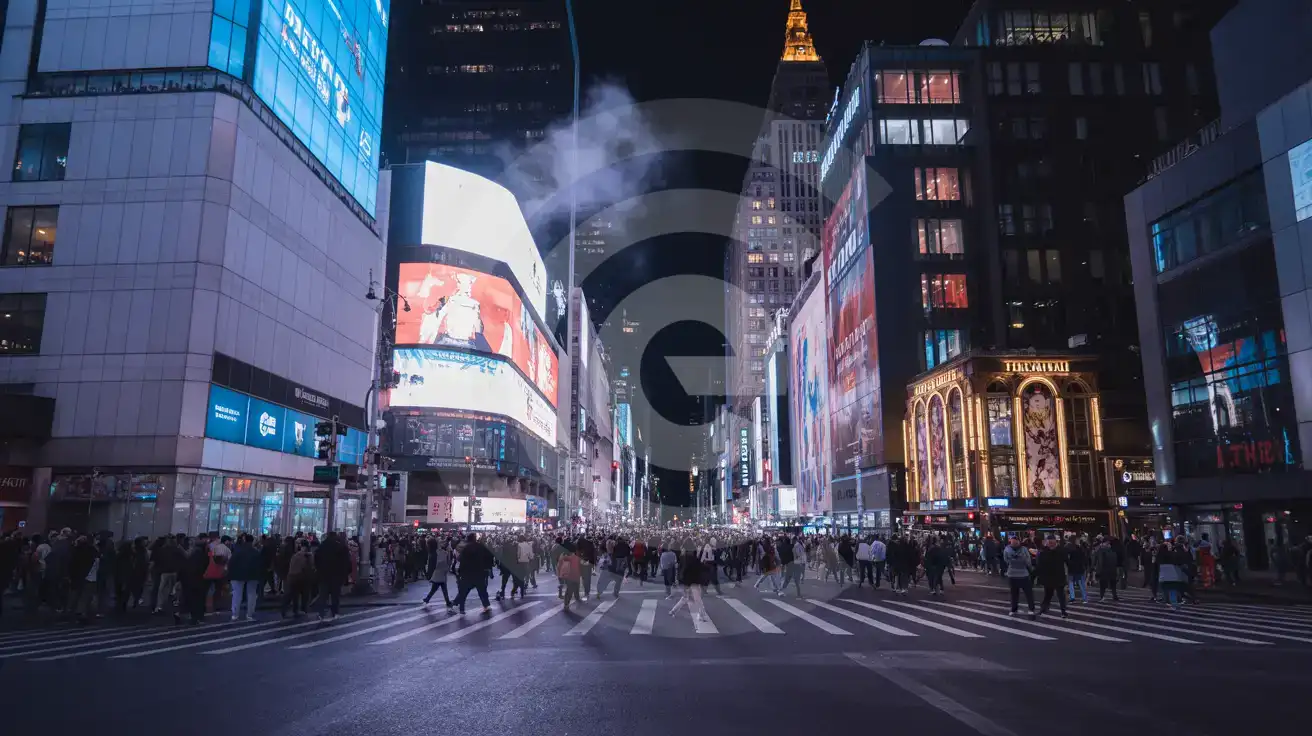
Times Square After Dark
Compare WiFi Options at Times Square
 Recommended Recommended | Local SIM / Operator | Roaming | |
|---|---|---|---|
| FEATURES | |||
| Setup time | Few minutes | Store visit + paperwork | Auto |
| No local ID needed | Online checkout | Local ID required | Use home account |
| Speed | 4G/LTE; 5G in some areas | Carrier-grade | Partner-dependent |
| Travel support | English support 24/7 | Operator shops and call centre | Home carrier hours |
| Keep home number | Dual SIM | Replaces it | Same number |
| Cost predictability | Fixed price | Bills can spike | Bill-shock risk |
| PRICING | |||
Typical pricing | See plans below | — | — |
PRICING — PICK YOUR ESIMNO PLAN
Featured eSIM plans
American Mobile

American Mobile
American Mobile
American Mobile
American Mobile
American Mobile


