
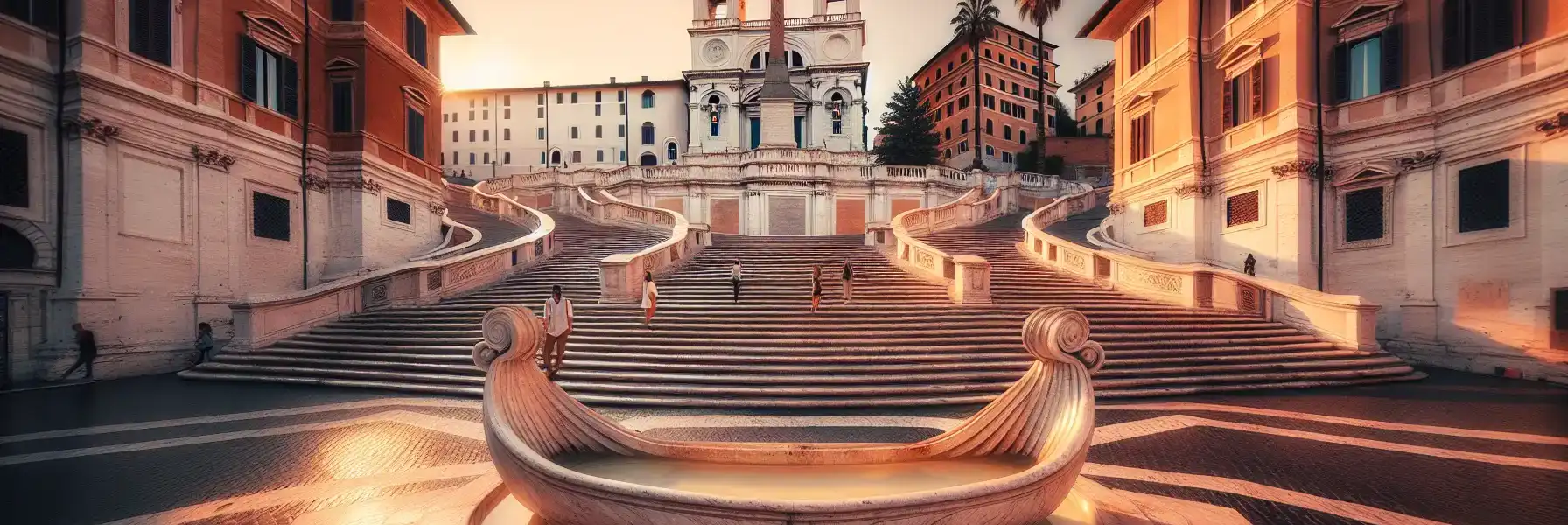
Quick Facts
About the Spanish Steps
The Spanish Steps — Scalinata di Trinità dei Monti in Italian — didn't emerge from any single vision. They emerged from 65 years of diplomatic standoff.
The story begins in 1660, when French diplomat Étienne Gueffier died and left funds specifically designated to connect the Bourbon Spanish embassy at the base of the hill (which gave Piazza di Spagna its name) with the French church of Trinità dei Monti at the summit. A simple bequest, seemingly. But nothing in Baroque Rome was ever simple.
The French wanted a grand statement of their presence in the Eternal City. They proposed placing an equestrian statue of Louis XIV at the summit. The papacy — specifically Pope Innocent XIII by the time construction finally began — objected to a foreign monarch looming over Roman rooftops. The Spanish, whose embassy sat at the base, had opinions of their own. Three powers, one hillside, zero agreement.
The Architects' Solution
Roman architect Francesco de Sanctis, with assistance from Alessandro Specchi, finally produced a design that satisfied everyone by glorifying no one. The 135 steps flow in three distinct sections: a central channel flanked by side flights that converge, then diverge, then converge again at the upper terrace. The effect is theatrical — a cascade of travertine that seems to pour down the hillside rather than climb it. Construction lasted from 1723 to 1725, funded by Gueffier's long-dormant bequest.
The Grand Tour Era
Almost immediately, the staircase became one of Rome's great gathering places. The 18th and 19th centuries saw the surrounding neighborhood transform into a hub for English, Anglo-American, and Northern European expatriates. Artists came for the Roman light and stayed for the cheap rents. Models — often peasant women from the hills outside Rome — gathered on the steps each morning hoping to catch the eye of painters seeking subjects.
The English Romantic poets made the neighborhood their own. Percy Bysshe Shelley and his circle lodged nearby. Lord Byron frequented the area's coffeehouses. Most famously, John Keats took rooms in the pink building directly to the right of the steps as you face up — the Casina Rossa — where he died of tuberculosis on February 23, 1821, at age 25. That building is now the Keats-Shelley Memorial House, preserving his death room and a library of first editions.
Modern Conservation
By the 2010s, centuries of foot traffic had worn the travertine smooth and cracked in places. The Italian luxury jeweler Bulgari — whose flagship boutique has anchored Via dei Condotti at the foot of the steps since 1905 — funded a €1.5 million restoration between 2015 and 2016. Workers cleaned each of the 135 steps, repaired structural damage, and restored the monument to something approaching its 18th-century appearance.
Then came the sitting ban. In 2019, Rome's city authorities prohibited sitting on the steps entirely — a regulation that continues to confuse visitors who remember the steps as a gathering place. The change aimed to protect the newly restored stone and manage crowds. Police patrol regularly, and fines can reach €250 to €400 for repeat or serious offenses. You can walk, you can stand, you can photograph. You just can't sit.
The Spanish Steps remain part of the Historic Centre of Rome UNESCO World Heritage Site, inscribed in 1980. They function as intended — as a public stair connecting two elevations — while simultaneously operating as one of Rome's most visited monuments. Roughly 15 million people climb or descend the Scalinata annually.
Highlights and Must-See Features
The Spanish Steps reward close attention. Each element carries its own history.
The Fontana della Barcaccia
At the base of the steps in Piazza di Spagna sits the Barcaccia — literally, 'the ugly boat' — a Baroque fountain shaped like a half-sunken vessel. Pietro Bernini designed it around 1627-1629, with assistance from his more famous son Gian Lorenzo Bernini. Pope Urban VIII commissioned the fountain, and the design supposedly commemorates a boat deposited in the square during a catastrophic Tiber flood in 1598.
The fountain's low profile wasn't artistic preference — it was engineering necessity. The Acqua Vergine aqueduct that feeds this area has notoriously weak water pressure, insufficient to power the vertical jets favored by other Roman fountains. Pietro Bernini's solution was elegant: a basin sunk below street level, allowing water to bubble up rather than spray. Drink from it if you dare — Romans consider Acqua Vergine some of the city's purest water, flowing from springs 13 kilometers northeast of the city walls.
The Sallustian Obelisk
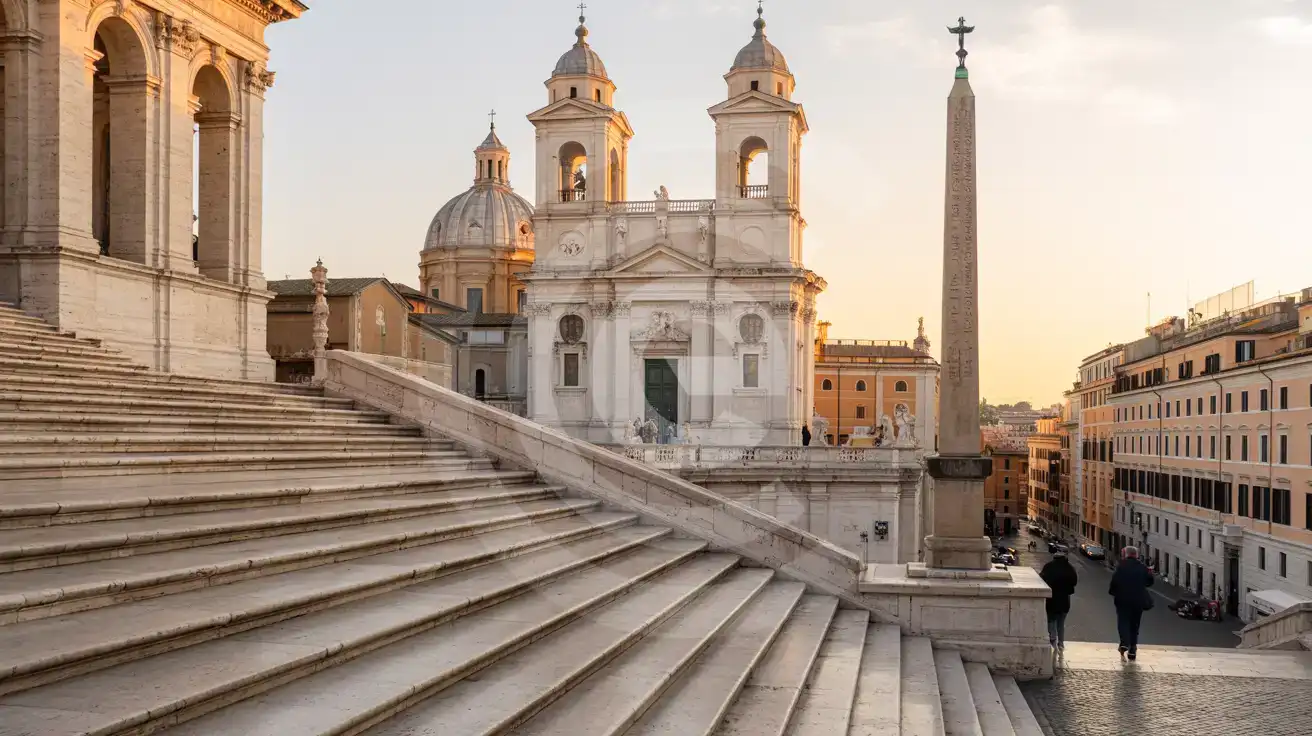
The red granite obelisk standing before Trinità dei Monti church isn't Egyptian — not originally, anyway. It's a Roman-era copy, carved with hieroglyphs that don't quite make sense to Egyptologists because they were decorative rather than meaningful. The obelisk once stood in the Gardens of Sallust on the Pincian Hill before Pope Pius VI ordered it moved to its current location in 1789. At roughly 14 meters tall, it frames photographs of the steps from below and provides a vertical counterpoint to the horizontal flow of the staircase.
Trinità dei Monti Church
The twin-towered French church at the summit predates the steps by more than two centuries. King Louis XII of France founded it in 1502 as a church for the Order of Minims, and it was consecrated in 1585. The facade, with its distinctive paired bell towers, defines the Roman skyline from multiple vantage points across the city.
Inside, the church contains notable works of Mannerist painting. Daniele da Volterra's Deposition (or Descent from the Cross), completed around 1545, hangs in the second chapel on the left. Art historians rank it among the finest works of the Roman Mannerist period — Michelangelo himself praised it. The church typically opens late morning through early evening with a midday closure; modest dress is required.
The Keats-Shelley Memorial House
The pink-fronted building immediately to the right of the steps (facing up) is where John Keats spent his final months. He arrived in Rome in November 1820, hoping the warmer climate might ease his tuberculosis. It didn't. He died in the small corner room overlooking the steps on February 23, 1821.
The house is now a museum and library dedicated to the English Romantic poets. Keats's death room has been preserved, complete with the daisy-pattern ceiling he stared at during his final days. The library holds first editions of works by Keats, Shelley, Byron, and their contemporaries. Admission runs approximately €6-7, and the museum opens Monday through Saturday.
The View from the Upper Terrace
Climb all 135 steps and turn around. The view west across the Campo Marzio rooftops toward the dome of St. Peter's Basilica — visible on clear days — ranks among Rome's best. The terrace in front of Trinità dei Monti catches evening light beautifully, turning the travertine gold at sunset.
The May Azalea Display
Each spring, typically in late April through early May, the city's parks service decorates the central channel of the steps with thousands of potted azaleas in shades of pink, red, and white. The tradition dates back decades and transforms the monument into a cascade of color. Timing varies slightly each year depending on the weather and the blooming season.
The December Immaculate Conception Ceremony
On December 8 each year, the Feast of the Immaculate Conception, the Pope (or a papal representative) visits a column bearing a statue of the Virgin Mary in nearby Piazza Mignanelli, just off Piazza di Spagna. The ceremony draws crowds, and the steps are typically decorated with flowers for the occasion.
Via dei Condotti
The street running west from the base of the steps — visible straight ahead as you stand at the Barcaccia fountain — is Rome's most exclusive shopping street. Bulgari, Gucci, Prada, Salvatore Ferragamo, and Valentino all maintain flagship boutiques along its narrow length. Even if high fashion isn't your thing, the street offers one of Rome's most direct lines of sight toward the steps, making it a classic photography angle.
Visit Strategy
The Spanish Steps are free, open 24 hours, and located at one of Rome's most central Metro stations. This makes visiting easy. The challenge is visiting well.
Timing Your Visit
Early morning — before 8:30 a.m. — offers the quietest window. The steps face roughly west, so morning light illuminates Trinità dei Monti and the Sallustian Obelisk beautifully while keeping the staircase itself in softer shadow. You'll share the space with joggers, dog walkers, and perhaps a few other photographers, but nothing like the midday crowds.
Late evening, after 9:00 p.m., is the second-best window. The steps are illuminated, the day-trippers have dispersed, and the atmosphere turns romantic in a way that justifies every cinematic cliché ever filmed here. Police still patrol, so don't try to sit, but walking the steps in the quiet of a Roman evening is a different experience entirely from the daytime crush.
Midday — roughly 11:00 a.m. to 7:00 p.m. during the tourist season (April through October) — is the most crowded period. You'll still be able to walk up and down, but photography becomes a game of waiting for gaps in the human traffic. The sitting ban has actually helped somewhat; without clusters of people lounging on the steps, foot traffic flows more freely than it once did.
Getting There
Spagna Metro station on Line A (the orange line) exits directly into Piazza di Spagna. From Roma Termini, the journey takes about 10 minutes with trains running every 3-5 minutes during the day. The station elevator deposits you at street level facing the Barcaccia fountain — one of Rome's more theatrical Metro arrivals.
Walking from other landmarks: the Trevi Fountain is roughly 10 minutes south through the narrow streets of the Tridente; Piazza del Popolo is 10 minutes north along Via del Babuino; the Pantheon is 15-20 minutes through the medieval street grid. These walks are part of experiencing the centro storico, and none of them requires navigation apps once you've oriented yourself — just follow the crowds moving toward or away from the steps.
The Sitting Ban in Practice
Since 2019, sitting on the steps is prohibited. This isn't a suggestion — police actively patrol, particularly during high-traffic hours, and fines range from €250 for a first offense to €400 for repeat violations. Eating and drinking on the steps are similarly prohibited.
What you can do: walk, stand, photograph, linger on landings while taking pictures. The enforcement focuses on people who park themselves on the steps for extended periods, not on tourists pausing briefly to frame a shot. Just keep moving.
Recommended Duration
The steps themselves take five minutes to climb if you're in a hurry. But that misses the point. Budget at least 30-45 minutes to appreciate the full experience: the Barcaccia fountain at the base, the climb itself (pausing at the curved landings), the view from the upper terrace, a peek inside Trinità dei Monti if it's open, and a walk back down. Add another 30-45 minutes if you plan to visit the Keats-Shelley Memorial House. The house museum is compact but dense with literary history.
Combining with Other Sites
The Spanish Steps anchor one end of Rome's classic walking route through the historic center. A logical sequence: start at the steps early morning, walk to the Trevi Fountain (10 minutes), continue to the Pantheon (another 15 minutes), then loop back via Piazza Navona and Campo de' Fiori. This covers most of Rome's Baroque highlights in a single morning before the afternoon crowds peak.
Alternatively, climb the steps to Trinità dei Monti, continue uphill to the Villa Medici gardens and the Pincio terrace (about 10 minutes), and enjoy views across Piazza del Popolo to St. Peter's dome. The Pincio connects to the Villa Borghese gardens, making it possible to spend an entire morning in Rome's green belt before descending back to the centro storico for lunch.
Best Time to Visit and Photographer's Guide
The Spanish Steps photograph well in almost any light, but certain conditions separate a good shot from a memorable one.
Month-by-Month Crowd and Weather
January-February: Rome's quietest tourist months. Temperatures hover around 8-12°C (46-54°F), with occasional rain. The steps are manageable even at midday. February light can be soft and flattering, though overcast days are common.
March-April: Shoulder season begins. Easter crowds spike for 10-14 days around the holiday, but otherwise visitor numbers remain moderate. Late April brings the azalea display — spectacular for photography but also increased crowds. Temperatures climb to 15-20°C (59-68°F).
May: Peak azalea season (usually early May) transforms the central channel into a cascade of pink and red blooms. This is the most photogenic period of the year but also one of the busiest. Book accommodation early if you're timing a visit specifically for the flowers.
June-August: High summer. Temperatures reach 30-35°C (86-95°F), and midday visits are uncomfortable. Tourist numbers peak. The saving grace: long days mean sunrise comes early (around 5:30 a.m. in June) and golden hour extends past 8:00 p.m.
September-October: The second shoulder season. Crowds thin after mid-September, temperatures moderate to 18-25°C (64-77°F), and the quality of light improves as the sun sits lower in the sky. Many photographers consider October ideal.
November: Quieter again. Some rainy days, but fewer crowds. The surrounding streets take on a melancholy beauty.
December: The Feast of the Immaculate Conception on December 8 brings ceremonies and flowers. Christmas decorations appear throughout the centro storico. Expect crowds around the holidays but quieter periods before and after.
Best Time of Day
Sunrise (5:30-7:00 a.m. summer, 7:00-8:00 a.m. winter): The most reliable window for empty steps. Morning light strikes Trinità dei Monti and the obelisk while the staircase remains in soft shadow. This is the time for clean architectural shots without human traffic.
Golden hour (1-2 hours before sunset): The travertine steps glow warm orange as the sun drops toward St. Peter's dome in the west. The upper terrace faces almost directly into the sunset — dramatic for portraits and wide shots looking west over the rooftops. Crowds are still present but thinning as people head to dinner.
Blue hour (30 minutes after sunset): The artificial illumination of the steps kicks in as the sky deepens to cobalt. This is the window for moody, atmospheric shots that capture the steps' theatrical lighting design. Fewer tourists than golden hour, though some remain.
Night (after 9:00 p.m.): The steps are beautifully lit and nearly empty. Night photography with a tripod — if allowed — produces images that feel like a private Rome.
Best Photo Spots
The Barcaccia Fountain angle: Stand at the fountain and shoot up the full length of the steps toward Trinità dei Monti. The classic postcard view. Works best in morning light.
The Via dei Condotti sightline: Walk 50-100 meters down Via dei Condotti and turn back. The steps frame perfectly between the luxury boutiques. Best at golden hour when the sun illuminates the facade.
The upper terrace wide shot: From the terrace in front of Trinità dei Monti, shoot back down the steps toward Piazza di Spagna. This angle works best at sunset, with the rooftops of the Campo Marzio in the background and — on clear days — the dome of St. Peter's visible in the distance.
The Sallustian Obelisk frame: Position yourself to shoot past the obelisk with Trinità dei Monti's twin towers behind. The vertical obelisk against the horizontal church facade creates strong geometric tension.
The Keats-Shelley House doorway: The pink facade and green shutters of Keats's death house photograph beautifully, especially with the steps rising behind. A story-rich image.
The Pincio terrace overlook: Climb past Trinità dei Monti to the Pincio terrace in the Villa Borghese gardens. From here, you can photograph the Spanish Steps in context with the Roman rooftops stretching toward St. Peter's.
Side landings at the curves: The mid-level landings where the side flights converge offer interesting angles looking both up and down the staircase. Less crowded than the main viewing spots.
Drone and Tripod Rules
Drone flights are prohibited over Rome's historic center without special permits from ENAC (the Italian civil aviation authority) and the Comune di Roma. The Spanish Steps fall within the no-fly zone, and enforcement is active. Don't try it.
Tripods occupy a gray area. There's no explicit ban, but police may ask you to move if your equipment blocks foot traffic or if they decide you're conducting commercial photography. Early morning or late evening — when crowds are minimal — offers the best chance of using a tripod without interference. Monopods attract less attention and work for most stabilization needs.
Hidden Sub-Spots Most Tourists Miss
The side alley behind Via dei Condotti: Vicolo del Bottino runs parallel to Via dei Condotti and offers glimpses of the steps through archways and between buildings — less polished compositions but more atmospheric.
The garden terrace at Trinità dei Monti: The small garden space to the side of the church (accessible when the church grounds are open) offers elevated angles without the crowded main terrace.
The back approach via Salita di San Sebastianello: Most visitors climb up from Piazza di Spagna. Approach instead from Via Sistina at the top, descending past the Hassler Hotel toward the obelisk. You'll see the steps unfold below you — a perspective most tourists never experience.
Piazza Mignanelli: This small square adjacent to Piazza di Spagna contains the Column of the Immaculate Conception and offers a slightly offset angle on the Barcaccia fountain and the lower steps without the head-on tourist crowd.
The Hassler Hotel rooftop bar: If you're willing to pay luxury bar prices, the rooftop terrace of the Hotel Hassler Roma (at the top of the steps) offers aerial views over the entire staircase and the centro storico beyond. Best at sunset.
Nearby Attractions and Logistics
The Spanish Steps sit at the heart of Rome's Tridente — the trio of streets (Via del Babuino, Via del Corso, Via di Ripetta) that fan southward from Piazza del Popolo. This is walkable Rome at its best.
Within 10 Minutes on Foot
Trevi Fountain: Walk 7-10 minutes south through Via dei Due Macelli and Via del Tritone. Nicola Salvi's Baroque masterpiece, completed in 1762, marks the terminus of the Acqua Vergine aqueduct — the same water source that feeds the Barcaccia fountain at the steps. Budget 15-20 minutes at the fountain; the coin-throwing crowds can be intense.
Piazza del Popolo: Walk 10 minutes north along Via del Babuino. Giuseppe Valadier redesigned this oval square in the early 19th century, framing the Egyptian obelisk of Ramesses II between the twin churches of Santa Maria in Montesanto and Santa Maria dei Miracoli. The ramp to the Pincio terrace climbs from the square's eastern edge.
Via dei Condotti shopping district: Directly west from the base of the steps. Bulgari, Gucci, Prada, Salvatore Ferragamo, and Valentino anchor the street. Even if you're not buying, the window displays and people-watching justify a stroll. The Antico Caffè Greco — founded in 1760, once frequented by Goethe, Stendhal, and Casanova — sits at number 86.
Within 15-20 Minutes on Foot
The Pantheon: Walk 15-20 minutes south through the medieval street grid via Via della Croce and Via del Corso. Hadrian's temple-turned-church, with its 43-meter unreinforced dome and oculus open to the sky, ranks among Rome's essential monuments. Free entry since 2023 (donation requested).
Piazza Navona: Continue past the Pantheon another 5 minutes to reach this elongated Baroque square, built over the footprint of Domitian's ancient stadium. Bernini's Fountain of the Four Rivers anchors the center.
Ara Pacis and the Mausoleum of Augustus: Walk 10-12 minutes west toward the Tiber. The Ara Pacis — Augustus's altar of peace, completed in 9 BCE — sits in a controversial glass pavilion designed by Richard Meier (opened 2006). The adjacent Mausoleum of Augustus reopened to visitors in 2021 after extensive restoration.
Getting Around
Metro Line A: Spagna station connects to Termini (10 minutes), Barberini/Trevi (2 minutes), Flaminio/Piazza del Popolo (2 minutes), and Vatican area at Ottaviano (6 minutes).
Bus routes 117 and 119: Small electric buses navigate the centro storico's narrow streets. The 117 connects the Spanish Steps area to the Colosseum via Piazza Venezia. The 119 loops through the Tridente.
Walking: The centro storico is compact enough that walking beats public transport for most destinations. Termini is roughly 25 minutes on foot via Via del Tritone and Via Nazionale.
Food and Coffee Near the Steps
Antico Caffè Greco (Via dei Condotti 86): Rome's oldest surviving café, founded 1760. Expensive, but you're paying for literary history — this is where the Romantics gathered.
Ciampini (Piazza Trinità dei Monti): A café with terrace seating at the top of the steps. Tourist-priced, but the views are real.
Giolitti (Via degli Uffici del Vicario 40): A 15-minute walk toward the Pantheon brings you to one of Rome's classic gelaterie, operating since 1900.
Roscioli Salumeria (Via dei Giubbonari 21): A 20-minute walk into the Campo de' Fiori area for serious Roman cuisine — cured meats, cheeses, and some of the city's best carbonara.
Why Data Matters at the Spanish Steps
The Spanish Steps themselves don't require connectivity — they've stood for three centuries without WiFi. But the experience around them often does.
Navigating from Spagna Metro to the steps is straightforward; navigating from the steps to a recommended restaurant through Rome's medieval street grid less so. Google Maps and Citymapper make the difference between a confident walk and a frustrating zigzag past dead-end alleys. Real-time transit updates matter when you're deciding whether to walk 25 minutes to Termini or catch a bus on Via del Corso.
The Keats-Shelley Memorial House hours vary; a quick check online saves a wasted trip. The azalea display dates shift annually; social media shows what's blooming. Trinità dei Monti closes for services without posted schedules — a live search confirms access.
An eSIMno plan running on Vodafone or Wind Tre networks gives you reliable 4G/5G coverage throughout the centro storico, including inside Spagna Metro station and on the steps themselves. Install before departure, activate on landing at Fiumicino, and walk out of the airport already connected. No queue at an airport SIM kiosk, no hunting for the right size card, no Italian-only menus on a vending machine. That's the practical case for arriving with data already sorted.
The Spanish Steps at Golden Hour
Compare WiFi Options at Spanish Steps
 Recommended Recommended | Local SIM / Operator | Roaming | |
|---|---|---|---|
| FEATURES | |||
| Setup time | Few minutes | Store visit + paperwork | Auto |
| No local ID needed | Online checkout | Local ID required | Use home account |
| Speed | 4G/LTE; 5G in some areas | Carrier-grade | Partner-dependent |
| Travel support | English support 24/7 | Operator shops and call centre | Home carrier hours |
| Keep home number | Dual SIM | Replaces it | Same number |
| Cost predictability | Fixed price | Bills can spike | Bill-shock risk |
| PRICING | |||
Typical pricing | See plans below | — | — |
PRICING — PICK YOUR ESIMNO PLAN
Featured eSIM plans
Italian Mobile

Italian Mobile
Italian Mobile
Italian Mobile
Italian Mobile
Italian Mobile
Italian Mobile
Italian Mobile


