
Quick Facts
- Location
- South of Dade Boulevard, Miami Beach barrier island
- Beach Length
- Approximately 2 miles (1st to 23rd Street)
- Beach Access
- Free, open daily
- Lifeguard Hours
- Daily 9:00 AM – 7:00 PM (shorter in winter)
- Art Deco Buildings
- 800+ protected structures
- Historic District Added
- National Register, 1979
- Parking
- Municipal garages ~$4/hour (7th, 12th, 17th Street)
- Transit
- Free Miami Beach Trolley, Route 150 bus from MIA
- eSIMno Networks
- AT&T, T-Mobile, Verizon
About South Beach
South Beach exists because a handful of determined preservationists refused to let bulldozers win. The neighborhood occupies the southern tip of Miami Beach, a barrier island that sits across Biscayne Bay from downtown Miami, and its transformation from mosquito-infested mangrove swamp to international destination spans barely a century. Carl Fisher, the automotive entrepreneur who built the Indianapolis Speedway, dredged the bay and laid out streets in the 1910s. By the 1920s and 1930s, architects drawn to the Florida land boom were designing hotels and apartment buildings in the emerging Art Deco and Streamline Moderne styles — geometric facades, porthole windows, neon signage, and decorative reliefs that referenced ocean liners, tropical flora, and the Jazz Age optimism that defined the era.
The neighborhood's protected status came remarkably close to never happening. By the 1970s, South Beach had deteriorated into a neglected retirement community with crumbling buildings and rising crime. Developers saw the valuable oceanfront land and planned demolitions. Barbara Baer Capitman, a designer and writer, founded the Miami Design Preservation League in 1976 and spent years documenting, photographing, and advocating for the district's architectural significance. Her efforts culminated in 1979 when a one-square-mile area became the first 20th-century neighborhood listed on the National Register of Historic Places.
What visitors see today — roughly 800 preserved buildings painted in pastels that range from flamingo pink to seafoam green — represents an aesthetic that didn't actually exist in the 1930s. The original color schemes were predominantly white and off-white. The vibrant palette came later, popularized by designer Leonard Horowitz in the 1980s as part of a revitalization effort that coincided with the television show Miami Vice putting these streets on screens worldwide. The authenticity lies in the structures themselves: the Colony Hotel at 736 Ocean Drive with its iconic blue neon sign, the Carlyle at 1250 with its three vertical neon strips, the Beacon at 720 with its ziggurat-style roofline, the Breakwater at 940 with its central tower and racing stripes, the Park Central at 640 with its bas-relief ornamentation.
South Beach isn't owned or operated by any single entity. The City of Miami Beach manages the beach itself and Lummus Park, while everything else — the hotels, restaurants, clubs, and condominiums — operates independently within the historic district's preservation guidelines. This creates a neighborhood that functions simultaneously as a beach resort, a nightlife destination, an architectural museum, a fashion-industry backdrop, and a Cuban-American cultural zone where the rhythm of salsa and the smell of cortadito spill from cafés along Ocean Drive at all hours.
Highlights & Must-See
Ocean Drive and the Art Deco Historic District
The ten blocks between 5th Street and 15th Street along Ocean Drive contain the neighborhood's highest concentration of landmark buildings and its most persistent energy. Walking north from 5th, you'll pass the Beacon Hotel with its stepped roofline, the Colony Hotel where the blue neon sign has been photographed more times than anyone could count, and the Waldorf Towers with its distinctive corner turret. At 1116 Ocean Drive stands Casa Casuarina, the 1930 Mediterranean Revival mansion that Gianni Versace purchased in 1992 and expanded before his murder on the front steps in 1997 — it operates today as the Villa Casa Casuarina hotel and restaurant, its ornate gates perpetually surrounded by tourists. The Art Deco Welcome Center at 1001 Ocean Drive serves as the headquarters for the Miami Design Preservation League, offering guided walking tours that cover architectural details and preservation history that you'd miss on your own.
Lummus Park and the Lifeguard Towers
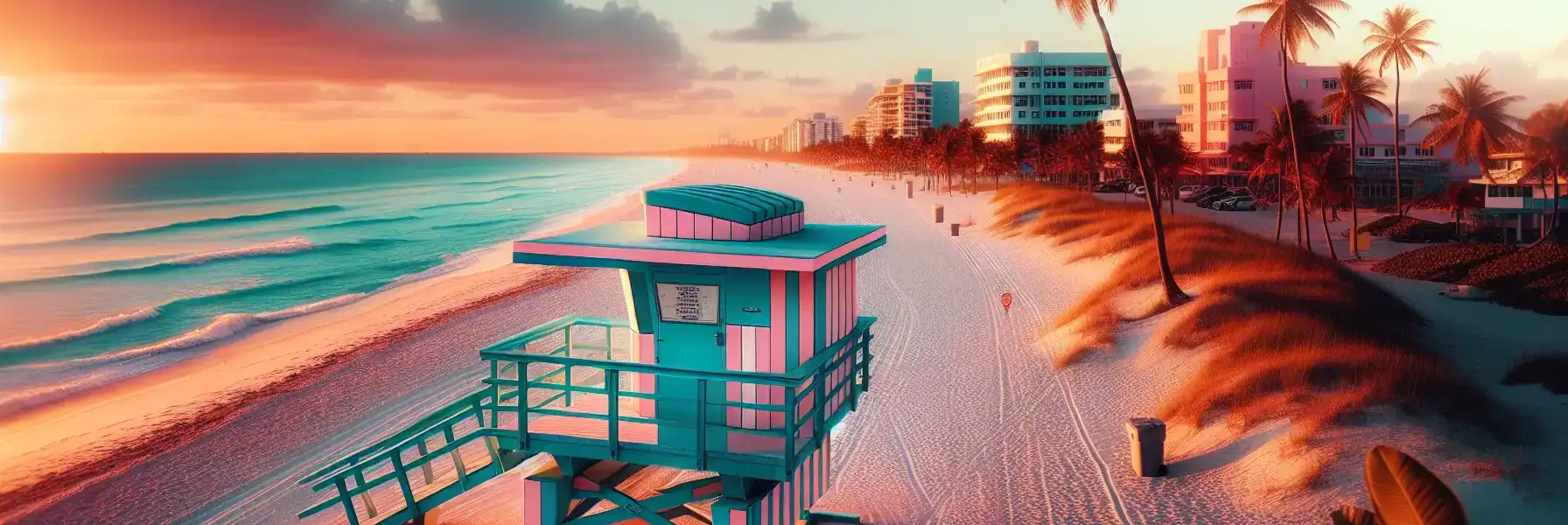
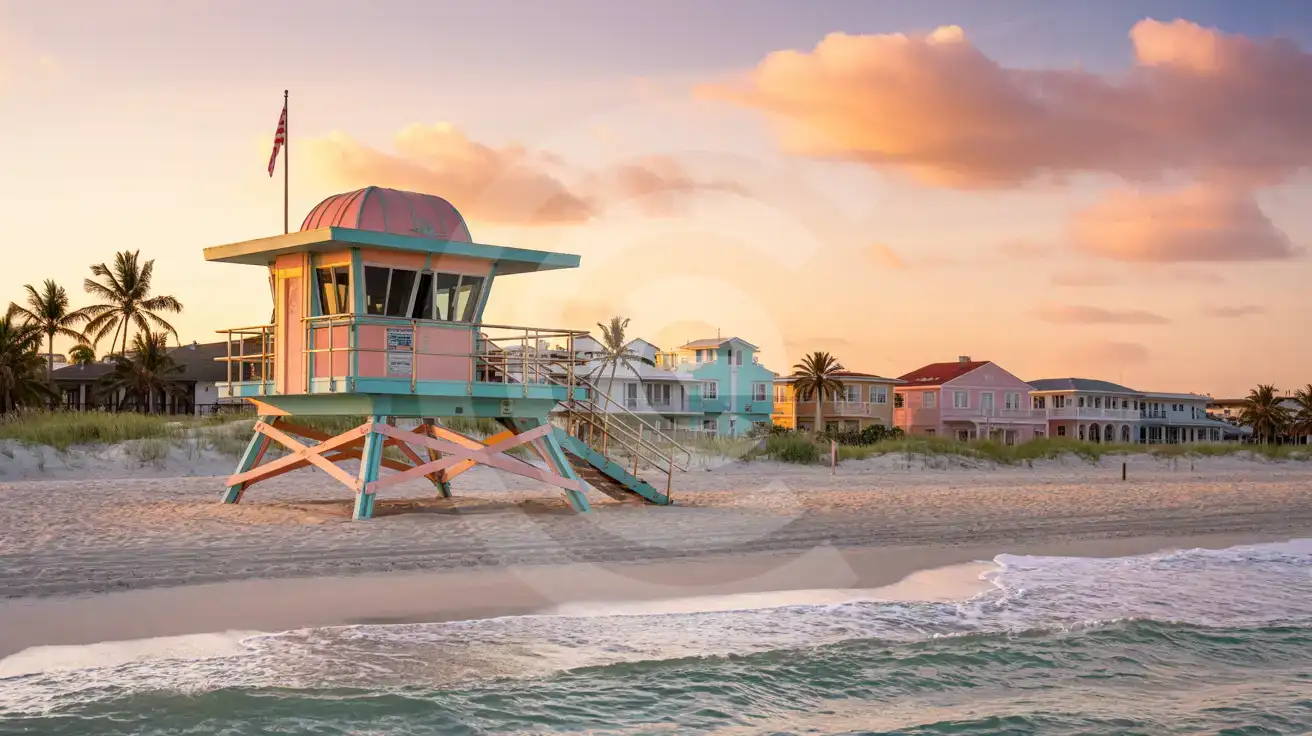
Between Ocean Drive's sidewalk and the sand lies Lummus Park, a grassy strip stretching from 5th to 14th Street that contains outdoor fitness stations (the original Muscle Beach South Beach), volleyball courts, and the famous lifeguard towers. These colorful wooden structures — designed by architect William Lane in varying configurations of Post-Modern whimsy — have appeared in countless films, television shows, and fashion shoots. Each tower sports a different color combination: aqua and pink at one stand, yellow and purple at another. They're operational rather than decorative, staffed by Miami Beach lifeguards who monitor swimmers daily. The best photography light hits the towers in early morning before the crowds arrive or in late afternoon when the western sun casts long shadows across the sand.
Lincoln Road Mall
Eight blocks north of the main beach action, Lincoln Road runs east-west between Washington Avenue and Alton Road as a pedestrianized shopping and dining promenade. The street itself dates to the 1920s, but its current incarnation emerged from a 1960 redesign by Morris Lapidus, the same architect responsible for the Fontainebleau Hotel. Lapidus created the broad pedestrian walkways, the sculptural concrete canopies, and the open-air atmosphere that defines the street today. Major retailers include Apple, Zara, H&M, and Anthropologie, while independent bookshop Books & Books has anchored a corner since 1982. Restaurants worth noting include Juvia, the rooftop Japanese-Peruvian fusion spot with skyline views, and Meat Market, an upscale steakhouse that draws a late-night crowd. A farmers market operates on Sundays from 9 a.m. to 6:30 p.m., filling the pedestrian corridor with produce vendors, artisan food stalls, and live music.
Española Way
This two-block stretch between Washington Avenue and Drexel Avenue offers a Mediterranean fantasy in the middle of Miami Beach. Built in 1925, the lane was designed to evoke a Spanish village, complete with wrought-iron balconies, terracotta roof tiles, and stucco facades painted in coral and ochre. The original vision imagined an artists' colony; the reality became a string of restaurants, gelaterias, and small hotels. Hosteria Romana serves Roman-style Italian, Oh! Mexico offers tacos and margaritas beneath string lights, and on weekend evenings the narrow street fills with salsa music and outdoor dancers. Española Way represents a visual break from the Art Deco dominant elsewhere — proof that South Beach's architectural history includes more than one vocabulary.
South Pointe Park and Pier
At the very southern tip of Miami Beach, where Government Cut separates the island from Fisher Island, South Pointe Park offers 17 acres of green space, a playground, a fishing pier, and front-row views of cruise ships entering and leaving PortMiami. The Smith & Wollensky steakhouse occupies the point itself, its outdoor deck positioned for sunset watching. A promenade runs along the jetty, and the pier extends into the channel where anglers cast lines for snook and tarpon. This is the quietest section of South Beach's shoreline, drawing joggers, dog-walkers, and families rather than the party crowd that dominates the Lummus Park section.
The Bass Museum of Contemporary Art
Located at 2100 Collins Avenue in Collins Park, The Bass houses a permanent collection of contemporary art in a building originally designed as the Miami Beach Library and Art Center in 1930, later expanded and renovated by Arata Isozaki in 2001 and again for a 2017 reopening. Exhibitions rotate frequently, featuring video installations, sculpture, and works by emerging and established international artists. Admission runs around $15 for adults, with reduced rates for students and seniors. The museum sits within a cultural campus that includes the Miami City Ballet and the Miami Beach Regional Library.
The Wolfsonian–FIU
On Washington Avenue at 10th Street, the Wolfsonian houses the Mitchell Wolfson Jr. collection of decorative and propaganda arts from 1885 to 1945 — a period the museum describes as 'the modern era.' The building itself, a 1927 Mediterranean Revival warehouse, contains over 180,000 objects ranging from furniture and industrial design to political posters and architectural drawings. The permanent collection explores how design has been used to promote ideologies, sell products, and shape public opinion. General admission is approximately $12; Friday evenings from 6 to 9 p.m. are free.
The Versace Mansion (Villa Casa Casuarina)
The ornate entrance gates at 1116 Ocean Drive draw constant foot traffic from visitors photographing the location where Gianni Versace was shot on July 15, 1997. The building itself — originally the Amsterdam Palace, constructed in 1930 — was purchased by Versace in 1992 and expanded to include a 54-foot mosaic pool lined with 24-karat gold. Today it operates as a boutique hotel with a restaurant open to non-guests for dinner and Sunday brunch. The interior features Versace's original decorative elements, including frescoes, custom tiles, and the infamous South Beach excess that defined its era.
Visit Strategy
Best Time to Visit
South Beach operates year-round, but the season matters more than most destinations. Late November through April delivers the optimal combination of pleasant temperatures (ranging 21–27°C / 70–80°F), lower humidity, and minimal rain. This is also peak season for pricing and crowds — hotel rates climb dramatically during Art Basel in early December, the South Beach Wine & Food Festival in February, and Miami Beach Pride in April. If you're budget-conscious and heat-tolerant, May and early June offer reduced rates before the worst of summer humidity arrives. Hurricane season officially runs June through November, with September historically the peak month for major storms. The beach doesn't close for approaching hurricanes until mandatory evacuations are ordered, but planning a trip during September means accepting some weather risk.
Timing Your Day
The difference between a pleasant South Beach morning and a miserable midday experience comes down to roughly four hours. Arrive at the beach by 8 or 9 a.m. and you'll find cooler sand, emptier stretches near Lummus Park, and morning light that makes the lifeguard towers glow. By noon, the sand temperature rises to genuinely uncomfortable levels — the pale quartz reflects intensely and retains heat — and the Ocean Drive sidewalks fill with visitors. Late afternoon brings the second optimal window: the sun drops behind the hotels by 5 or 6 p.m. depending on season, shadows lengthen across the beach, and the Art Deco facades catch golden-hour light. Nightlife along Ocean Drive starts coming alive around 10 p.m. and doesn't wind down until well past 3 a.m.
Photography Strategy
The Art Deco buildings photograph best in early morning (roughly 7–9 a.m.) when eastern light illuminates the Ocean Drive facades directly, or at sunset when the western sky provides dramatic backdrops. The lifeguard towers in Lummus Park face east toward the water, meaning morning light hits them from behind while afternoon light illuminates them against the ocean background — choose based on whether you want silhouettes or saturated colors. For interior photography at Casa Casuarina, The Bass, or the Wolfsonian, standard museum restrictions apply: no flash, no tripods, and some special exhibitions prohibit all photography.
Navigating the Crowds
The Lummus Park beach section between 10th and 12th Streets draws the densest crowds, concentrated around the most photographed lifeguard towers and the adjacent bars and restaurants. Walking north above 15th Street or south toward 3rd Street thins the crowd considerably. Lincoln Road peaks on weekend afternoons, particularly during the Sunday farmers market; visit on a weekday morning for easier navigation. Ocean Drive restaurant patios fill throughout the day with tourists, but the restaurants one or two blocks inland — Collins Avenue, Washington Avenue — serve the same cuisine to more local crowds at better prices.
Dress and Entry
The beach itself has no dress code beyond standard swimwear requirements, and topless sunbathing is legal on Miami Beach though not universally practiced. Lummus Park permits alcohol in non-glass containers, though enforcement varies. Restaurants along Ocean Drive and Lincoln Road range from casual to upscale — beachwear with a cover-up works for lunch, while dinner at higher-end spots expects something beyond flip-flops and tank tops. Nightclubs enforce strict dress codes: closed-toe shoes for men, no athletic wear, and 21+ age verification at the door.
Duration and Pacing
A thorough South Beach visit requires at least a full day, ideally two. One day allows for a morning beach session, an afternoon walk through the Art Deco district with stops at the Wolfsonian or The Bass, and an evening exploring Lincoln Road and Ocean Drive. Two days lets you add South Pointe Park, Española Way, a walking tour through the Miami Design Preservation League, and proper time at both museums without rushing. Day-trippers from cruise ships or Miami hotels typically see only the most crowded sections of Ocean Drive — which is better than nothing, but misses much of what makes the neighborhood distinct.
Activities, Safety & Best Times
Water Activities
Swimming conditions at South Beach favor casual bathers rather than serious surfers. The Atlantic here produces gentle waves most of the year — rarely exceeding 2–3 feet — with a gradual sandy bottom that extends well offshore. This makes the beach ideal for wading, bodyboarding, and beginner paddleboarding, but surfers seeking real breaks head north to Haulover or south to the jetties near South Pointe. Rental operations along the beach offer paddleboards ($25–40/hour), kayaks ($30–50/hour), and jet skis ($80–150/hour depending on duration). Boucher Brothers operates multiple concession stands along Lummus Park offering chair and umbrella rentals ($20–40/day for a chair, $50–80 for a full setup including umbrella). Snorkeling holds limited appeal — the water visibility near the beach averages 10–20 feet, and the sandy bottom lacks reef structure — though more ambitious snorkelers can join boat trips to nearby artificial reefs.
Beach Clubs & Restaurants
The concept of a 'beach club' at South Beach means something different than Mediterranean resort culture. There's no enclosed beach-club infrastructure along Lummus Park; instead, the model involves hotel pools with day passes, beachside bars, and food service delivered to your rental chair. The Fontainebleau and the Faena — both technically in Mid-Beach rather than South Beach proper — operate the most elaborate poolside setups. Along the South Beach stretch itself, the Clevelander on Ocean Drive at 10th Street offers a beachside bar and pool with constant music and a spring-break atmosphere. For dining adjacent to the sand, Smith & Wollensky at South Pointe offers steakhouse fare with cruise-ship views. A La Folie sits along the beach near 13th Street serving French crêpes and sandwiches. Palace Bar at 12th Street is both a restaurant and a drag-show venue, its outdoor seating becoming a prime spot for people-watching along the boardwalk.
Best Time of Day & Year
Water temperatures range from approximately 73°F (23°C) in winter months to 86°F (30°C) in late summer — swimmable year-round but noticeably warmer June through October. Jellyfish appear sporadically, with higher concentrations in late summer and fall when southeastern winds push Portuguese man-of-war toward shore. Lifeguards post purple flags to indicate dangerous marine life presence. The calmest water conditions typically occur morning hours before afternoon sea breezes develop; by 2 or 3 p.m., small chop makes swimming slightly less comfortable. Crowd density follows a predictable pattern: early morning (7–9 a.m.) brings joggers and locals; mid-morning through mid-afternoon (10 a.m.–4 p.m.) sees peak tourist concentration; late afternoon into sunset draws photographers, happy-hour seekers, and a more relaxed energy.
Lifeguard, Flag System & Safety
Miami Beach lifeguards staff the distinctive towers daily from approximately 9 a.m. to 7 p.m., with shortened hours in winter months. The flag system indicates conditions: green means calm water and low hazard, yellow signals moderate surf or currents, red warns of dangerous conditions with high surf or strong currents, double red means water is closed to swimming, and purple indicates dangerous marine life. Rip currents pose the primary drowning risk — they form when water channeled back to sea creates fast-moving streams that can pull even strong swimmers offshore. If caught in a rip, swim parallel to shore rather than fighting directly against the current. The quartz sand reflects UV intensely; even visitors who tan easily find themselves burning faster than expected. Apply waterproof SPF 30+ sunscreen before arriving and reapply every 90 minutes.
Getting There & Parking
From Miami International Airport (MIA), the most economical option is the Miami Beach Airport Express bus (Route 150), which runs along Washington Avenue through South Beach for $2.65 one-way; travel time averages 35–50 minutes depending on traffic. Rideshares (Uber, Lyft) from MIA run $30–45 and take 20–35 minutes. From downtown Miami, Metrobus routes 103, 119, and 120 cross the causeway for $2.25. Once on the island, the free Miami Beach Trolley operates a South Beach Loop along Washington and Collins Avenues. Parking fills quickly on weekends and during events; municipal garages at 7th Street, 12th Street (1100 Collins Avenue), and 17th Street near Pennsylvania Avenue charge approximately $4 per hour or $20–30 for full-day parking. Street meters use the PayByPhone app. Citi Bike Miami operates docking stations throughout the neighborhood — a 30-minute ride costs $4.50 — making two-wheeled exploration practical for covering distance between Lincoln Road and South Pointe.
Nearby Attractions & Logistics
Within Walking Distance
Everything between South Pointe Park and Lincoln Road falls within reasonable walking distance — roughly 1.5 miles end to end, entirely flat, with shade from palm trees along the park sections. The Art Deco Welcome Center at 1001 Ocean Drive makes a logical starting point for orientation. Española Way lies three blocks west of Ocean Drive between 14th and 15th Streets. Lincoln Road runs eight blocks north of the main beach action, an easy 15–20 minute walk or a quick trolley ride.
Short Drives and Rides
Wynwood Walls, the open-air street-art complex on NW 2nd Avenue between 25th and 26th Streets, sits approximately 15 minutes west across the MacArthur Causeway. The murals rotate regularly, and the surrounding Wynwood Arts District has developed into a gallery, restaurant, and nightlife zone. Combine Wynwood with the Pérez Art Museum Miami (PAMM) at Museum Park downtown — they're a 10-minute drive apart, and together they represent Miami's contemporary art ambitions.
Vizcaya Museum and Gardens, the 1916 Italianate estate built for industrialist James Deering, occupies 50 acres in Coconut Grove about 20 minutes south of South Beach. The house itself contains 34 rooms of European antiques, while the formal gardens include fountains, sculpture, and a limestone barge in Biscayne Bay.
Little Havana centers on Calle Ocho (SW 8th Street) in mainland Miami, roughly 20 minutes west. Domino Park at Máximo Gómez Park hosts Cuban men playing dominoes under the shade structure; Versailles Restaurant at 3555 SW 8th Street has served Cuban food since 1971; and the ventanita (walk-up window) culture means excellent cortadito and pastelitos without sitting down.
Food Worth Seeking
Joe's Stone Crab at 11 Washington Avenue has operated since 1913, serving stone crab claws (season runs mid-October through early May) in a no-reservations dining room where waits can exceed two hours on peak nights. Puerto Sagua, a Cuban diner on Collins Avenue at 7th Street, offers breakfast and lunch at prices that feel transplanted from decades past. For Lincoln Road dining beyond the chain restaurants, Juvia's rooftop combines Japanese, Peruvian, and French influences with views across the neighborhood.
Transit Connections
PortMiami sits across Government Cut from South Pointe, visible from the park's promenade. Cruise passengers can reach South Beach in roughly 10 minutes by taxi or rideshare. For connections to greater Miami, the Metrorail system doesn't extend to Miami Beach island — the closest station is Government Center in downtown Miami, reachable via Metrobus routes across the causeway. Plans for a Beach Corridor transit extension have been discussed for decades without construction.
Why Data Matters at South Beach
South Beach functions best with a phone that works. The neighborhood sprawls across two miles of shoreline with restaurants that require OpenTable reservations, rideshare pickups on streets where parking doesn't exist, and an address system where the difference between 7th Street and 17th Street determines whether you're walking 10 minutes or 40. Google Maps becomes essential for navigating the distinction between Ocean Drive (expensive tourist traps), Collins Avenue (slightly better options), and Washington Avenue (where locals actually eat). Translation apps help with the Spanish-language menus at Cuban spots. Instagram-driven decisions about which lifeguard tower to photograph require checking conditions in real time.
An eSIMno plan connecting through AT&T or T-Mobile means your phone works immediately — no hunting for SIM card vendors, no airport kiosk lines, no hoping your hotel Wi-Fi reaches the pool. Activate before your flight lands at MIA and you'll have data for the Route 150 bus schedule, the Uber from baggage claim, and the OpenTable booking you'll make while still in the terminal.
South Beach at Golden Hour
Compare WiFi Options at South Beach
 Recommended Recommended | Local SIM / Operator | Roaming | |
|---|---|---|---|
| FEATURES | |||
| Setup time | Few minutes | Store visit + paperwork | Auto |
| No local ID needed | Online checkout | Local ID required | Use home account |
| Speed | 4G/LTE; 5G in some areas | Carrier-grade | Partner-dependent |
| Travel support | English support 24/7 | Operator shops and call centre | Home carrier hours |
| Keep home number | Dual SIM | Replaces it | Same number |
| Cost predictability | Fixed price | Bills can spike | Bill-shock risk |
| PRICING | |||
Typical pricing | See plans below | — | — |
PRICING — PICK YOUR ESIMNO PLAN
Featured eSIM plans
American Mobile

American Mobile
American Mobile
American Mobile
American Mobile
American Mobile


