
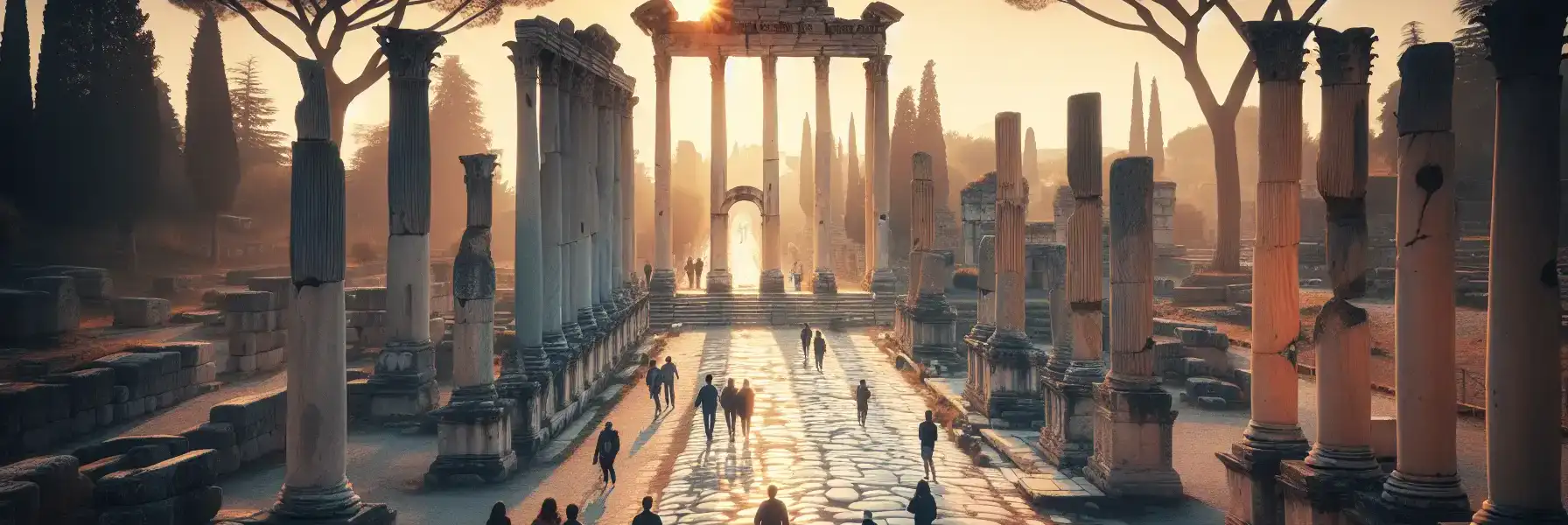
Quick Facts
- Address
- Via della Salara Vecchia 5/6, Rome
- Hours
- Daily 9:00 AM – closing varies (4:30 PM winter to 7:15 PM summer)
- Last Entry
- 1 hour before closing
- Standard Ticket
- €18 (combined Colosseum/Forum/Palatine)
- Full Experience Ticket
- €24 (includes restricted areas)
- Free Admission
- Under-18s; first Sunday of month
- Nearest Metro
- Colosseo (Line B) – 3 min walk
- Official Booking
- CoopCulture website
- UNESCO Status
- Historic Centre of Rome (1980/1990)
- Recommended Duration
- 90 minutes – 2.5 hours
- eSIMno Networks
- Vodafone, Wind Tre
About the Roman Forum
The Roman Forum — Forum Romanum in Latin, Foro Romano in Italian — occupies a rectangular valley between two of Rome's legendary seven hills. The Palatine rises to the south, site of Romulus's legendary founding and later the imperial palaces. The Capitoline looms to the west, crowned by temples to Jupiter and Juno that represented Rome's religious authority. Between them, this marshy depression was transformed around the 7th century BCE into the beating heart of a civilization that would eventually control the Mediterranean world.
The transformation required engineering that still impresses. The Cloaca Maxima, one of the world's earliest sewage systems, drained the swamp and channeled water into the Tiber. Traditionally attributed to the Etruscan king Tarquinius Priscus, this drainage project made permanent construction possible where previously only seasonal markets had functioned. Over the following millennium, the Forum accumulated temples, basilicas, monuments, and administrative buildings in layers that archaeologists continue to untangle.
For roughly a thousand years, this space hosted nearly every significant public function of Roman life. Elections took place here. Criminal trials drew crowds to the Rostra, the speaker's platform decorated with the prows (rostra) of captured enemy ships. Triumphal processions for victorious generals wound along the Via Sacra, the "Sacred Way" that bisects the Forum, before ascending to the Temple of Jupiter on the Capitoline. Gladiatorial combats were staged here before the Colosseum's construction. Religious festivals centered on the numerous temples lining the plaza. Markets operated in designated areas. Funeral orations for prominent citizens echoed across the stones.
The Forum witnessed moments that shaped Western history. Julius Caesar was cremated here in 44 BCE, on a pyre near the spot where Augustus later erected the Temple of Caesar (Tempio del Divo Giulio). Cicero delivered his Catiline Orations from the Rostra, rhetorical masterpieces still taught in Latin classes worldwide. The Vestal Virgins maintained Rome's sacred flame in the Temple of Vesta for over a millennium, their status as living embodiments of Roman religious continuity making them among the most powerful women in the ancient world.
After the Western Roman Empire's collapse in 476 CE, the Forum's decline accelerated. Buildings were stripped for materials, fires ravaged wooden structures, and gradually the valley filled with debris and sediment. By the medieval period, cattle grazed among the ruins — the area became known as "Campo Vaccino," the cow field. Churches were built atop some structures, inadvertently preserving them. Systematic excavation began only in the late 18th century and continues today, with new discoveries reported regularly around sites like the Lapis Niger and the adjacent Forum of Caesar.
The site now operates under the Parco archeologico del Colosseo, the same authority managing the Colosseum and Palatine Hill. Its 1980 UNESCO inscription as part of the Historic Centre of Rome recognizes not just the Forum's individual monuments but its role as the prototype for civic spaces throughout the Roman world — and, through them, for Western urban planning itself.
Highlights & Must-See Structures
Arch of Septimius Severus
Standing at the Forum's northwest corner near the ascent to the Capitoline, this triple-bay triumphal arch rises 23 meters high. Dedicated in 203 CE, it commemorates Emperor Septimius Severus and his sons Caracalla and Geta's victories over the Parthian Empire in Mesopotamia. The relief panels depict military campaigns with remarkable detail — siege engines, prisoners, and the emperor addressing troops. After Caracalla murdered Geta in 211 CE, his brother's name and image were chiseled away in a damnatio memoriae; look closely at the inscription to spot the erasure. The arch's preservation owes partly to medieval fortification — the Frangipane family converted it into a defensive structure.
Temple of Saturn
Eight towering Ionic columns of grey and red granite mark one of the Forum's oldest and most important religious sites. The temple was originally dedicated around 497 BCE, though the current columns date from a 4th-century CE reconstruction after fire. Saturn, associated with agriculture and wealth, made this an appropriate home for the Aerarium — the Roman state treasury. During Saturnalia each December, Romans celebrated with feasting, gift-giving, and a temporary inversion of social hierarchies that influenced later winter festivals.
House of the Vestal Virgins and Temple of Vesta
Along the Via Sacra's south side, near the Palatine slope, stands the complex that housed Rome's six Vestal Virgins. Selected between ages 6-10 from patrician families, these priestesses served 30-year terms maintaining the sacred fire in the adjacent circular Temple of Vesta. Their status was extraordinary: Vestals could own property, give testimony in court without swearing an oath, and moved freely through Rome with lictors clearing their path. The Atrium Vestae's rectangular courtyard still displays statues of chief Vestals around a central pool. The temple itself, partially reconstructed, shows the distinctive round form believed to echo Rome's earliest hut-temples.
Curia Julia
The large brick building on the Forum's north side housed the Roman Senate. Julius Caesar began its construction to replace an earlier Curia destroyed by fire; Augustus completed it around 29 BCE. The structure's remarkable preservation resulted from its 7th-century conversion into the church of Sant'Adriano, which protected it through the medieval period. Step inside to see the original opus sectile marble floor — geometric patterns in colored stone that once witnessed debates shaping an empire. The bronze doors are replicas; the originals now grace the Basilica of San Giovanni in Laterano.
Arch of Titus
At the Forum's eastern end, where the Via Sacra climbs toward the Colosseum, this single-bay arch commemorates Emperor Titus's victory in the Jewish War and the destruction of Jerusalem's Second Temple in 70 CE. The inner reliefs are among Roman art's most famous images: soldiers carrying the Temple's menorah and silver trumpets in triumphal procession. For this reason, many Jewish visitors traditionally avoided passing through the arch — a custom that shifted after Israel's founding, when some walked through in the opposite direction. The inscription's gilded bronze letters were stolen long ago, but their mounting holes remain visible.
Basilica of Maxentius and Constantine
Three colossal coffered concrete vaults on the Via Sacra's north side are all that remain of the Forum's largest basilica. Emperor Maxentius began construction around 308 CE; after Constantine's victory at the Milvian Bridge in 312 CE, he completed and renamed it. The surviving northern aisle once had a southern counterpart of equal size, with a massive central nave rising above both. The scale influenced Renaissance architects — Bramante and Michelangelo studied these vaults when designing St. Peter's Basilica. A colossal statue of Constantine, fragments now in the Capitoline Museums, once sat in the western apse.
Temple of Antoninus and Faustina
The remarkably complete colonnade of this temple survives because of its conversion into the church of San Lorenzo in Miranda in the 7th century. Emperor Antoninus Pius dedicated it in 141 CE to his deified wife Faustina; after his own death and deification in 161 CE, the Senate added his name to the inscription. Grooves cut into the columns show where medieval workers tried unsuccessfully to pull them down for reuse. The baroque church façade now rises incongruously behind the ancient columns.
Rostra
This raised platform near the Arch of Septimius Severus served as Rome's primary speaker's platform. Its name derives from the ship prows (rostra) mounted on its face after a naval victory in 338 BCE. Mark Antony allegedly delivered his funeral oration for Caesar here. Cicero's severed head and hands were displayed on the Rostra after his murder in 43 BCE — grim evidence of the political violence that accompanied the Republic's collapse. The current structure dates from Julius Caesar's Forum reorganization.
Temple of Caesar (Temple of Divus Iulius)
The modest remains near the Forum's center mark where Julius Caesar was cremated in 44 BCE. Augustus constructed this temple over the cremation site, making it the first temple dedicated to a deified Roman leader. The altar's niche, behind protective glass, often holds fresh flowers left by visitors — a tradition continuing 2,000+ years after Caesar's death.
Via Sacra
Not a single structure but the processional road threading through the entire Forum, the Sacred Way remains paved with its original basalt polygonal stones in many sections. Triumphal processions followed this route from the Arch of Titus to the Temple of Jupiter on the Capitoline. Walking these stones, worn smooth by millions of feet over millennia, provides perhaps the Forum's most visceral connection to ancient Rome.
Visit Strategy
Best Times to Visit
The Forum's open archaeological terrain offers almost no shade, making timing critical for comfort. Early morning — arriving right at the 9:00 AM opening — provides the coolest temperatures and smallest crowds. The slanting light also transforms photography, picking out textures in ancient stonework that flatten under midday sun. The last two hours before closing offer similar advantages: lower crowds, softer light, and that golden-hour glow that makes Mediterranean ruins photograph like dream sequences.
Seasonal differences matter enormously. April through May and late September through October deliver the ideal combination of comfortable temperatures (typically 15-25°C), manageable crowds, and good light. July and August afternoons can exceed 35°C with no respite — if you must visit in summer, treat the 9:00 AM opening as a hard commitment or return for the final hours before closing. Winter offers surprisingly pleasant conditions: fewer visitors, mild temperatures, and low-angle light that photographers prize, though shorter hours limit available time.
Ticket Strategy
The standard €18 ticket covers the Colosseum, Roman Forum, and Palatine Hill as a combined experience valid for 24 hours. Critically, the Colosseum portion requires a timed entry slot — you cannot simply show up. Book through the official CoopCulture website at least several weeks ahead, especially for peak season. The Forum and Palatine count as a single visit on this ticket, meaning you can move freely between them but cannot exit and re-enter.
The €24 Full Experience ticket adds restricted areas including the Domus Tiberiana on the Palatine, the church of Santa Maria Antiqua with its Byzantine frescoes, and the Palatine Museum. For serious history enthusiasts, the additional access justifies the price increase. EU citizens aged 18-25 qualify for reduced rates; under-18s enter free regardless of nationality.
The first Sunday of each month brings free admission under Italy's #DomenicaAlMuseo program. This sounds appealing until you experience the resulting queues — waits of 2-3 hours are common. Unless budget absolutely demands it, pay the admission fee and enjoy the site without the crush.
Recommended Duration
Budget 90 minutes minimum for a meaningful visit — enough time to walk the Via Sacra's length, pause at major monuments, and absorb the setting without rushing. Two to two-and-a-half hours allows more contemplative exploration, time to read informational panels, and opportunities to photograph without constant movement. Visitors combining the Forum with the Palatine Hill should plan for 3-4 hours total between both sites.
Photography Rules
Personal photography without flash is permitted throughout the open-air site. Tripods and selfie sticks are prohibited, as are drones (a rule rigorously enforced given the site's UNESCO status and proximity to Italian government buildings on the Capitoline). No dress code applies — this is an archaeological park, not a religious site — but sturdy closed-toe shoes are strongly recommended. The ancient paving stones are uneven, often slippery, and interspersed with excavation areas. Flip-flops and heels invite twisted ankles.
Avoiding Crowds
Tour groups tend to arrive between 10:00 AM and 3:00 PM, clustering around the Arch of Septimius Severus, the Vestal complex, and the Arch of Titus — the Forum's most photogenic spots. Independent travelers can exploit this pattern by visiting these highlights either at opening or during the final 90 minutes. The Basilica of Maxentius and the Temple of Saturn see consistently lighter traffic throughout the day, rewarding those who venture slightly off the main Via Sacra axis.
Weekdays draw fewer visitors than weekends, with Monday mornings particularly calm. Avoid Italian national holidays and the week between Christmas and New Year's, when domestic tourism spikes. The day after Rome Marathon (typically March) tends to be quieter as exhausted runners sleep in.
Site Walk-Through & Photographer's Guide
Recommended Walk Sequence
Enter through the Via della Salara Vecchia entrance near the Curia Julia rather than the Via dei Fori Imperiali gate. This northwestern entry point places you immediately beside the Forum's administrative heart and allows a chronological progression eastward that ends at the Arch of Titus — the natural visual climax and convenient exit toward the Colosseum if you're continuing there.
From the entrance, orient yourself beside the Curia Julia's brick façade. Step inside to see the marble floor, then exit and turn right toward the Arch of Septimius Severus. The morning light rakes across its relief panels beautifully in the first hour after opening. Continue past the Rostra and pause at the Temple of Saturn's columns before bearing southeast onto the Via Sacra proper.
The road leads past the Temple of Castor and Pollux (three standing columns) toward the Vestal complex. Budget significant time here — the Atrium Vestae's statue-lined courtyard photographs well from multiple angles, and the circular Temple of Vesta rewards close examination. Continue east past the Temple of Romulus (its original bronze doors still functional after 1,700 years) toward the Basilica of Maxentius's towering vaults.
The Via Sacra climbs gently from here toward the Arch of Titus. Save this for the walk's conclusion: emerging from the Forum's archaeological zone with the Arch framing your exit, the Colosseum visible beyond, creates the journey's most powerful visual moment.
Key Structures to Spend Time At
Curia Julia: Look for the opus sectile floor's geometric patterns and imagine senators seated on the marble tiers lining the walls. The bronze doors are replicas, but the space's proportions remain authentic.
Arch of Septimius Severus: The relief panels on the southeast face show the clearest detail. Look for siege engines, captive Parthians, and the erased references to Geta in the inscription.
Temple of Saturn: Stand beneath the columns at the temple's base and look upward to appreciate their 11-meter height. The grey-pink granite came from Aswan, Egypt — a reminder of Rome's imperial reach.
House of the Vestal Virgins: The statues around the central pool represent chief Vestals whose names and honors are inscribed on their bases. One base was deliberately defaced — likely a Vestal convicted of breaking her vow of chastity.
Basilica of Maxentius: The three surviving vaults dwarf everything else in the Forum. Walk beneath them and look up at the coffered ceiling — the concrete engineering that made this possible influenced Renaissance architects designing St. Peter's dome.
Temple of Caesar: The altar niche behind protective glass often holds flowers. This is where Caesar's body was burned and where grieving Romans gathered in 44 BCE.
Arch of Titus: The interior reliefs showing the menorah and Temple treasures are on the arch's south side. Stand directly beneath the vault and look up at the apotheosis panel showing Titus ascending to heaven on an eagle's back.
Best Photo Spots & Lighting Times
The Arch of Septimius Severus photographs best in the first 90 minutes after opening, when eastern light illuminates its relief panels and the Capitoline Hill provides a dramatic backdrop. The Temple of Saturn's columns catch golden light beautifully in the final hour before sunset, when the low sun angle creates long shadows across the Forum floor.
For the classic panoramic shot showing the Forum's full expanse, climb to the terrace beside the Tabularium on the Capitoline Hill (accessible via the Capitoline Museums or the free viewing platform). Late afternoon light from this angle is exceptional.
The Arch of Titus works best photographed from within the Forum looking east toward the Colosseum, with morning light backlighting the arch's silhouette. Alternatively, return at sunset when the western light floods through the arch directly.
Restoration & Excavation Status
The Forum remains an active archaeological site with ongoing excavations, particularly around the Lapis Niger area near the Comitium and in sections of the adjacent Forum of Caesar. Scaffolding and barriers shift periodically as conservation work progresses on different structures. The Temple of Vesta and portions of the Vestal complex sometimes have sections cordoned for restoration.
The Domus Tiberiana on the Palatine, long closed to visitors, recently reopened with the Full Experience ticket — an indication that restricted areas may expand as restoration completes. Check the Parco archeologico del Colosseo website before visiting for current closure information.
Souvenirs & On-Site Shopping
A small bookshop near the Via della Salara Vecchia entrance stocks academic guides, photography books, and detailed archaeological maps that far exceed tourist-shop quality. The multi-language site guidebooks (€12-15) provide structure-by-structure descriptions worth having in hand during your visit. Skip the miniature Colosseum replicas and gladiator helmets sold by vendors outside — these are available throughout Rome at identical prices. The Forum's official publications and archaeological maps are the items genuinely worth purchasing on-site.
Nearby Attractions & Logistics
Colosseum (Anfiteatro Flavio)
Directly east of the Forum, accessed through the Arch of Titus exit, Rome's most iconic monument sits a 5-minute walk away. The Flavian Amphitheater was completed around 80 CE under Emperor Titus and could seat 50,000 spectators for gladiatorial combat and public spectacles. Your combined ticket covers entry, but remember: the Colosseum requires a separate timed slot booked in advance.
Palatine Hill
Rising directly above the Forum to the south, the Palatine is Rome's most legend-laden hill — reputedly where Romulus founded the city and later where emperors built increasingly elaborate palace complexes. The Domus Augustana, Stadium of Domitian, and Farnese Gardens occupy the summit, offering panoramic views over the Forum and toward the Circus Maximus. Access is included on your combined ticket; enter via the path near the Arch of Titus or from Via di San Gregorio.
Capitoline Museums (Musei Capitolini)
A 5-minute walk west from the Forum, atop the Capitoline Hill in Michelangelo's Piazza del Campidoglio, these museums hold the original bronze equestrian statue of Marcus Aurelius, the Capitoline Wolf, and the Dying Gaul. Separate admission (approximately €15) applies, but the collection's quality justifies the additional ticket.
Imperial Fora (Fori Imperiali)
Stretching along Via dei Fori Imperiali north of the Republican Forum, these later complexes include Trajan's Forum with its 38-meter column, the Forum of Augustus, and Trajan's Market — a multi-level commercial complex that now houses the Museum of the Imperial Fora. The column and much of the forum area is visible free from the street; Trajan's Market requires separate paid admission.
Transit Options
Metro Line B's Colosseo station sits 3 minutes' walk from the Forum's main entrances — the most convenient public transit option. Tram line 3 stops nearby, as do bus lines 51, 75, 85, 87, and 118. From Piazza Venezia and the Vittoriano monument, the Forum is a 15-20 minute walk south along Via dei Fori Imperiali.
Suggested Day Itinerary
Begin at 9:00 AM with your timed Colosseum entry to exploit morning coolness and manageable crowds. Spend 90 minutes inside, then walk to the Palatine Hill entrance on Via di San Gregorio. Explore the imperial palaces for an hour before descending into the Forum via the Arch of Titus path. Allow 90 minutes to two hours for the Forum itself, exiting via Via della Salara Vecchia near the Curia.
Break for lunch in the Monti neighborhood — Via dei Serpenti and Via Urbana offer trattorias and wine bars away from tourist-trap pricing. In the afternoon, walk west to the Capitoline Museums for two to three hours, finishing with sunset views from the Vittoriano terrace overlooking the entire ancient core.
Why Data Matters at the Roman Forum
The Roman Forum rewards preparation that pure guidebooks can't provide. Standing before the Temple of Saturn's columns, you might wonder what the Saturnalia festival actually involved — a quick search reveals details that transform static ruins into imagined celebration. The Arch of Titus's menorah relief connects to Jerusalem's Second Temple in ways a 30-second Wikipedia check illuminates. The erased inscription on the Arch of Septimius Severus tells a murder story that Google reveals in full.
Beyond historical research, practical navigation benefits from connectivity. The Forum sprawls across uneven terrain with structures that look interchangeable to first-time visitors. GPS-enabled maps help locate specific monuments when signage proves inadequate. Translation apps decode the Italian-only informational panels that supplement English signage. Audio guide apps — several excellent options exist beyond the official offering — provide narration calibrated to your walking pace and interests.
Photography workflows benefit too. Cloud backup means your sunset shots reach safety before your phone's battery dies. Instagram-worthy angles often emerge from geotagged photos others have posted. Even something as simple as checking the Parco archeologico del Colosseo website for last-minute closure announcements can save wasted visits to scaffolded structures.
An eSIMno plan connects through Vodafone and Wind Tre networks — Italy's most reliable carriers — without the queue at the airport SIM counter or the roaming charges that can shock travelers reviewing their bills post-trip. Activation takes minutes before departure, meaning you're connected the moment you step off the plane at Fiumicino.
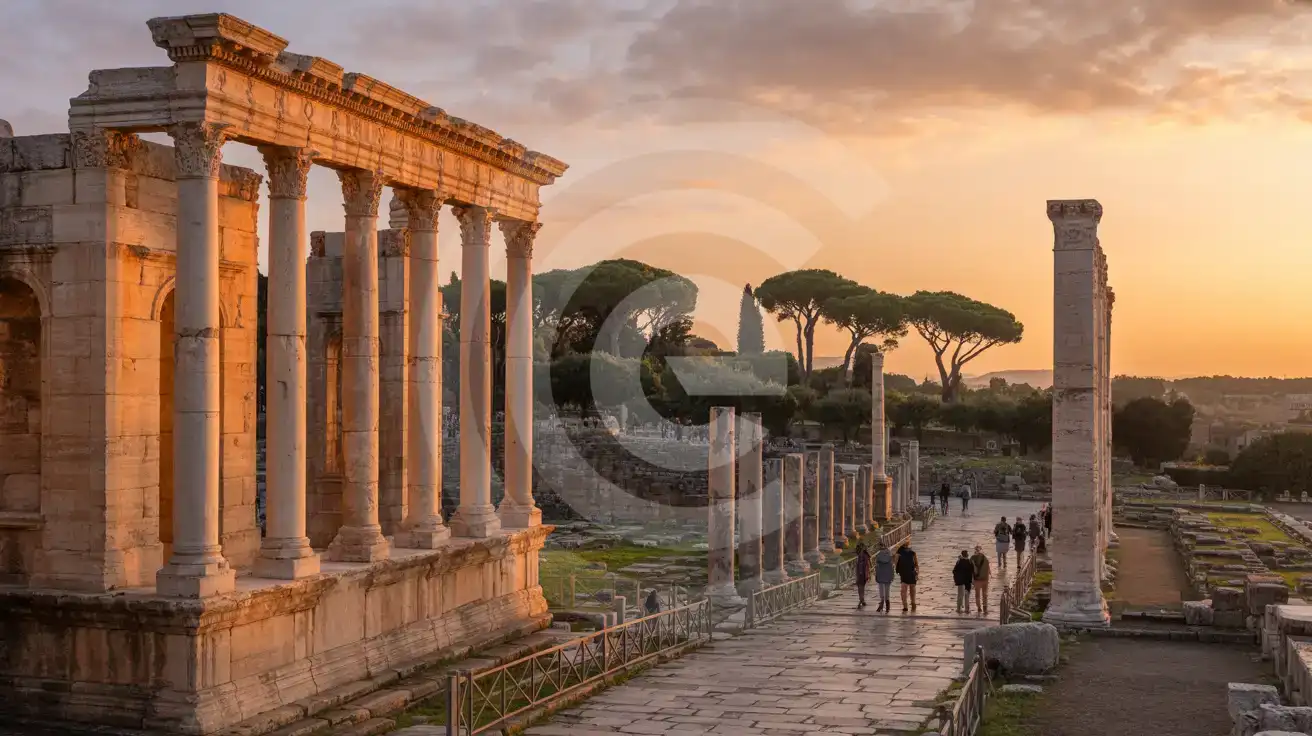
The Forum at Golden Hour
Compare WiFi Options at Roman Forum
 Recommended Recommended | Local SIM / Operator | Roaming | |
|---|---|---|---|
| FEATURES | |||
| Setup time | Few minutes | Store visit + paperwork | Auto |
| No local ID needed | Online checkout | Local ID required | Use home account |
| Speed | 4G/LTE; 5G in some areas | Carrier-grade | Partner-dependent |
| Travel support | English support 24/7 | Operator shops and call centre | Home carrier hours |
| Keep home number | Dual SIM | Replaces it | Same number |
| Cost predictability | Fixed price | Bills can spike | Bill-shock risk |
| PRICING | |||
Typical pricing | See plans below | — | — |
PRICING — PICK YOUR ESIMNO PLAN
Featured eSIM plans
Italian Mobile

Italian Mobile
Italian Mobile
Italian Mobile
Italian Mobile
Italian Mobile
Italian Mobile
Italian Mobile


