
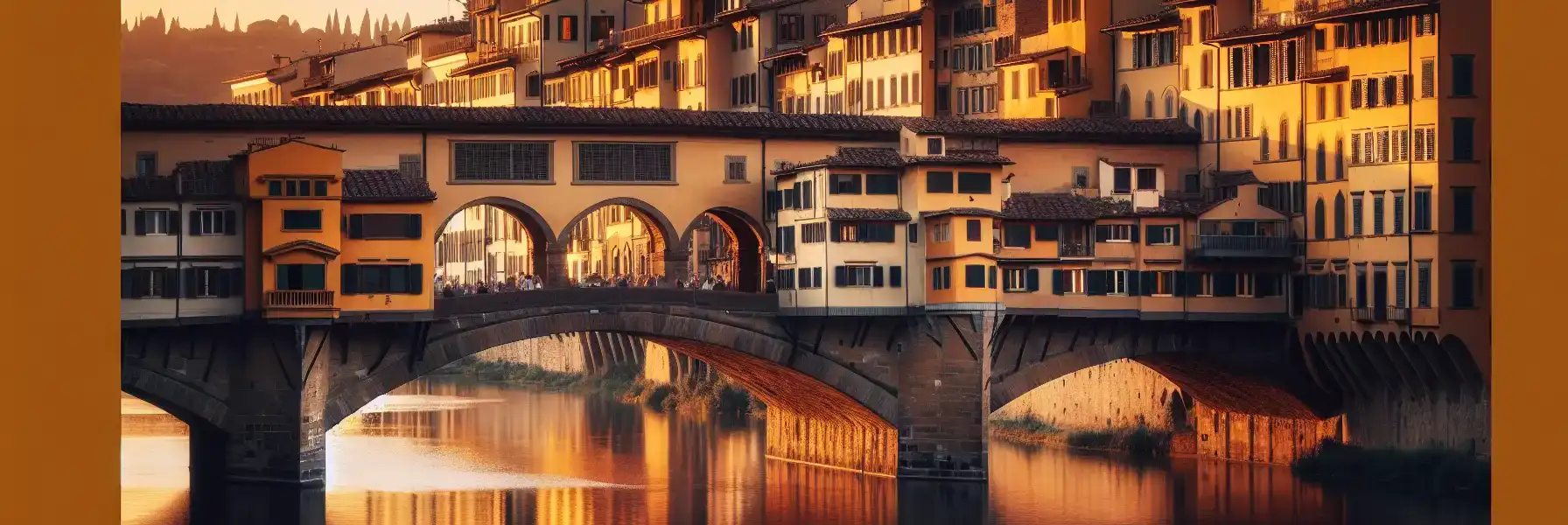
Quick Facts
- Built
- 1345 (current structure)
- Architect
- Attributed to Taddeo Gaddi or Neri di Fioravante
- Length
- 84 meters
- Width
- 32 meters
- Central Arch Span
- 30 meters
- Number of Shops
- 40-50 jewelry botteghe
- Bridge Access
- 24 hours, free
- Shop Hours
- Generally 10:00-19:00, many closed Sundays
- Address
- Ponte Vecchio, 50125 Firenze FI
- Nearest Train Station
- Firenze Santa Maria Novella (15-min walk)
- UNESCO Status
- Part of Historic Centre of Florence (1982)
- Official Management
- Comune di Firenze
- eSIMno Networks
- Vodafone, Wind Tre
About Ponte Vecchio
The name translates simply as 'Old Bridge,' and the Ponte Vecchio earns that title by centuries. A Roman crossing likely stood here first, followed by a wooden medieval structure that the Arno's floods repeatedly demolished. The catastrophic flood of 1333 swept away everything, and the Florentine authorities commissioned a replacement built to last — the three segmental stone arches that have carried traffic, commerce, and eventually Medici royalty since 1345.
The Architects and the Engineering
Attribution remains contested between Taddeo Gaddi, the painter and architect who worked on Santa Croce, and Neri di Fioravante, documented as a bridge consultant to the Florentine government. Whoever deserves credit produced an engineering solution that has survived 679 years of floods, including the devastating 1966 alluvione that submerged much of central Florence but left the Ponte Vecchio's structure intact. The three arches spread the load efficiently, with the central span of roughly 30 meters flanked by two smaller arches. The total width of 32 meters accommodated not just pedestrian passage but the row of shops — botteghe — that have defined the bridge's character since construction.
From Butchers to Goldsmiths
The original tenants were butchers, fishmongers, and tanners — trades that required water access for waste disposal and weren't particularly fragrant. For two and a half centuries, crossing the Ponte Vecchio meant enduring the smells of a working meat and fish market. That changed abruptly in 1593 when Grand Duke Ferdinando I de' Medici issued a decree expelling the existing merchants and reserving the bridge for goldsmiths and jewelers. The decision wasn't purely aesthetic refinement. The Vasari Corridor, completed in 1565, ran directly above the eastern shops, and Ferdinando found the stench unbearable when crossing between his administrative offices at the Uffizi and his residential palace, the Pitti, on the Oltrarno side.
The Vasari Corridor Connection
Giorgio Vasari designed and built the elevated passageway in just five months for Cosimo I de' Medici, creating a private route that allowed the Grand Duke to move between government and home without descending to street level among the populace. The corridor begins at Palazzo Vecchio, runs through the Uffizi, crosses atop the Ponte Vecchio's eastern shop row (visible as the series of small windows above the storefronts), continues along the Oltrarno riverbank, and enters Palazzo Pitti through the Boboli Gardens. It's nearly a kilometer of elevated, enclosed walkway — an architectural expression of Medici power and paranoia in equal measure.
Survival in World War II
The Ponte Vecchio holds another distinction: it's the only Florentine bridge that German forces didn't demolish during their retreat in August 1944. Retreating Wehrmacht troops systematically destroyed the Ponte Santa Trinita, Ponte alle Grazie, Ponte alla Carraia, and every other Arno crossing to slow the Allied advance. The Ponte Vecchio survived, reportedly on direct orders from Hitler himself, though the Germans blocked access by demolishing medieval buildings at both approaches. The rubble piles that replaced those structures were eventually cleared, but the contrast remains visible — the bridge's approaches feature postwar reconstruction rather than the medieval fabric that lines the bridge itself.
UNESCO Recognition and Contemporary Status
The Historic Centre of Florence received UNESCO World Heritage designation in 1982, and the Ponte Vecchio anchors that recognition as one of the city's most intact medieval structures. Today, the Comune di Firenze manages the bridge as public infrastructure, while the individual shop spaces remain private businesses — many held by families whose goldsmithing lineage stretches back generations. It's a living commercial artifact, not a museum piece, which makes crossing it feel fundamentally different from visiting preserved sites where commerce has ceased.
Highlights & Must-See
The Ponte Vecchio rewards both the quick crossing and the extended exploration. These are the specific elements worth seeking out.
The Goldsmith Botteghe
Around 40 to 50 jewelry shops line both sides of the bridge, their display windows glittering with gold chains, gemstone rings, cameos, and coral pieces. The tradition of Florentine goldsmithing here predates the 1593 Medici decree — goldsmiths simply displaced the butchers rather than inventing a new trade presence. Several shops carry particular historical weight:
Fratelli Piccini, founded in 1903, occupies one of the bridge's most prominent positions and specializes in traditional Florentine techniques including hand-engraving and filigree work. Cassetti Gioielli has operated since 1926, known for contemporary designs alongside classical pieces. Gherardi represents another multi-generational family business. Melli specializes in antique jewelry and silver, offering pieces that predate the shop itself. Look for the Consorzio Orafi Ponte Vecchio plaque displayed by member shops — it indicates official recognition within the bridge's goldsmith association.
The Central Terraces and River Views
At the bridge's midpoint, the shop rows break to create two open terraces — loggia-like spaces where buildings were never constructed. These gaps offer direct views up and down the Arno, framing the hills of the Oltrarno to the south and the tile rooftops of central Florence to the north. The terraces existed from the bridge's construction, possibly as market spaces or simply as structural design choices. They now function as the primary gathering spots for photography and pause.
The Cellini Bust
A bronze bust of Benvenuto Cellini stands at the eastern terrace, installed in 1900 to honor the Renaissance goldsmith, sculptor, and author whose autobiography remains one of the period's most vivid personal accounts. Raffaello Romanelli created the sculpture. Cellini worked in Florence, Rome, and France, producing the famous Perseus with the Head of Medusa that stands in the Loggia dei Lanzi at Piazza della Signoria. The bust's railings became notorious as a destination for 'love locks' — padlocks attached by couples as romantic gestures. The practice is now officially prohibited, with fines around €160, and the city periodically removes accumulated locks to protect the historic ironwork.
The Vasari Corridor Windows
Look up along the eastern side of the bridge. Above the shop level, a row of small, regularly spaced windows marks the Vasari Corridor's passage. These windows — some round, some rectangular — allowed light into the elevated passageway while maintaining visual privacy for the Medici moving between palaces. After years of closure for restoration, the Gallerie degli Uffizi reopened the corridor to the public in late 2024 with timed-entry tickets bookable through the official Uffizi website. Walking the corridor provides the inverse perspective: looking down through those windows onto the shoppers and tourists crossing the bridge below.
The Backshop Overhangs
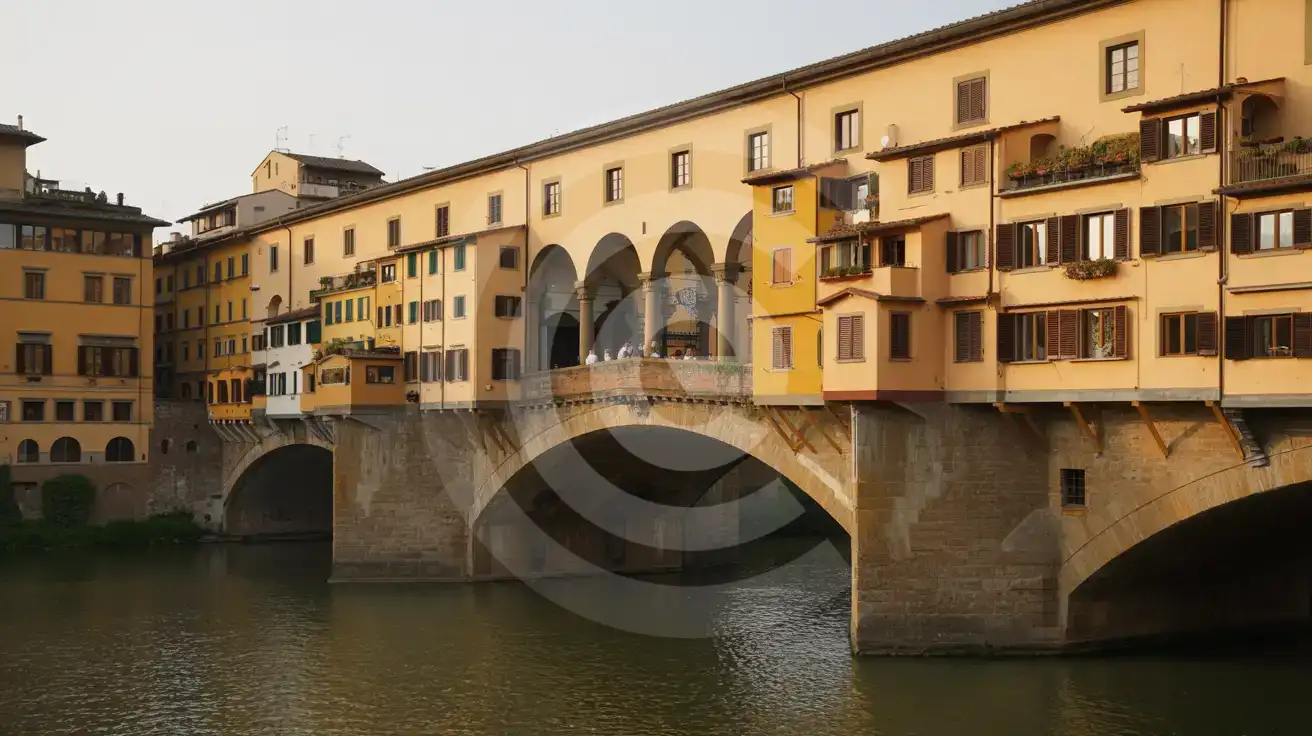
The shops' most distinctive architectural feature isn't visible from the bridge's central walkway. Step onto Lungarno degli Archibusieri on the north bank or the corresponding riverside path on the south to see the sporti — wooden extensions cantilevered over the river, supported by brackets called beccatelli. These overhangs expanded the shops' interior space without encroaching on the pedestrian thoroughfare. They create the Ponte Vecchio's signature silhouette in photographs: a bridge that appears to drip with buildings, their ochre and yellow walls seemingly suspended above the water.
Street Musicians at the Terraces
The central terraces regularly host buskers, and the quality can be remarkably high. Classical guitarists, accordion players, and occasionally opera singers performing Puccini and Verdi arias use the natural acoustics — sound bouncing off the stone and shop walls — to create performances that stop foot traffic. Evening hours, particularly around sunset, tend to attract the most accomplished performers. There's no formal schedule; it's luck and timing whether you catch a conservatory-trained tenor or a mediocre harmonica player.
The Approach Streets
The bridge connects two of Florence's most commercially vibrant pedestrian streets. Via Por Santa Maria runs north toward the Duomo, lined with leather goods shops (some legitimate, many tourist-oriented), gelaterias, and the occasional quiet church entrance. Via de' Guicciardini runs south into the Oltrarno, passing Palazzo Pitti after about 300 meters. Both streets funnel pedestrian traffic onto the bridge, creating the crowds that define midday visits — and both empty dramatically before 8:00 a.m.
Night Illumination
The bridge remains open around the clock, and after the shops close (typically by 19:00 or 19:30), the atmosphere shifts entirely. Street lamps illuminate the walkway while the shop windows go dark, and the crowds thin to couples and late-evening strollers. The view from Ponte Santa Trinita at night — the Ponte Vecchio's silhouette against the dark water, lights reflecting on the Arno — is genuinely different from the golden-hour photograph everyone else captures.
Visit Strategy
The Ponte Vecchio requires zero tickets and charges no admission — it's a functioning bridge on a public right-of-way. But timing and approach dramatically affect the experience.
Best Time to Visit
Early morning wins for photography and solitude. Arrive before 8:30 a.m., particularly in summer, to find the bridge nearly empty. The shops remain shuttered until 10:00, so you won't browse the botteghe, but you'll have unobstructed shots and cool morning air. The light at this hour comes from the east, illuminating the Oltrarno-facing sides of the shop buildings.
The classic golden-hour photography happens from Ponte Santa Trinita, not from the Ponte Vecchio itself. Walk west to that bridge — designed by Bartolomeo Ammannati in 1567 and reconstructed after WWII destruction — around one hour before sunset. The Ponte Vecchio's western facades catch the warm light directly, and the angle from Santa Trinita frames the ochre buildings, the Arno's reflections, and often a gondola-style boat or rowing crew passing beneath.
Midday from June through August brings the worst combination: dense crowds, temperatures frequently above 35°C, and harsh overhead light that flattens the architectural details. If your schedule forces a midday visit, accept that you're crossing for logistics (getting from the Uffizi area to Palazzo Pitti) rather than lingering.
Seasonal Considerations
Spring (April-May) offers the best overall conditions — pleasant temperatures, manageable crowds before the summer surge, and long evening light. The Arno runs higher from winter rains, which can make the river views more dramatic.
Summer (June-August) brings peak crowds and heat. Many shops close for the ferragosto period around mid-August, when Italian vacation culture essentially shuts down retail for one to three weeks. Check individual shop websites if you're specifically visiting for jewelry.
Autumn (September-October) rivals spring for conditions, with harvest-season warmth and thinning tourist numbers after the August peak.
Winter (November-February) is quietest for crowds, though occasional Arno flooding alerts can restrict bridge access. The river rose dramatically in 1966 and again in lesser floods since; the city now monitors levels carefully and closes low-lying areas when warnings arise.
Recommended Duration
A simple crossing takes five minutes. Browsing a few shops, photographing from the central terraces, and examining the Cellini bust extends that to 20-30 minutes. If you're seriously shopping for jewelry — comparing prices, asking about certifications, requesting custom work — allow 90 minutes to two hours to visit multiple botteghe without rushing.
Photography Rules and Etiquette
The bridge itself has no photography restrictions — it's public space. However, individual shops may prohibit interior photography of their merchandise, particularly detailed shots of specific pieces (to prevent design copying). Ask before photographing inside a bottega.
Drone photography over the historic center is prohibited without specific permits from Italian aviation authorities (ENAC) and often from municipal offices as well. The Ponte Vecchio falls squarely within restricted airspace.
Tripod use during crowded hours is impractical and potentially hazardous given the foot traffic density. Early morning visits allow tripod work without blocking passage.
Crowd Avoidance
The bridge functions as a chokepoint — pedestrian traffic funnels through its 32-meter width, and during peak hours the central terraces become genuinely congested. Beyond timing your visit for early morning or evening, consider approaching from the Oltrarno side (Via de' Guicciardini) rather than from the Uffizi side. Most tourists arrive from the Duomo direction, walking south. Swimming against that tide means slightly less jostling.
Weekdays beat weekends, though the difference matters less than time of day. A Tuesday at 2:00 p.m. will be crowded; a Sunday at 7:30 a.m. will be empty.
Shop Hours and the Lunch Break
Most goldsmith shops open around 10:00 and close between 19:00 and 19:30. However, the traditional Italian lunch break — pausa pranzo — still governs many Ponte Vecchio businesses. Expect some shops to close between roughly 13:00 and 15:30. Larger or more tourist-oriented shops may remain open continuously, but family-run botteghe often maintain the midday closure. Sunday mornings see many shops closed entirely; some open Sunday afternoons.
What to Bring
Comfortable walking shoes — the bridge surface is stone, and you'll likely explore surrounding streets extensively. A crossbody bag worn in front for security (pickpocket warnings are genuine, not paranoia). A light jacket or scarf for air-conditioned shop interiors if you're visiting in summer heat. A portable phone charger if you're relying on map navigation and photography throughout the day — the historic center offers limited public charging options.
Tour Options & Booking Strategy
The Ponte Vecchio itself requires no booking — you simply walk across. But several organized tour formats incorporate the bridge within broader Florence experiences, and understanding the options helps you decide whether guided context adds value or whether self-exploration serves better.
Tour Variants
Walking Tours of Historic Florence nearly always include a Ponte Vecchio stop, typically lasting 10-20 minutes for historical narration and photography. These tours usually cover the Duomo exterior, Piazza della Signoria, the Uffizi courtyard, the Ponte Vecchio, and sometimes extend into the Oltrarno. Duration runs 2-3 hours. Prices range from €25-50 per person for group tours, €150-300 for private guides.
Vasari Corridor Tours represent the premium option directly involving the Ponte Vecchio. The corridor reopened in late 2024 after extensive restoration, and timed-entry tickets (around €45-55 plus Uffizi admission) book through the Gallerie degli Uffizi official website. Walking the corridor means crossing above the bridge's eastern shops, looking down through the windows that Vasari designed in 1565. Availability is limited; book weeks in advance during high season.
Sunset/Photography Tours specifically target the Ponte Vecchio's golden-hour views from Ponte Santa Trinita, sometimes continuing to Piazzale Michelangelo for the panoramic hilltop perspective. These typically run 2 hours and cost €40-80 for small groups. Quality varies enormously — some are led by professional photographers who teach composition, others are standard walking tours with sunset timing.
Goldsmithing Workshop Experiences occasionally operate in Oltrarno artisan studios, teaching basic metalworking techniques in the Florentine tradition. These don't occur on the Ponte Vecchio itself but connect thematically to its goldsmith heritage. Expect 2-4 hours, €100-200 per person, with advance booking required.
Evening/Night Tours capture the bridge after shop closure, emphasizing the quieter atmosphere, illuminated views, and sometimes combining with dinner reservations in the Oltrarno. These appeal to visitors who've seen the daytime crowds and want the contrast.
Established Operators
The Gallerie degli Uffizi directly manages Vasari Corridor access — book through their official site (uffizi.it) rather than resellers to ensure availability and avoid markup. For general walking tours, Context Travel offers small-group and private tours led by scholars and specialists, typically more expensive (€80-150) but substantively different from budget walking tours. Walks of Italy and City Wonders run frequent scheduled group tours in the €30-50 range. For photography-specific tours, search for Florence-based photographers offering workshop walks rather than standard tour operators — the teaching quality varies by individual instructor.
What to Bring & Wear
Comfortable walking shoes are essential — Florence's streets are stone and uneven, and any tour will cover 2-5 kilometers on foot. Layers help manage the temperature differential between sun-exposed piazzas and shaded alleys (or air-conditioned museum interiors if your tour includes Uffizi entry). Bring water, especially in summer; refill at the free public drinking fountains (fontanelle) scattered throughout the historic center. A portable charger ensures your phone survives a full day of navigation and photography.
For Vasari Corridor tours specifically, bags may be subject to size restrictions — check the Uffizi booking confirmation for current rules. Large backpacks typically require coat-check deposit.
Best Season & Time of Day
Spring (April-May) and autumn (September-October) offer optimal conditions for any tour involving extended outdoor walking — comfortable temperatures and longer evening light. Summer tours mean heat management; morning departures (finishing by early afternoon) work better than midday starts.
For sunset-focused tours, departure times shift with the seasons. June tours might start at 19:00; October tours at 17:00. Confirm timing with operators rather than assuming.
Vasari Corridor tours run on fixed schedules determined by the Uffizi — you book an available slot rather than choosing your preferred time. Morning slots tend to book first.
Booking Lead Time & Cancellation Policy Patterns
Vasari Corridor tickets for high season (May-September) can sell out 4-8 weeks in advance. Book as early as your travel dates firm up. The Uffizi typically allows date changes with advance notice but not refunds.
Standard walking tours through major operators usually allow booking 24-48 hours ahead except during peak periods. Most offer free cancellation up to 24 hours before departure.
Private guide bookings generally require 1-2 weeks advance notice for availability and offer varied cancellation terms — some refund deposits minus a fee, others hold deposits as credits for rescheduling.
Photography workshops and artisan experiences often have stricter policies given limited capacity — expect to lose deposits for cancellations within 7 days.
Nearby Attractions & Logistics
The Ponte Vecchio sits at the geographic and psychological center of historic Florence, with major attractions clustered within a 15-minute walk in every direction.
Immediately North: The Uffizi and Piazza della Signoria
The Galleria degli Uffizi stands three minutes' walk north of the bridge — exit the bridge onto Via Por Santa Maria, turn right onto Lungarno degli Archibusieri, and the Uffizi's colonnade appears immediately. The collection includes Botticelli's Birth of Venus and Primavera, Leonardo's Annunciation, and Caravaggio's Medusa. Tickets run approximately €25 in high season; book timed entry through uffizi.it to avoid the queue that wraps around the building by mid-morning.
Piazza della Signoria lies five minutes further north, dominated by Palazzo Vecchio's tower and the open-air sculpture gallery of the Loggia dei Lanzi (where Cellini's Perseus with the Head of Medusa stands — the sculptor whose bust anchors the bridge's central terrace).
Immediately South: Palazzo Pitti and the Oltrarno
Cross the bridge and continue 300 meters down Via de' Guicciardini to reach Palazzo Pitti, the Medici's later residential palace that now houses the Galleria Palatina (Raphael's Madonna della Seggiola among other masterworks), the Royal Apartments, and access to the Boboli Gardens terraced up the hillside behind. Combined tickets cover multiple Pitti museums and Boboli.
The Oltrarno neighborhood surrounding Pitti offers a different Florence — artisan workshops restoring antique furniture, family trattorias without English menus, and Piazza Santo Spirito, a neighborhood square anchored by Brunelleschi's church facade where Florentines gather for aperitivo without tourist-crowd density.
Further Afield: Panoramic Views and the Duomo
Piazzale Michelangelo sits a 20-25 minute uphill walk southeast from the bridge, across the Arno and up through residential streets or the stepped pathway from Porta San Miniato. The panoramic terrace offers the iconic Florence postcard view — Duomo, Palazzo Vecchio tower, and Ponte Vecchio lined up across the red-tile roofscape. Arrive before sunset for parking availability and viewing-spot choice.
The Cathedral of Santa Maria del Fiore (Duomo) is a 10-minute walk north through the commercial streets. Brunelleschi's dome remains the engineering marvel of the Renaissance; climbing it requires advance booking through the Opera del Duomo.
Transit Logistics
From Santa Maria Novella train station: Walk 15 minutes southeast via Via dei Cerretani and Via Roma, or catch ATAF bus C2 (€1.70 single ticket, €2.50 onboard) which circulates through the historic center. The ZTL (restricted traffic zone) means taxis drop you at the zone perimeter rather than at the bridge.
From Florence Airport (Amerigo Vespucci/FLR): The T2 tram line runs to Unità stop in about 20 minutes (€1.70). From there, walk 15 minutes south to the bridge. Taxis from the airport run €22-25 fixed fare into the historic center.
By car: Don't. The Ponte Vecchio is pedestrian-only, surrounded by ZTL with fines for unauthorized vehicles, and parking in the center is essentially nonexistent. Use peripheral garages (Parcheggio Beccaria, Parterre) and walk or use transit.
Dining Near the Bridge
The immediate bridge vicinity skews tourist-oriented, but options improve within a five-minute walk. In the Oltrarno, Trattoria 4 Leoni on Piazza della Passera serves Florentine classics (ribollita, bistecca) in a neighborhood setting. North of the river, Mercato Centrale (15 minutes' walk toward San Lorenzo) offers food-hall variety under a 19th-century iron-and-glass structure — grab a lampredotto sandwich from the ground-floor market vendors or sit down upstairs at one of the restaurant stalls.
Why Data Matters at Ponte Vecchio
Standing on the central terrace trying to identify which window belongs to the Vasari Corridor, you'll want more than guesswork. Having mobile data means pulling up the corridor's architectural history, confirming which shops belong to the Consorzio, or translating a goldsmith's explanation of Florentine filigree technique in real-time.
The practical moments stack up quickly: checking Uffizi ticket availability while you're steps from the entrance, navigating the Oltrarno's twisting streets to find that trattoria someone recommended, confirming the T2 tram schedule back to the airport, or simply sharing a sunset shot from Ponte Santa Trinita before the light fades.
Free WiFi exists in some shops and nearby cafes, but coverage is spotty and often requires purchases or registration. An eSIMno plan connects you to Vodafone or Wind Tre — the same networks Florentines use — with data active before you leave the airport. No hunting for SIM card vendors, no language-barrier transactions at phone shops, no connection gaps while you're trying to figure out whether that goldsmith's price is reasonable.
The Medieval Bridge at Golden Hour
Compare WiFi Options at Ponte Vecchio
 Recommended Recommended | Local SIM / Operator | Roaming | |
|---|---|---|---|
| FEATURES | |||
| Setup time | Few minutes | Store visit + paperwork | Auto |
| No local ID needed | Online checkout | Local ID required | Use home account |
| Speed | 4G/LTE; 5G in some areas | Carrier-grade | Partner-dependent |
| Travel support | English support 24/7 | Operator shops and call centre | Home carrier hours |
| Keep home number | Dual SIM | Replaces it | Same number |
| Cost predictability | Fixed price | Bills can spike | Bill-shock risk |
| PRICING | |||
Typical pricing | See plans below | — | — |
PRICING — PICK YOUR ESIMNO PLAN
Featured eSIM plans
Italian Mobile

Italian Mobile
Italian Mobile
Italian Mobile
Italian Mobile
Italian Mobile
Italian Mobile
Italian Mobile


