
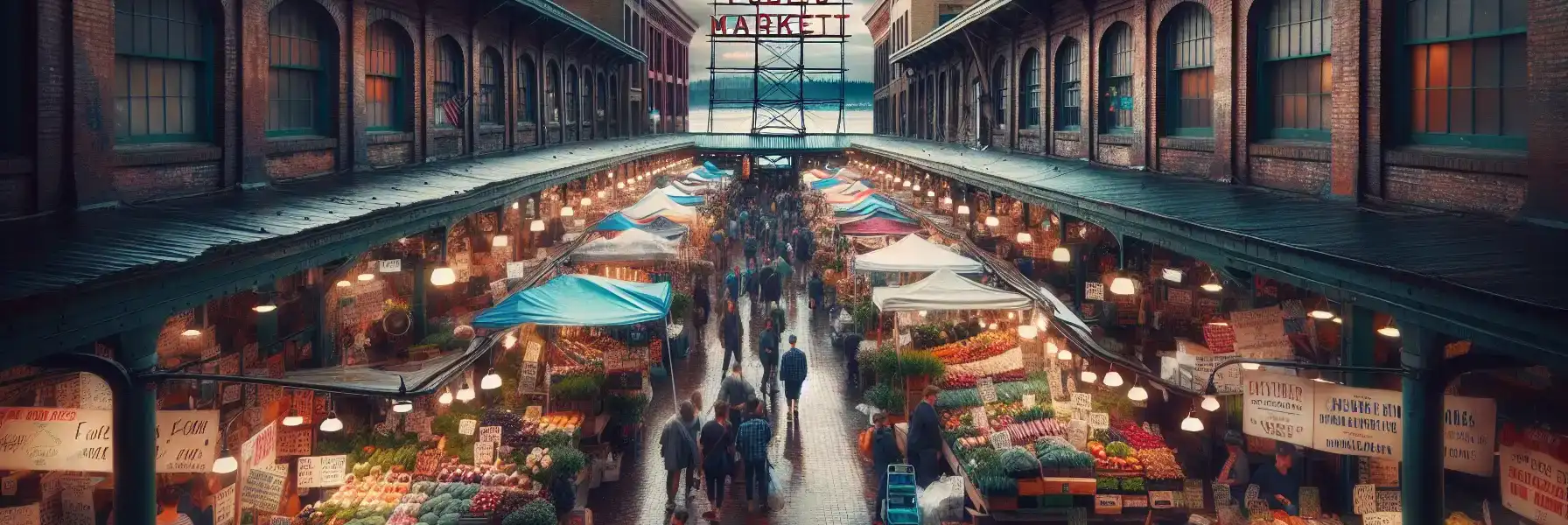
Quick Facts
- Address
- 85 Pike Street, Seattle, WA 98101
- Hours
- Daily 9 AM - 6 PM (most vendors 9 AM - 5 PM)
- Closed
- Thanksgiving Day, Christmas Day
- Admission
- Free
- Annual Visitors
- ~10 million
- Year Opened
- August 17, 1907
- Size
- 9 acres, 7 historic buildings
- Nearest Light Rail
- Westlake Station (Link 1 Line) - 10 min walk
- Parking
- Pike Place Market Garage on Western Ave
- Official Site
- pikeplacemarket.org
- eSIMno Networks
- AT&T, T-Mobile, Verizon
About Pike Place Market
The market exists because Seattle residents got tired of being swindled. In 1907, the price of onions had tripled despite a bumper crop, and the city's consumers understood exactly who was profiting: commission merchants who bought produce from farmers at rock-bottom prices and sold it to families at inflated rates. The markup wasn't subtle. It was brazen enough to trigger public outrage and force the Seattle City Council to act.
City Councilman Thomas Revelle proposed the ordinance that designated the corner of Pike Place and First Avenue as a public market where farmers could sell directly to consumers. On opening day — August 17, 1907 — eight farmers brought their wagons to the site. They sold out within hours. Within a week, the crowd had grown so large that the city had to expand the designated selling area.
The Goodwin Era and Architectural Character
Real estate developer Frank Goodwin recognized opportunity in chaos. Over the following decades, he designed and constructed many of the buildings that define the market's character today: the Main Arcade with its distinctive shed roof, the Corner Market, the Sanitary Market (named for its then-revolutionary indoor plumbing), and the Economy Market. These weren't grand architectural statements — they were functional structures built to accommodate the maximum number of vendors in the minimum footprint, which is why the market still feels like a maze rather than a mall.
The iconic 'Public Market Center' neon sign and clock went up in 1927, making it one of the oldest neon signs on the West Coast. The sign faces west toward Elliott Bay, positioned so that ferry passengers approaching the waterfront would see it glowing against the hillside — an advertisement and a landmark in one.
The Demolition Fight and Preservation Victory
By the 1960s, Pike Place Market had deteriorated. The buildings leaked, the infrastructure was failing, and city officials saw an opportunity for 'urban renewal' — the mid-century euphemism for demolition. The proposed plan would have replaced the market with hotels, parking garages, and a convention center. The character that made Pike Place unique was precisely what made it seem disposable to planners who valued modernization over authenticity.
Architect Victor Steinbrueck led the 'Keep the Market' campaign, organizing preservation advocates, local vendors, and Seattle residents who understood what demolition would destroy. The campaign culminated in a 1971 ballot initiative where Seattle voters approved the creation of the Pike Place Market Historical District by a margin of nearly two to one. The seven-acre district was subsequently listed on the National Register of Historic Places.
The Modern Market
Today Pike Place Market operates under the Pike Place Market Preservation and Development Authority (PDA), a public nonprofit chartered by the city. The PDA manages a complex ecosystem: more than 200 year-round commercial businesses, around 80 restaurants, roughly 240 daystall vendors who rent space by the day, and over 190 craftspeople who sell handmade goods. The market also maintains low-income housing for approximately 500 residents in buildings above the commercial spaces — a reminder that Pike Place was always intended to serve the community, not just tourists.
The 10 million annual visitors who walk through the Main Arcade today are experiencing something that almost didn't survive. Every salmon toss, every busker's chord, every bunch of dahlias arranged in a five-gallon bucket exists because Seattle voters decided in 1971 that some things matter more than parking garages.
Highlights & Must-See
Pike Place Fish Market
The fish-throwing spectacle happens near the main entrance, directly beneath the neon clock and 'Public Market Center' sign. Founded in 1930, this fishmonger became internationally famous in the 1980s when employees began hurling whole salmon — sometimes weighing 20 pounds or more — across the counter to be wrapped. The throws happen throughout the day whenever a customer places an order large enough to justify the performance; there's no fixed schedule, but late morning typically sees the most action as lunch crowds build. The staff announce each throw with coordinated shouts, and visitors routinely form crowds three-deep waiting for the next flight. It's theater, but it's also a working fish counter. If you want to buy Copper River salmon or Dungeness crab, you'll get the same quality whether they throw it or not.
Rachel the Piggy Bank
This life-size bronze pig sits at the market's main entrance beneath the clock, sculpted by Georgia Gerber and installed in 1986. Rachel is named after the 1977 Island County prize-winning pig and serves as a donation collection point for the Pike Place Market Foundation. Visitors stuff bills and coins into Rachel's slot throughout the day, collectively contributing somewhere between $6,000 and $9,000 annually. Those donations fund the Market Foundation's social services, including a food bank, senior center, child care, and medical clinic that serve Pike Place's low-income residents. Rubbing Rachel's snout for good luck has become a tourist tradition — you'll notice the bronze is worn smooth around her face.
The Gum Wall
Located in Post Alley beneath the market, this stretch of brick wall is covered in thousands of pieces of chewed gum left by visitors over three decades. The tradition started in the early 1990s when patrons waiting in line for shows at the Market Theater began sticking gum to the wall. Management initially tried to discourage the practice, then gave up. The wall was steam-cleaned in November 2015 — reportedly removing 2,350 pounds of gum — but visitors immediately began recoating it. Today's gum layer is several inches thick in places, arranged in patterns, initials, and multicolored abstract designs. It smells exactly like you'd expect. Some find it disgusting; others find it oddly compelling. Either way, it's become one of Seattle's most photographed oddities.
The Original Starbucks
At 1912 Pike Place, this storefront has operated as a Starbucks since 1976, after the company's actual first location (at 2000 Western Avenue) closed. The store retains the original brown 'siren' logo — more anatomically detailed than the sanitized green version used globally today — and draws coffee enthusiasts who treat it as a pilgrimage site. Lines frequently stretch down the block, especially on weekends and during cruise ship season. The store sells exclusive merchandise unavailable at other locations. Inside, the space is deliberately kept small and cramped, matching the scale of the original Pike Place shops. Don't expect anything revolutionary about the coffee itself; the significance is purely historical.
DownUnder Levels and the Economy Market Atrium
Most visitors never descend below the Main Arcade, which means they miss four entire floors of the market. The DownUnder levels — accessed via stairs near the Main Arcade's center — house a completely different character than the produce-and-fish spectacle above. Here you'll find the Market Magic Shop, operating since 1976 and staffed by magicians who demonstrate tricks for anyone who lingers; antique dealers with booths crammed floor-to-ceiling with vintage Seattle memorabilia; comic book stores with hand-lettered 'No Photography' signs; bead shops; used bookstores; and oddity vendors selling taxidermy and medical antiques. The Economy Market Atrium brings natural light into this warren through skylights, creating an unexpectedly pleasant space amid the labyrinthine corridors. Budget at least 45 minutes for the DownUnder levels if you appreciate eclectic small businesses.
The Athenian Inn and Elliott Bay Views
On the lower level of the Main Arcade, the Athenian Inn has served food and drinks since 1909. The bar's claim to fame is its west-facing windows overlooking Elliott Bay, the Olympic Mountains, and the Seattle Great Wheel on Pier 57. Tom Hanks and Rob Reiner filmed a pivotal scene from 'Sleepless in Seattle' here in 1993, which cemented the Athenian's place in pop-culture tourism. The food is standard American diner fare — nothing remarkable — but the view during golden hour is genuinely spectacular. Grab a stool at the window counter if one's available.
Craft Vendors and Daystall Artists
Pike Place requires that craftspeople sell only items they've made themselves, a rule enforced by a jury system that vets applicants for authenticity. This means the jewelry, pottery, photography, and woodwork sold in the craft market's outdoor tables and North Arcade spaces genuinely comes from the hands of the person selling it. Over 190 registered craftspeople rotate through daystall spaces, so the selection changes daily. Arrive early if you want first pick; serious collectors know to be there when the tables set up around 9 AM.
Flower Vendors
The Hmong and Southeast Asian flower vendors who dominate Pike Place's outdoor tables represent one of the market's most enduring immigrant success stories. Many of these families have sold flowers at the same stalls for generations, growing their own inventory in the Snoqualmie Valley and Carnation area east of Seattle. Bouquets cost a fraction of retail florist prices — $5 to $15 for arrangements that would run $40 elsewhere — because you're buying directly from the grower. The flower selection peaks in late spring through early fall, with dahlias, peonies, and sunflowers dominating the tables.
Visit Strategy
Best Time to Visit
Weekday mornings between 9:00 AM and 11:00 AM offer the ideal Pike Place experience. Vendors are fully stocked, the fish counter has fresh inventory to throw, and you can actually move through the Main Arcade without being pressed against strangers. By noon on any day, crowds thicken noticeably. By 2:00 PM on weekends, the market approaches capacity.
Saturdays are the busiest day by a significant margin — the market was founded as a Saturday farmers' gathering, and that tradition persists. If you must visit on a Saturday, arrive before 9:30 AM or accept that you'll shuffle rather than walk. Sundays are marginally calmer. Mondays tend to be quietest, though some vendors take the day off.
Seasonal variation matters too. Summer months (June through August) bring cruise ship passengers by the thousands; ships dock at Pier 66 and Pier 91, and Pike Place is the default destination for passengers with six-hour shore excursions. December holiday shopping season creates similar density. The shoulder seasons — April through May and September through October — combine pleasant weather with manageable crowds. January through March offers the thinnest crowds but also reduced vendor participation and gray skies.
How Long to Spend
A thorough Pike Place visit requires 2.5 to 3 hours minimum. That's enough time to walk the Main Arcade, descend through all four DownUnder levels, explore Post Alley including the Gum Wall, and stop for coffee or a quick meal. If you're photographing seriously or want to eat a full sit-down meal, budget 4 hours.
Many visitors make the mistake of treating Pike Place as a 45-minute photo stop. You'll see the fish throw, snap Rachel, wait in the Starbucks line, and leave. That's fine if you're checking a box, but you'll miss the market's actual character — the magic shop demonstrations, the antique dealers who want to tell you the history of their strangest items, the view from the Athenian's window counter.
Ticket Strategy
Entry to Pike Place Market is free. No tickets required, no reservations needed. You simply walk in.
If you want guided context, independent walking tours run daily. Savor Seattle Food Tours offers a flagship pike-place-focused tour that costs around $65-75 per person and includes tastings at multiple vendors. The tours typically run 2 hours and require advance booking, especially during summer. Show Me Seattle and other operators offer similar experiences at comparable prices. Free self-guided maps are available at the Market Information Booth near the main entrance at First Avenue and Pike Street.
Photography Rules
Photography is permitted throughout all public areas of the market. No permits required for personal use. However, individual vendors and shop owners may request that you ask before photographing their stalls, products, or staff — this is particularly common inside private shops in the DownUnder levels and among craftspeople who've had their designs copied. A quick 'Mind if I take a photo?' goes a long way.
Tripods are technically allowed but practically difficult; the corridors are too narrow and crowded to set up without blocking foot traffic. Monopods work better if you need stabilization. Professional shoots or commercial photography require advance permission from the PDA.
Crowd Avoidance Tactics
If you arrive after 11 AM and find the Main Arcade packed, immediately descend to the DownUnder levels. Crowds thin dramatically below the main floor because most tourists don't realize those levels exist. The Economy Market Atrium on the lower levels offers a calmer atmosphere and interesting shops.
Post Alley — the narrow passage behind the Main Arcade — also sees lighter traffic than the main corridor, and it connects to the Gum Wall, several restaurants, and shops that reward exploration.
For the fish-throwing experience, position yourself 10 minutes before a likely busy period (around 10:30 AM on weekends) to secure a front-row spot. The throws happen on customer demand, so there's no guarantee of timing, but late morning typically delivers.
Best Time to Visit & Photographer's Guide
Month-by-Month Crowd & Weather
January–February: The quietest months. Gray skies and drizzle are constant, but crowds are minimal. Some vendors reduce hours or take extended breaks. Indoor shooting is easy; outdoor shots will have flat, diffused light that actually works well for the market's textures and colors.
March–April: Spring flower season begins. The outdoor flower tables explode with tulips and daffodils, creating the most colorful photography opportunities of the year. Crowds remain manageable on weekdays. Cherry blossoms appear in nearby streets by late March.
May: Shoulder season sweet spot. Weather improves, flowers peak, cruise ships haven't fully ramped up. This may be the single best month for photography — good light, full vendor participation, reasonable crowd levels.
June–August: Peak tourist season. Cruise ships disgorge thousands daily. Weekends are extremely crowded; even weekday mornings see substantial traffic. The upside: longest daylight hours mean early morning and late evening golden-hour opportunities. Outdoor vendors have maximum inventory.
September–October: Second shoulder season. Cruise traffic diminishes, kids return to school, but weather remains pleasant through mid-October. Fall produce — squash, apples, late-season dahlias — creates rich visual opportunities. Excellent time for serious photography.
November–December: Holiday shopping crowds return, especially weekends. The market decorates modestly for the season. November rain returns; December can be cold and wet. Holiday lights add evening atmosphere if you're willing to shoot in drizzle.
Best Time of Day
Pre-opening (7:30–8:30 AM): Vendors arrive and set up. The neon sign glows against gray dawn light. You can photograph the empty arcade corridors and exterior signage without crowds, though interior access is limited until 9 AM.
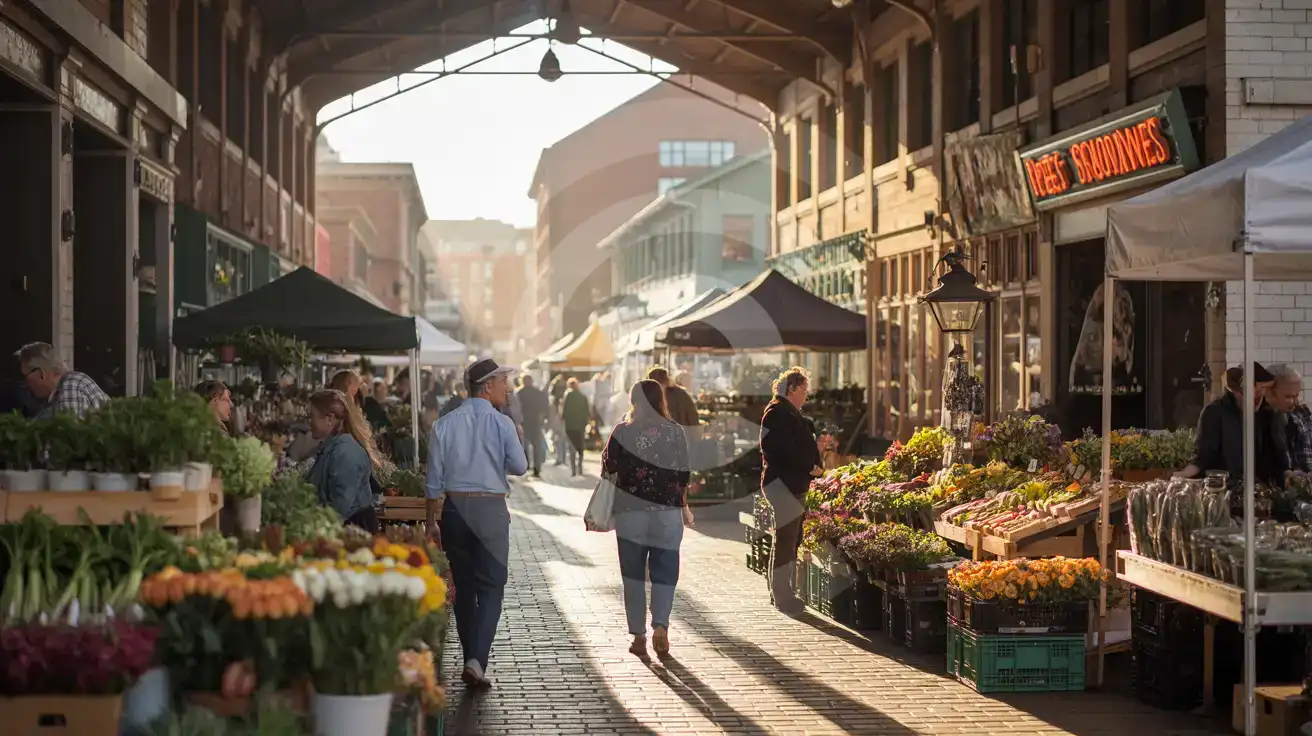
Golden hour opening (9:00–10:00 AM): When the market opens, morning light streams through the Main Arcade from the east, illuminating the flower vendors and produce stalls. This is the magic window — vendors are fresh, light is warm, crowds haven't built.
Midday (11 AM–3 PM): Harsh overhead light if shooting outdoors; interior arcade stays evenly lit. Crowds peak. Not ideal for photography unless you're specifically shooting the human energy and chaos.
Late afternoon (4:00–5:30 PM): Golden hour returns, with warm west light filtering in from Elliott Bay. The Athenian Inn's windows face directly into sunset. Flower vendors begin packing up around 5 PM, so act fast if you want those shots.
Evening (after 6 PM): Most vendor stalls close, but the neon sign glows against blue hour sky. Restaurants in Post Alley and the arcade remain open and lit. The market feels quieter, more atmospheric. Excellent for signage and architectural shots.
Best Photo Spots
1. The Clock and Neon Sign from First Avenue: Stand on First Avenue facing west, positioning yourself so the 'Public Market Center' sign fills the frame with Pike Street descending behind it. Morning light works best; evening blue hour with the neon illuminated is iconic.
2. Pike Place Fish Counter Action Shot: Position yourself to the left of the fish counter (as you face it) to capture throwers and catchers in profile. A 50mm or 85mm lens isolates the action from the crowd. Anticipate the throw by watching for staff gathering a large order.
3. The Main Arcade Corridor Looking North: Stand near the south entrance and shoot down the length of the arcade. Early morning, before crowds fill in, captures the architecture and vendor tables in depth. Wide angle (24-35mm) works well.
4. Economy Market Atrium Skylight: In the DownUnder levels, the Economy Market's skylights create dramatic shafts of light on clear days. Position yourself beneath a skylight looking up, or capture vendors illuminated by the natural spotlight effect.
5. Post Alley Gum Wall: The wall photographs best in overcast light, which eliminates harsh shadows and reveals the gum's color variations. Get close for abstract texture shots; step back for the full psychedelic effect. Include a human figure for scale.
6. Athenian Inn Window View: Grab a seat at the bar's west-facing window counter around 4:30 PM for golden hour views over Elliott Bay and the Olympic Mountains. The Great Wheel frames nicely in the distance.
7. Pike Street Hill Climb Looking Back Up: Descend the Hill Climb stairs toward the waterfront, then turn and photograph the market buildings rising above. This angle shows the market's dramatic hillside setting and connects it visually to the waterfront below.
Drone & Tripod Rules
Drones are prohibited within Pike Place Market boundaries and throughout downtown Seattle without special permits. The market's location under Sea-Tac approach paths and near the waterfront helipad makes drone operation both illegal and impractical.
Tripods are technically permitted in public market areas but rarely practical. The corridors are narrow, crowded, and actively used by vendors pushing carts. You'll be asked to move constantly. Monopods are less obtrusive. Handheld shooting with image stabilization or higher ISO is the realistic approach. For the neon sign exterior shots, early morning before crowds arrive is your tripod window.
Hidden Sub-Spots Most Tourists Miss
The Lower Post Alley Mural: Below the Gum Wall, Post Alley continues south past restaurants to a large mural installation on the alley's brick walls. Fewer visitors descend this far, and the light filtering between buildings creates interesting shadows.
Economy Market Fourth Floor: The lowest of the DownUnder levels opens onto Western Avenue with views across to the waterfront. Most tourists never descend past the second underground floor. The shops here tend to be the most eccentric, and the lighting has a cave-like quality.
The Flower Vendor Loading Zone: On Pike Place itself, around the corner from the main arcade entrance, a loading area serves the flower vendors. Arrive before 8 AM to watch vendors unload trucks and arrange inventory — documentary-style photographs of market labor that most visitors never witness.
The Sanitary Market Interior: The Sanitary Market building (named for its 1910 indoor plumbing) connects to the Main Arcade but has its own distinct character — lower ceilings, different vendors, fewer crowds. The corridor linking it to the Main Arcade is one of the market's more atmospheric passages.
Rachel's Alley View: Most people photograph Rachel head-on. Walk around to the alley side of the pig and shoot back toward the arcade entrance with Rachel in the foreground and the market crowds behind her — a more dynamic composition than the standard tourist snap.
Nearby Attractions & Logistics
Getting to Pike Place Market
The market sits in downtown Seattle at 85 Pike Street, perched on a hillside above Elliott Bay. The closest Link Light Rail station is Westlake Station on the 1 Line, approximately a 10-minute walk west along Pike Street. King County Metro buses run constantly along Third Avenue and First Avenue, with dozens of routes stopping within two or three blocks of the market entrance. The Seattle Streetcar South Lake Union Line terminates at Westlake, connecting the market to South Lake Union's tech campus and Lake Union itself.
From the Seattle waterfront, the Pike Street Hill Climb provides a direct pedestrian connection — a series of stairs and ramps ascending from the piers to the market's western edge. This is the most scenic approach if you're combining Pike Place with waterfront attractions.
Driving is actively discouraged. Street parking in the Pike Place vicinity is extremely limited, metered, and expensive. The Pike Place Market Garage on Western Avenue offers the most convenient parking — validated parking with purchase from participating vendors typically runs $4-6 for 2 hours — but fills early on busy days. Public garages along First Avenue and near the waterfront provide alternatives at similar rates.
Seattle Waterfront and the Seattle Great Wheel
A 7-minute walk via the Pike Street Hill Climb leads to Pier 57 on Elliott Bay. The Seattle Great Wheel — a 175-foot Ferris wheel that opened in 2012 — offers views of Puget Sound, the Olympic Mountains, and the Seattle skyline. Adjacent piers host the Seattle Aquarium at Pier 59, Miner's Landing arcade and restaurants at Pier 57, and harbor cruises operated by Argosy Cruises at Pier 55. The waterfront makes a natural afternoon addition to a morning Pike Place visit.
Seattle Art Museum
SAM sits roughly a 5-minute walk south at 1300 First Avenue. The museum's collection includes significant Native American and Pacific Northwest art, contemporary works, and rotating exhibitions. Jonathan Borofsky's kinetic 'Hammering Man' sculpture — 48 feet of motorized black steel — stands outside the entrance. General admission runs around $32.99 for adults, with discounts for seniors and students, and free entry for visitors under 14. Combined with Pike Place, SAM makes for a full downtown Seattle cultural day.
Olympic Sculpture Park
About a 15-minute walk north along the waterfront, this 9-acre outdoor extension of the Seattle Art Museum is free to enter. Large-scale sculptures including Alexander Calder's 'Eagle' and Richard Serra's 'Wake' occupy paths that descend from a hillside pavilion to the water's edge, with views over Elliott Bay toward Bainbridge Island and the Olympic Mountains. The park connects to Myrtle Edwards Park for extended waterfront walking north toward Interbay.
Pioneer Square
Roughly a 12-minute walk south from Pike Place, Pioneer Square represents Seattle's original downtown — the neighborhood rebuilt in brick after the Great Fire of 1889 destroyed 25 blocks of wooden buildings. Romanesque Revival architecture, Occidental Square's tree-lined plaza, and the Klondike Gold Rush National Historical Park visitor center make for an interesting historical contrast to the market. Underground tours exploring the subterranean remnants of pre-fire Seattle depart from Doc Maynard's Public House.
Suggested Day Itinerary
Begin at Pike Place Market around 9:00 AM. Grab breakfast at Le Panier (French bakery) or Three Girls Bakery (soups and sandwiches), then explore the Main Arcade and DownUnder levels until late morning. Walk down the Hill Climb to the waterfront for lunch on Pier 57 and a ride on the Great Wheel. In the afternoon, walk north to the Olympic Sculpture Park, then return south to visit the Seattle Art Museum. End the day with dinner back at the market — The Pink Door (Italian, Post Alley, reservations recommended) or Matt's in the Market (Pacific Northwest cuisine, views over the arcade, reservations essential).
Why Data Matters at Pike Place Market
Pike Place Market sprawls across nine acres of hillside, multiple buildings, and four underground levels. The layout is intentionally labyrinthine — it grew organically over decades rather than being planned as a coherent whole. Your phone becomes essential navigation equipment the moment you realize the stall you're looking for is two floors below you in a building you didn't know existed.
Real-time search matters here. You'll want to look up vendor hours (they vary wildly), check whether that restaurant in Post Alley takes reservations, read reviews of the antique dealer someone recommended, or find out whether the magic shop is doing demonstrations today. The market's own website helps, but the practical answers often live in Google Maps reviews, Yelp, and local food blogs.
The Pike Place area has solid cellular coverage — both AT&T and T-Mobile maintain strong signals throughout downtown Seattle — but international visitors relying on expensive roaming or hunting for WiFi hotspots will find themselves frustrated by the market's fragmented connectivity. An eSIMno plan connected to local networks means your maps work instantly, your translation app functions when you're trying to read a menu in the dim light of Post Alley, and your photo uploads don't wait until you find a coffee shop with guest WiFi.
Pike Place rewards the prepared visitor. Having data in your pocket is part of that preparation.
Pike Place Market at Golden Hour
Compare WiFi Options at Pike Place Market
 Recommended Recommended | Local SIM / Operator | Roaming | |
|---|---|---|---|
| FEATURES | |||
| Setup time | Few minutes | Store visit + paperwork | Auto |
| No local ID needed | Online checkout | Local ID required | Use home account |
| Speed | 4G/LTE; 5G in some areas | Carrier-grade | Partner-dependent |
| Travel support | English support 24/7 | Operator shops and call centre | Home carrier hours |
| Keep home number | Dual SIM | Replaces it | Same number |
| Cost predictability | Fixed price | Bills can spike | Bill-shock risk |
| PRICING | |||
Typical pricing | See plans below | — | — |
PRICING — PICK YOUR ESIMNO PLAN
Featured eSIM plans
American Mobile

American Mobile
American Mobile
American Mobile
American Mobile
American Mobile


