
Quick Facts
- Address
- Piazza della Rotonda, 00186 Roma RM, Italy
- Hours
- Mon-Sat 9:00 AM - 7:00 PM, Sun 9:00 AM - 6:00 PM
- Last Entry
- 15-30 minutes before closing
- Admission
- €5 (free first Sunday of month)
- Online Booking Fee
- ~€2 for timed entry
- Dome Diameter
- 43.3 metres (142 feet)
- Oculus Diameter
- 8.7 metres (29 feet)
- Completed
- ~125 AD under Emperor Hadrian
- Nearest Metro
- Barberini or Spagna (Line A) — 12-15 min walk
- Nearby Bus Stops
- Largo di Torre Argentina (lines 30, 40, 62, 64, 81, 87, 492)
- Official Website
- www.pantheonroma.com
- UNESCO Status
- Part of Historic Centre of Rome (1980)
- eSIMno Networks
- Vodafone, Wind Tre
About the Pantheon
The building standing on Piazza della Rotonda today is not the original Pantheon. Marcus Agrippa — son-in-law and trusted general of Emperor Augustus — constructed the first temple here around 27 BC, dedicating it to all the gods of Roman religion (the name derives from the Greek pan theon, meaning 'all gods'). Fire destroyed that structure, and a second version also succumbed to flames in 110 AD. What visitors see now is Emperor Hadrian's complete rebuild, finished around 125 AD, though Hadrian characteristically retained Agrippa's original inscription on the portico: M·AGRIPPA·L·F·COS·TERTIVM·FECIT — 'Marcus Agrippa, son of Lucius, three times consul, made this.'
The architect responsible for Hadrian's Pantheon remains disputed. Some scholars attribute it to Apollodorus of Damascus, Hadrian's court architect who also designed Trajan's Forum, though the evidence is circumstantial. What is certain is that whoever conceived the dome achieved something unprecedented: an unreinforced concrete span of 43.3 metres that remained the largest dome in the world for 1,300 years, until Brunelleschi's Florence Cathedral surpassed it in 1436. The dome still holds the record for the largest unreinforced concrete dome ever constructed — a distinction modern engineers find remarkable given the material science limitations of the 2nd century.
The building's survival through the medieval period — when most Roman monuments were systematically quarried for building materials — owes almost entirely to its conversion into a Christian church. On 13 May 609 AD, Pope Boniface IV consecrated the temple as Santa Maria ad Martyres (St. Mary and the Martyrs), dedicating it to the Virgin Mary and all Christian martyrs. Cartloads of martyrs' bones were supposedly transferred from the catacombs to sanctify the former pagan space. This Christian dedication protected the structure from the systematic stripping that reduced the Colosseum to a skeleton of its original self.
Today the Pantheon functions simultaneously as an active Catholic basilica, a national monument of Italy, and a mausoleum for notable Italians. Mass is celebrated every Saturday at 5:00 PM and Sunday at 10:30 AM. The building falls within the UNESCO World Heritage Site 'Historic Centre of Rome,' inscribed in 1980, and draws millions of visitors annually — making it one of Italy's most-visited monuments and arguably the single most influential building in the entire history of Western architecture. Its proportions, its dome, its coffered ceiling, its columned portico, and its dramatic oculus have been copied, referenced, and reimagined from the Rotunda at the University of Virginia to the British Museum Reading Room to countless state capitols and civic buildings across the globe.
Highlights & What to See Inside
The Dome and the Oculus
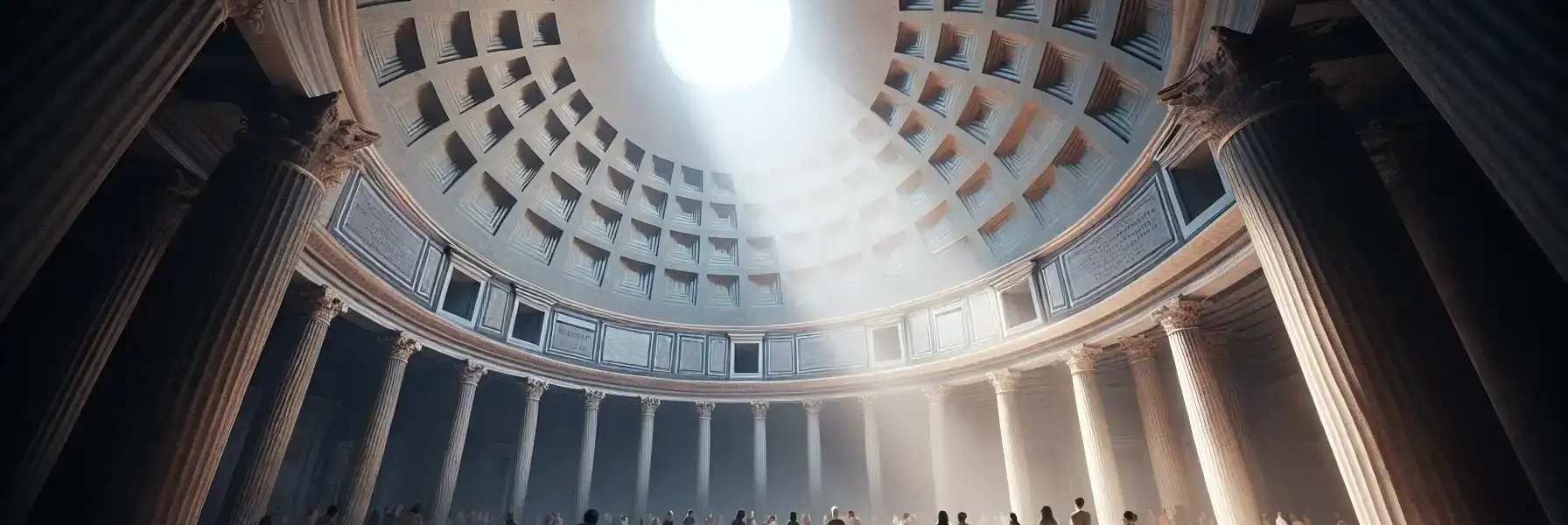
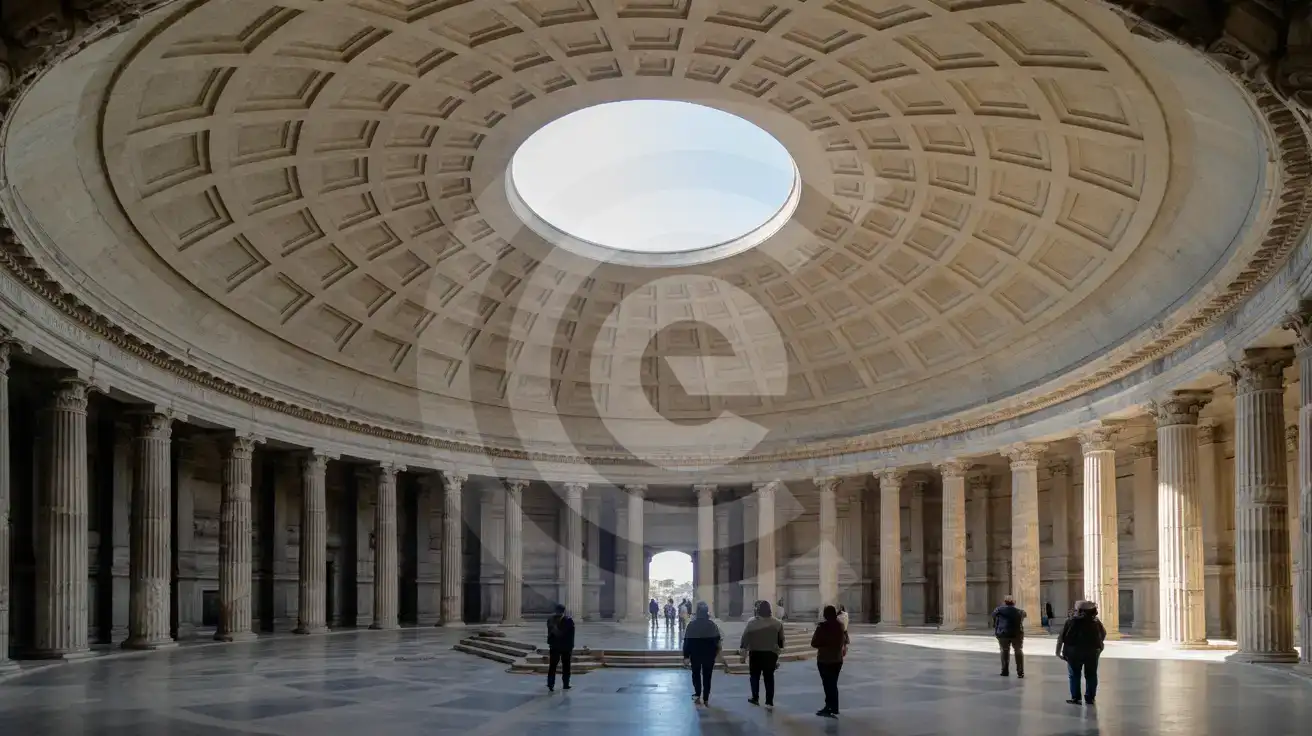
Stand in the centre of the rotunda, look up, and you're gazing at the defining achievement of Roman engineering. The dome rises in a perfect hemisphere, its interior surface articulated with five concentric rings of coffers — 28 coffers per ring, 140 total — that both reduce the structure's weight and create the geometric pattern drawing the eye toward the 8.7-metre oculus at the apex. This circular opening is the building's only source of natural light, and it remains completely open to the sky. Yes, rain falls through. Stand in the Pantheon during a storm and you'll watch water descend in a visible column, landing on the marble floor below. The floor slopes gently toward 22 drainage holes (look for the small rectangular openings) that channel rainwater into the ancient sewers beneath.
The dome's construction is a masterclass in variable-density concrete. At the base, where the walls meet the drum, the aggregate includes heavy travertine and tufa. As the dome rises, the aggregate shifts to lighter materials — brick fragments, then volcanic pumice near the oculus — reducing weight where it matters most. The walls also thin progressively, from over 6 metres thick at the base to just 1.2 metres at the oculus ring. Modern analysis suggests the coffers reduce the dome's weight by approximately 80% compared to a solid concrete hemisphere of equal dimensions.
Tomb of Raphael
On the left side of the rotunda as you enter — between the second and third aedicule — rests Raffaello Sanzio, the Renaissance painter who died on Good Friday 1520 at age 37. His tomb sits beneath a statue of the Madonna del Sasso (Madonna of the Rock) sculpted by his student Lorenzetto. The Latin epitaph, composed by the humanist Pietro Bembo, reads: Ille hic est Raphael timuit quo sospite vinci rerum magna parens et moriente mori — 'Here lies Raphael; while he lived, great Nature feared to be outdone by him, and when he died, feared to die herself.' The inscription captures the Renaissance conviction that Raphael had achieved perfection in painting. Beside him lies his fiancée Maria Bibbiena, who died before their wedding.
Royal Tombs of the House of Savoy
Two Italian kings are interred in the Pantheon, transforming part of the space into a de facto national mausoleum. On the right side of the rotunda, Vittorio Emanuele II — the first king of unified Italy, who died in 1878 — rests beneath a bronze sarcophagus. Across the way lies Umberto I, assassinated by an anarchist in 1900, alongside his wife Queen Margherita (yes, the queen for whom margherita pizza is named). Volunteer guards from the Istituto Nazionale per la Guardia d'Onore alle Reali Tombe del Pantheon often stand watch in ceremonial uniform, particularly on royal anniversaries.
The Bronze Doors
The massive bronze doors at the entrance measure approximately 7.5 metres tall and are believed to be largely original to antiquity — making them among the oldest functioning doors in Rome. Over the centuries they've been repaired and reinforced, but their core material dates to the Hadrianic period. Push through them (they still swing on their ancient hinges) and you pass from the glare of Piazza della Rotonda into the hushed interior. Notice how the proportions shift immediately: the portico's columns frame a horizontal world, while the rotunda opens into a vertical one culminating in the distant oculus.
The Portico and Egyptian Granite Columns
The portico's 16 monolithic granite columns were quarried at Mons Claudianus in Egypt's Eastern Desert, transported to the Nile, shipped across the Mediterranean, hauled up the Tiber, and erected in Rome — a logistical undertaking that modern engineers still find staggering. Each shaft is a single piece of stone roughly 12 metres tall and 1.5 metres in diameter, weighing approximately 60 tonnes. The eight columns across the front are grey granite; the four behind are red granite from Aswan. Above them, the triangular pediment originally held bronze decoration, long since removed.
The High Altar and Apse
Directly opposite the entrance, the apse contains the high altar and a 7th-century Byzantine icon of the Virgin and Child, traditionally associated with the building's 609 AD Christian dedication. The altar and choir were redesigned in the 18th century under Pope Clement XI, adding Baroque elements to the otherwise largely unaltered Roman interior. Mass is celebrated here, and during services the apse becomes the spiritual focal point — a reminder that despite the tourists, this remains a functioning church.
The Floor
Don't forget to look down. The marble floor is a geometric pattern of circles and squares in grey granite, red porphyry, yellow giallo antico, and white marble — much of it original to the Hadrianic construction. The pattern creates visual rhythm that complements the dome's coffers above. The gentle slope toward the centre, barely perceptible underfoot, ensures drainage from the oculus. Polished smooth by nearly two millennia of footsteps, the floor is itself an artifact of remarkable preservation.
Visit Strategy
Best Time to Visit
The Pantheon opens at 9:00 AM most days, and the first hour after opening offers the smallest crowds and the most dramatic light. In the morning, sunlight entering through the oculus strikes the upper walls of the dome, creating a slowly moving spotlight effect as the earth rotates. By midday in peak season (May through September), the queue often stretches across Piazza della Rotonda and wait times can exceed 45 minutes without a reservation.
Late afternoon — around 5:00 PM in summer — brings a second golden window. The crowds thin as tour groups depart, and the angled light creates warm tones on the interior surfaces. Avoid arriving during Mass times (Saturday 5:00 PM, Sunday 10:30 AM) unless you're attending worship, as tourist visits are suspended during services.
For a genuinely memorable experience, visit during a rainstorm. Watching rain fall through the oculus and onto the marble floor — a phenomenon that has occurred continuously for 1,900 years — connects you to the building's engineering in a way no sunny day can. Romans have always known this; tourists often don't.
Ticket Strategy
Since July 2023, admission costs approximately €5 for adults. EU residents under 18 enter free, as do worshippers attending Mass. The first Sunday of each month offers free admission to all (though expect longer queues). Timed-entry reservations through the official booking system cost around €2 extra but allow you to bypass the on-site queue — a worthwhile investment during peak season when the walk-up line can consume an hour of your morning.
Book tickets through the official website (www.pantheonroma.com) rather than third-party vendors, who often mark up prices significantly. Audio guides are available for rental at the entrance and provide solid historical context for visitors unfamiliar with Roman architecture.
How Long to Spend
Most visitors spend 20 to 40 minutes inside. If you're architecturally inclined, allow a full hour to examine the dome construction, locate the drainage holes, study the floor patterns, and read the tomb inscriptions. Photography enthusiasts may want longer — the shifting light throughout the day means multiple visits at different hours yield different images.
Photography Rules
Non-flash photography is permitted, and the interior is photogenic from nearly every angle. Tripods and professional equipment (video cameras, lighting rigs) require advance permission from the basilica administration. For the classic oculus shot, position yourself near the centre of the rotunda and shoot vertically with a wide-angle lens. Morning light creates more dramatic contrast than the diffuse illumination of overcast afternoons.
Dress Code
As an active Catholic basilica, the Pantheon enforces a modest dress code. Shoulders must be covered (no tank tops or spaghetti straps), and knees should not be exposed (no short shorts or miniskirts). Hats should be removed upon entry. Staff at the entrance will turn away visitors in beachwear, and unlike some Roman churches, there's no rental service for shawls or cover-ups. Pack a light scarf in your bag if you're touring Rome in summer clothing.
Avoiding Crowds
Beyond the early-morning and late-afternoon windows, consider visiting on weekdays rather than weekends, when Roman day-trippers and cruise excursions swell the numbers. January and February see the lowest tourist volumes, though the trade-off is shorter daylight hours and occasional rain. If you're in Rome during the first Sunday of the month, arrive before the 9:00 AM opening — free admission draws larger crowds than the modest €5 fee.
Site Walk-Through & Photographer's Guide
Recommended Walk Sequence
Enter through the main bronze doors beneath the portico — there's only one public entrance. As you pass through, pause in the threshold where the rectangular portico transitions into the circular rotunda. This liminal moment, where the horizontal world of columns gives way to the vertical world of the dome, is architecturally intentional. The Romans understood theatrical staging.
Turn immediately left after entering. This positions you for a clockwise circuit that passes Raphael's tomb first (between the second and third aedicule on the left), then continues around to the high altar and apse, then to the royal tombs on the right side, and finally back to the entrance. This sequence keeps the main attractions — Raphael, the altar, the kings — in a logical progression and ends you near the doors for exit.
After completing the circuit, move to the centre of the rotunda for the full dome experience. Stand on or near the central porphyry disk in the floor (look for the large circular stone) and look directly up. This is the geometric centre of the space, where the dome's curvature appears most symmetrical and the oculus sits directly overhead.
Key Structures to Spend Time At
The Entrance Threshold: Note the bronze doors' weathered patina and the worn marble threshold beneath your feet — polished smooth by 19 centuries of visitors. The proportional shift from portico to rotunda happens in a single step.
Raphael's Tomb (left side, second-third aedicule): Read the Bembo epitaph slowly. The Madonna sculpture above is by Lorenzetto. The adjacent tomb belongs to Maria Bibbiena, Raphael's fiancée.
Chapel of the Crucifix (third aedicule, left): Contains a 15th-century wooden crucifix. Less crowded than Raphael's tomb, with good angles back toward the centre.
High Altar and Apse (directly opposite entrance): The 7th-century Byzantine icon is difficult to see clearly from a distance. Approach as close as the rope barrier allows. The 18th-century Baroque additions contrast with the Roman simplicity elsewhere.
Tomb of Vittorio Emanuele II (right side): The bronze sarcophagus and perpetual lamp draw Italian visitors paying respects. The ceremonial guards, when present, add solemnity.
Tomb of Umberto I and Queen Margherita (right side, further along): The arrangement places husband and wife together. Less visited than Vittorio Emanuele's tomb.
The Floor's Central Porphyry Disk: This is your marker for the geometric centre. Stand here for the classic oculus shot.
The Drainage Holes: Small rectangular openings in the floor near the centre. Most visitors miss them. They've channeled rainwater into ancient sewers since the 2nd century.
Best Photo Spots & Lighting Times
For the iconic oculus shot looking straight up, the central porphyry disk offers the best symmetry. Use a wide-angle lens (16-24mm equivalent) and shoot vertically. Morning light between 9:00-11:00 AM creates a dramatic sunbeam effect when weather permits; the light column moves visibly across the interior as the hour progresses.
For interior portraits with the dome as background, position subjects in the nave between the entrance and centre, shooting toward the apse. The diffuse light through the oculus flatters faces without harsh shadows.
The exterior portico photographs best in early morning when Piazza della Rotonda's cafés haven't yet filled with umbrellas and tourists. The columns appear most impressive from a low angle, shooting upward to emphasize their 12-metre height.
Late afternoon (4:00-6:00 PM in summer) brings warm tones as angled light enters through the oculus. The upper reaches of the dome glow amber, and the coffers cast subtle shadows.
Restoration & Excavation Status
The Pantheon undergoes continuous conservation rather than dramatic restoration campaigns. As of recent years, work has focused on the bronze doors (cleaning and stabilization), the marble floor (repair of worn sections), and the exterior portico columns (removal of pollutant buildup). The dome itself is structurally sound and has required minimal intervention since antiquity — a testament to Roman engineering.
No major sections are typically closed to visitors, unlike sites such as the Colosseum where ongoing excavation restricts access to portions of the hypogeum. The greatest threat to the Pantheon remains vibration from Rome's traffic and the cumulative impact of millions of annual visitors on the marble floor. Conservation efforts focus on mitigation rather than reconstruction.
Souvenirs & On-Site Shopping
There is no gift shop inside the Pantheon itself. The bookstands and souvenir vendors immediately outside on Piazza della Rotonda sell the usual Roman merchandise — postcards, miniature replicas, magnets, and guidebooks of varying quality. For worthwhile souvenirs, seek out the bookshops near Largo di Torre Argentina, which stock better art history volumes on Roman architecture.
The Pantheon's official audio guide, available for rental at the entrance, makes a better investment than most trinkets. Alternatively, the small religious items sold at the basilica's information desk (prayer cards, medallions of Santa Maria ad Martyres) offer authentic mementos connected to the building's Christian heritage rather than generic tourist fare.
Nearby Attractions & Logistics
Walking Distance Highlights
Piazza Navona (5 minutes): Rome's most celebrated Baroque square occupies the footprint of the ancient Stadium of Domitian. Bernini's Fontana dei Quattro Fiumi (1651) anchors the centre, its four river gods representing the Nile, Ganges, Danube, and Río de la Plata. Borromini's Sant'Agnese in Agone church faces across the piazza in what legend describes as an architectural rivalry (Bernini's river god shielding his eyes from Borromini's façade). Street artists, cafés, and gelato vendors operate throughout the day.
Sant'Ignazio di Loyola (3 minutes): A 17th-century Jesuit church containing Andrea Pozzo's trompe-l'œil ceiling fresco 'Apotheosis of Saint Ignatius' (1685) — one of the most technically accomplished perspective paintings in existence. A small marble disk in the nave floor marks the optimal viewing position; stand there, look up, and the flat ceiling appears to vault into a three-dimensional architectural space opening to heaven. Free entry.
Trevi Fountain (10 minutes): Nicola Salvi's 18th-century Baroque fountain fed by the ancient Aqua Virgo aqueduct. The tradition of tossing a coin over your left shoulder to ensure a return to Rome generates an estimated €3,000 daily, collected and donated to charity. Visit before 8:00 AM to avoid the worst crowds.
Largo di Torre Argentina (7 minutes): A sunken square exposing four Republican-era Roman temples (3rd-2nd century BC) and the traditional site of Julius Caesar's assassination on 15 March 44 BC. A cat sanctuary operates among the ruins, caring for Rome's stray population. No entry to the archaeological area, but viewing from street level is clear.
Galleria Doria Pamphilj (5 minutes): A private aristocratic collection still owned by the Doria Pamphilj family, housing Velázquez's portrait of Pope Innocent X — considered one of the finest portraits ever painted — alongside works by Caravaggio, Raphael, and Titian. Admission around €14. The audio guide, narrated by a family member, adds atmospheric context.
Coffee & Food
Sant'Eustachio Il Caffè (2 minutes): A Roman institution since 1938, famous for its gran caffè — espresso with pre-sweetened crema whipped to a frothy consistency. The house blend is a closely guarded secret. Expect to stand at the bar; sitting costs extra.
Tazza d'Oro (2 minutes): The rival espresso temple across Piazza della Rotonda, known for granita di caffè con panna — frozen coffee slush topped with whipped cream, essential on summer afternoons.
Armando al Pantheon (1 minute): A family-run trattoria operating since 1961, serving Roman classics: cacio e pepe, carbonara, amatriciana. Reservations recommended; the tiny dining room fills quickly.
Transit Options
The Pantheon sits in Rome's pedestrianized historic centre, inaccessible by car. The nearest Metro stations — Barberini and Spagna on Line A — are 12-15 minutes on foot. Bus lines 30, 40, 62, 64, 81, 87, and 492 stop at Largo di Torre Argentina or along Corso Vittorio Emanuele II, both roughly 5-7 minutes from Piazza della Rotonda. Taxis cannot enter the immediate vicinity; ask to be dropped at Largo di Torre Argentina.
Why Data Matters at the Pantheon
Standing beneath the Pantheon's dome with no signal means missing the layers that make the building extraordinary. Pull up a cross-section diagram showing how the concrete density changes as the dome rises. Read Bembo's epitaph at Raphael's tomb in the original Latin while your translation app works in real time. Check whether Galleria Doria Pamphilj's Velázquez is on display today or out for conservation.
Rome's historic centre — the dense pedestrian zone surrounding the Pantheon — has patchy public WiFi at best, and café networks require purchases and Italian-language logins. An eSIMno plan connecting through Vodafone or Wind Tre means consistent 4G/5G coverage from the moment you step off the bus at Largo di Torre Argentina. Book your timed-entry ticket while walking through Piazza Navona. Share that perfect oculus photo before leaving the rotunda. Navigate to Sant'Eustachio Il Caffè without stopping to ask directions. The Pantheon rewards visitors who arrive prepared — and data is part of that preparation.
The Eternal Dome
Compare WiFi Options at Pantheon
 Recommended Recommended | Local SIM / Operator | Roaming | |
|---|---|---|---|
| FEATURES | |||
| Setup time | Few minutes | Store visit + paperwork | Auto |
| No local ID needed | Online checkout | Local ID required | Use home account |
| Speed | 4G/LTE; 5G in some areas | Carrier-grade | Partner-dependent |
| Travel support | English support 24/7 | Operator shops and call centre | Home carrier hours |
| Keep home number | Dual SIM | Replaces it | Same number |
| Cost predictability | Fixed price | Bills can spike | Bill-shock risk |
| PRICING | |||
Typical pricing | See plans below | — | — |
PRICING — PICK YOUR ESIMNO PLAN
Featured eSIM plans
Italian Mobile

Italian Mobile
Italian Mobile
Italian Mobile
Italian Mobile
Italian Mobile
Italian Mobile
Italian Mobile


