
Quick Facts
- Address
- Rue de Rivoli, 75001 Paris, France
- Hours
- Wed-Mon 9:00-18:00, Fri until 21:45, Closed Tuesdays
- Adult Ticket
- €22 online (timed entry required)
- Free Entry
- Under 18; EU residents under 26
- Nearest Métro
- Palais Royal–Musée du Louvre (Lines 1, 7)
- Collection Size
- 35,000 works on display
- Total Collection
- 480,000+ objects
- Opened
- 10 August 1793
- eSIMno Networks
- Bouygues, Orange, SFR
- Official Site
- louvre.fr
About the Louvre Museum
The Louvre began as a defensive necessity. In 1190, King Philip II ordered a fortress built on the Right Bank of the Seine to protect Paris from Viking raids and English threats approaching from the west. That original structure — a square keep surrounded by moats and towers — occupied roughly the southwest corner of what is now the Cour Carrée. You can still walk through its medieval foundations in the museum's lower level, where excavated walls and the base of the central donjon reveal the building's martial origins.
The transformation from fortress to royal residence happened gradually. Charles V moved the court here in the 14th century and began converting military architecture into something more livable. But the real pivot came under Francis I, who demolished the old keep in 1528 and commissioned architect Pierre Lescot to design Renaissance wings that would reflect French ambitions to rival Italian cultural achievements. The southwest corner of the Cour Carrée, with its sculptural decoration by Jean Goujon, dates from this period and established the architectural vocabulary that later monarchs would extend.
Henry IV connected the Louvre to the Tuileries Palace via the Grande Galerie — at 460 meters, it was the longest building in the world when completed. Louis XIII and Louis XIV continued expanding the complex, though Louis XIV's 1682 move to Versailles left the Louvre in a strange limbo: too important to abandon, too associated with old Paris to remain the center of royal power.
The French Revolution gave the building its current purpose. On 10 August 1793 — exactly one year after the storming of the Tuileries — the Muséum Central des Arts de la République opened to the public, displaying royal collections that had been nationalized along with the crown itself. The democratic principle was explicit: art that had belonged to kings now belonged to citizens.
Napoleon understood the propaganda value of a world-class museum bearing his name. The Musée Napoléon, as it was briefly called, grew dramatically through military conquest — Egyptian antiquities following the 1798 campaign, Italian Renaissance masterpieces seized during the Italian wars. Many works were returned after Waterloo, but the acquisitive pattern was set. Napoleon III completed the physical structure in the 1850s, finally joining all the wings into the continuous palace you see today.
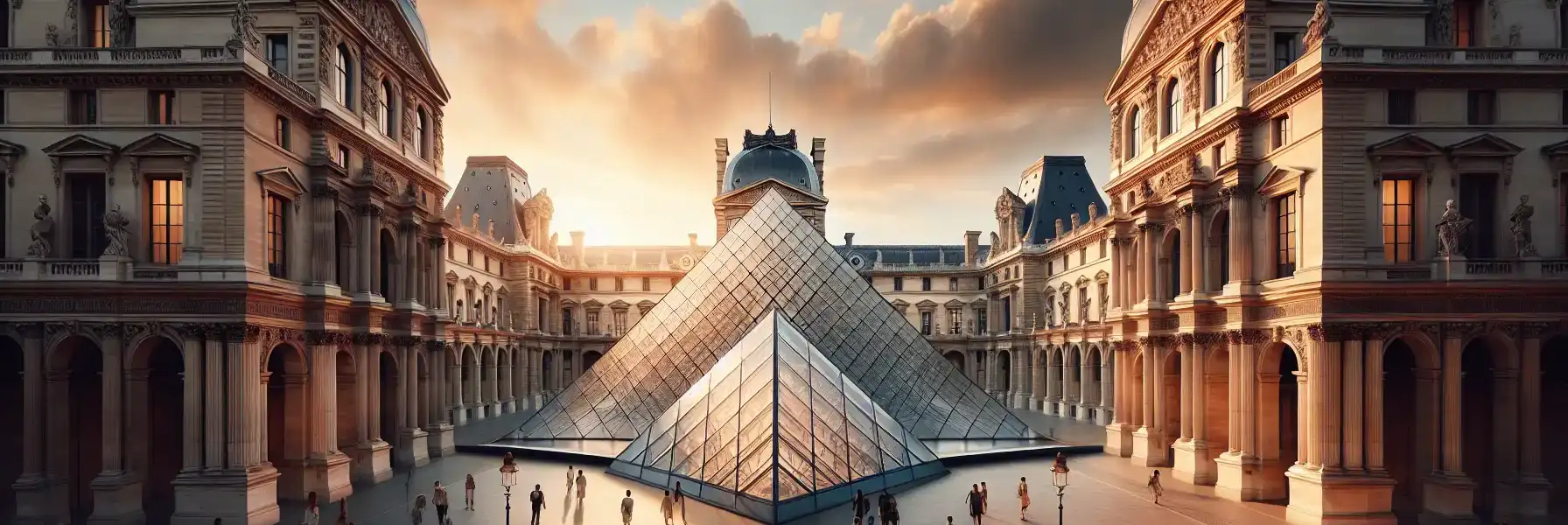
The most controversial modern addition arrived in 1989. I. M. Pei's glass pyramid, commissioned by President François Mitterrand as part of the Grand Louvre renovation project, provoked fierce opposition during construction. Critics called it an architectural insult, a modernist intrusion on classical harmony. Three decades later, it's difficult to imagine the museum without it — the pyramid functions both as the main entrance and as the building's most recognizable symbol, its geometry creating a deliberate conversation between contemporary design and Baroque facades.
Today the Louvre holds the largest art collection in the world, with approximately 480,000 objects across eight curatorial departments: Egyptian Antiquities; Near Eastern Antiquities; Greek, Etruscan, and Roman Antiquities; Islamic Art; Sculpture; Decorative Arts; Paintings; and Prints and Drawings. Of these, roughly 35,000 are on display at any given time across 72,735 square meters of gallery space. The building and its Seine riverbank setting are inscribed on the UNESCO World Heritage List, and annual visitor numbers regularly exceed 9 million, making it the most visited museum on Earth.
Highlights and Must-See Works
The Louvre's collection sprawls across three wings — Denon, Sully, and Richelieu — each named for figures in French cultural administration. Most first-time visitors gravitate toward the Denon Wing, where the museum concentrates its most famous paintings and classical sculpture. But limiting yourself to Denon means missing entire civilizations housed in Sully and the decorative arts treasury of Richelieu.
Mona Lisa (La Joconde)
Leonardo da Vinci's portrait of Lisa Gherardini, painted between 1503 and 1519, hangs in the Salle des États on the first floor of the Denon Wing. The room was redesigned specifically to accommodate the crowds this single painting attracts — a climate-controlled case behind bulletproof glass, a wooden barrier keeping viewers several meters back, and capacity management that still can't prevent the crush during peak hours. The painting itself measures just 77 by 53 centimeters; the experience of seeing it often involves more elbows than enlightenment. Still, the sfumato technique, the ambiguous smile, and the landscape background dissolving into atmospheric haze represent a genuine breakthrough in Renaissance portraiture. Come early or late, accept that you won't have a contemplative moment alone with it, and give yourself permission to prefer the other paintings in the same room — Veronese's Wedding at Cana, covering the entire opposite wall at 6.77 by 9.94 meters, deserves more attention than it typically receives.
Venus de Milo
This Hellenistic marble statue of Aphrodite, dating to approximately 100 BCE, stands in the Greek antiquities galleries on the ground floor of the Sully Wing. Discovered on the island of Milos in 1820 by a peasant farmer, the statue was acquired by the French ambassador and presented to Louis XVIII. The missing arms have inspired centuries of speculation about her original pose — holding a shield, spinning thread, embracing a companion — but the uncertainty only adds to her appeal. The slightly twisted posture, the drapery falling from her hips, and the idealized proportions make her the Louvre's primary example of Classical beauty. The surrounding galleries contain significant Greek and Roman works that most visitors hurry past in their rush to find the Mona Lisa.
Winged Victory of Samothrace
Nike alighting on the prow of a ship, carved in Parian marble around the 2nd century BCE, occupies the landing of the Daru staircase in the Denon Wing. The placement is theatrical by design — you climb the stairs and encounter her suddenly, wings swept back, drapery pressed against her body by an invisible wind. The statue was discovered in fragments on the island of Samothrace in 1863 and painstakingly reconstructed over decades. Recent conservation work revealed traces of original polychrome painting. More than almost any other work in the museum, the Winged Victory demonstrates how architectural setting can elevate sculpture. The staircase approach is worth experiencing even if you've seen photographs countless times.
Liberty Leading the People
Eugène Delacroix painted this monumental canvas in 1830, commemorating the July Revolution that had just overthrown Charles X. The allegorical figure of Marianne — barefoot, breast exposed, tricolor flag raised — strides over a barricade of fallen bodies while bourgeois and working-class revolutionaries follow. The painting hangs in the Mollien Gallery on the first floor of the Denon Wing, surrounded by other large-format French Romantic works. It's impossible to miss, both for its scale and for its enduring status as a symbol of French republican values.
The Coronation of Napoleon
Jacques-Louis David's enormous canvas depicting Napoleon crowning Joséphine at Notre-Dame in December 1804 measures approximately 6 by 10 meters — one of the largest paintings in the Louvre. David was present at the ceremony and spent three years on the commission, adjusting historical accuracy to suit political messaging. Napoleon appears taller than he was; his mother, who boycotted the event, sits prominently in the gallery. The painting hangs in the Denon Wing's grand French painting galleries, and its sheer scale commands attention even in rooms designed for oversized works.
Napoleon III Apartments
Most visitors to the Louvre focus entirely on the art collection and miss the museum's most lavish preserved interiors. The Napoleon III Apartments, located in the Richelieu Wing, were created in the 1850s and 1860s as state reception rooms for the Ministry of State. The Grand Salon features massive chandeliers, gilded moldings, crimson upholstery, and ceiling paintings that epitomize Second Empire taste. Walking through these rooms offers a useful reminder that the Louvre building itself is a work of decorative art, not merely a container for other objects.
Medieval Louvre Foundations
Beneath the Sully Wing, excavated remains of the original 12th-century fortress reveal the building's pre-museum history. The circular base of the main keep, portions of the defensive moat, and fragments of the curtain wall survived centuries of construction above. The archaeological presentation is thoughtful, with clear sight lines and explanatory panels. Few visitors make it down here, which means you can often explore without crowds — a rare experience in this museum.
Islamic Art Galleries
Opened in 2012 in the Cour Visconti, the Department of Islamic Art occupies a striking contemporary space beneath an undulating glass-and-metal roof designed by Mario Bellini. The collection spans 13 centuries and three continents, from Spanish Umayyad ivories to Ottoman ceramics to Mughal manuscripts. Highlights include the Pyxis of al-Mughira, a 10th-century Córdoban ivory casket, and the Baptistère de Saint Louis, a 14th-century Mamluk basin of inlaid brass. The galleries are often less crowded than the painting collections, and the contemporary architecture creates an interesting contrast with the historical building.
Visit Strategy
The Louvre rewards planning more than almost any other museum. Its scale means that wandering without a strategy leads to exhaustion before you've seen the works you actually came for. Here's how to approach a visit that matches your available time and energy.
Ticket Strategy
Online booking with a timed entry slot is effectively mandatory during busy periods and always advisable. Tickets cost €22 for adults when purchased through the official website. Arriving without a reservation means joining a separate queue that may not gain entry at all during peak season. Free admission applies to visitors under 18 regardless of nationality, and to European Union residents under 26 with valid ID. The museum offers free evening entry on the first Friday of each month from October through March (excluding July and August), and all-day free entry on Bastille Day, 14 July — both occasions draw enormous crowds.
Best Time to Visit
Wednesday and Friday have the longest hours, making them better choices than other weekdays. Friday evenings after 18:00 are particularly good: tour groups have departed, the atmosphere becomes calmer, and you can reach popular works without aggressive positioning. Early mornings — arriving right at 9:00 opening — offer a window before the crowds fully materialize. The period between 11:00 and 15:00 is consistently the worst, especially around the Mona Lisa and the Italian painting galleries. Avoid French school holidays if possible; the museum becomes significantly more congested during February break, spring break, and summer vacation periods.
Entrance Choice
The iconic glass pyramid is the main entrance, but it's also where queues form most visibly. Two alternatives are worth knowing. The Carrousel du Louvre entrance, accessible from 99 Rue de Rivoli or directly from the Palais Royal–Musée du Louvre Métro station, bypasses the outdoor pyramid line and deposits you in the underground shopping mall leading to the same central Hall Napoléon. The Porte des Lions entrance on the Seine side of the Denon Wing reopens periodically and offers the most direct access to Italian paintings, though its hours are inconsistent. Check the museum website on your visit day to confirm which entrances are operating.
Recommended Duration
A focused visit hitting major highlights requires at least three hours. Attempting to see everything in one day is inadvisable and physically grueling — the galleries alone cover more than 15 kilometers of walking paths. A full-day visit (arriving at opening, breaking for lunch, continuing until closing) allows for one thorough wing exploration plus selected highlights from others. Serious art enthusiasts often plan multiple visits across several days, treating the Louvre as a destination that rewards return trips rather than a box to check.
Navigation
The museum layout can be disorienting. The three wings — Denon, Sully, and Richelieu — surround the central pyramid and connect at each level, but finding specific galleries requires attention to floor plans. The free museum map is essential; the official Louvre app provides interactive navigation with GPS positioning inside the building. Room numbers follow a logical system (department abbreviation plus number), but the physical signage inside corridors can be sparse. Knowing that major works are distributed across all three wings, not clustered together, helps set realistic route expectations.
Practical Considerations
Large bags, suitcases, and backpacks exceeding 55 by 35 by 20 centimeters must be checked at the free cloakroom beneath the pyramid. Strollers are permitted but narrow galleries and stairs make them awkward. Wheelchairs are available for loan. Eating inside the galleries is prohibited, but the museum contains several cafés — Café Mollien in the Denon Wing offers views toward the pyramid, and the underground Carrousel du Louvre has additional food options. Restrooms are located beneath the pyramid and at intervals throughout the wings, though queues at women's facilities can be substantial.
Highlights and Visit Strategy
Must-See Works and Where to Find Them
Orienting yourself within the Louvre's gallery system requires understanding the wing and floor structure. The Denon Wing contains Italian, Spanish, and French painting alongside Greek and Roman antiquities. The Sully Wing houses Egyptian antiquities, Greek antiquities, and the medieval Louvre foundations. The Richelieu Wing holds Northern European painting, French sculpture, and the decorative arts including the Napoleon III Apartments.
Mona Lisa — Denon Wing, First Floor, Salle des États (Room 711). Approach via the Grande Galerie or from the Daru staircase after seeing the Winged Victory.
Venus de Milo — Sully Wing, Ground Floor, Room 346. Located within the Greek antiquities galleries, accessible from the medieval Louvre level or via Sully ground-floor entrance.
Winged Victory of Samothrace — Denon Wing, First Floor Landing, Daru Staircase. The staircase is immediately visible from the Hall Napoléon below the pyramid.
Liberty Leading the People — Denon Wing, First Floor, Mollien Gallery (Room 700). Same floor as the Mona Lisa, in the French painting section.
The Coronation of Napoleon — Denon Wing, First Floor, Room 702. Adjacent to the Mollien Gallery in the large-format French paintings area.
Code of Hammurabi — Richelieu Wing, Ground Floor, Room 227. The 18th-century BCE Babylonian law stele, one of the oldest deciphered writings of significant length.
The Seated Scribe — Sully Wing, First Floor, Room 635. A 4th-dynasty Egyptian painted limestone figure, remarkably preserved with inlaid eyes.
Psyche Revived by Cupid's Kiss — Denon Wing, Ground Floor, Room 403. Antonio Canova's neoclassical marble sculpture from 1793.
The Lacemaker — Richelieu Wing, Second Floor, Room 837. Vermeer's tiny masterpiece of domestic genre painting, easily missed in a cabinet of Dutch works.
Raft of the Medusa — Denon Wing, First Floor, Room 700. Géricault's monumental shipwreck painting near Delacroix's Liberty.
Recommended Visit Sequence by Time Available
90-Minute Express Route: Enter via the pyramid, proceed directly to the Daru staircase (Winged Victory), continue to the Grande Galerie and Salle des États (Mona Lisa), then descend to the Denon ground floor for Greek sculpture and Canova. Exit back through the pyramid. This route covers the three most famous works plus context.
3-Hour Focused Visit: Begin with the 90-minute route, then add the Sully Wing Egyptian antiquities (ground and first floors) including the Seated Scribe and the Great Sphinx of Tanis. If energy permits, descend to the medieval Louvre foundations before returning to the pyramid.
Full-Day Comprehensive Visit: Arrive at 9:00 opening. Spend the morning on Denon Wing painting and sculpture, including the complete Italian Renaissance galleries and French Romantic rooms. Break for lunch at Café Mollien or exit to the Tuileries Garden kiosks. Return for the afternoon to explore the Richelieu Wing — Northern European painting (Vermeer, Rubens, Rembrandt), French decorative arts, and the Napoleon III Apartments. End with the Sully Wing Egyptian collection and medieval foundations before closing.
Audio Guide and App Tips
The official Louvre app (free download, available in multiple languages including English, French, German, Spanish, Italian, Portuguese, Japanese, Korean, and Chinese) provides interactive maps with indoor positioning, curated tour routes, and detailed commentary on major works. The app functions offline once downloaded, which can be useful given inconsistent indoor WiFi coverage — though having mobile data active ensures map positioning works accurately. A paid Nintendo 3DS audio guide is available for rental at the entrance (€5), offering seven themed tours and child-friendly options. For most visitors, the smartphone app provides equivalent or better functionality at no cost.
Photography Rules
Personal photography without flash is permitted throughout the permanent collection galleries. Flash photography, tripods, monopods, and selfie sticks are prohibited everywhere. Photography of any kind is forbidden in temporary exhibitions and in certain galleries displaying light-sensitive works — signage indicates these restrictions. Videography for personal use follows the same rules as still photography; commercial filming requires advance authorization. The museum requests that photography not impede other visitors' enjoyment, though enforcement around the Mona Lisa is minimal and the experience there often involves dozens of smartphones held overhead simultaneously.
Quiet Galleries and Crowd-Avoidance Tips
The Louvre's visitor flow is highly uneven. Roughly 80% of guests concentrate in 20% of the galleries — primarily the Mona Lisa room, the Winged Victory staircase, and the route connecting them. Several excellent collections remain comparatively empty:
Islamic Art Galleries (Richelieu/Denon Wings, Lower Level): The contemporary architecture and world-class collection attract only a fraction of main-floor traffic.
French Sculpture Courtyards (Richelieu Wing, Ground Floor): The Cour Marly and Cour Puget, glass-roofed sculpture courts, are often nearly deserted in early morning and late afternoon.
Northern European Painting (Richelieu Wing, Second Floor): Vermeer, Rembrandt, and Rubens without the Italian gallery crowds.
Egyptian Antiquities Upper Galleries (Sully Wing, First Floor): Beyond the ground-floor highlights, the thematic rooms upstairs see lighter foot traffic.
Decorative Arts (Richelieu Wing, First Floor): Period rooms, furniture, and objects that most visitors skip entirely.
Timing matters significantly. If you must see the Mona Lisa, do it first thing at 9:00 or after 16:00 on a Friday evening. Spend the crowded midday hours in quieter wings, then return to Denon when the tour groups have departed.
Nearby Attractions and Logistics
The Louvre sits at the geographic and cultural heart of Paris, surrounded by monuments, gardens, and museums that can fill several additional days. Planning your exit strategy and onward itinerary is as important as planning the museum visit itself.
Tuileries Garden
Exit the Louvre through the Porte des Lions or the Carrousel Arc and walk directly into the Jardin des Tuileries, the formal French garden stretching 850 meters west toward Place de la Concorde. André Le Nôtre designed the layout in 1664, and the central promenade, octagonal basin, and geometric tree plantings remain essentially unchanged. The garden is freely accessible and offers benches for recovery after museum fatigue, plus seasonal kiosks selling sandwiches and crêpes. Continue through to the Orangerie Museum at the western end for Monet's Water Lilies — an entirely different scale of experience from the Louvre's encyclopedic collections.
Musée d'Orsay
Cross the Seine via the Passerelle Léopold-Sédar-Senghor (a pedestrian footbridge directly south of the Tuileries) and reach the Musée d'Orsay in approximately 10 minutes. The Orsay houses Impressionist and Post-Impressionist painting — essentially everything the Louvre's collection stops before, from roughly 1848 to 1914. Monet, Degas, Renoir, Van Gogh, Cézanne, Seurat, and Gauguin are all represented in depth. The building itself, a former Beaux-Arts railway station from 1900, offers a dramatic architectural contrast to the Louvre's palace setting. Combination tickets are sometimes available.
Palais Royal
Walk north across Rue de Rivoli (about 5 minutes from the pyramid) to enter the Palais Royal gardens, an elegant enclosed courtyard surrounded by 18th-century arcades housing boutiques, rare-book dealers, and historic restaurants. Daniel Buren's Les Deux Plateaux — the striped black-and-white columns installed in 1986 — occupies the southern Cour d'Honneur and provides an unexpectedly playful counterpoint to the classical surroundings. The Palais Royal garden itself is a peaceful rectangle of formal plantings, lime trees, and benches, far quieter than the Tuileries.
Sainte-Chapelle
A 15-minute walk east via the Pont Neuf reaches the Île de la Cité and one of Paris's most extraordinary interiors. Sainte-Chapelle, the 13th-century royal chapel built by Louis IX to house relics of Christ's Passion, contains 1,113 stained-glass panels that filter light through 600 square meters of medieval color. The upper chapel — accessible via a narrow spiral staircase — creates an effect of standing inside a jeweled reliquary. Timed tickets are advisable; combination tickets with the adjacent Conciergerie (a former royal palace and Revolutionary prison) are available.
Pont Neuf and Île de la Cité
The Pont Neuf (1607) is the oldest surviving bridge across the Seine in Paris, despite its name meaning "New Bridge." Cross it to reach the western tip of the Île de la Cité, where the leafy Square du Vert-Galant descends to water level and offers one of the city's best river views. From here, Notre-Dame Cathedral is a 10-minute walk east along the island; the cathedral reopened in December 2024 after post-fire restoration.
Transit Connections
The Palais Royal–Musée du Louvre Métro station (Lines 1 and 7) provides the most direct museum access, with a tunnel leading into the Carrousel du Louvre. Louvre–Rivoli (Line 1) and Tuileries (Line 1) are surface-level alternatives within 5 minutes' walk. Bus lines 21, 27, 39, 68, 69, 72, 81, and 95 serve nearby stops. For river transport, the Pont Neuf Batobus stop is the closest; Seine cruise embarkation points cluster near the Pont de l'Alma (20 minutes west) and Pont d'Iéna near the Eiffel Tower.
Eating Near the Louvre
The immediate vicinity includes tourist-priced cafés and a few better options. Café Kitsuné in the Palais Royal garden serves quality coffee and Japanese-inflected pastries. Le Fumoir, across from the Louvre on Rue de l'Amiral de Coligny, offers Franco-Nordic brasserie food in a library-bar atmosphere. For a quick lunch, the Carrousel du Louvre food court includes a Comptoir de l'Arc with sandwiches and salads. Rue Saint-Honoré heading west has bakeries and casual options. For a full meal, the Palais Royal restaurant Le Grand Véfour (two Michelin stars, reservations essential) has occupied the same arcade location since 1784.
Why Data Matters at the Louvre
The Louvre's scale makes a connected phone genuinely useful, not just convenient. The official app's indoor positioning helps you navigate between wings without retracing steps. Audio commentary on your own device means no rental queues. Translation of French signage happens instantly. And the practical moments — confirming restaurant hours for post-museum lunch, checking Métro disruptions, coordinating with travel companions somewhere in 72,735 square meters of gallery space — all work better with reliable data than with hope.
Airport SIM queues and carrier stores eat into museum time. With eSIMno, you activate a French data plan before landing, connect to local networks like Bouygues, Orange, or SFR the moment you clear customs, and arrive at the Louvre with maps, apps, and tickets already functional. Indoor coverage beneath the pyramid and throughout the gallery wings depends on carrier infrastructure, and eSIMno's local-network approach means you're using the same signal French residents rely on — not roaming agreements that can deprioritize data speeds.
You'll use data most heavily during arrival logistics and post-museum planning. Inside the galleries, the app functions offline once downloaded. But having connectivity as a backup — for crowd-sourced wait times, spontaneous ticket changes, or finding the fastest route to Sainte-Chapelle afterward — transforms a museum visit from a set itinerary into something more flexible.
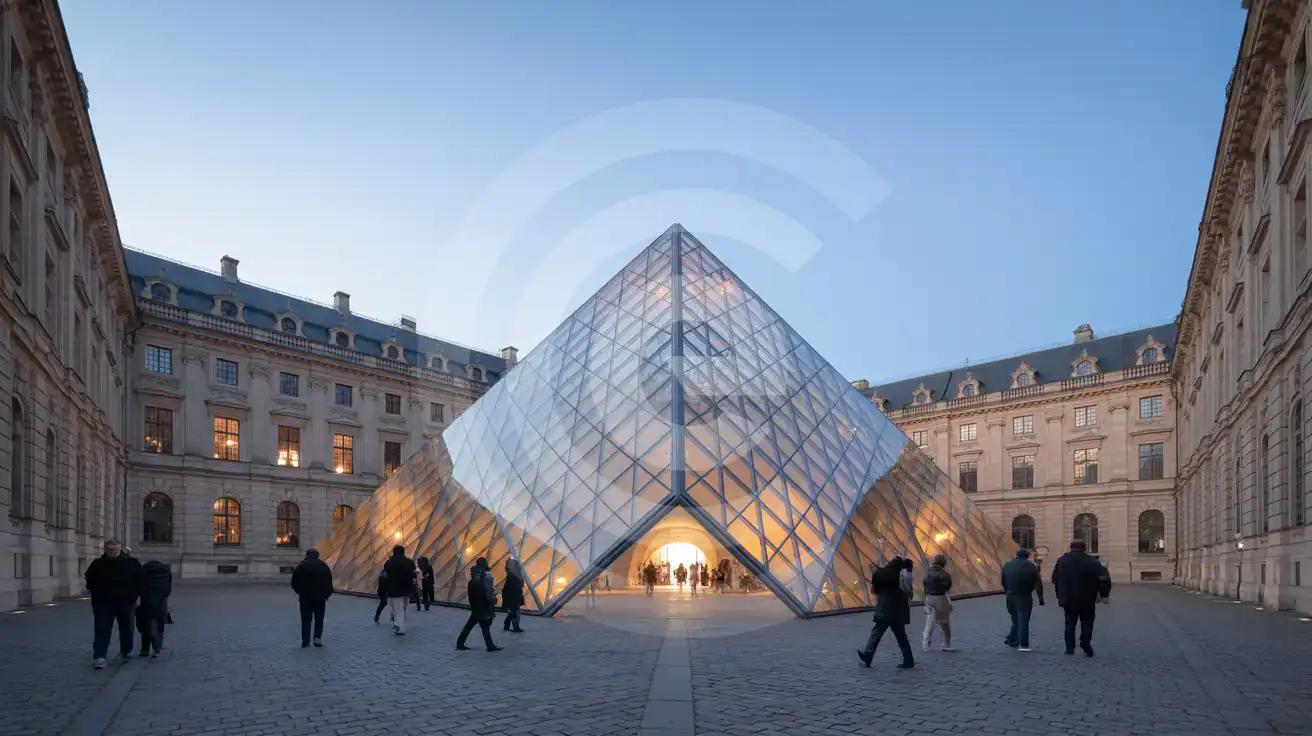
The Louvre at Dusk
Compare WiFi Options at Louvre Museum
 Recommended Recommended | Local SIM / Operator | Roaming | |
|---|---|---|---|
| FEATURES | |||
| Setup time | Few minutes | Store visit + paperwork | Auto |
| No local ID needed | Online checkout | Local ID required | Use home account |
| Speed | 4G/LTE; 5G in some areas | Carrier-grade | Partner-dependent |
| Travel support | English support 24/7 | Operator shops and call centre | Home carrier hours |
| Keep home number | Dual SIM | Replaces it | Same number |
| Cost predictability | Fixed price | Bills can spike | Bill-shock risk |
| PRICING | |||
Typical pricing | See plans below | — | — |
PRICING — PICK YOUR ESIMNO PLAN
Featured eSIM plans
France Mobile

France Mobile
France Mobile
France Mobile
France Mobile
France Mobile
France Mobile
France Mobile


