
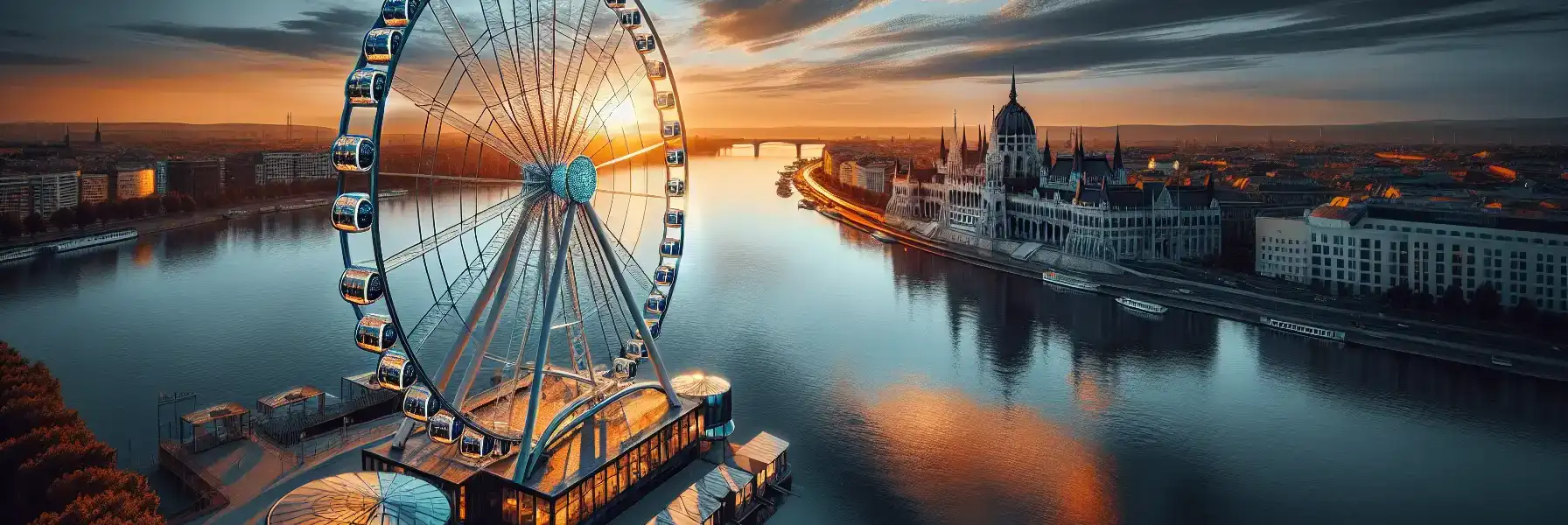
Quick Facts
- Height
- 135 metres (443 feet)
- Capsules
- 32 sealed glass pods, up to 25 passengers each
- Rotation Time
- Approximately 30 minutes
- Opening Hours
- Typically 11:00-18:00, extended to 21:00 in summer
- Standard Adult Ticket
- £29-£36 online, £5-£10 more walk-up
- Fast Track Ticket
- £45-£55
- Champagne Experience
- £55-£65
- Nearest Tube
- Waterloo (5 min walk), Westminster (7 min)
- Address
- Riverside Building, County Hall, London SE1 7PB
- Official Website
- londoneye.com
- eSIMno Networks
- EE, O2, Three
About the London Eye
The London Eye emerged from a 1993 architectural competition organized by The Sunday Times and the Architecture Foundation, seeking designs to mark the approaching millennium. Husband-and-wife architects David Marks and Julia Barfield submitted their cantilevered observation wheel concept and, despite not winning the official competition, spent years pursuing its realization through private financing and sheer determination. Construction began in 1998, and the wheel was raised from a horizontal position on the Thames in an audacious engineering operation that captured global media attention.
The structure opened to the public on 9 March 2000, initially under British Airways sponsorship as the British Airways London Eye. At 135 metres tall, it immediately claimed the title of world's tallest observation wheel — a record it held until Singapore's 165-metre Flyer opened in 2008. The wheel has since been surpassed by several larger structures, including the 167-metre High Roller in Las Vegas and the 250-metre Ain Dubai, but it remains Europe's tallest and arguably the most architecturally significant.
The Engineering Marvel
What sets the London Eye apart from traditional Ferris wheels is its cantilevered design — the entire structure is supported from one side only, like a bicycle wheel mounted on a single A-frame support. This asymmetrical engineering feat was achieved through collaboration between Marks Barfield Architects, Arup (structural engineering), Hollandia (steelwork fabrication), and Mitsubishi Heavy Industries (capsule and drive systems). The hub-and-spindle assembly at the centre was, at the time of construction, the largest ever fabricated.
The 32 capsules — numbered 1 through 33, skipping 13 for superstitious reasons — are attached to the outer circumference and rotate on individual motorized systems, keeping them level throughout the journey. Each capsule weighs approximately 10 tonnes, is fully enclosed and climate-controlled, and features curved glass panels offering 360-degree visibility. The number 32 represents the 32 London boroughs, from Westminster to Havering, Greenwich to Harrow.
From Temporary Attraction to Permanent Landmark
Originally granted only five-year temporary planning permission, the wheel's extraordinary popularity — drawing roughly 3 million visitors annually — convinced Lambeth Council to grant permanent status in 2002. The attraction has changed sponsorship hands multiple times: from British Airways (2000-2005) to no sponsorship (2005-2011), then EDF Energy (2011-2014), Coca-Cola (2015-2019), and currently lastminute.com. Through each rebranding, its silhouette has become inseparable from London's identity — the focal point of New Year's Eve fireworks broadcasts watched by billions, a frequent film location, and one of the most photographed structures in the United Kingdom.
The London Eye sits within view of the Palace of Westminster and Westminster Abbey, both part of the UNESCO World Heritage Site designated in 1987. While the wheel itself has no heritage listing, its visual relationship with these historic buildings creates one of the most recognizable urban compositions in world architecture — modernity meeting Gothic Revival across the width of the Thames.
Highlights and Must-See Experiences
The Capsule Rotation
The signature experience requires no further activity than simply standing inside the glass pod and watching London unfold. The wheel rotates slowly enough — about 0.26 metres per second — that it never stops for boarding; passengers step on and off the moving capsules at ground level. This continuous motion means your 30-minute journey is uninterrupted, rising gradually from the South Bank gardens to the apex opposite Big Ben, then descending toward the river's eastern reaches.
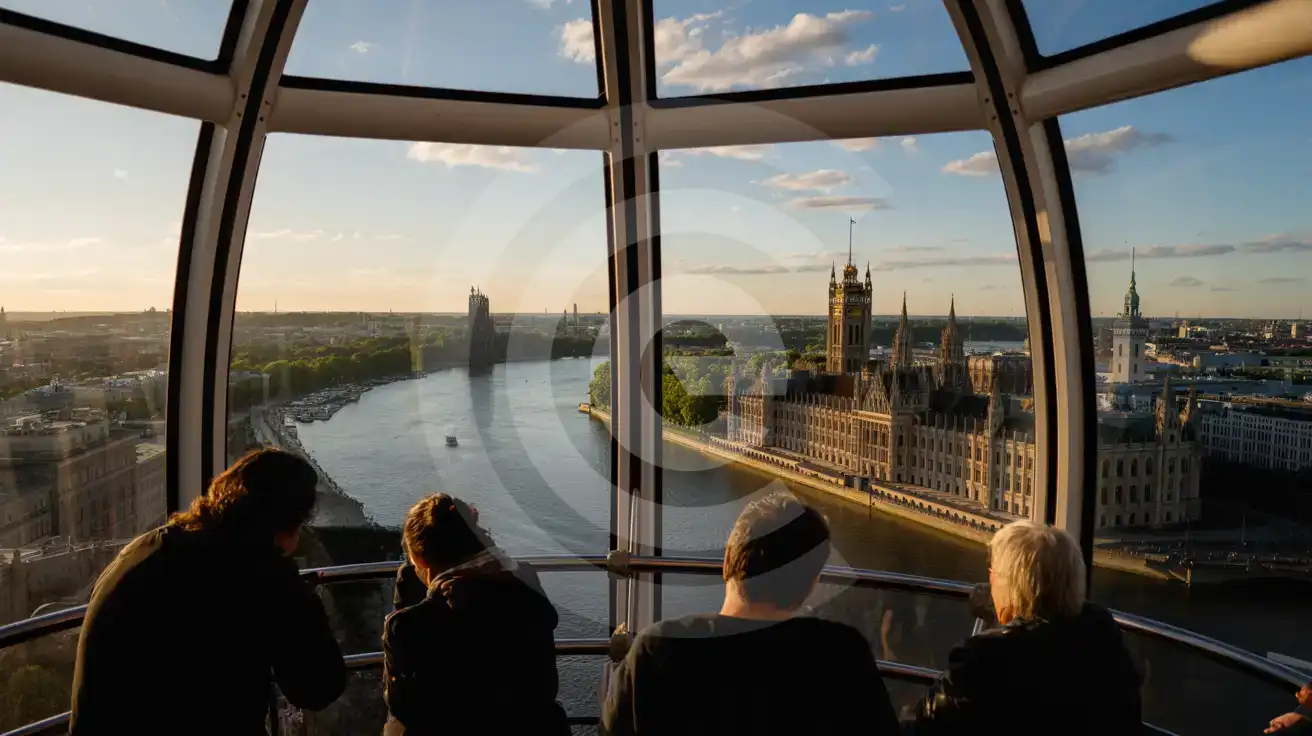
On clear days, visibility extends approximately 40 kilometres in every direction. To the west, Windsor Castle becomes visible as a grey silhouette above the suburban sprawl. To the east, the Canary Wharf towers and the Thames Barrier's curved silver shells mark the river's passage toward the estuary. The most concentrated architectural drama lies directly below and across the water: the Palace of Westminster's ornate Gothic facades, Big Ben's clock face (officially the Elizabeth Tower since 2012), Westminster Bridge's green iron spans, and the geometric mass of the Treasury and Foreign Office buildings lining Whitehall.
The A-Frame Structure from Jubilee Gardens
Before or after your rotation, walk into Jubilee Gardens — the landscaped park directly behind the wheel — for the best ground-level appreciation of the engineering. From here, the cantilevered A-frame support reveals itself: two massive steel legs angling toward the river, tensioned steel cable spokes radiating from the central hub, and the enormous white rim tracing its slow arc against the sky. Evening visits when the wheel is illuminated in colour (which changes for various occasions — purple for Remembrance, rainbow for Pride) offer particularly striking photographic opportunities.
The 4D Cinema Experience
Included with standard ticket purchases, this short immersive film is located in the County Hall complex adjacent to the main ticket hall. The 4D element adds physical effects — wind, mist, bubbles, and moving seats — to aerial footage of London landmarks. It's lighthearted rather than educational, lasting only a few minutes, but provides a pleasant prelude while queuing for your boarding slot. Children particularly enjoy the sensory surprises.
The Champagne Experience
For premium ticket holders, a dedicated fast-track lane leads to capsules where a host serves Pommery champagne during the rotation. You'll receive a glass of champagne (or non-alcoholic alternative) and spend the 30-minute flight with fewer fellow passengers and more personalized attention. The Champagne Experience capsules board from a separate area near the main boarding ramp.
The Thames Riverbank Promenade
The concrete walkway directly in front of the London Eye, part of the South Bank's continuous riverside path, positions the wheel against the Thames with Westminster Bridge and Big Ben in the background. Street performers often work this stretch, and the viewing area fills with photographers capturing the wheel against changing skies. Walking east from here leads to the Southbank Centre; walking west crosses beneath Hungerford Bridge toward County Hall and the Westminster Bridge approach.
Sunset and Evening Rotations
The most coveted slots are those timed to catch the transition from daylight to illuminated night. During a sunset rotation, you'll ascend in golden afternoon light and descend as the city's lights flicker on — Big Ben's clock face glowing, the Treasury buildings outlined, the Shard's tip blinking red to the east. Evening rotations after full darkness reveal a completely different London, the Thames reflecting ribbons of light from both banks.
The London Eye Pier
Thames Clippers (operated under the Uber Boat brand) stop at a dedicated pier directly beside the wheel. Arriving by river from Greenwich, Canary Wharf, or Tower Bridge offers a different perspective — watching the wheel grow larger as your boat approaches Westminster. The pier also serves as an alternative departure point, allowing you to continue east toward the Tate Modern or west toward Battersea without returning to the Underground.
Combined Merlin Attractions
The SEA LIFE London Aquarium and the London Dungeon occupy the County Hall building immediately adjacent to the Eye. Merlin Entertainments operates all three attractions, and combination tickets often provide better value than individual admissions. The aquarium is particularly convenient for families — the shark walk and penguin exhibits require no additional walking, and children too young for lengthy attention spans on the wheel can split their energy across multiple experiences.
Visit Strategy
Ticket Strategy
The most important decision is whether to book standard or fast-track tickets. Standard tickets require queuing twice — first for the ticket hall or validation, then for the capsule boarding ramp. During summer weekends and school holidays, combined waits can exceed 90 minutes. Fast-track tickets eliminate the validation queue and provide a dedicated boarding lane, typically reducing total wait time to 15-30 minutes.
Always book online rather than purchasing at the door. Walk-up prices run £5-£10 higher than advance rates, and you'll still need to queue for the ticket office before joining the boarding line. Online booking allows you to select a specific 15-minute time slot, giving you control over your schedule. The booking window opens several months in advance, and popular sunset slots fill quickly during peak season — book at least two weeks ahead for summer evenings.
Consider combination tickets if you're planning multiple Merlin attractions. Packages bundling the Eye with SEA LIFE, Madame Tussauds (near Baker Street), or the London Dungeon typically cost £10-£20 less than separate admissions. The Merlin Magical London Pass covers multiple attractions with flexible validity.
Best Time of Day
The first rotation (typically 11:00) draws fewer crowds than midday or afternoon slots. Staff are fresh, the morning light illuminates the eastern cityscape beautifully, and you'll avoid the lunch-hour rush. If you can't manage the early slot, aim for the final hour before closing — crowds thin as people head for dinner, and depending on season, you may catch evening light.
Sunset slots are the most popular for good reason. You'll experience the full transition from daylight city to illuminated night across a single 30-minute rotation. Check sunset times for your visit date and book the slot immediately preceding dusk. These fill quickly — don't expect walk-up availability for prime sunset times during summer.
Best Days to Visit
Weekdays outside school holidays offer the thinnest crowds. Tuesday through Thursday mornings during term time can feel genuinely quiet. Avoid UK bank holiday weekends, half-term breaks (typically mid-February, late May, late October), and the entire period from mid-July through August when international tourist numbers peak.
Weather matters more for the view than for comfort — the capsules are climate-controlled regardless of temperature outside. After a rainy morning, skies often clear with exceptional visibility; the washed atmosphere reveals distant landmarks that haze obscures on warmer days. Check forecasts, and don't dismiss cloudy mornings if afternoon clearing is predicted.
How Long to Allow
The rotation itself takes 30 minutes. Budget additional time for:
- Ticket validation or will-call pickup: 5-15 minutes with standard tickets
- Boarding queue: 15-60+ minutes depending on day/time
- 4D cinema (optional but included): 10-15 minutes
- Photography from Jubilee Gardens: 10-20 minutes
A reasonable total estimate: 90 minutes for fast-track visitors, 2-2.5 hours for standard ticket holders during moderate crowds, potentially 3+ hours during peak periods.
Photography Rules and Restrictions
Personal photography is freely permitted inside the capsules and throughout the grounds. Tripods, selfie sticks, and professional-scale equipment (large lenses, lighting rigs) face restrictions — staff may ask you to stow these before boarding. Standard smartphones and compact cameras present no issues. There's no dress code; wear what's comfortable for the weather and for standing during the 30-minute rotation.
Accessibility
The wheel accommodates wheelchairs, though the continuous rotation means capsules are stopped briefly for boarding and alighting. Staff assist with timing the entry, and dedicated accessible capsules have wider doors. Notify staff at the entrance if you require accessibility assistance. Guide dogs are permitted.
Best Time to Visit and Photographer's Guide
Month-by-Month Crowd and Weather
January-February: The quietest period. January typically includes a one-to-two-week closure for annual maintenance — check the official calendar before booking flights. February half-term (usually mid-month) brings a temporary surge. Cold temperatures keep casual visitors away, and short daylight hours mean early sunsets; a 16:30 rotation captures golden hour in late January. Visibility can be excellent on crisp, clear winter days.
March-April: Shoulder season begins. Easter holidays (variable dates) create peak-level crowds for 7-10 days. Outside Easter, March offers improving light with manageable visitor numbers. April delivers increasingly pleasant weather, longer evenings, and spring flowers in Jubilee Gardens — a good balance before summer intensity.
May-June: Late May bank holiday marks the start of high season. June brings the longest days — sunset rotations as late as 21:00 — but also significant crowds. Weekdays remain manageable; weekends require advance booking and fast-track consideration. Early June before school holidays is the sweet spot for many visitors: warm weather, long light, fewer families.
July-August: Peak season. The wheel operates extended hours, often until 21:00 or later. Crowds are substantial every day. European and American tourist numbers peak. Sunset slots book out weeks in advance. Heat can create hazy conditions limiting distant visibility. If you must visit in August, commit to the earliest morning slot or invest in Champagne Experience tickets for faster access.
September-October: Shoulder season returns. September offers summer-like weather with reduced crowds once UK schools resume. October half-term (late month) brings another family surge. Autumn light creates dramatic skies, and the Shard's glass catches afternoon sun spectacularly. Halloween week features special lighting.
November-December: Winter atmosphere descends. Early darkness means sunset rotations as early as 15:30 in December. Christmas markets along the South Bank add festive energy, but the week between Christmas and New Year draws extreme crowds. New Year's Eve itself sees the Eye as the centrepiece of midnight fireworks — a ticketed event requiring separate arrangements months in advance. The wheel closes 25 December.
Best Time of Day
Sunrise: Not applicable — the Eye opens at 11:00, well after summer sunrise. However, photographers can capture the wheel from Jubilee Gardens or Westminster Bridge at dawn without entering.
Late Morning (11:00-12:00): The first rotations offer the cleanest light for interior capsule photographs. Eastern views toward the City and Canary Wharf catch direct sunlight. Shadows define the architectural details of St Paul's dome and the Gherkin's glass facets.
Golden Hour (1-2 hours before sunset): The most sought-after slot. Warm light bathes Westminster's Gothic stonework in honey tones. The Thames reflects orange and gold. Book these slots weeks ahead during summer.
Blue Hour (30 minutes after sunset): If your rotation spans this period, the sky deepens to cobalt while city lights intensify. Big Ben's clock face glows against the twilight. This brief window produces some of the most dramatic photographs possible from the capsules.
Full Darkness: Evening rotations after nightfall reveal an entirely different city — a web of illuminated streets, glowing windows, and floodlit monuments. The Shard's apex blinks red, the Gherkin becomes a luminous pickle, and the Thames reflects double images of everything above.
Best Photo Spots
1. Inside the Capsule (Apex): The highest point of rotation, roughly opposite Big Ben, offers the widest panorama. Position yourself on the capsule's southern side for clear Westminster views without reflections from other passengers.
2. Jubilee Gardens: Walk to the southern edge of the gardens for a straight-on view of the wheel against the sky. This angle captures the A-frame support legs and the full circular rim. Early morning before crowds or evening with illumination both work well.
3. Westminster Bridge: The bridge's central section positions the Eye on your right and Parliament on your left, allowing compositions that frame both landmarks. The green ironwork of the bridge provides foreground texture.
4. Golden Jubilee Bridges: The pedestrian bridges flanking Hungerford Rail Bridge offer elevated perspectives looking south toward the Eye, with the Southbank Centre and National Theatre in frame.
5. South Bank Promenade East of the Eye: Walking toward the BFI and National Theatre places the wheel behind you — turn around for shots that include County Hall and the wheel rising above the riverbank trees.
6. Victoria Embankment Gardens: Cross the river to the north bank and walk east past the Ministry of Defence. The gardens offer benches and greenery framing the wheel across the water.
7. Lambeth Bridge: The red-painted bridge further upstream provides a longer focal length view, compressing the Eye against the Westminster skyline with fewer competing elements.
Drone and Tripod Rules
Drone flights within central London are heavily restricted under UK Civil Aviation Authority regulations. The area around Westminster, including the South Bank, falls within the London CTR (Control Zone) and requires specific CAA authorization. Recreational drone operators will not receive permission; professional operators must apply weeks in advance and demonstrate compelling editorial need. Don't attempt unauthorized flights — penalties are severe, and security presence around Parliament is constant.
Tripods face practical rather than legal restrictions. Inside the capsules, space is limited and tripods obstruct other passengers; staff typically prohibit them. On the South Bank promenade and Jubilee Gardens, tripods are permitted but attract security attention after dark near County Hall. Use a compact travel tripod rather than a full-size system to avoid questions.
Hidden Sub-Spots Most Tourists Miss
1. The Undercroft: Walk directly beneath the boarding ramp to see the base of the A-frame supports up close. Few tourists pause here, but the engineering scale — the massive steel legs meeting the concrete foundation — photographs dramatically from below.
2. The Shell Centre Plaza (weekdays): The corporate plaza behind Shell's former headquarters, directly south of Jubilee Gardens, offers an elevated perspective with the wheel framed against the river. It's a working office area, so visit during lunch hours when access is easiest.
3. Belvedere Road: The service road behind County Hall sees minimal foot traffic. From here, the wheel appears against County Hall's Edwardian facade — a less common angle than the river views.
4. Archbishop's Park: A 10-minute walk south brings you to this quiet green space beside Lambeth Palace. The Eye is visible above the treeline, and spring brings daffodils and cherry blossoms for foreground interest.
5. The London Eye Pier at Water Level: Descend to the floating pier (accessible even without a boat ticket during operational hours). Standing at water level with the wheel towering above creates a dramatic low-angle perspective that most visitors miss.
Nearby Attractions and Logistics
Westminster Across the Bridge
The Palace of Westminster and Big Ben (Elizabeth Tower) sit directly across Westminster Bridge, a 7-10 minute walk from the Eye's entrance. The palace's ornate Gothic Revival facades date to the mid-19th century, rebuilt after an 1834 fire destroyed most of the medieval structure. Big Ben's restoration completed in 2022, and the clock faces once again glow at night. Parliament offers guided tours on Saturdays year-round and during parliamentary recess periods; book online in advance for entry to the Great Hall and the chambers.
Westminster Abbey requires only 10-12 minutes' walk via the bridge and Parliament Square. This Gothic church has hosted English and British coronations since 1066, including King Charles III's ceremony in May 2023. Entry is ticketed (approximately £25-£27), and queues can be substantial during peak hours. The abbey closes to tourists during services — check the schedule to avoid disappointment.
South Bank Cultural Mile
Walking east along the riverside promenade leads to one of Europe's greatest concentrations of arts venues. The Southbank Centre — comprising Royal Festival Hall, Queen Elizabeth Hall, and the Purcell Room — sits about 5 minutes' walk from the Eye. The brutalist concrete Hayward Gallery hosts rotating contemporary art exhibitions. BFI Southbank, the British Film Institute's cinema complex, screens repertory films and hosts festivals in its multiple theatres. The National Theatre, Denys Lasdun's 1976 brutalist masterpiece, presents world-class drama on three stages.
Continue 20 minutes east to reach the Tate Modern (free entry), the reconstructed Globe Theatre, and the Millennium Bridge crossing to St Paul's Cathedral. This full South Bank walk represents one of London's finest urban promenades.
Immediately Adjacent
County Hall, the Edwardian building directly beside the Eye, houses the SEA LIFE London Aquarium and the London Dungeon — both operated by Merlin Entertainments and easily combined with Eye tickets. The aquarium suits families with younger children; the Dungeon's theatrical horror experiences target older children and adults.
Getting There
Underground: Waterloo station (Bakerloo, Jubilee, Northern, Waterloo & City lines) is approximately 5 minutes' walk via the York Road exit. Westminster station (Circle, District, Jubilee lines) is about 7 minutes' walk across Westminster Bridge — this approach offers the iconic view of Big Ben as you cross.
National Rail: London Waterloo is one of Britain's busiest stations, serving trains from southern England and the southwest. Walk through the main concourse and exit via the South Bank exit.
River Bus: Thames Clippers (Uber Boat) stop at London Eye Pier directly beside the wheel. Services run from Greenwich, Canary Wharf, Tower Pier, Embankment, and Westminster. This is the most scenic arrival method, particularly from the east.
Bus: Numerous routes serve stops along York Road and on Westminster Bridge. The RV1 route (if still operating) connects the South Bank venues.
Suggested Day Itinerary
Arrive at Westminster station around 10:00 and cross the bridge for photographs of the Eye with Big Ben in frame. Walk along the South Bank to Jubilee Gardens for ground-level wheel shots. Take a pre-booked 11:00 rotation (first slot of the day). After descending, cross back via Westminster Bridge for lunch in the Parliament Square area — there's a café in Westminster Abbey's cloister, or pubs along Great Smith Street. Spend the early afternoon touring Westminster Abbey (pre-book). Recross to the South Bank via the Golden Jubilee Bridges, which deposit you near the Southbank Centre. Walk the cultural mile, stopping at any venues that interest you. Reach the Tate Modern by late afternoon (free entry), then cross the Millennium Bridge to St Paul's Churchyard for cathedral photographs as the sun lowers. This itinerary covers both banks, multiple centuries of architecture, and finishes with one of London's most photographed views — St Paul's dome framed by the bridge's steel cables.
Why Data Matters at the London Eye
Standing 135 metres above the Thames with the city spread beneath you, the impulse to share what you're seeing is immediate. A single Instagram story from the apex can consume 15-20 MB of data; a live FaceTime call to show distant relatives Big Ben's clock face will burn through 100+ MB before you've descended. And that's assuming you have signal — which, inside a rotating glass capsule, you might not always maintain with a home network roaming at £6 per megabyte.
The practical reality: you want your phone working at full speed when it matters. Maps for navigating between the Eye, Westminster Abbey, and the Tate Modern. Translation apps if you need them. Real-time train departures from Waterloo. Restaurant availability at short notice. The moment you step off the capsule, South Bank crowds swallow you, and reliable data becomes the difference between smooth logistics and frustrated wandering.
An eSIMno plan connecting through EE, O2, or Three gives you local-network speeds without swapping physical SIM cards. You'll have coverage from the moment your plane touches down at Heathrow, through your Tube journey to Waterloo, inside the Eye capsule, and along every step of your South Bank walking itinerary. No hunting for WiFi hotspots, no bill shock from roaming charges — just consistent connectivity when the view demands to be shared.
The View from Above
Compare WiFi Options at London Eye
 Recommended Recommended | Local SIM / Operator | Roaming | |
|---|---|---|---|
| FEATURES | |||
| Setup time | Few minutes | Store visit + paperwork | Auto |
| No local ID needed | Online checkout | Local ID required | Use home account |
| Speed | 4G/LTE; 5G in some areas | Carrier-grade | Partner-dependent |
| Travel support | English support 24/7 | Operator shops and call centre | Home carrier hours |
| Keep home number | Dual SIM | Replaces it | Same number |
| Cost predictability | Fixed price | Bills can spike | Bill-shock risk |
| PRICING | |||
Typical pricing | See plans below | — | — |
PRICING — PICK YOUR ESIMNO PLAN
Featured eSIM plans
BritMobile

BritMobile
BritMobile
BritMobile
BritMobile
BritMobile
BritMobile
BritMobile


