
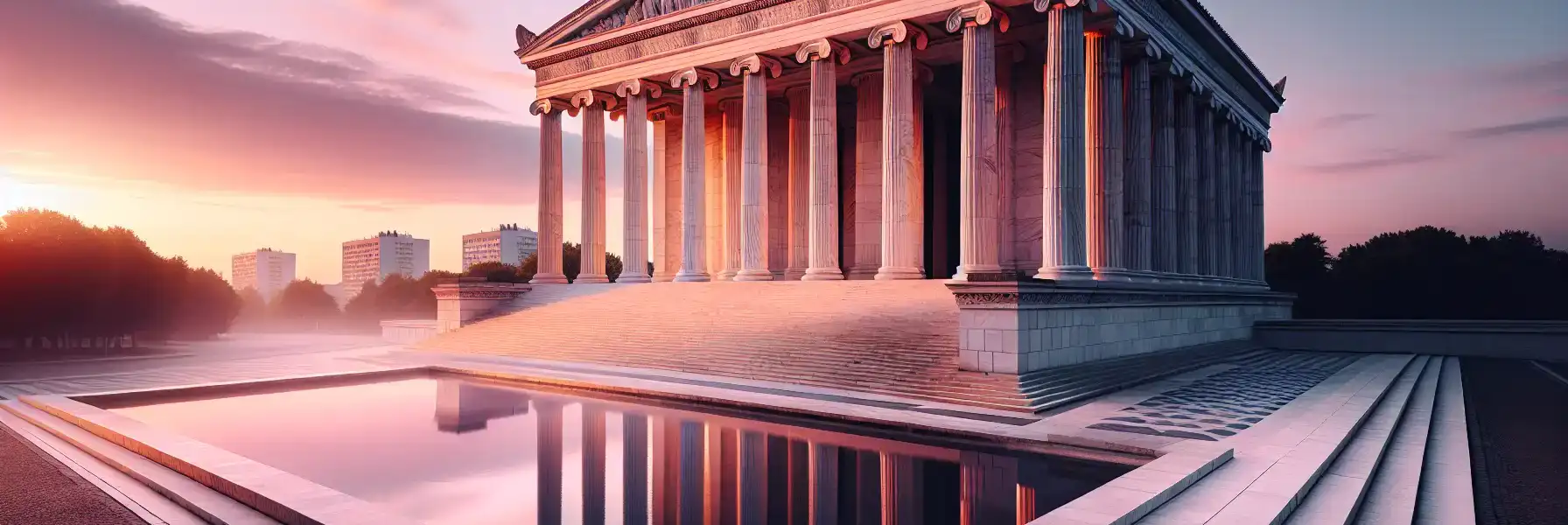
Quick Facts
- Address
- 2 Lincoln Memorial Circle NW, Washington, DC 20002
- Hours
- Open 24 hours, 365 days/year
- Admission
- Free — no tickets required
- Ranger Hours
- 9:30 AM – 10:00 PM daily
- Nearest Metro
- Foggy Bottom–GWU (Blue/Orange/Silver)
- Walk from Metro
- 15–20 minutes
- Year Dedicated
- May 30, 1922
- Architect
- Henry Bacon
- Sculptor
- Daniel Chester French
- Column Count
- 36 (one per state in 1865)
- Official Site
- nps.gov/linc
- eSIMno Networks
- AT&T, T-Mobile, Verizon
About the Lincoln Memorial
The Lincoln Memorial anchors the western terminus of the National Mall, facing east across the Reflecting Pool toward the Washington Monument and the U.S. Capitol nearly two miles away. This deliberate alignment places Lincoln's gaze toward the seat of government he fought to preserve, creating one of the most powerful symbolic axes in American civic design.
Construction and Design
Construction began on February 12, 1914 — Lincoln's 105th birthday — and continued for eight years through World War I. Architect Henry Bacon drew directly from Greek temple architecture, specifically the Parthenon in Athens, but inverted the orientation: where Greek temples place the entrance on the short side, Bacon positioned Lincoln's chamber along the building's length, creating a deeper, more dramatic interior approach.
The building materials came from across the country, a symbolic gesture for a president who preserved the Union. Colorado Yule marble forms the exterior walls. Indiana limestone and Georgia marble line the interior. The ceiling panels, made of Alabama marble saturated with paraffin, allow natural light to filter through with a soft, even glow. The foundation required driving concrete-filled steel cylinders 44 to 65 feet down to reach bedrock beneath the former Potomac River marshland.
The 36 Columns
Thirty-six Doric columns encircle the memorial, each standing 44 feet tall and weighing 85 tons. Each column represents one of the 36 states in the Union at the time of Lincoln's assassination in April 1865. Their names are inscribed on the frieze above. An additional inscription on the attic walls lists the 48 states that existed when the memorial was dedicated in 1922 — Alaska and Hawaii, admitted in 1959, appear on a plaque at the entrance.
The Dedication Ceremony
President Warren G. Harding presided over the dedication on Memorial Day 1922. Robert Todd Lincoln, the president's only surviving son, attended at age 78 — the last public appearance of any Lincoln child. In a reflection of the era's racial politics, the event was segregated: Black attendees, including Tuskegee Institute president Robert Russa Moton who delivered a speech, were seated in a separate section across the road from white guests.
A Stage for History
The memorial's symbolic weight has made it a natural gathering place for movements seeking moral authority. On Easter Sunday 1939, contralto Marian Anderson performed for 75,000 people on the memorial steps after the Daughters of the American Revolution refused to let her sing at Constitution Hall because she was Black. Interior Secretary Harold Ickes introduced her with the words: 'In this great auditorium under the sky, all of us are free.'
Twenty-four years later, Martin Luther King Jr. stood on the same steps before 250,000 people during the March on Washington for Jobs and Freedom. His 'I Have a Dream' speech, delivered on August 28, 1963, is now commemorated with an engraved marker on the exact stone where he stood. The memorial has since hosted presidential inaugurations, protest movements, and candlelight vigils — its steps functioning as a kind of national front porch.
Cultural Presence
The Lincoln Memorial appears on the reverse of the U.S. penny (since 1959) and the back of the five-dollar bill. It has featured in dozens of films, from Mr. Smith Goes to Washington to Forrest Gump, cementing its image as the backdrop for American moral reckoning.
Highlights and Must-See Features
The Lincoln Memorial rewards visitors who slow down enough to notice the details. Beyond the famous statue, every surface tells a story.
The Statue of Lincoln
Daniel Chester French's seated figure dominates the central chamber, rising 19 feet from the pedestal to Lincoln's head. The statue was carved from 28 blocks of Georgia white marble by the Piccirilli Brothers, Italian immigrant sculptors based in the Bronx. Lincoln's expression shifts depending on your vantage point: viewed from directly below, his face appears stern, even severe. Step back toward the entrance, and the features soften into something closer to contemplation.
Look closely at Lincoln's hands. The left hand is clenched — representing strength and resolve. The right hand is open and relaxed — symbolizing compassion. A persistent legend claims French, who had a deaf brother, positioned the hands to form 'A' and 'L' in American Sign Language. The National Park Service considers this apocryphal, but it persists in visitor lore.
The Gettysburg Address Inscription
The south interior wall bears the complete text of Lincoln's Gettysburg Address, delivered on November 19, 1863, at the dedication of a Civil War cemetery in Pennsylvania. At 272 words, it remains one of the most economical and powerful speeches in English. Jules Guerin's mural above, titled Emancipation, depicts an angel of truth freeing enslaved people.
Sharp-eyed visitors may notice a spelling error in the inscription: the word 'FUTURE' was initially carved as 'EUTURE.' The mistake was corrected by filling the errant letter with matching stone, but the repair remains visible under certain light conditions.
The Second Inaugural Address Inscription
The north wall features Lincoln's Second Inaugural Address from March 4, 1865 — just 41 days before his assassination. This speech, with its famous closing ('With malice toward none, with charity for all'), argued for reconciliation even as the Civil War ground toward its conclusion. Guerin's accompanying mural, Reunion, depicts the North and South coming together under an angel's guidance.
The 'I Have a Dream' Marker
Descend about 18 steps from the chamber entrance to find an engraved granite marker reading: 'I HAVE A DREAM / MARTIN LUTHER KING, JR. / THE MARCH ON WASHINGTON / FOR JOBS AND FREEDOM / AUGUST 28, 1963.' This is the exact spot where King stood before 250,000 people. The marker was added in 2003, 40 years after the speech. It's small — roughly the size of a doormat — but it draws as many photographs as the statue itself.
The Reflecting Pool Vista
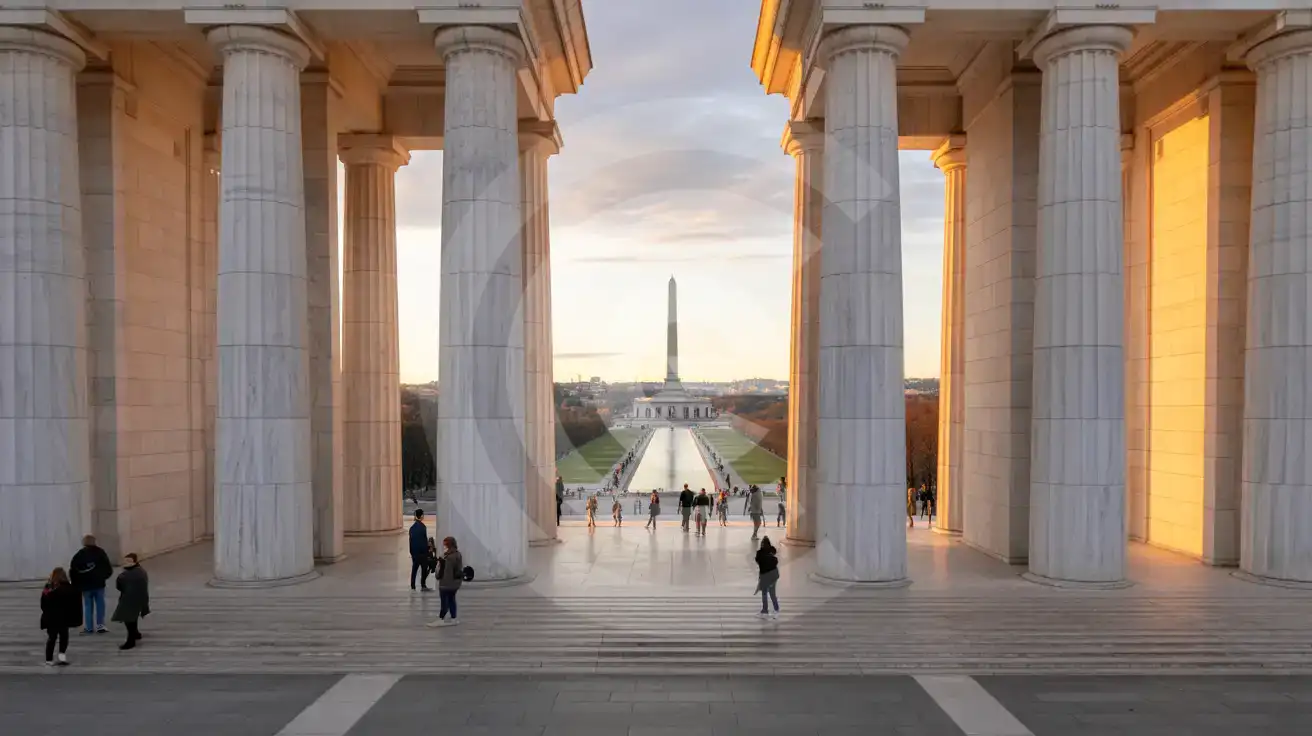
From the top of the memorial steps, the view east encompasses the 2,029-foot-long Reflecting Pool, the World War II Memorial, the Washington Monument, and on clear days, the dome of the U.S. Capitol. This is the most photographed vista in Washington. At night, the pool mirrors the Washington Monument's illuminated obelisk. At dawn, the rising sun backlights the entire composition.
The Murals by Jules Guerin
The two oil-on-canvas murals flanking the inscriptions are easy to overlook against the marble walls. Emancipation (south) measures 60 by 12 feet and depicts the Angel of Truth freeing enslaved people. Reunion (north), the same dimensions, shows North and South joined in harmony. Guerin was a Beaux-Arts painter known for his work at the 1893 World's Columbian Exposition and the Panama-Pacific International Exposition.
The Undercroft
Beneath the memorial lies a cavernous basement space supported by 122 concrete columns, never intended for public viewing. Workers left graffiti during construction — sketches, names, and the occasional cartoon — that remained hidden until the space was explored in the 1970s. The National Park Service has occasionally offered undercroft tours, though access depends on ongoing restoration work and staffing. Check at the ranger station for availability.
The Exterior Inscriptions
Above the 36 columns, each state's name is carved in the order of its admission to the Union. Delaware comes first; Nevada, admitted in 1864 just before Lincoln's death, is last among the original 36. The attic level lists the 48 states present at the 1922 dedication. A small plaque near the entrance acknowledges Alaska and Hawaii, admitted in 1959.
Visit Strategy
The Lincoln Memorial operates 24 hours a day, 365 days a year, with no admission fee and no tickets required. This openness is both a gift and a challenge — timing your visit correctly transforms the experience.
Best Time to Visit
Sunrise is the least crowded window. Arrive around 6:00–6:30 a.m. in summer (later in winter) and you'll share the memorial with joggers, a few photographers, and almost no one else. The eastern-facing Reflecting Pool catches morning light beautifully, and the interior chamber feels almost private.
Late evening, after 9:00 p.m., offers a different magic. The statue is dramatically illuminated, the crowds have thinned, and the Reflecting Pool mirrors the Washington Monument against a dark sky. Rangers are on duty until 10:00 p.m. for questions.
Midday, especially on weekends and during peak season (April through August), can mean shoulder-to-shoulder crowds on the steps. School groups arrive in waves from late March through early June. If midday is your only option, start at a nearby memorial (the Korean War Veterans Memorial or the Vietnam Veterans Memorial) and approach the Lincoln Memorial from the side, avoiding the main central staircase crush.
Seasonal Considerations
The National Cherry Blossom Festival (late March to mid-April) draws massive crowds to the Tidal Basin, which spills over to nearby memorials. The Lincoln Memorial isn't surrounded by cherry trees, but the general National Mall congestion affects everything.
Summer brings heat, humidity, and tourists. Temperatures regularly exceed 90°F (32°C) with high humidity. The marble steps radiate heat. There's no shade. Bring water.
Fall and winter weekdays offer the quietest conditions. December through February can be cold, but the memorial is fully accessible, and you might find the chamber nearly empty on a Tuesday morning in January.
Recommended Duration
Plan for 30 to 45 minutes at the memorial itself. That's enough time to read both inscriptions, study the statue from multiple angles, find the 'I Have a Dream' marker, and absorb the Reflecting Pool view. Add another 15 minutes if you want to photograph the exterior from the base of the steps or walk around to the north side for a different angle.
If you're combining with nearby memorials, budget 2 to 3 hours for a walking loop: Lincoln Memorial → Vietnam Veterans Memorial → Korean War Veterans Memorial → back to Lincoln. Add another hour to extend to the World War II Memorial and the Reflecting Pool's eastern end.
Photography Rules and Tips
Personal photography — including tripods — is permitted throughout the memorial and grounds. No permits are required for non-commercial use. Flash photography is allowed inside the chamber but discouraged out of respect for other visitors and the contemplative atmosphere.
Commercial photography and filming require a National Park Service permit, obtained in advance. Drones are prohibited over the entire National Mall, including the Lincoln Memorial grounds.
For the classic shot of the statue, stand just inside the chamber entrance and shoot toward Lincoln with a wide lens. For the Reflecting Pool vista, position yourself at the top of the steps, centered on the pool's axis. Golden hour (sunrise or the hour before sunset) delivers the best light on both.
Accessibility
An elevator on the north side of the building provides step-free access to the main chamber. The elevator entrance is clearly marked and staffed during ranger hours. The chamber floor is flat marble. Wheelchairs and mobility devices are welcome throughout.
Accessible parking is limited. The closest lots are along Ohio Drive SW, but they fill quickly. Ride-share drop-off at the memorial's base is often the most practical approach for visitors with mobility needs.
Ranger Programs
National Park Service rangers offer brief interpretive talks throughout the day, typically every 30 minutes from late morning through early evening. Topics rotate but often cover the memorial's construction, Lincoln's presidency, and the civil rights history associated with the site. Check the ranger station near the entrance for the current schedule. All programs are free.
Site Walk-Through and Photographer's Guide
The Lincoln Memorial rewards a deliberate approach. Rush through and you'll miss half of what makes it powerful. Here's how to walk the site for maximum impact — and maximum photographic opportunity.
Recommended Walk Sequence
Start from the east — the Reflecting Pool side. This is the ceremonial approach, the view Lincoln faces, and the path that builds anticipation properly. Walk west along the pool's north edge (the paved path is more comfortable than the grass), letting the memorial grow larger with each step. At the pool's western end, you'll reach the base of the grand staircase.
Pause here. Look up at the 36 columns. Read the state names on the frieze if the light allows. Then climb the central stairs slowly — there are 58 steps from ground level to the chamber entrance, with a broad landing about two-thirds up where the 'I Have a Dream' marker sits.
Stop at the marker. Turn around. This is the view King saw: the Reflecting Pool stretching east, the Washington Monument rising beyond. Take your time.
Continue up to the chamber. Enter centrally and approach the statue. Stand directly beneath Lincoln's gaze first — note how his expression appears stern from this angle. Then step back toward the entrance and watch the face soften. Walk to the south wall for the Gettysburg Address, then north for the Second Inaugural. Exit via the north side to find the elevator alcove, the exterior inscription plaques, and a less-crowded view of the grounds.
Key Structures to Spend Time At
The Central Statue: Study the hands, the chair arms, and the texture of Lincoln's coat. The Piccirilli Brothers carved individual wrinkles and folds. Notice how the light from the ceiling panels falls across the face.
The Gettysburg Address Wall: Read the full 272 words. They take less than two minutes. Look for the corrected 'FUTURE' error in the fourth paragraph. Note the Emancipation mural above — the angel's wings span nearly the full width.
The Second Inaugural Wall: The final paragraph ('With malice toward none...') is carved in larger letters. Lincoln delivered this speech knowing the war would end soon. He was assassinated 41 days later.
The 'I Have a Dream' Marker: It's easy to walk past. Look for a small cluster of visitors photographing the ground about 18 steps below the chamber entrance. The marker is granite, roughly 2 by 3 feet, flush with the stone.
The Frieze and Attic Inscriptions: The 36 state names above the columns are visible from the base of the stairs. The 48 states on the attic walls require stepping back further — the south side offers the clearest view.
The North Exterior: Walk around to the memorial's north face for a quieter perspective. The elevator entrance is here, along with plaques acknowledging Alaska and Hawaii.
Best Photo Spots and Lighting Times
Reflecting Pool View (from memorial steps): Best at sunrise, when the sun rises behind the Washington Monument and backlights the entire scene. Also excellent at night when the monument's lights reflect in the water.
Statue Interior Shot: Best in late afternoon (4:00–6:00 p.m.) when diffused light through the ceiling panels creates even illumination without harsh shadows. Midday overhead sun can create unflattering shadows under Lincoln's brow.
Exterior Columns: Golden hour light (sunrise or the hour before sunset) rakes across the marble and accentuates the column fluting. Midday sun flattens everything.
'I Have a Dream' Marker: Any time works for a documentation shot, but morning light from the east illuminates the engraving most clearly.
The Memorial from the World War II Memorial: For a reverse view, walk east to the World War II Memorial plaza and photograph the Lincoln Memorial across the Reflecting Pool. Sunset positions the memorial against the western sky.
Restoration and Excavation Status
The National Park Service conducts ongoing preservation work, though major restoration projects are infrequent. The most significant recent work addressed water infiltration in the chamber and cleaning of the exterior marble. Occasionally, scaffolding may obscure portions of the exterior, but the chamber remains accessible during most maintenance. The undercroft tours depend on current restoration priorities — some years they're available regularly, others not at all.
Souvenirs and On-Site Shopping
A small bookshop operated by Eastern National sits near the ranger station at the memorial's base. Worth buying: the official National Park Service guidebook (well-researched, pocket-sized), postcards featuring historical photographs of the dedication ceremony and the 1963 March on Washington, and replica copies of the Gettysburg Address on parchment-style paper.
Skip: generic 'Washington D.C.' merchandise available cheaper elsewhere, and anything claiming to be 'authentic Lincoln memorabilia.' For more substantial Lincoln-related books, the gift shops at Ford's Theatre and the Library of Congress offer better selections.
Nearby Attractions and Logistics
The Lincoln Memorial sits at the western anchor of a memorial corridor that makes for one of the best walking days in American tourism. Here's how to connect the dots.
Immediately Adjacent (5-Minute Walk)
Vietnam Veterans Memorial: Northeast of the Lincoln Memorial, Maya Lin's black granite wall lists 58,318 names in chronological order of casualty. The reflective surface creates an intentionally disorienting effect — you see yourself among the names. Allow 20–30 minutes.
Korean War Veterans Memorial: Southeast of Lincoln, this memorial features 19 stainless steel soldiers on patrol, representing a squad crossing a rice paddy. The black granite mural wall opposite depicts support troops. The Wall of Remembrance, added in 2022, now lists the 36,574 American service members killed. Allow 15–20 minutes.
Within 15 Minutes Walking
World War II Memorial: East along the Reflecting Pool, the plaza features 56 granite pillars (states and territories), two 43-foot arches (Atlantic and Pacific theaters), and the Freedom Wall with 4,048 gold stars — one for every 100 American deaths. Allow 20–30 minutes.
Martin Luther King Jr. Memorial: South across the Tidal Basin, the 'Stone of Hope' sculpture by Lei Yixin depicts King emerging from a mountain of despair. Inscriptions from his speeches ring the surrounding walls. Allow 15–20 minutes.
Franklin Delano Roosevelt Memorial: Further south along the Tidal Basin, four outdoor 'rooms' represent FDR's four terms. Waterfalls, bronze sculptures, and carved quotations make this one of the Mall's most immersive memorials. Allow 30–40 minutes.
Within 20–25 Minutes Walking
Washington Monument: The 555-foot obelisk requires timed-entry tickets (free, but a $1 online reservation fee) for the observation deck. Same-day tickets are sometimes available at the Washington Monument Lodge, but book online weeks in advance during peak season.
Thomas Jefferson Memorial: Across the Tidal Basin to the southeast, the circular marble rotunda houses a 19-foot bronze statue of Jefferson surrounded by his most famous writings.
Getting There and Away
Metro: Foggy Bottom–GWU Station (Blue, Orange, Silver Lines) is the closest, about a 15–20 minute walk east along Constitution Avenue or through the campus of George Washington University. Smithsonian Station (same lines) is slightly farther but approaches from the Mall's center.
DC Circulator: The National Mall route stops directly at the Lincoln Memorial, running every 10 minutes during peak hours. This is the easiest public transit option and costs $1.
Ride-Share: Drop-off works well at the memorial's base. Pick-up can be chaotic during peak hours — walk to Ohio Drive SW for easier connections.
Parking: Street parking along Ohio Drive SW fills by mid-morning on weekends. The lots near the Franklin Delano Roosevelt Memorial offer more capacity but require a walk. Accessible parking near the memorial is extremely limited.
Food Options
There's no food service at the Lincoln Memorial itself. The nearest options:
Food Kiosks: Scattered along the Mall, typically near the World War II Memorial and along Madison Drive. Hot dogs, pretzels, and bottled water. Functional, not memorable.
Foggy Bottom: A 15-minute walk north brings you to the neighborhood around George Washington University, with casual restaurants, coffee shops, and lunch spots along Pennsylvania Avenue NW and I Street NW.
Georgetown: A 25-minute walk northwest reaches Georgetown's waterfront and M Street, with significantly more dining options ranging from quick-service to upscale.
Suggested Day Itinerary
Start at the Lincoln Memorial at sunrise. Walk north to the Vietnam Veterans Memorial, then loop south past the Korean War Veterans Memorial. Continue east to the World War II Memorial. Detour south across the Tidal Basin to the Martin Luther King Jr. Memorial and the Franklin Delano Roosevelt Memorial. Break for lunch at a food kiosk or walk to Foggy Bottom. Afternoon: continue east to the Washington Monument (with advance tickets), then explore whichever Smithsonian museum appeals — the National Museum of African American History and Culture, the National Air and Space Museum, and the National Museum of American History are all free and within walking distance. Return to the Lincoln Memorial after dark to see the statue illuminated and the Reflecting Pool mirroring the Washington Monument.
Why Data Matters at the Lincoln Memorial
The Lincoln Memorial itself won't challenge your phone's connectivity — AT&T and T-Mobile both provide strong coverage across the National Mall. But having reliable data transforms a visit in ways that aren't immediately obvious.
Standing before the Gettysburg Address inscription, you might want to pull up the full historical context: who Lincoln was addressing, what had just happened at Gettysburg, how the speech was received. At the 'I Have a Dream' marker, a quick search brings up footage of King's actual delivery — watching a few minutes on your phone while standing in that exact spot creates a connection that reading about it later can't match.
Navigation matters too. The National Mall is deceptively large. Walking from the Lincoln Memorial to the Washington Monument takes 15–20 minutes, and the Tidal Basin loop to Jefferson and FDR adds another 40. Real-time maps help you calibrate your pace, find the nearest restroom (critical when you're an hour into a memorial walk), and locate DC Circulator stops when your feet give out.
An eSIMno plan for the U.S. connects through AT&T or T-Mobile, meaning you're on the same networks locals use. Activate before you arrive, and your phone works the moment you step off the Metro at Foggy Bottom — no hunting for airport SIM kiosks, no carrier stores to find, no configuration headaches.
The Memorial at Golden Hour
Compare WiFi Options at Lincoln Memorial
 Recommended Recommended | Local SIM / Operator | Roaming | |
|---|---|---|---|
| FEATURES | |||
| Setup time | Few minutes | Store visit + paperwork | Auto |
| No local ID needed | Online checkout | Local ID required | Use home account |
| Speed | 4G/LTE; 5G in some areas | Carrier-grade | Partner-dependent |
| Travel support | English support 24/7 | Operator shops and call centre | Home carrier hours |
| Keep home number | Dual SIM | Replaces it | Same number |
| Cost predictability | Fixed price | Bills can spike | Bill-shock risk |
| PRICING | |||
Typical pricing | See plans below | — | — |
PRICING — PICK YOUR ESIMNO PLAN
Featured eSIM plans
American Mobile

American Mobile
American Mobile
American Mobile
American Mobile
American Mobile


