
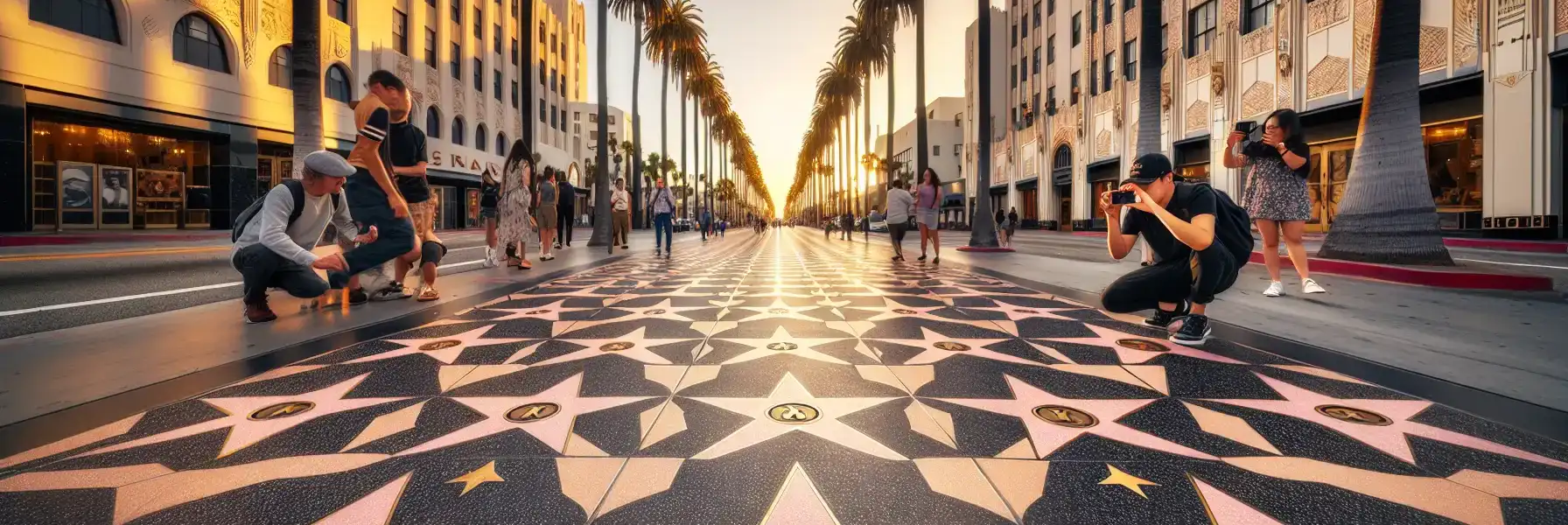
Quick Facts
- Length
- 1.3 miles (2.1 km)
- Total Stars
- 2,700+ (20-30 added annually)
- Hours
- 24/7, 365 days (public sidewalk)
- Admission
- Free
- Address
- Hollywood Blvd & Vine St, Los Angeles, CA 90028
- Metro Stations
- Hollywood/Western, Hollywood/Vine, Hollywood/Highland (B Line)
- Established
- 1960
- Historic Status
- LA Historic-Cultural Monument (1978), National Register of Historic Places
- Official Website
- walkoffame.com
- eSIMno Networks
- AT&T, T-Mobile, Verizon
About the Hollywood Walk of Fame
The Hollywood Walk of Fame began as a desperate idea. By the mid-1950s, the Hollywood neighborhood had lost much of its film-industry cachet — studios had scattered across Los Angeles, and the famous boulevard was becoming just another commercial strip. The Hollywood Chamber of Commerce needed something to pull visitors back, something permanent and impossible to ignore. Their solution: embed celebrity names directly into the sidewalk.
Oliver Weismuth, an artist and Chamber volunteer, is generally credited with the star design — the five-pointed terrazzo-and-brass emblem that now feels inseparable from Hollywood itself. Construction began in 1960. Director Stanley Kramer's star was set as a prototype, but actress Joanne Woodward received the first permanent installation, her name pressed into pink terrazzo on February 9, 1960. The initial class included 1,558 stars, honoring entertainers across five categories: Motion Pictures (marked by a film camera emblem), Television (a TV set), Recording (a phonograph record), Radio (a microphone), and Live Theatre/Live Performance (comedy and tragedy masks). A sixth category, Sports Entertainment, arrived decades later.
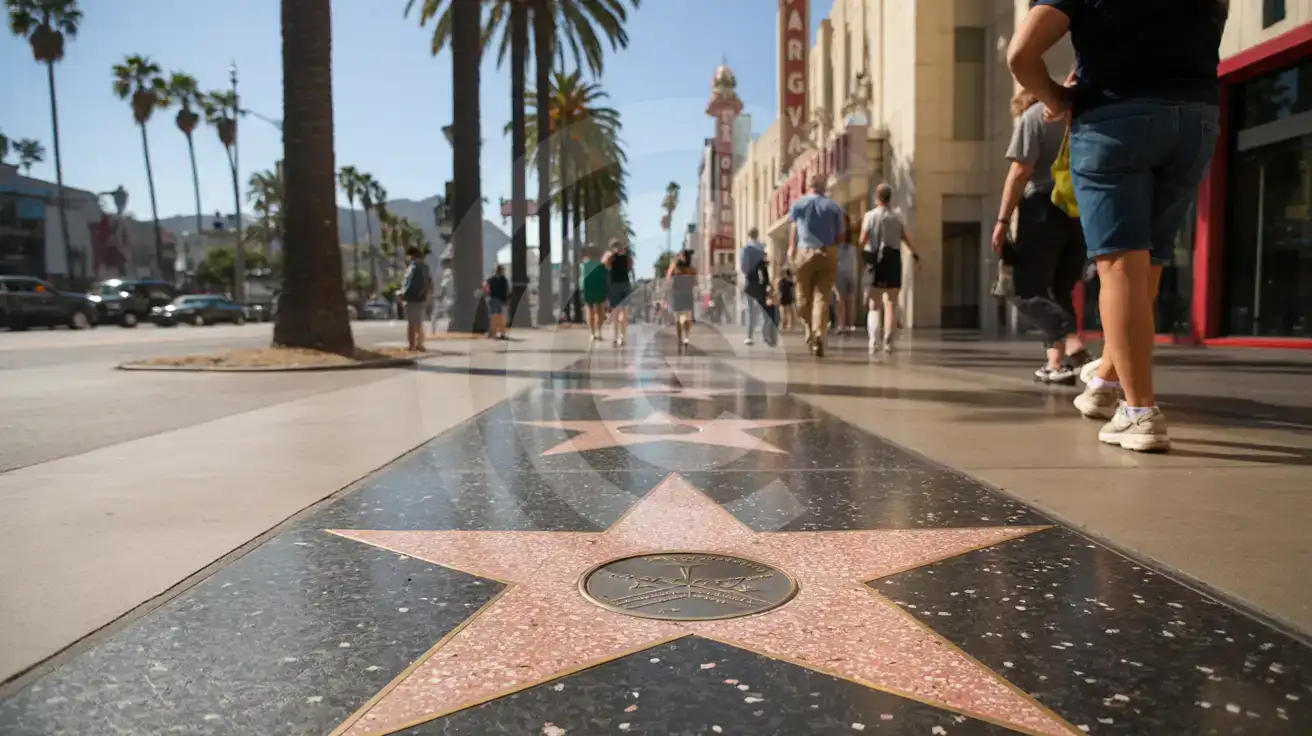
The Walk stretches along Hollywood Boulevard from Gower Street to La Brea Avenue, with a perpendicular section running north-south along Vine Street from Yucca Street to Sunset Boulevard. That's 1.3 miles of sidewalk, roughly 30-40 minutes of walking end-to-end without stops — though nobody walks it without stopping. The stars themselves measure about 3 feet across, coral-pink terrazzo borders surrounding charcoal centers where the brass name and category emblem sit.
What started as urban revitalization became a global symbol. The Walk was designated a Los Angeles Historic-Cultural Monument in 1978 and later added to the National Register of Historic Places. The City of Los Angeles owns the sidewalk; the Hollywood Chamber of Commerce administers everything else through the Hollywood Historic Trust — the selection committee, the induction ceremonies, the maintenance. Approximately 20 to 30 new stars are added each year. Nominees don't just get chosen; someone (a studio, a fan club, a record label) must sponsor them and pay the current fee of roughly $75,000, which covers the ceremony, the star fabrication, and perpetual upkeep.
Today, roughly 10 million visitors walk the Walk annually, making it one of the most visited free attractions in Southern California. The stars aren't arranged by category or chronology — finding a specific one requires either the official website's searchable database or an app like the Hollywood Star Walk. Some stars cluster naturally: Capitol Records artists near the tower at 1750 Vine Street, film legends near the Chinese Theatre, television personalities scattered along the central stretch. The randomness is part of the experience. You're walking along photographing Marilyn Monroe's star and suddenly realize you're standing on Johnny Cash's.
Highlights and Must-See Stars
Marilyn Monroe's Star (6774 Hollywood Boulevard)
Located in front of a former McDonald's site (now a souvenir shop), Marilyn's star draws the longest photo lines on the entire Walk. She was inducted in the original 1960 class, and her star sits in one of the most congested stretches — plan for crowds unless you arrive before 9 a.m.
Muhammad Ali's Star (Dolby Theatre Complex)
This is the only star mounted vertically on a wall rather than embedded in the sidewalk. Ali requested the placement in 2002 because he didn't want his name walked upon — a stipulation the Hollywood Chamber of Commerce honored. You'll find it inside the Hollywood & Highland (now Ovation Hollywood) complex, near the main entrance to the Dolby Theatre.
TCL Chinese Theatre Forecourt (6925 Hollywood Boulevard)
Technically not part of the Walk of Fame, but nobody visits one without the other. The forecourt contains cement handprints, footprints, and signatures dating back to 1927, when silent-film actress Norma Talmadge supposedly stepped into wet cement by accident — and Sid Grauman realized he had a publicity goldmine. Today the forecourt holds imprints from Marilyn Monroe, Humphrey Bogart, the Star Wars cast, Harry Potter cast members, and Marvel Cinematic Universe actors. Free to view anytime the theater is open.
The Dolby Theatre (6801 Hollywood Boulevard)
The permanent home of the Academy Awards since 2002, the Dolby Theatre offers 30-minute guided tours daily that take visitors backstage, into the green room, and onto the actual Oscar stage. Tours run roughly every half hour, starting around 10:30 a.m., and cost approximately $25 for adults. Book online or at the box office — walk-up availability depends on the day.
The Four Ladies of Hollywood Gazebo (Hollywood Boulevard at La Brea Avenue)
Most tourists walk right past this silver Art Deco-style monument at the western gateway of the Walk. The gazebo features statues of Dolores del Río, Mae West, Anna May Wong, and Dorothy Dandridge — four women who broke barriers in early Hollywood. It's a quieter photo opportunity and a good place to start or end a Walk of Fame visit.
Capitol Records Building Stars (1750 Vine Street)
The 1956 circular tower designed by Welton Becket is a Hollywood landmark in its own right — its rooftop beacon blinks 'Hollywood' in Morse code day and night. The surrounding sidewalk clusters stars of Capitol Records artists: Frank Sinatra, the Beatles, Nat King Cole, Garth Brooks, and dozens of others. It's a short walk south from the Hollywood/Vine Metro station.
The Hollywood Roosevelt Hotel (7000 Hollywood Boulevard)
The 1927 Spanish Colonial Revival hotel hosted the first Academy Awards ceremony in 1929 — a 15-minute affair with 270 guests. The lobby is open to visitors, and the Tropicana Pool (painted by David Hockney in 1988) is visible from certain angles. Marilyn Monroe lived here early in her career, and the hotel maintains a suite in her honor.
El Capitan Theatre (6838 Hollywood Boulevard)
A 1926 Spanish Colonial Revival movie palace now operated by Disney for first-run premieres and special screenings. The ornate interior is worth seeing if you catch a film here, and Disney sometimes stages live pre-show entertainment. Clark Gable's star sits directly outside.
The Hollywood Museum (1660 N. Highland Avenue)
Housed in the historic 1914 Max Factor Building — where Max Factor himself created makeup for Hollywood's early stars — this museum displays over 10,000 pieces of movie memorabilia across four floors. Highlights include Marilyn Monroe artifacts, a recreation of Hannibal Lecter's cell from The Silence of the Lambs, and the actual makeup rooms where golden-age stars were transformed.
Visit Strategy
Best Time to Visit
Early morning — before 10 a.m. — is the quietest window. The tour buses haven't arrived, the costumed performers haven't fully assembled, and the light hits the stars at a low angle that makes photography easier. Late afternoon and weekend evenings bring the heaviest crowds, particularly around the Hollywood & Highland intersection where the Dolby Theatre, the framed Hollywood Sign view, and the densest cluster of attractions converge.
Weekday visits are noticeably calmer than weekends. If your schedule allows Tuesday through Thursday, you'll notice the difference immediately.
Weather-wise, the mild dry season runs October through May. Summer afternoons regularly exceed 90°F (32°C) with minimal shade along the boulevard — the palm trees are tall but not particularly useful for blocking sun. Bring water, wear sunscreen, and consider breaking your visit into a morning walk and an afternoon museum session indoors.
Which Metro Station to Use
The Metro B Line (Red Line) runs directly under Hollywood Boulevard with three stations on the Walk itself:
- Hollywood/Western: The eastern end of the Walk. Useful if you want to start at the quieter section and walk westward toward the main attractions.
- Hollywood/Vine: Central location near the Capitol Records Building and Pantages Theatre. Good for a Vine Street focus or a balanced walk in either direction.
- Hollywood/Highland: Deposits you directly at the Dolby Theatre, TCL Chinese Theatre, and the most congested (but most famous) stretch. Best for visitors prioritizing the main highlights over completeness.
From Downtown Los Angeles Union Station, the B Line ride takes approximately 20 minutes to Hollywood/Highland.
Driving and Parking
Driving is possible but frustrating. Street parking on Hollywood Boulevard is scarce and metered. The Hollywood & Highland parking garage offers validated rates with a purchase at the complex — typically $3-$5 for the first two hours with validation, jumping sharply after that. Expect to pay $15-$25 for longer stays without validation.
How Long to Spend
A focused walk covering the major highlights — Marilyn's star, the Chinese Theatre forecourt, the Dolby Theatre exterior, a loop past Capitol Records — takes 90 minutes to two hours. Add a Dolby Theatre guided tour (30 minutes plus wait time) and a walk through the Hollywood Museum (60-90 minutes), and you've got a half-day itinerary. Walking the full 1.3 miles end-to-end, stopping for photos and star-hunting, can easily fill three hours.
Photography Rules
The public sidewalk is unrestricted — photograph freely. Inside the Dolby Theatre, photography is permitted on guided tours but flash and tripods may be restricted in certain areas. The Chinese Theatre forecourt allows photography but prohibits commercial shoots without a permit.
Costumed Performers
Spider-Man, Batman, Marilyn Monroe impersonators, various superheroes — they congregate along the boulevard, particularly near the Chinese Theatre. They work for tips. The standard expectation is $5-$10 per photo. Agree on a price before posing. Most are friendly; a few are aggressive. A polite 'no thanks' and continued walking usually ends any interaction.
Best Time to Visit and Photographer's Guide
Month-by-Month Crowd and Weather
January–February: Post-holiday lull means thinner crowds and mild temperatures (55-68°F highs). February brings Oscar season activity around the Dolby Theatre — expect increased foot traffic and possible street closures leading up to the Academy Awards ceremony.
March–May: Shoulder season with comfortable weather (65-75°F) and moderate crowds. Spring break weeks in late March and early April spike visitor numbers temporarily. May is arguably the best overall month: warm but not hot, pre-summer-tourist-surge, long daylight hours for photography.
June–August: Peak tourist season. Temperatures regularly hit 85-95°F, crowds are at their densest, and the combination of heat and congestion makes midday visits uncomfortable. If summer is your only option, arrive at 8 a.m. or return after 7 p.m.
September–October: Crowds thin after Labor Day. September remains warm (80-90°F) but October brings ideal conditions — mid-70s, clear skies, lower humidity. Film premieres increase as awards season approaches.
November–December: The Hollywood Christmas Parade (late November) draws massive crowds to the boulevard. December holiday weekends are busy, but mid-week days remain manageable. Weather is mild (60-70°F) with occasional rain.
Best Time of Day
Sunrise to 9 a.m.: Golden hour light, near-empty sidewalks, perfect for photographing individual stars without feet in frame. The boulevard faces roughly east-west, so morning light rakes across the stars from behind you if you're facing west.
9 a.m. to 11 a.m.: Still relatively calm. Good time for Chinese Theatre forecourt photos before tour groups arrive.
11 a.m. to 3 p.m.: Midday sun creates harsh shadows and washes out the pink terrazzo. Crowds peak. This is the worst window for photography but fine for indoor activities like the Dolby Theatre tour or Hollywood Museum.
3 p.m. to 6 p.m.: Crowds remain heavy but light softens. Late afternoon golden hour (roughly 4-6 p.m. depending on season) offers warm tones on building facades.
Blue hour and night: The neon signs, theater marquees, and Dolby Theatre illumination create a completely different atmosphere. The stars themselves are harder to photograph without supplemental light, but the boulevard's vintage signage comes alive.
Best Photo Spots
1. Marilyn Monroe's Star, Early Morning: 6774 Hollywood Boulevard. Arrive before 9 a.m. for an unobstructed overhead shot of the most photographed star on the Walk.
2. Chinese Theatre Forecourt, Low Angle: Kneel or crouch to photograph the handprints with the pagoda-style facade rising behind them. The roof architecture frames dramatically against blue sky.
3. Hollywood & Highland Courtyard, Hollywood Sign View: The Ovation Hollywood complex courtyard contains a deliberately designed archway framing the Hollywood Sign in the distant hills. Mid-morning light is best; afternoon sun backlights the sign.
4. Capitol Records Building from Vine Street: Stand on the east side of Vine Street, facing west, to capture the circular tower with its rooftop beacon. Late afternoon sun illuminates the facade beautifully.
5. El Capitan Theatre Marquee, Night: The vintage neon signage photographs best after dark. Pair with the neighboring Chinese Theatre marquee for a classic Hollywood Boulevard shot.
6. Four Ladies Gazebo at La Brea Gateway: The silver Art Deco structure is undervisited and photographs well without crowds. Morning or late afternoon light works equally well.
7. Star Reflections After Rain: Los Angeles doesn't rain often, but when it does, the wet terrazzo creates gorgeous reflections of neon signs and streetlights. Night photography after a winter rain shower produces images most visitors never capture.
Drone and Tripod Rules
Drone flights over Hollywood Boulevard are effectively prohibited. The airspace falls within the Los Angeles restricted zone, and the LAPD actively enforces no-fly policies in this high-traffic tourist area. Don't even try.
Tripods on the public sidewalk are technically legal but practically difficult during busy hours — you'll block pedestrian traffic and attract attention from performers who may assume you're a professional (and ask for payment accordingly). Early morning tripod use is feasible. Some photographers prefer monopods for stability without the footprint.
Hidden Sub-Spots Most Tourists Miss
The Pantages Theatre Facade (6233 Hollywood Boulevard): This 1930 Art Deco movie palace, now a Broadway touring venue, has one of the most beautiful exteriors on the boulevard. Most visitors focus on the Chinese Theatre and miss this gem entirely. The marquee photographs beautifully at night.
Musso & Frank Grill Exterior (6667 Hollywood Boulevard): Hollywood's oldest restaurant (1919) has a classic neon sign and an old-Hollywood atmosphere. Even if you don't eat here, the exterior is worth photographing.
The Knickerbocker Hotel Building (1714 Ivar Avenue): One block north of Hollywood Boulevard, this 1929 building once hosted celebrity residents and was the site of several Hollywood scandals. The Spanish Revival architecture is photogenic and crowd-free.
Side Streets Near Vine: The stars extend slightly onto side streets near major intersections. These peripheral stars see almost no foot traffic and allow leisurely, crowd-free photography.
The Max Factor Building's Art Deco Entrance (1660 N. Highland Avenue): Even if you don't visit the Hollywood Museum inside, the building's pink Regency Moderne exterior and original Max Factor signage deserve a photograph.
Nearby Attractions and Logistics
Within Walking Distance
Griffith Observatory: The Art Deco observatory perched in the Hollywood Hills offers free admission, planetarium shows (ticketed), and the best views of the Hollywood Sign and Los Angeles Basin. It's not walking distance from the Walk — 7 miles by car — but it's the natural afternoon extension to a morning Walk of Fame visit. Rideshare runs about $20-25 each way; parking at the observatory is free but fills quickly on weekends.
Hollywood Sign: Visible from the Hollywood & Highland courtyard but not accessible on foot from the boulevard. The closest hiking trails (Brush Canyon, Hollyridge) start several miles away. Many visitors combine a Walk of Fame morning with an afternoon Sign hike, but it's a separate excursion requiring transportation.
Runyon Canyon Park: A popular hiking trail with city views, about 1 mile north of Hollywood Boulevard. The Fuller Avenue entrance is walkable from Hollywood & Highland in 20-25 minutes. Good for burning off energy after a morning of sidewalk strolling.
Hollywood Forever Cemetery: This 1899 cemetery on Santa Monica Boulevard (about 1.5 miles south of the Walk) holds the graves of Cecil B. DeMille, Rudolph Valentino, Judy Garland, and other Hollywood legends. Free to visit during daylight hours. Summer outdoor film screenings are a local favorite.
Dining Options
Musso & Frank Grill (6667 Hollywood Boulevard): Hollywood's oldest restaurant, operating since 1919. The red leather booths and martini service feel unchanged since the golden age. Prices are old-school steakhouse ($30-60 entrees). Reservations recommended for dinner.
Pig 'N Whistle (6714 Hollywood Boulevard): A 1927 original recently restored, serving American comfort food in an ornate Spanish Colonial interior. Good lunch spot between star-hunting sessions.
In-N-Out Burger (7009 Sunset Boulevard): About a 10-minute walk south from Hollywood & Highland. The California fast-food institution serves fresh burgers at reasonable prices ($5-10). Always crowded but moves quickly.
Transit Connections
The Metro B Line connects the Walk to Downtown Los Angeles (Union Station, 20 minutes), Universal Studios Hollywood (transfer at North Hollywood to a shuttle or rideshare), and the wider Metro system. Metro buses 180, 217, and 222 serve Hollywood Boulevard directly. Rideshare (Uber, Lyft) pickup zones are marked near Hollywood & Highland — avoid hailing from the most congested stretch directly in front of the Chinese Theatre.
Suggested Half-Day Itinerary
9:30 a.m.: Arrive at Hollywood/Highland Metro station. Walk the stars westward toward the Chinese Theatre forecourt (30 minutes). 10:30 a.m.: Dolby Theatre guided tour (30 minutes). 11:15 a.m.: Hollywood Museum in the Max Factor Building (60-75 minutes). 12:30 p.m.: Lunch at Musso & Frank Grill. 2:00 p.m.: Walk east along Vine Street to Capitol Records Building and Frank Sinatra's star. 3:00 p.m.: Return via Hollywood/Vine Metro station, or extend to Griffith Observatory by rideshare for sunset views.
Why Data Matters at the Walk of Fame
Finding a specific star among 2,700+ requires either the official website's searchable database or the Hollywood Star Walk app — both demand data. The Walk isn't organized by category, genre, or era; stars sit wherever space was available when they were installed. Walking from Marilyn Monroe's star to Muhammad Ali's wall plaque to Frank Sinatra's spot near Capitol Records means constant navigation.
Beyond star-hunting, you'll want data for Dolby Theatre tour ticket purchases (often easier online than at the walk-up window), Metro trip planning through the Transit app, and real-time rideshare requests when afternoon heat makes walking back to your hotel less appealing. The surrounding area has patchy public WiFi — the Hollywood & Highland complex offers some coverage, but it drops the moment you step onto the sidewalk.
An eSIMno plan running on AT&T or T-Mobile keeps you connected along the entire 1.3-mile stretch without hunting for hotspots or draining international roaming fees. Activate before you land at LAX, and you'll have data working by the time you step off the Metro at Hollywood/Highland.
The Walk of Fame at Golden Hour
Compare WiFi Options at Hollywood Walk of Fame
 Recommended Recommended | Local SIM / Operator | Roaming | |
|---|---|---|---|
| FEATURES | |||
| Setup time | Few minutes | Store visit + paperwork | Auto |
| No local ID needed | Online checkout | Local ID required | Use home account |
| Speed | 4G/LTE; 5G in some areas | Carrier-grade | Partner-dependent |
| Travel support | English support 24/7 | Operator shops and call centre | Home carrier hours |
| Keep home number | Dual SIM | Replaces it | Same number |
| Cost predictability | Fixed price | Bills can spike | Bill-shock risk |
| PRICING | |||
Typical pricing | See plans below | — | — |
PRICING — PICK YOUR ESIMNO PLAN
Featured eSIM plans
American Mobile

American Mobile
American Mobile
American Mobile
American Mobile
American Mobile


