
Quick Facts
- Address
- 350 Fifth Avenue, New York, NY 10118, between West 33rd and West 34th Streets
- Type
- 102-story Art Deco skyscraper and historic observation attraction
- Opened
- May 1, 1931
- Architect
- Shreve, Lamb & Harmon
- Height
- About 1,250 feet to the roof and 1,454 feet to the top of the lightning rod
- Main Observatory
- 86th Floor Observation Deck
- Upper Observatory
- 102nd Floor Observatory (additional ticket upgrade)
- Typical Hours
- Daily, usually around 10:00 AM to midnight; last elevator up roughly 45 minutes before closing
- Typical Ticket Price
- About $44 adult for 86th floor general admission; around $79 for 86th + 102nd floor; Express options usually $100+
- Nearest Subway
- 34th Street–Herald Square (B, D, F, M, N, Q, R, W), about 2 blocks west
- Other Nearby Transit
- 33rd Street (6) and 34th Street–Penn Station (1, 2, 3, A, C, E), each about 5–10 minutes on foot; Fifth Avenue buses M1, M2, M3, M4, M5
- Accessibility
- Both observatories are wheelchair accessible via elevator
- Photography
- Phones and standard cameras allowed; tripods, monopods, and selfie sticks not permitted
- Official Site
- esbnyc.com
- eSIMno Networks
- AT&T, T-Mobile, Verizon
About the Empire State Building
There are taller buildings in New York now, and there are newer observation decks with more recent technology. None of them quite replace the Empire State Building. This is the skyscraper that turned height into folklore.
Completed in 1931 and opened to the public on May 1 of that year, the Empire State Building rose at extraordinary speed during one of the hardest economic periods in American history. The project was driven by John J. Raskob and Alfred E. Smith, designed by Shreve, Lamb & Harmon, and constructed by Starrett Brothers and Eken in a little over 13 months. That timeline still sounds improbable today. Thousands of laborers worked on it, including many Mohawk ironworkers from Kahnawake, whose skill at high steel became part of the building’s creation story and, more broadly, New York’s vertical history.
Its setting is as important as its height. The building stands at 350 Fifth Avenue in Midtown Manhattan, between West 33rd and West 34th Streets, right where department-store New York, commuter New York, office-tower New York, and tourist New York all overlap. You don’t approach it through a park or a ceremonial plaza. You meet it in the middle of the city’s ordinary motion: buses along Fifth Avenue, commuters cutting across 34th Street, shoppers heading toward Herald Square, and visitors glancing up just before the limestone facade disappears into the sky.
Architecturally, it remains one of the defining Art Deco skyscrapers anywhere in the world. The setbacks are not only decorative; they reflect the zoning laws that shaped early 20th-century Manhattan towers. The building’s pale Indiana limestone, vertical window bands, and aluminum spire create a profile that reads instantly even in silhouette. The spire itself was originally intended to include a mooring mast for dirigibles, an idea that sounds wonderfully futuristic and almost comic in hindsight. It was never practical, but it says a lot about the era’s faith in speed, engineering, and the future.
For nearly 40 years, from 1931 until 1970, the Empire State Building held the title of the world’s tallest building. That mattered symbolically as much as physically. It became a shorthand for New York ambition, appearing in postcards, films, magazine covers, and nearly every skyline image the city exported to the world. Its role in popular culture—especially through King Kong, but also later films like An Affair to Remember and Sleepless in Seattle—cemented its reputation as more than a feat of engineering. It became emotional architecture, tied to romance, spectacle, and the city’s own self-mythology.
The building also carries harder history. On July 28, 1945, a B-25 bomber struck the 79th floor in dense fog, a reminder that even icons live through ordinary urban risk and extraordinary accident. Later, the tower continued evolving rather than becoming a frozen monument. It was designated a National Historic Landmark in 1986, underwent major restoration work, and completed a widely noted energy-efficiency retrofit around 2013. The nightly tower lights, converted to programmable LED technology in 2012, turned the upper floors into a kind of civic signal system, changing color for holidays, charitable causes, sports victories, and cultural moments.
That combination is what makes a visit rewarding. The Empire State Building is not a sealed museum piece. It is still an office tower, still a live part of Midtown, and still one of the clearest expressions of New York’s belief that a building can be practical, theatrical, and symbolic all at once.
Highlights & Must-See Areas
Most people come for the skyline, which is fair enough, but the Empire State Building rewards attention long before the elevator doors open to the observatories. A strong visit is built from several distinct spaces rather than one quick ride to the top.
1. The Fifth Avenue Art Deco Lobby. Start by slowing down here, because many visitors rush past one of the best preserved interiors in Midtown. The three-story lobby is landmarked and carefully restored, with marble sourced from France, Italy, Belgium, and Germany. The standout piece is the north-wall relief of the tower itself in aluminum and 24-karat gold leaf, radiating upward in a way that still feels futuristic. Look up too: the ceiling mural, rendered in metallic tones, blends celestial imagery with machine-age geometry.
2. The Second Floor Visitor Experience. After security and ticket processing, the second floor introduces the building through a more contemporary museum-style sequence. These galleries help frame what you are about to see rather than simply moving you toward an elevator queue. If you like architecture or city history, this level matters.
3. Dare to Dream Exhibit. This is the section to linger in if you want the human story behind the tower. Original blueprints, period photographs, and scale models explain how the building was designed and erected so quickly in 1930 and 1931. The engineering challenge becomes much clearer here, especially once you see the famous images of ironworkers balancing on steel high above Manhattan.
4. Construction and design displays. Not every case and panel gets equal attention from visitors, but they should. The exhibits are strongest when they show the building as process rather than legend: drafting tables, materials, labor, logistics, and the race to build upward in an era obsessed with modernity. This is where the Empire State Building stops being a postcard and becomes a serious work of design and coordination.
5. The 80th Floor exhibits. Many visitors treat this level as a transfer point, but it has its own atmosphere and is worth a look. It acts as a transition between the historical exhibits below and the main observation deck above, often with windows that already begin opening the city outward.
6. The King Kong Encounter. This is the playful counterweight to the building’s engineering gravitas. The exhibit acknowledges the tower’s role in film history, especially the 1933 King Kong, and includes a giant themed gorilla hand and photo-op setup. It is unabashedly theatrical, but it also makes a useful point: the Empire State Building is one of the few landmarks that exists equally in cinema and in urban reality.
7. The 86th Floor Observation Deck. This is the classic Empire State Building experience and, for many visitors, the real reason to come. At about 1,050 feet, the open-air deck wraps the tower with Art Deco parapets and that unmistakable exposure to wind, light, and city noise rising from below. The deck gives you a full four-direction reading of New York. To the east, the Chrysler Building is the visual conversation partner everyone looks for first. To the south, Lower Manhattan narrows toward One World Trade Center. To the west, the Hudson River and New Jersey open up. To the north, Central Park pulls the eye like a long green runway through the island. On especially clear days, visibility can stretch roughly 80 miles across five states.
8. The 102nd Floor Observatory. This enclosed upper level sits around 1,250 feet and feels very different from the 86th. It is smaller, quieter, and more compressed, with floor-to-ceiling glass after its redesign and reopening in 2019. The additional height does make a difference, but less in dramatic panorama than in sensation: the city feels more abstract, more mapped than inhabited. If the 86th floor feels cinematic, the 102nd feels almost aerial.
9. The nightly tower lights. You won’t experience them from inside in the same way, but they are part of the building’s identity and worth checking before or after your visit. New Yorkers often read the colors as a kind of skyline bulletin board. During major sports wins, holidays, and civic moments, the tower becomes a signal as much as a landmark.
10. The building as viewpoint on Midtown itself. This sounds obvious, but it is easy to miss. From the deck, you can read how close everything is: Bryant Park a short walk north, Madison Square Garden near Penn Station to the west, Koreatown just south, and the spine of Fifth Avenue running beneath you. The Empire State Building is not isolated from the city. It explains the city.
Visit Strategy: Timing, Tickets, and Crowd Management
The Empire State Building is one of those attractions where timing changes the whole experience. Go at the wrong hour and the visit can feel queue-heavy and crowded. Go at the right one and it becomes surprisingly smooth.
Book timed-entry tickets in advance. This is the single most useful planning decision. Same-day tickets are sold at the building, but online timed entry is far better, especially if you want a specific window such as early morning or sunset. Standard admission usually covers the 86th Floor Observatory, while the 102nd floor is an added upgrade. Express Pass options can make sense if your time in New York is very limited, but for most travelers, careful scheduling works just as well.
Choose your hour based on what you value. For lighter crowds, the best windows are typically shortly after opening—around 10:00 AM—and late at night after about 10:00 PM. Early morning often gives you calmer galleries and shorter waits for elevators. Late-night visits trade daytime detail for sparkle and atmosphere; the city reads as a sea of lights rather than a street grid. Sunset is the most coveted slot and often the most crowded. It can be beautiful, but it is rarely peaceful. If sunset is your priority, reserve several days ahead and expect company.
Weekdays beat weekends. This is especially true outside school holidays and major event periods. New York Fashion Week, marathon weekend, the run-up to Christmas, and summer vacation periods all increase visitor numbers across Midtown. If you are in town during a big city event, aim for opening time or a late-night slot rather than the middle of the afternoon.
Watch the weather, not just the clock. Cool, clear days after rainfall often produce the sharpest visibility. Hazy summer afternoons can flatten the skyline, and low cloud can obscure the upper views entirely. If your schedule has any flexibility, check the forecast before locking yourself into a premium sunset time. A plain blue morning can outperform a famous golden-hour ticket if the air is clearer.
Allow 90 minutes to 2 hours. That is enough for the lobby, exhibits, the 80th floor, the 86th floor deck, and the 102nd floor if you have upgraded. Visitors who rush through can do it faster, but the building makes more sense if you give the historical material some time. If you are pairing the visit with Bryant Park, the New York Public Library, or a meal in Koreatown, it fits very naturally into a half day.
Know what you can bring. Standard bags are usually manageable, but oversized luggage is a bad idea, especially if you are heading over from Penn Station. This is not a convenient left-luggage stop. Tripods, monopods, and selfie sticks are not allowed on the observatories, and professional or commercial photography requires advance permission. Phones and standard cameras are fine.
Think about where this sits in your day. The building is best used as a pivot point in Midtown rather than a standalone errand. An early visit can flow north to Bryant Park and the New York Public Library by late morning, then farther toward Rockefeller Center if you still have energy. A late-night visit pairs surprisingly well with dinner in Koreatown on West 32nd Street, where multi-story barbecue spots and bakeries stay lively after many Midtown blocks have quieted down.
Accessibility is strong. Both observatories are wheelchair accessible by elevator, and the visitor route is designed for high volume. If anyone in your group tires easily, plan a slower pace through the exhibits and save the longest standing time for the 86th floor, where people naturally want to circle the deck more than once.
The practical rule is simple: treat the Empire State Building less like a quick box to tick and more like a timed urban experience. Pick the hour carefully, buy ahead, and shape the surrounding block or two of Midtown around it. That is usually the difference between “we went up” and “that was one of the best things we did in New York.”
Site Walk-Through & Photographer's Guide
Recommended Walk Sequence
For the smoothest visit, enter from the Fifth Avenue side and give yourself a few extra minutes before your timed slot rather than arriving exactly on the minute. The best sequence is lobby first, then the second-floor exhibits, then the 80th floor if open as part of your route, followed by the 86th Floor Observation Deck, and finally the 102nd floor if you have upgraded. This order is not just operational; it also helps with crowd flow and visual build-up. The historical galleries give context before the skyline appears, which makes the reveal stronger. For photography, morning favors eastward and southward clarity, while late afternoon into sunset can be better for west-facing light toward the Hudson. If you are here near closing, save most of your time for the 86th floor and treat the 102nd as a shorter add-on.
Key Structures to Spend Time At
The Fifth Avenue lobby deserves real attention for its restored Art Deco detailing, especially the aluminum-and-gold relief of the tower and the polished marble surfaces. The Dare to Dream gallery is the key interpretive space for understanding the 1930-1931 construction race. The elevator ascent itself is part of the experience, not dead time; visitors often underestimate how much the quick vertical movement shapes the sense of arrival. The 80th floor works as an intermediate viewing and exhibit zone and can feel less frantic than the main deck. The 86th Floor Observation Deck is the core experience: open air, parapets, binoculars, and the fullest sense of New York’s scale. The 102nd Floor Observatory is worth focusing on if you care about compression and geometry—the city seen almost as a diagram. Finally, the exterior setbacks and spire are worth studying from the deck itself. Looking back up at the tower’s own upper structure helps explain why the silhouette is so memorable from around the city.
Best Photo Spots & Lighting Times
On the 86th floor, the most sought-after views usually face east toward the Chrysler Building, south toward Lower Manhattan and One World Trade Center, and north toward Central Park. For cleaner architectural detail, cool mornings after rain are often better than humid afternoons. Midday gives even light but can feel visually flatter. Sunset offers warmth and drama, yet also the heaviest crowding and the greatest chance of people occupying rail positions for long stretches. Blue hour—roughly the short period after sunset—can be the sweet spot if you want both sky color and city lights. On the 102nd floor, window reflections are the main issue, so keep your lens or phone close to the glass and avoid bright clothing if possible. For lobby shots, morning or late evening generally gives a little more breathing room.
Restoration & Excavation Status
This is a heavily maintained landmark rather than an archaeological site, so visitors should think in terms of restoration and operational upgrades rather than excavation. Over the years, the building has gone through major lobby restoration, exhibit redesign, observatory improvements, and a large energy-efficiency retrofit. Because it remains an active office building and top visitor attraction, portions of the route may occasionally be adjusted for maintenance, security, or exhibit refreshes. The most common impact is not full closure of headline spaces but temporary queue rerouting, elevator timing changes, or partial access adjustments. It is worth checking the official site on the day of your visit if a particular observatory level matters to you.
Souvenirs & On-Site Shopping
The best on-site purchases are the ones tied directly to the building’s design language: Art Deco-inspired stationery, architectural prints, skyline books, and tasteful model pieces that reflect the tower’s form. Postcards still make sense here, especially if you want a classic New York image without hunting one down later. Branded novelty items can be fun, but the more oversized or gimmicky pieces tend to travel badly and feel less special once you are home. If luggage space is tight, skip the bulky souvenirs and go for something flat, well designed, and easy to pack. The building is iconic enough that the object does not need to shout.
Nearby Attractions & Logistics
One of the Empire State Building’s strengths is that it sits in a part of Manhattan that works beautifully on foot. You do not need to build a complicated transit plan around it. In fact, the best follow-up stops are close enough that walking usually beats taking the subway one stop.
Two blocks west is Macy’s Herald Square, the famous flagship that fills a full block at 151 West 34th Street. Even if you are not shopping seriously, it is an easy historic retail detour, especially on a rainy day. A little farther west, 34th Street–Penn Station links you to the 1, 2, 3, A, C, and E subway lines as well as regional rail connections, which makes the Empire State Building a sensible stop before or after onward travel.
For food, the smartest nearby move is often Koreatown on West 32nd Street, about one block south. This stretch is dense, vertical, and lively well into the evening, with Korean barbecue, noodle spots, bakeries, and karaoke venues stacked above street level. It is one of Midtown’s best places to eat after a late observatory visit. If you want something calmer, head north on Fifth Avenue for about 10 to 15 minutes to Bryant Park and the New York Public Library. The library’s Stephen A. Schwarzman Building offers a completely different kind of grandeur, while Bryant Park is useful for a coffee pause, public seating, and a little breathing room from Midtown’s pace.
A further 10-minute walk south along Fifth Avenue brings you toward Madison Square Park and the Flatiron Building area. That route is especially good if you visit the Empire State Building in the morning and want to keep moving on foot through older Manhattan streetscapes. If you are after shopping, Fifth Avenue itself gives you the straightest northbound line toward larger retail corridors and eventually Rockefeller Center.
Transit is simple. The nearest subway is 34th Street–Herald Square on the B, D, F, M, N, Q, R, and W lines. The 33rd Street station on the 6 is also close, and buses M1 through M5 run along Fifth Avenue. Taxis and app-based rides are easy enough to summon here, but Midtown traffic can be maddening at peak hours, so walking or the subway usually wins for short hops.
Why Data Matters at the Empire State Building
The Empire State Building is one of those attractions where your phone ends up doing more than you expect. Timed-entry tickets live in your inbox, weather checks can decide whether the skyline is worth a premium slot, and once you come back down, you may be navigating straight to Koreatown, Bryant Park, Penn Station, or a Broadway show. In Midtown, plans change fast.
Mobile data is also handy for practical little moments: pulling up the right subway entrance at 34th Street–Herald Square, checking whether the 102nd floor upgrade is still available, messaging friends from the deck, or identifying what you are actually looking at when the Chrysler Building, One World Trade Center, and Central Park all appear in one sweep. If you want that sorted before you start the day, you can explore eSIMno plans for New York City and get connected on arrival through local network partners, rather than hunting for SIM options after landing.
At a landmark this busy, convenience matters. A working connection helps keep the visit focused on the skyline instead of the small logistics around it.
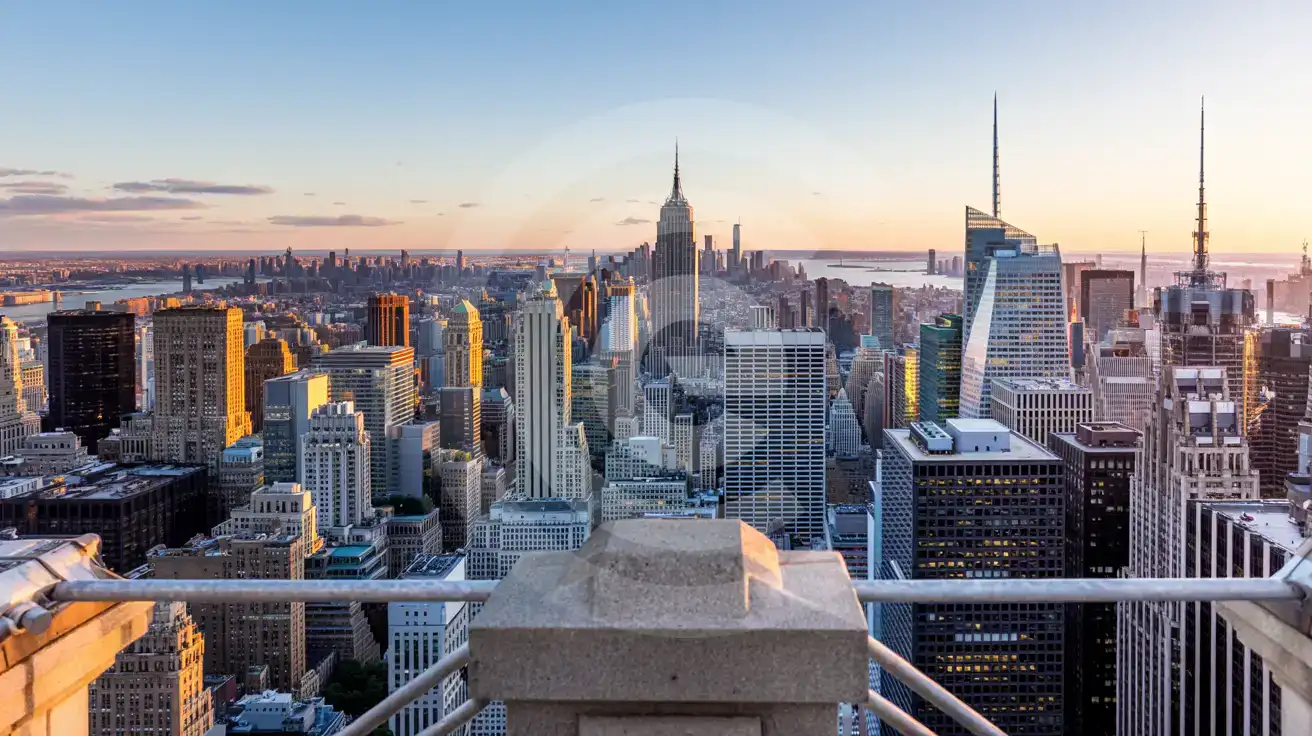
Midtown Skyline Atmosphere
Compare WiFi Options at Empire State Building
 Recommended Recommended | Local SIM / Operator | Roaming | |
|---|---|---|---|
| FEATURES | |||
| Setup time | Few minutes | Store visit + paperwork | Auto |
| No local ID needed | Online checkout | Local ID required | Use home account |
| Speed | 4G/LTE; 5G in some areas | Carrier-grade | Partner-dependent |
| Travel support | English support 24/7 | Operator shops and call centre | Home carrier hours |
| Keep home number | Dual SIM | Replaces it | Same number |
| Cost predictability | Fixed price | Bills can spike | Bill-shock risk |
| PRICING | |||
Typical pricing | See plans below | — | — |
PRICING — PICK YOUR ESIMNO PLAN
Featured eSIM plans
American Mobile

American Mobile
American Mobile
American Mobile
American Mobile
American Mobile


