
Quick Facts
- Address
- Champ de Mars, 5 Avenue Anatole France, 75007 Paris
- Height
- 330 metres (including antennas)
- Opened
- 31 March 1889
- Hours
- 09:30–23:45 daily (extended in summer)
- Lift to Summit
- €35–40 adult
- Lift to 2nd Floor
- €20–25 adult
- Stairs to 2nd Floor
- €11–15 adult
- Nearest Métro
- Bir-Hakeim (Line 6), Trocadéro (Lines 6, 9)
- Nearest RER
- Champ de Mars–Tour Eiffel (RER C)
- Official Website
- toureiffel.paris
- Annual Visitors
- ~6–7 million
- eSIMno Networks
- Bouygues, Orange, SFR
About the Eiffel Tower
The Eiffel Tower emerged from a competition to create a centerpiece for the 1889 Exposition Universelle, the World's Fair marking the centennial of the French Revolution. Gustave Eiffel's engineering firm won the contract, though the detailed structural design came largely from Maurice Koechlin and Émile Nouguier, with architect Stephen Sauvestre adding the decorative arches and glass pavilion that soften the tower's industrial silhouette. Construction took just over two years — remarkably fast for a structure requiring 18,038 metallic parts joined by 2.5 million rivets.
The tower's 330-metre height (including antennas) made it the world's tallest man-made structure for four decades, until the Chrysler Building claimed the title in 1930. That original height was only 300 metres; broadcasting equipment added over the following century accounts for the rest. The iron lattice design wasn't merely aesthetic — it minimized wind resistance while maximizing structural integrity, a solution so elegant that contemporary critics who called the tower an eyesore eventually fell silent.
Demolition was always the plan. The tower's twenty-year permit should have seen it dismantled by 1909. What saved it was utility: the structure proved invaluable for radiotelegraphy, intercepting German military communications during World War I and later supporting television broadcasts. During the German occupation of World War II, French resistance fighters famously cut the lift cables, forcing Nazi soldiers to climb the 1,665 steps on foot if they wanted to raise a flag at the summit — a flag that blew away within hours anyway.
Today the Société d'Exploitation de la Tour Eiffel (SETE) operates the tower on behalf of the City of Paris. The structure sits within the Banks of the Seine UNESCO World Heritage Site, inscribed in 1991, and the hourly golden sparkle illumination introduced for the millennium celebrations has become as iconic as the tower's daytime profile. The paint — currently a specially formulated "Eiffel Tower Brown" requiring 60 tonnes of paint every seven years — has changed shades throughout history, from Venetian red to yellow-ochre to the bronze-brown familiar today.
Roughly six to seven million visitors ascend annually, making it the most visited paid monument in the world. But the tower's meaning extends beyond tourism statistics. It has served as a canvas for artists, a symbol of resistance, a scientific instrument, and an enduring argument for the beauty of functional engineering. The view from the summit takes in 70 kilometres on clear days; the view of the tower from the city below has shaped how the world imagines Paris.
Highlights & Must-See Features
The Summit (Third Level) — 276 Metres
The highest accessible platform delivers panoramic views extending to roughly 70 kilometres on clear days — far enough to glimpse the spires of Chartres Cathedral southwest of Paris. The summit houses a reconstruction of Gustave Eiffel's private office, preserved with wax figures of Eiffel himself, his daughter Claire, and Thomas Edison, who visited during the 1889 Exposition. Edison presented Eiffel with one of his phonographs as a gift; a replica sits on the desk. The small Champagne Bar at the summit has served rosé and blanc champagne since the tower's early years, maintaining a tradition that fits the monument's original aspirations as both engineering triumph and celebration.
The Glass Floor on Level 1 — 57 Metres
Installed during the 2014 renovation designed by architect Alain Moreau, this transparent floor panel allows visitors to look directly down to the Champ de Mars below. The sensation is vertiginous even at this relatively modest height. The first level also contains the Ferrié Pavilion, named after General Gustave-Auguste Ferrié who pioneered wireless telegraphy from the tower, and an immersive exhibition covering the tower's construction, engineering principles, and cultural impact through film projections and interactive displays.
The Second Floor Observation Deck — 115 Metres
Many regular visitors consider the second level the tower's photographic sweet spot. It's high enough to see Paris's urban grid clearly yet close enough to identify individual monuments: the golden dome of Les Invalides, the twin towers of Notre-Dame (scaffolded during restoration), the white domes of Sacré-Cœur on Montmartre, the glass pyramid of the Louvre, and the distant skyscrapers of La Défense. The Michelin-starred restaurant Le Jules Verne occupies this level, accessed via a private lift in the south pillar. Reservations book weeks ahead, and the tasting menu runs to several hundred euros, but the experience pairs haute cuisine with altitude in a way few restaurants can match.
The 72 Engraved Names
Around the perimeter of the first-floor balcony, Gustave Eiffel commissioned the names of 72 French scientists, engineers, and mathematicians to be inscribed in gold letters. The names were painted over in the early 20th century, deemed old-fashioned, then restored during the 1986–1987 renovation. Look for Lavoisier (chemistry), Ampère (electromagnetism), Foucault (pendulum and speed of light), Fourier (heat transfer), Gay-Lussac (gas laws), and Fresnel (optics). No women appear — not because none contributed to French science, but because the selection reflected 1889 norms. Finding and identifying these names adds a layer of historical texture to the first-level circuit.
The Machinery Rooms
The original hydraulic lift machinery from 1899 remains visible in the east pillar, preserved as a working exhibit. The Fives-Lille machines — massive counterweighted systems using water pressure — operated for nearly a century before electric systems supplemented them. Watching the mechanics offers a reminder that the tower is not merely a static monument but a functioning vertical transport system moving thousands of people daily.
The Bust of Gustave Eiffel
Located at the base of the north pillar, sculptor Antoine Bourdelle's bronze bust of Gustave Eiffel faces the Champ de Mars. Most visitors walk past without noticing, but it marks the spot where Eiffel maintained an office during construction and the early years of operation. The inscription notes his dates (1832–1923) and his role as the tower's creator.
The Iron Lattice Structure Itself
The tower's 18,038 individual iron pieces, visible from any angle, repay close attention. The decorative arches at the first level — Sauvestre's contribution — serve no structural purpose but soften what would otherwise be a purely industrial profile. The lattice pattern becomes denser toward the base to handle greater loads, a visual expression of structural logic. Standing directly beneath the tower and looking up through the central void remains one of the more disorienting perspectives available in Paris.
The Evening Sparkle
Every hour from dusk until 23:00 (01:00 in summer), 20,000 light bulbs flash in a five-minute golden sparkle sequence. The effect is best viewed from a distance — Trocadéro, the Champ de Mars, or a Seine river cruise — rather than from within the tower itself. The illumination system, introduced for the year 2000 celebrations, has become inseparable from the tower's modern identity.
Visit Strategy: Timing, Tickets & Crowd Avoidance
Booking Strategy
The single most important decision is whether to book online. Time-slotted tickets through the official site (toureiffel.paris) typically sell out two to three weeks ahead during summer and school holidays, one to two weeks ahead during shoulder seasons. The alternative — arriving without a reservation and joining the walk-up queue — can mean waits of 90 minutes to three hours during peak periods. That time could be spent at the Musée du Quai Branly, a Seine-side café, or the Trocadéro gardens.
Three main ticket types exist: lift access to the second floor only, lift access to the summit (which includes the second floor), and stair access to the second floor. The stair option covers 674 steps to the first level and another 360 to the second — not prohibitive for reasonably fit visitors, and often available when lift tickets are sold out. From the second floor, a separate lift-only ticket can be purchased on-site for the summit ascent, though queues for this internal ticket also build during busy periods.
Best Time Slots
Early morning slots (09:30–10:30) draw smaller crowds than mid-afternoon. Late evening slots (after 21:00) offer the tower illuminated against the Paris skyline and shorter queues, though you'll miss the daytime panorama detail. Sunset slots are the most requested and book first; if that's your priority, set a calendar reminder for when tickets release.
Weekday visits outperform weekends. Tuesday through Thursday typically sees the lowest weekday traffic. Monday and Friday draw workers extending their weekends. Saturday peaks around 14:00–17:00; Sunday mornings are relatively calm before the afternoon rush.
Seasonal Patterns
Peak season runs from mid-June through August, overlapping with European school holidays and American summer travel. Shoulder seasons — late September through early November and late January through March — offer the best balance of manageable crowds and pleasant weather. December brings holiday visitors but also early darkness that limits daylight photography. January is the quietest month, though cold winds at 276 metres require warm layers.
Recommended Duration
Allow 90 minutes to two hours for a thorough visit including all three accessible levels. The lift rides themselves consume 15–20 minutes of that time. If you've booked a summit ticket, spend roughly 20 minutes at the top, 30 minutes at the second level (the photography priority), and 20–30 minutes at the first level exploring the glass floor and exhibits. Add buffer time for security screening at the base, which can take 10–20 minutes during busy periods.
Photography Rules
Personal photography is unrestricted during daylight hours across all levels. The evening light show — the hourly sparkle and the static illumination — is technically copyrighted as an artistic work under French law, meaning commercial photography requires permission from SETE. In practice, personal photos and videos shared on social media are not enforced, but professional shoots and commercial use require licensing. Tripods and professional equipment (determined at security's discretion) require prior authorization through the official site. Drone photography within Paris city limits is prohibited without specific permits, which are rarely granted near the tower.
Security & Prohibited Items
All visitors pass through airport-style security screening at the base perimeter. Large luggage, suitcases, and oversized bags are not permitted; there's no luggage storage on-site, so plan accordingly if arriving from a hotel checkout. Small backpacks and handbags are allowed. Glass bottles, alcohol, and weapons are prohibited. The screening process adds 10–20 minutes during busy periods; arriving before your time slot allows buffer.
Best Time to Visit & Photographer's Guide
Month-by-Month Crowd & Weather
January–February: The quietest months. Average highs around 7°C, occasional rain, and early sunsets by 17:30. Crowds are minimal, queues short, but the summit can feel bitterly cold with wind chill. Ideal for visitors who prioritize access over weather.
March–April: Spring arrives unevenly. Cherry blossoms appear in the Champ de Mars gardens by late March. Temperatures climb to 12–16°C, and daylight extends past 20:00 by April's end. Easter holidays bring a mid-season surge, but weekdays remain manageable.
May–June: Arguably the best weather-to-crowd balance. Temperatures reach 18–22°C, long twilight hours allow late-evening visits, and the Champ de Mars fills with picnickers at dusk. Early June is preferable to late June, when school holidays begin.
July–August: Peak season. Temperatures often exceed 25°C, occasionally spiking above 35°C during heat waves. Crowds are at their heaviest, with 25,000+ daily visitors common. Book tickets at maximum advance; arrive at opening or after 21:00.
September–October: Shoulder season resumes. September retains summer warmth (18–22°C) with reduced crowds. October brings autumn colors to the Trocadéro gardens and cooler temperatures (12–16°C). An excellent window for photography.
November–December: Temperatures drop to 6–10°C. November is grey and often rainy, with the shortest queues of the year. December brings Christmas markets to the Champ de Mars and festive illumination, but also increased holiday visitor traffic.
Best Time of Day
Sunrise (07:00–08:30, varies by season): The tower opens at 09:30, so true sunrise photography happens from ground level — Trocadéro, the Champ de Mars, or the Pont d'Iéna. The eastern light illuminates the tower's iron lattice with warm tones and long shadows.
Golden Hour (1–2 hours before sunset): The most requested time slot for tower access. Late afternoon light warms the Parisian roofscape, and the transition from day to illuminated night unfolds during your visit. Book these slots earliest.
Blue Hour (20–40 minutes after sunset): The sky deepens to cobalt while city lights emerge. From the second or summit level, this brief window captures Paris in its most cinematic state. Timing requires checking sunset times for your visit date.
Night (after 21:00): The illuminated tower against a dark sky photographs dramatically from ground level. From within the tower, the city becomes a grid of lights. The hourly sparkle (until 23:00, or 01:00 in summer) is best observed from Trocadéro or a river cruise rather than from the tower itself.
Best Photo Spots
Trocadéro Esplanade: The definitive head-on view, framing the tower symmetrically between the curved wings of the Palais de Chaillot. Arrive early morning to avoid crowds; the platform fills by mid-morning with photographers and selfie-takers.
Pont d'Iéna: The bridge connecting Trocadéro to the tower offers an unobstructed approach shot with the Seine in the foreground. Stand mid-bridge for the classic centered composition.
Champ de Mars Carousel: Near the southeast end of the gardens, the vintage carousel provides foreground interest with the tower rising behind. Works best in afternoon light.
Pont de Bir-Hakeim: The elevated metro viaduct and Parisian lampposts create a layered composition with the tower in the background. The scene appears in numerous films, including Inception. Walk onto the bridge from the Passy side for the best angles.
Rue de l'Université: This narrow street in the 7th arrondissement frames the tower at the end of a classic Haussmann building corridor. Less crowded than Trocadéro, it captures the tower as Parisians actually see it — integrated into the urban fabric.
Palais de Tokyo Terrace: The museum's outdoor terrace offers a side-angle view across the river, with fewer tourists than Trocadéro. The café serves decent coffee while you wait for the light.
From the Second Level Looking Down: Inside the tower, the second floor offers the best vantage for photographing the Champ de Mars, the Seine curve, and the radial street pattern extending toward Les Invalides.
Drone & Tripod Rules
Drone flights are prohibited within Paris city limits without exceptional permits, which authorities rarely grant near the tower due to security concerns and protected airspace. Violations carry significant fines. Tripods and monopods inside the tower require prior written authorization from SETE; security typically confiscates unauthorized professional equipment at the perimeter screening. Handheld stabilizers and small travel tripods sometimes pass unnoticed, but there's no guarantee. For ground-level night photography at Trocadéro or the Champ de Mars, tripods are generally tolerated, though official park rules technically prohibit them.
Hidden Sub-Spots Most Tourists Miss
Allée Adrienne Lecouvreur: This tree-lined path along the western edge of the Champ de Mars offers a less-trafficked angle with the tower framed through branches. Particularly effective in autumn when the leaves turn.
Square Rapp: A small garden square about 10 minutes' walk east, featuring Art Nouveau buildings and an unexpected tower view above the rooflines. Few tourists find it.
Port Debilly: The boat dock below Trocadéro, accessible via stairs from the Pont d'Iéna, places you at water level with the tower reflected in the Seine. Early morning, before river traffic disturbs the surface, produces the best reflections.
The Northwest Pillar Interior: Most visitors queue for the east or south pillar lifts. The northwest pillar base, where stairs begin, offers an uncrowded angle looking up through the iron lattice — a perspective that emphasizes the structure's engineering rather than its silhouette.
Avenue de Suffren Viewpoint: Walking south from the tower along Avenue de Suffren, around the Rue de la Fédération intersection, provides a less-photographed three-quarter angle with street-level Parisian context.
Nearby Attractions & Logistics
Immediate Surroundings (Under 10 Minutes' Walk)
Champ de Mars: The formal lawn extending 780 metres from the tower's base to the École Militaire was laid out in the 18th century as a parade ground. It's a 1-minute walk and the obvious spot for ground-level photographs, picnics, and watching the evening sparkle. During summer, crowds gather at dusk with wine and cheese; police occasionally enforce open-container rules but enforcement is inconsistent.
Trocadéro and the Palais de Chaillot: Cross the Pont d'Iéna (5-minute walk) and climb the gardens to the Trocadéro esplanade. The Palais de Chaillot's curved wings, built for the 1937 Exposition, house the Musée de l'Homme (anthropology), the Cité de l'Architecture et du Patrimoine (architectural models and casts), and the Musée National de la Marine (naval history). The terrace between the wings provides the iconic head-on tower view.
Musée du Quai Branly–Jacques Chirac: A 7-minute walk east along the Seine, this Jean Nouvel–designed museum houses art from Africa, Asia, Oceania, and the Americas. The building's green wall, designed by botanist Patrick Blanc, is worth seeing even if you don't enter. Tuesday evenings the museum stays open until 21:00.
Moderate Walk (15–25 Minutes)
Les Invalides and the Musée de l'Armée: A 20-minute walk east brings you to the Hôtel des Invalides, its golden dome visible from the tower's upper levels. Napoleon's tomb lies beneath that dome; the surrounding Musée de l'Armée covers French military history from medieval armor to World War II. Combined tickets available.
Musée Rodin: Just beyond Les Invalides, this 18th-century mansion and its sculpture gardens display The Thinker, The Gates of Hell, and Rodin's extensive collection. The gardens alone justify the entry fee on a good-weather day. Allow 90 minutes for a thorough visit.
Rue Cler Market Street: This pedestrianized market street in the 7th arrondissement, a 12-minute walk east, offers bakeries, cheese shops, wine merchants, and café terraces. It's the classic Parisian neighborhood market experience, ideal for assembling a Champ de Mars picnic or a quick lunch.
Transport Connections
Métro: Bir-Hakeim (Line 6) is the closest station, a 6-minute walk via the Pont de Bir-Hakeim. Trocadéro (Lines 6 and 9) is across the river, 10 minutes' walk, but offers the most scenic approach. École Militaire (Line 8) serves the southeast end of the Champ de Mars.
RER: Champ de Mars–Tour Eiffel station on RER C sits directly below the tower's south side, useful for connections to Versailles (RER C toward Versailles-Château-Rive-Gauche) or central Paris stations.
Bus: Lines 30, 42, 69, 72, 82, and 86 serve stops within a 5-minute walk. Line 69 is particularly useful, connecting the tower to the Louvre, Bastille, and Père Lachaise in the east.
Batobus: The river shuttle docks at the Tour Eiffel pier near the Pont d'Iéna. Batobus passes allow hop-on/hop-off access to eight piers along the Seine, including the Louvre, Musée d'Orsay, Notre-Dame, and Jardin des Plantes.
Suggested Combined Itineraries
Morning Tower, Afternoon Culture: Book a 10:00 tower slot, descend by noon, walk to the Musée du Quai Branly or Musée Rodin for early afternoon, finish with Les Invalides before closing. Dinner in the Rue Cler area.
River-Focused Day: Start at Trocadéro for morning photographs, cross to the tower for a late-morning ascent, walk along the Seine to the Musée d'Orsay (40 minutes), then catch a Bateaux-Mouches dinner cruise from Pont de l'Alma to see the tower's evening sparkle from the water.
Late-Evening Visit: Book a 21:00 slot, ascend as dusk settles, watch the 22:00 sparkle from the second level, descend and walk to Trocadéro to see the 23:00 sparkle from ground level. Late dinner in the 16th arrondissement or return to central Paris via Métro.
Why Data Matters at the Eiffel Tower
A tower visit generates more phone activity than you might expect. The ticket QR code needs to load at security screening. The official app offers augmented-reality overlays identifying landmarks from the observation decks. Google Maps or Citymapper guides you from whichever metro exit you emerge from to the correct pillar queue. Restaurant reservations at Le Jules Verne or nearby Rue Cler spots live in email confirmations or booking apps. And the photos — there will be many — want to sync or share before you've even descended.
Free WiFi exists at the tower but performs inconsistently under visitor load. A working mobile data connection, on local French networks, handles the gaps more reliably. If you're arriving without a local SIM, eSIMno connects through Bouygues, Orange, or SFR — the same carriers Parisians use — so your navigation, tickets, and translation apps work as expected from landing at Charles de Gaulle through the summit champagne bar and back.
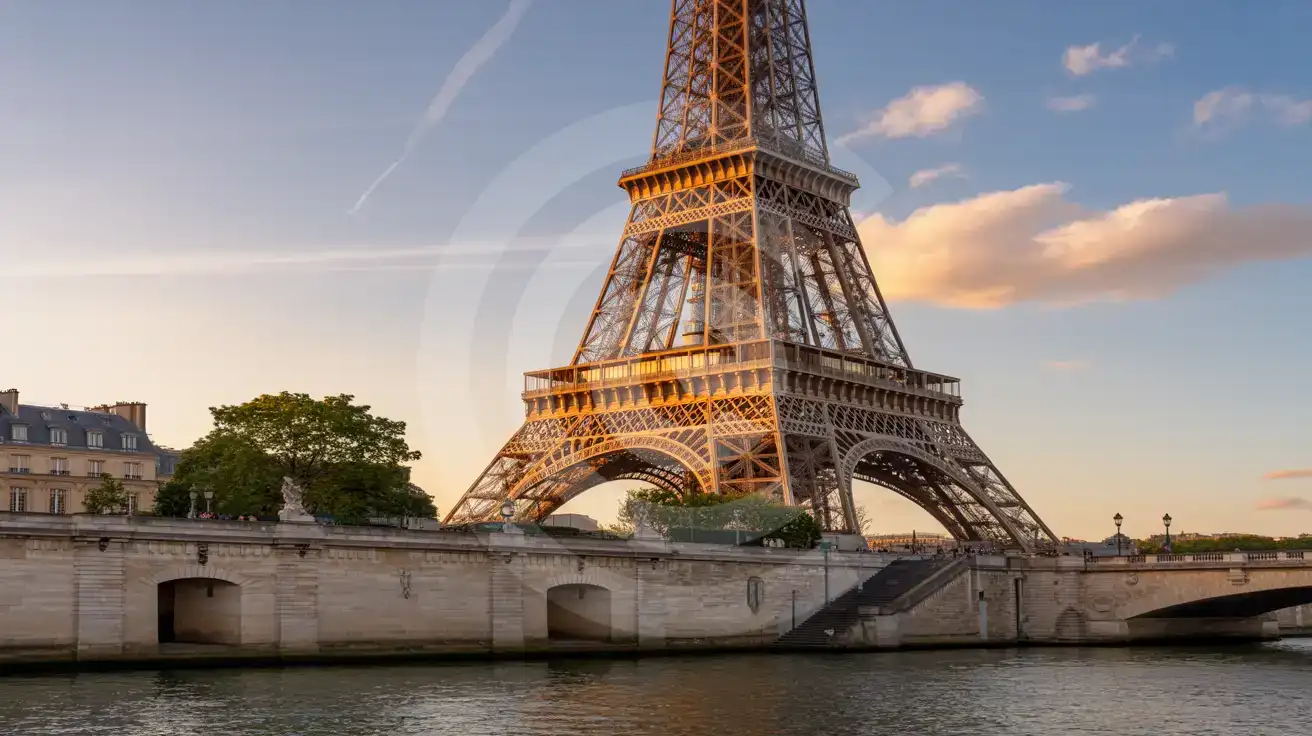
The Tower at Golden Hour
Compare WiFi Options at Eiffel Tower
 Recommended Recommended | Local SIM / Operator | Roaming | |
|---|---|---|---|
| FEATURES | |||
| Setup time | Few minutes | Store visit + paperwork | Auto |
| No local ID needed | Online checkout | Local ID required | Use home account |
| Speed | 4G/LTE; 5G in some areas | Carrier-grade | Partner-dependent |
| Travel support | English support 24/7 | Operator shops and call centre | Home carrier hours |
| Keep home number | Dual SIM | Replaces it | Same number |
| Cost predictability | Fixed price | Bills can spike | Bill-shock risk |
| PRICING | |||
Typical pricing | See plans below | — | — |
PRICING — PICK YOUR ESIMNO PLAN
Featured eSIM plans
France Mobile

France Mobile
France Mobile
France Mobile
France Mobile
France Mobile
France Mobile
France Mobile


