
Quick Facts
- Festival starts
- 4 September 2027
- Founded
- 2008
- Typical run length
- About 2 to 3 weeks each September
- Main venue area
- Rudolfinum and other historic central Prague halls
- Typical concert start time
- 19:30 or 20:00
- Typical door opening
- Usually 45 to 60 minutes before the concert
- Main hall capacity
- Rudolfinum Dvořák Hall: about 1,100 seats
- Ticket range
- Roughly CZK 490 to CZK 3,500+, depending on seat and gala program
- Airport to Old Town venue area
- About 16 km, usually 35 to 50 minutes by public transport or 25 to 35 minutes by taxi
- City centre to Rudolfinum
- About 10 to 20 minutes on foot from Old Town Square
- Nearest transport stops
- Staroměstská metro/tram, tram 2, 17, 18, bus 194 nearby
- Typical taxi fare
- Around CZK 550 to CZK 800 from the airport to central Prague
- eSIMno Networks
- O2, T-Mobile, Vodafone
Why This Event Feels Different
Some festivals are about scale. This one is about concentration. Dvořák Prague is an annual festival dedicated to Antonín Dvořák and major orchestral performance, and that gives it a tone you feel straight away: formal, international, and deeply tied to Czech musical culture rather than generic festival branding.
That matters if you’re choosing between Prague’s many event weeks. The reason to travel for this one is exactly what regular attendees love about it: it draws an international classical audience and fits beautifully into Prague’s autumn cultural calendar, when the city starts to feel serious again after summer. We’re talking evening concerts in landmark halls, audiences who actually listen, and programs built around artistic quality rather than volume.
It’s also a smart pick for people who want a short premium break. If you’re a classical music traveler, a mature cultural tourist, or simply someone who’d rather book a good seat than a loud afterparty, this festival makes sense. Prague already has global name recognition; what Dvořák Prague adds is a clear Czech identity inside that familiar city backdrop. That combination is hard to fake, and honestly, it’s why people come back.
Getting There and Moving Between Prague’s Concert Halls
The airport you need is Václav Havel Airport Prague. From there to the main historic venue zone around Rudolfinum, Old Town, and the river, public transport usually takes 35 to 50 minutes. The common route is Airport Express to Praha hlavní nádraží or bus 59 to Nádraží Veleslavín, then Metro A toward Staroměstská. If you’ve got evening clothes and don’t fancy stairs or tram changes, a taxi or rideshare is usually 25 to 35 minutes in normal traffic and about CZK 550 to CZK 800.
For accommodation, stay central. Josefov and Staré Město are the easiest if Rudolfinum is your anchor venue; you can walk back after a 19:30 concert. Malá Strana is gorgeous and still practical, especially if you don’t mind crossing the river. Nové Město works well too if you want slightly more hotel choice and easier access to Wenceslas Square, Národní třída, and the main rail station. We’d avoid staying too far out unless you know Prague well, because late-evening venue changes feel much longer once you’re juggling coats, tickets, and tram platforms.
During festival days, Prague’s transport is your friend. Metro A is the key line for Staroměstská and Malostranská; trams 17 and 18 are especially useful along the river corridor, while tram 22 helps if your plans spill toward Malá Strana or the castle side. Bus 194 is handy in the centre for short hops. The city is walkable, yes, but classical evenings usually mean keeping an eye on exact start times. A data connection helps more than you’d think, so if you want transit and maps working the minute you land, it’s worth having a plan ready and to explore eSIMno plans for Prague before the trip.
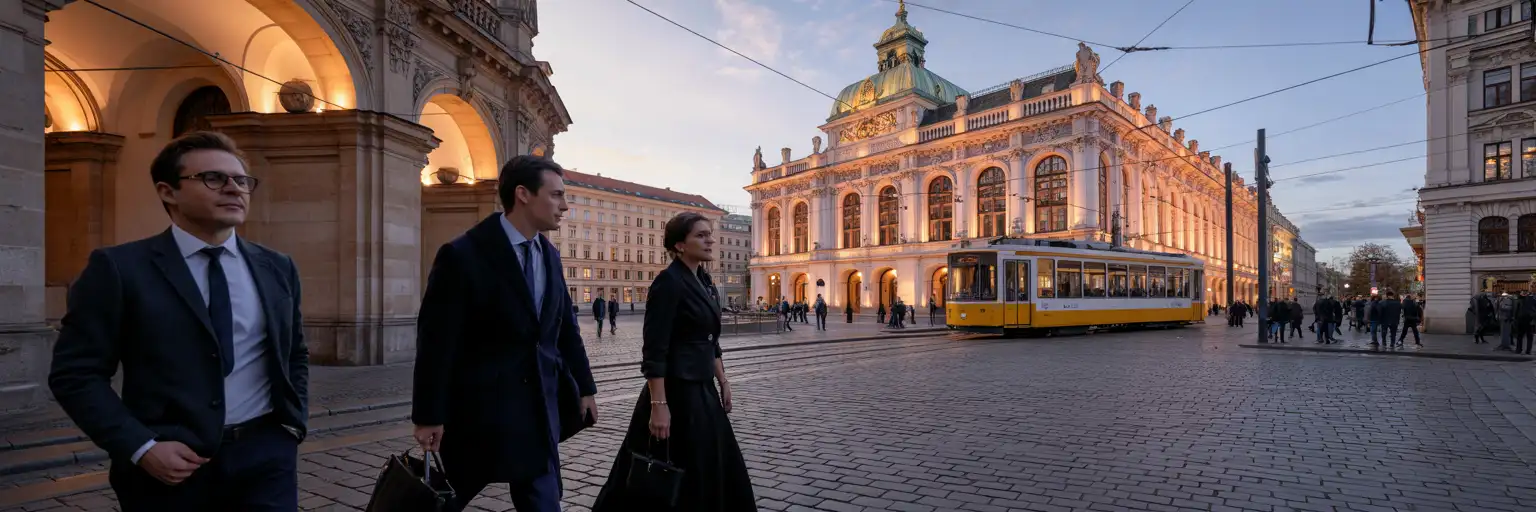
Prague Concert Evening Mood

What to Do Before the Applause and After It
You don’t need to overpack your daytime schedule here. A better rhythm is one major sight, one proper meal, then the concert.
Start with the Klementinum area and the riverside near Smetanovo nábřeží. It’s close to the likely venue cluster, and the walk itself is half the point. If you want a pre-concert lookout, go up the Old Town Bridge Tower rather than forcing the castle into a tight day. The views are excellent, and it won’t leave you sprinting to your seat.
For a quieter cultural detour, the Museum of Decorative Arts Prague sits right by Rudolfinum. It’s one of those places that travelers often skip, which is exactly why we like it before a formal evening program. You can also cross to Kampa Island after the concert if you want Prague at its softer, less crowded best.
Food-wise, keep it local and realistic. In Old Town and around Havelský trh, look for svíčková, roast duck, or kulajda if you want a full Czech meal before the performance. For something lighter, the streets around Dlouhá have plenty of bistros and wine bars, though we’d book ahead on Friday and Saturday nights. In Nové Město, Lokál Dlouhááá is good for straightforward Czech plates and Pilsner; Café Louvre works if you want a grand old-school setting without making dinner too heavy. And don’t leave Prague without trying koláče from a bakery in the morning and chlebíčky at least once. They sound simple. They’re not boring.
Staying Connected When the Festival Spreads Across Historic Venues
This isn’t the kind of festival where one giant gate solves everything. Dvořák Prague usually unfolds across more than one historic hall in central Prague, which means your phone becomes the thing tying the trip together: ticket email, seating info, last-minute venue check, tram arrival, restaurant booking, and the message to your travel companion saying, quite possibly, “wrong entrance, I’m by the river side.”
Old concert buildings can be beautiful and mildly inconvenient in the modern sense. Venue WiFi, if offered, isn’t something we’d rely on when several hundred people are trying to pull up QR tickets at once. Download your tickets in advance, but keep mobile data active for backup. It’s also useful for live navigation because Prague’s centre has enough lanes, courtyards, and tram islands to confuse even confident walkers after dark.
Photo and video needs are lighter here than at a pop festival, obviously, but you’ll still want data after the concert, when everyone steps outside and starts sending shots of the façade, the program booklet, or the river at night. Add in translation, ride apps, and changing transport times, and having steady service matters. We’d sort it before departure so you don’t waste airport time; you can explore eSIMno plans for Prague and land with data ready on local partner networks.
How to Use Your Data Smartly for This Festival
- Before the first concert
Save your ticket as both email and screenshot, then pin the exact venue entrance. Historic Prague venues can have multiple approaches, and the difference between the river side and the square side can cost you 10 minutes. - On arrival day
Use data from the airport for the first transfer into Staré Město, Josefov, or Nové Město. Prague public transport is excellent, but after a flight it’s much easier when Metro A, tram 17, and backup taxi options are already in your pocket. - Between dinner and doors
Check your route again about 60 minutes before concert time. Doors often open 45 to 60 minutes early, and central Prague traffic can slow taxis around 18:30 to 19:30. - After the applause
Don’t count on venue WiFi spilling outside. Use your own connection for late tram times, rideshare pickup points, and group messages if your party leaves separately from the hall.
A Few Things Worth Knowing Before You Dress for the Evening
- Early September weather in Prague is usually mild, around 18 to 24°C by day, but evenings can drop closer to 12 to 16°C. Bring a light jacket even if the afternoon feels warm.
- Prague concert audiences tend to dress smart-casual to formal for major evening programs. You don’t need black tie, but trainers and tourist daywear can feel out of place in the top-tier venues.
- If you’re dining before a 19:30 start, reserve for 17:30 or 18:00 and ask for the bill early. Prague service is rarely rushed, which is great until you’re watching the clock.
Compare Connectivity for Dvořák Prague International Music Festival
 Recommended Recommended | Local SIM / Operator | Roaming | |
|---|---|---|---|
| FEATURES | |||
| Setup time | Few minutes | Store visit + paperwork | Auto |
| No local ID needed | Online checkout | Local ID required | Use home account |
| Speed | 4G/LTE; 5G in some areas | Carrier-grade | Partner-dependent |
| Travel support | English support 24/7 | Operator shops and call centre | Home carrier hours |
| Keep home number | Dual SIM | Replaces it | Same number |
| Cost predictability | Fixed price | Bills can spike | Bill-shock risk |
| PRICING | |||
Typical pricing | See plans below | — | — |
PRICING — PICK YOUR ESIMNO PLAN
Destination overview
Frequently Asked Questions
Featured eSIM plans
Czech Net

Czech Net
Czech Net
Czech Net
Czech Net
Czech Net
Czech Net
Czech Net