
Quick Facts
- Address
- Buckingham Palace, London SW1A 1AA
- Summer Opening
- Mid-July to late September, 09:30–19:30
- State Rooms Tickets
- £30–£35 adult, under-5s free
- Changing of the Guard
- 11:00 (check schedule for dates)
- Nearest Tube
- Victoria, Green Park, St James's Park
- Official Website
- rct.uk/visit/buckingham-palace
- eSIMno Networks
- EE, O2, Three
About Buckingham Palace
The land where Buckingham Palace now stands was once a mulberry garden planted by James I in a failed attempt to cultivate silkworms. A century later, in 1703, John Sheffield, the Duke of Buckingham, built a substantial townhouse on the site — Buckingham House — positioning it at the western end of what would become The Mall. That house caught the eye of King George III, who purchased it in 1761 as a private residence for Queen Charlotte. For the next six decades, it served as a comfortable retreat rather than a seat of power, known simply as 'The Queen's House.'
Everything changed in 1826 when George IV commissioned the architect John Nash to transform the modest house into something worthy of a monarch. Nash's vision was ambitious: he demolished much of the original structure, constructed new wings around a central courtyard, and created interiors dripping with French-influenced grandeur. The project spiraled over budget. Nash was dismissed before completion, and Edward Blore stepped in to finish the work. When Queen Victoria took the throne in 1837, she became the first sovereign to make Buckingham Palace the official royal residence — a status it has maintained through six reigns.
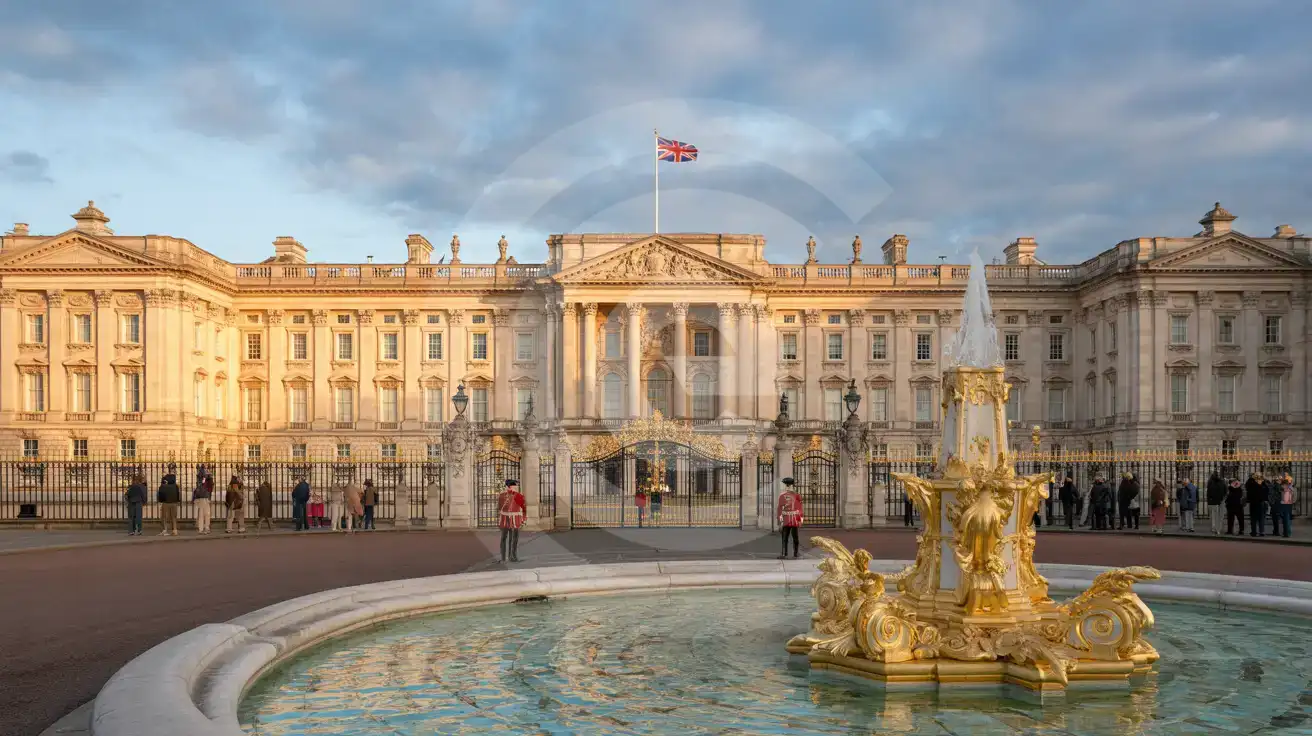
The familiar east front that tourists photograph today wasn't part of the original Nash design. Blore added it in 1847 to enclose the courtyard, and Sir Aston Webb refaced it in Portland stone in 1913, creating the symmetrical neoclassical facade with its central balcony that now anchors national celebrations from VE Day to royal weddings. That same year, the Victoria Memorial was completed — the massive white marble monument featuring a gilded figure of Victory that forms the visual terminus of The Mall.
Today's palace contains 775 rooms: 19 State Rooms used for official entertaining, 52 royal and guest bedrooms, 188 staff bedrooms, 92 offices, and 78 bathrooms. The building serves as the administrative headquarters of the monarchy, hosting approximately 50,000 people annually at state banquets, investitures, receptions, and the summer Garden Parties held in the 39-acre garden. A simple flag protocol signals royal presence: the Royal Standard flies when the monarch is in residence; the Union Flag flies at all other times.
Unlike the Tower of London or Westminster Abbey, Buckingham Palace is not a museum frozen in time. It is a working building where real diplomatic business occurs, real investitures honor British citizens, and real state dinners unfold in the Ballroom. This dual identity — heritage attraction and functioning headquarters — shapes every aspect of visiting.
Highlights & Must-See
The State Rooms
The 19 State Rooms form the heart of any summer visit. These interconnected spaces were designed for formal entertaining on a royal scale, and they retain that function today. Walking through them, you're tracing the same route ambassadors follow during credentials ceremonies. The furnishings aren't reproduction pieces brought in for visitors — they're the actual items used during state events, drawn from the Royal Collection's holdings of approximately one million objects.
The Grand Staircase
Nash designed the Grand Staircase as the ceremonial entrance for state visitors, and it delivers immediate visual impact. Gilded bronze balustrades curve upward beneath portraits of Queen Victoria's extended family. The staircase sets the tone for everything that follows: this is architecture designed to impress, to signal power through beauty rather than force.
The Throne Room
A pink-and-gold proscenium arch frames the far end of the Throne Room, creating a theatrical backdrop for the Chairs of State. The thrones currently displayed bear the initials 'EIIR' and 'P' — they were used by the late Queen Elizabeth II and Prince Philip. The room hosts formal receptions and the presentation of addresses from both Houses of Parliament.
The Picture Gallery
At 47 metres, the Picture Gallery is the longest room in the palace and one of the most significant private art collections accessible to the public. The top-lit space displays masterworks by Rembrandt (including 'The Shipbuilder and his Wife'), Vermeer ('The Music Lesson'), Rubens, Van Dyck, Canaletto, Claude, and Poussin. The collection was assembled largely by George IV, whose art-buying habits contributed to the financial pressures that saw Nash dismissed from the project.
The Ballroom
Added under Queen Victoria in the 1850s, the Ballroom measures approximately 36 by 18 metres — the largest room in the palace. It hosts state banquets, where up to 170 guests dine beneath six chandeliers and an enormous pipe organ. During investitures, the monarch presents honors here. The thrones displayed are those used at Queen Elizabeth II's 1953 coronation.
The Changing of the Guard
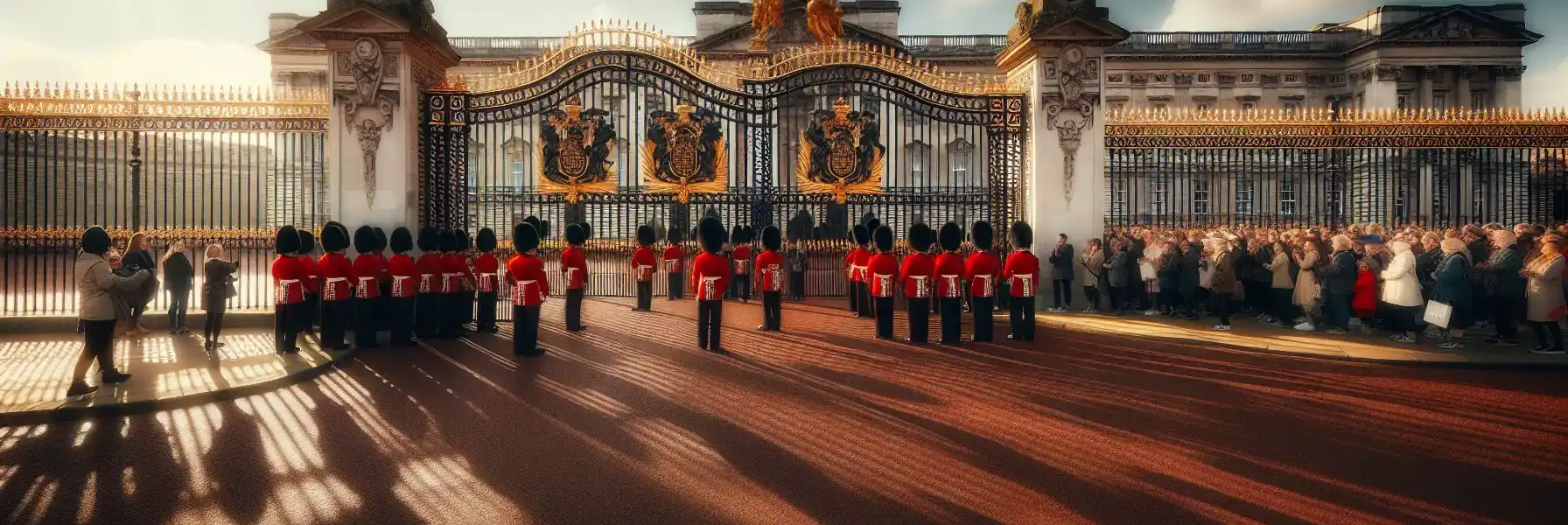
This isn't technically inside the palace, but it's inseparable from any Buckingham Palace visit. The ceremony on the forecourt involves the Foot Guards of the Household Division — soldiers in red tunics and bearskin caps accompanied by a regimental band. The New Guard marches from Wellington Barracks, the Old Guard hands over responsibility, and the whole thing unfolds with military precision against the palace backdrop. It runs daily during summer and on alternate days (Monday, Wednesday, Friday, Sunday) the rest of the year, weather permitting.
The Royal Mews
Located on Buckingham Palace Road, the Royal Mews houses the working stables and carriage collection. The star attraction is the Gold State Coach, built in 1762 and used for every coronation since George IV's. The Diamond Jubilee State Coach (2014) represents more modern craftsmanship, incorporating fragments of historic British artifacts. The Mews also houses the Windsor Greys and Cleveland Bays that draw state carriages.
The King's Gallery
Formerly called The Queen's Gallery, this purpose-built exhibition space presents rotating shows drawn from the Royal Collection. Exhibitions change every 6-9 months and have covered subjects from Canaletto's Venice paintings to Leonardo da Vinci drawings to the history of royal photography. It's the only part of the palace open year-round.
The Palace Garden
The summer opening route exits through the garden, where 39 acres of lawn, lake, and planting create an unexpected rural landscape behind the palace. The garden hosts annual parties for 8,000 guests each summer and contains a tennis court, a helicopter landing pad, and one of London's largest collections of mulberry trees — descendants of those planted by James I.
Visit Strategy
When to Visit
The State Rooms open for roughly ten weeks between mid-July and late September, when the monarch is typically at Balmoral. Additional dates appear in spring (usually around Easter) and Christmas for guided tours only. Summer opening hours run 09:30–19:30, with last admission around 17:15. September hours shorten slightly.
Weekday mornings at 09:30 entry are your best bet for a crowd-light experience. The Picture Gallery feels completely different when you can stand in front of the Vermeer without elbowing through a tour group. Late afternoon entries (15:30 onwards) also thin out, and you'll catch better light through the garden windows.
Tickets & Booking
Adult tickets run £30–£35 depending on the year and whether you add audio guide options. Reduced rates apply for ages 18–24, children 5–17, and disabled visitors. Under-5s enter free. The 'Royal Day Out' combination ticket bundles the State Rooms, Royal Mews, and King's Gallery at a discount — worthwhile if you want the full experience.
Book online through the Royal Collection Trust website. Summer weekends and school holidays sell out weeks in advance. Here's a tip many visitors miss: tickets purchased on the day can be converted into a free 1-Year Pass, allowing unlimited return visits for twelve months. If you're staying in London long-term or planning a return trip, this transforms a single visit into ongoing access.
Timing the Changing of the Guard
The ceremony begins at 10:45 with the new guard forming up, and the actual changeover happens at 11:00 on the forecourt. Arrive by 10:00 to secure a spot against the railings. If you arrive late, head to the Victoria Memorial — the stepped base offers elevated views over the crowd, and you'll have the palace facade as backdrop for photos.
Check the schedule before arriving. Summer runs daily; the rest of the year operates Monday, Wednesday, Friday, and Sunday. Ceremonies cancel in heavy rain. The Household Division website publishes confirmed dates.
Photography Rules
Photography is not permitted inside the State Rooms. This is strictly enforced. Phones must be put away, and staff will intervene if you're caught sneaking shots. The rule exists partly to protect the artwork from flash damage and partly to keep visitor flow moving.
Photography is freely permitted on the forecourt, at the Changing of the Guard, in the garden section of the State Rooms visit, and throughout the Royal Mews. The King's Gallery rules vary by exhibition — some loan agreements prohibit photography of specific works.
Duration & Pacing
Allow 2–2.5 hours for the State Rooms visit, including the garden walk at the end. The Royal Mews takes 45 minutes to an hour. The King's Gallery varies by exhibition but typically runs an hour. If you're doing the Royal Day Out combination, budget 4–5 hours for all three venues plus transitions.
Practical Notes
Bags larger than airline cabin size are not permitted, and there are no cloakroom facilities. Leave large luggage at your hotel or in a locker at Victoria Station. Comfortable walking shoes matter — the route covers significant distance on hard floors, and the garden involves uneven ground. There's no formal dress code, but you're walking through one of the world's most important residences; smart casual feels appropriate.
Site Walk-Through & Photographer's Guide
Recommended Walk Sequence
Ticket holders enter via the Ambassadors' Court entrance on Buckingham Palace Road, not through the famous front gates on The Mall. This southern approach leads through security screening into the inner quadrangle before ascending to the State Rooms proper. The route is one-way and strictly sequenced — you cannot backtrack — so absorb each room fully before moving forward.
The visitor flow moves through the Grand Hall, up the Grand Staircase, through the Green Drawing Room, Throne Room, Picture Gallery, Silk Tapestry Room, East Gallery, Ball Supper Room, State Dining Room, Blue Drawing Room, Music Room, White Drawing Room, Ministers' Staircase, Marble Hall, and Bow Room before exiting into the garden. The entire sequence takes most visitors 90–120 minutes without rushing.
Key Structures to Spend Time At
The Grand Staircase: Pause here before ascending. The gilded bronze balustrades feature elaborate scrollwork, and the portraits overhead establish the Victorian family narrative that runs through the palace. Look for the Carrara marble steps worn smooth by nearly two centuries of use.
The Throne Room: The pink-and-gold proscenium arch frames the thrones beautifully from the doorway. This is the money shot you can't photograph — commit the image to memory. Notice how the theatrical staging creates depth, with the Chairs of State positioned as if awaiting performers.
The Picture Gallery: Spend the longest time here. The Vermeer ('The Music Lesson') hangs on the east wall; the Rembrandt ('The Shipbuilder and his Wife') typically occupies a prominent central position. The skylight design means illumination varies by weather and time of day — overcast mornings produce even, gallery-quality light without harsh shadows.
The Blue Drawing Room: The thirty faux-onyx columns and Nash's ceiling design represent some of the finest surviving interiors from the original 1820s vision. The Sèvres porcelain displayed here was acquired by George IV.
The White Drawing Room: Contains a concealed door used by the Royal Family to enter state events without passing through public corridors. Look for the mirrored cabinet that swings open — it's visible but easy to miss if you're not looking.
Best Photo Spots & Lighting Times
External photography opportunities cluster in three locations. The classic frontal view works best from the Victoria Memorial base, shooting back toward the east facade — morning light (before 10:00) illuminates the Portland stone without harsh shadows. The railings along The Mall offer three-quarter angles with Foot Guards visible. St James's Park, from the Blue Bridge looking west, captures the palace framed across the lake — this shot works best in late afternoon when the sun sits behind you.
For the Changing of the Guard, position at the railings directly opposite the central gates if you want tight shots of the ceremony. Position at the Victoria Memorial if you want wide shots that include the palace facade. The Memorial's northwest corner catches the best light during the 11:00 ceremony.
The garden exit provides the only interior-adjacent photography opportunity — shoot back toward the palace's garden facade, which differs significantly from the public east front. Late afternoon visits mean better garden light.
Restoration & Excavation Status
The Reservicing Programme — a major infrastructure overhaul running through the late 2020s — involves replacing electrical wiring, plumbing, and heating systems across the palace. Some scaffolding may be visible on the east facade during certain phases, though work is scheduled to minimize summer opening disruption. Interior works rotate through different sections, meaning occasional rooms or objects may be inaccessible or relocated. Check the Royal Collection Trust website before visiting for current access notes.
Souvenirs & On-Site Shopping
The palace shop at the garden exit carries merchandise ranging from tea towels and royal crest items to more distinctive pieces. Worth buying: the illustrated guidebook (£12–15), which provides room-by-room detail and reproduction images you couldn't photograph inside; the marmalade and preserves carrying the Royal Warrant; and the Christmas ornaments if visiting during seasonal openings. The replicated jewelry and household items skew toward gift-shop generic — you'll find similar quality at any West End tourist shop. The King's Gallery has a separate shop with exhibition-specific catalogues and art books that offer better value for serious collectors.
Nearby Attractions & Logistics
St James's Park
Step through the gates east of the palace and you're immediately in St James's Park, 23 hectares of royal parkland stretching toward Horse Guards Parade and Whitehall. The pelicans have lived here since 1664, when a Russian ambassador presented them as a diplomatic gift — feeding happens daily at 14:30 near Duck Island Cottage. The Blue Bridge across the lake offers one of London's best photographs: the palace's garden facade reflected in the water, with the London Eye visible in the opposite direction. Walking time from palace gates: 1 minute.
The Royal Mews & King's Gallery
Both venues sit on Buckingham Palace Road, a 3-minute walk from the main palace entrance. The Mews opens year-round except during state events requiring the carriages, and the Gallery's rotating exhibitions make it worth checking even if you've visited before. If you're doing the Royal Day Out ticket, plan for the Mews after your State Rooms visit — the carriages provide a satisfying contrast to the interior grandeur.
Westminster Abbey & Parliament Square
Walk east through St James's Park along Birdcage Walk and you'll reach Parliament Square in 12–15 minutes. The cluster here includes Westminster Abbey (coronation church since 1066, UNESCO World Heritage Site), the Palace of Westminster with Elizabeth Tower (Big Ben), and the Supreme Court. The Abbey charges admission; Parliament offers free tours when in session. This route works perfectly as an afternoon extension after a morning palace visit.
The Mall & Trafalgar Square
Follow The Mall northeast from the palace gates, passing Clarence House (residence of the Prince of Wales) and Marlborough House, and you'll reach Admiralty Arch in about 10 minutes. Beyond it lies Trafalgar Square with Nelson's Column, the National Gallery, and the crypt café at St Martin-in-the-Fields. The National Gallery is free and makes an excellent rain backup or art-history continuation after the Picture Gallery.
Transport Options
Four Underground stations serve the palace area. Victoria Station (Victoria, Circle, District lines) sits 10 minutes' walk south and offers National Rail connections. Green Park (Piccadilly, Jubilee, Victoria lines) is 7 minutes north. Hyde Park Corner (Piccadilly line) works if you're approaching from Knightsbridge. St James's Park (Circle, District lines) positions you closest to the eastern side. Buses 11, 211, C1, and C10 stop on Buckingham Palace Road.
Suggested Itinerary
Start with coffee at the St James's Park café around 09:30. Walk to the Victoria Memorial for Changing of the Guard positioning by 10:00. Watch the ceremony at 11:00. Enter the State Rooms with a 12:00 timed ticket (book in advance). Exit through the garden around 14:30. Walk through Green Park to Piccadilly for lunch, or continue down Birdcage Walk to Westminster Abbey for an afternoon visit. End with sunset views from Westminster Bridge — the light on Parliament is spectacular in the hour before dusk.
Why Data Matters at Buckingham Palace
The palace sits in a mobile connectivity dead zone? Not remotely. Central London coverage is excellent across all major networks, and you'll have full signal throughout the forecourt, St James's Park, and the surrounding streets. But signal strength isn't the point — access is.
Your timed-entry ticket confirmation lives on your phone. The Changing of the Guard schedule needs checking the morning of (ceremonies cancel in poor weather). You'll want Google Maps or Citymapper routing you between the State Rooms, Royal Mews, and King's Gallery without backtracking. And when you finally stand in front of the Victoria Memorial with the palace behind you, you'll want that photo uploaded immediately — not held hostage until you find café Wi-Fi.
Grabbing an eSIMno plan for London before departure means connecting to EE, O2, or Three the moment your flight touches down at Heathrow. No SIM card queues at arrivals, no hunting for the Vodafone shop, no explaining your passport to a shop clerk. Your phone works. That's it. Real-time transport updates on the Jubilee line, instant translation if you're chatting with a French tour group at the railings, and live photo sharing that doesn't wait for hotel Wi-Fi. The palace isn't going anywhere. Your connectivity shouldn't be an obstacle.
The Palace at Golden Hour
Compare WiFi Options at Buckingham Palace
 Recommended Recommended | Local SIM / Operator | Roaming | |
|---|---|---|---|
| FEATURES | |||
| Setup time | Few minutes | Store visit + paperwork | Auto |
| No local ID needed | Online checkout | Local ID required | Use home account |
| Speed | 4G/LTE; 5G in some areas | Carrier-grade | Partner-dependent |
| Travel support | English support 24/7 | Operator shops and call centre | Home carrier hours |
| Keep home number | Dual SIM | Replaces it | Same number |
| Cost predictability | Fixed price | Bills can spike | Bill-shock risk |
| PRICING | |||
Typical pricing | See plans below | — | — |
PRICING — PICK YOUR ESIMNO PLAN
Featured eSIM plans
BritMobile

BritMobile
BritMobile
BritMobile
BritMobile
BritMobile
BritMobile
BritMobile


