
Quick Facts
- Opening Date
- May 24, 1883
- Main Span Length
- 1,595 feet (486 meters)
- Total Length
- 6,016 feet (1.1 miles)
- Tower Height
- 276 feet above water
- Admission
- Free, 24/7 access
- Walking Time
- 30-45 minutes
- Manhattan Access
- City Hall Park, near 4/5/6 at Brooklyn Bridge–City Hall
- Brooklyn Access
- DUMBO or Cadman Plaza, near A/C at High Street
- Official Website
- nyc.gov/dot
- eSIMno Networks
- AT&T, T-Mobile, Verizon
About the Brooklyn Bridge
The Brooklyn Bridge opened on May 24, 1883, after approximately fourteen years of construction that consumed $15.5 million, the lives of an estimated 27 workers, and the health of its chief engineer. It was the longest suspension bridge in the world at the time — its 1,595-foot main span exceeded the previous record holder by more than 50 percent — and the first to use steel cables rather than iron. The bridge changed not just what engineers believed possible, but how Americans thought about infrastructure as civic achievement.
The Roebling Family Saga
German-born engineer John Augustus Roebling conceived the bridge and designed its distinctive hybrid cable-stayed and suspension system. He died in 1869, just weeks after the project was approved, when a ferry crushed his foot against a piling during survey work. Tetanus set in. He was 63. His son Washington Roebling, a Civil War veteran and trained engineer, took over as chief engineer at age 32.
Washington spent months working in the underwater caissons — massive wooden boxes sunk to the riverbed and pressurized with compressed air so workers could excavate the foundation. The Brooklyn caisson descended 44 feet; the Manhattan caisson went down 78 feet before hitting bedrock. The work was dangerous and poorly understood. Workers suffered from what they called 'the bends' — decompression sickness that we now know is caused by nitrogen bubbles forming in the blood during rapid pressure changes. Washington Roebling collapsed in 1872 and never fully recovered. He was largely bedridden for the remaining eleven years of construction.
Emily Warren Roebling's Decade
Washington's wife, Emily Warren Roebling, became the de facto project manager. She had no formal engineering education — few women of her era could obtain one — but she taught herself stress calculations, cable construction, and materials science. For over a decade, she served as the communication link between her incapacitated husband and the site engineers, visiting the bridge daily, relaying instructions, answering questions from contractors, and handling correspondence with politicians and the press. When the bridge opened, Emily was the first person to cross the completed span. A plaque on the Brooklyn tower now honors her contribution alongside her husband and father-in-law.
Construction and Materials
The two Gothic-arched towers are constructed from limestone, granite, and Rosendale cement — a natural hydraulite cement quarried from Ulster County, New York, that was considered the finest in America. Each tower required 85,000 cubic yards of masonry. The cables are steel, galvanized to resist corrosion, with each main cable composed of 5,434 individual wires bundled into 19 strands. The diagonal stays radiating from the towers are a distinctive Roebling design element that provides additional stability and creates the bridge's signature visual texture.
Opening Day and the Elephant Proof
President Chester A. Arthur and New York Governor Grover Cleveland attended the opening ceremony. Fifty thousand people crossed the bridge that first day. The celebration was short-lived. Six days later, on May 30, 1883, a woman tripped on the stairway near the Manhattan tower. Someone shouted that the bridge was collapsing. The ensuing stampede killed twelve people and injured dozens more. Public confidence wavered.
P.T. Barnum, never one to miss a promotional opportunity, offered a solution. On May 17, 1884, he led 21 elephants from his circus across the bridge — including Jumbo, the famous African elephant — along with seven camels and ten dromedaries. The stunt worked. If elephants could cross, the logic went, surely the bridge was safe. Ridership recovered.
Landmark Status and Restoration
The Brooklyn Bridge was designated a National Historic Landmark in 1964 and a National Historic Civil Engineering Landmark in 1972. It is not a UNESCO World Heritage Site, though preservation advocates have argued it deserves consideration. The bridge remains an active transportation corridor, carrying vehicles on its lower roadways and pedestrians and cyclists on the elevated wooden promenade. Major restoration work has been undertaken periodically, including a multi-year rehabilitation program completed in 2021–2022 that expanded and reconfigured the bike and pedestrian lanes to reduce conflicts between the two groups.
Highlights & Must-See Features
The Brooklyn Bridge is not a museum with discrete exhibits — it's a continuous experience across 1.1 miles of wooden planks, steel cables, and stone arches. But certain moments along the crossing and certain vantage points from the surrounding neighborhoods deserve special attention. Here's what to look for.
The Gothic Stone Towers
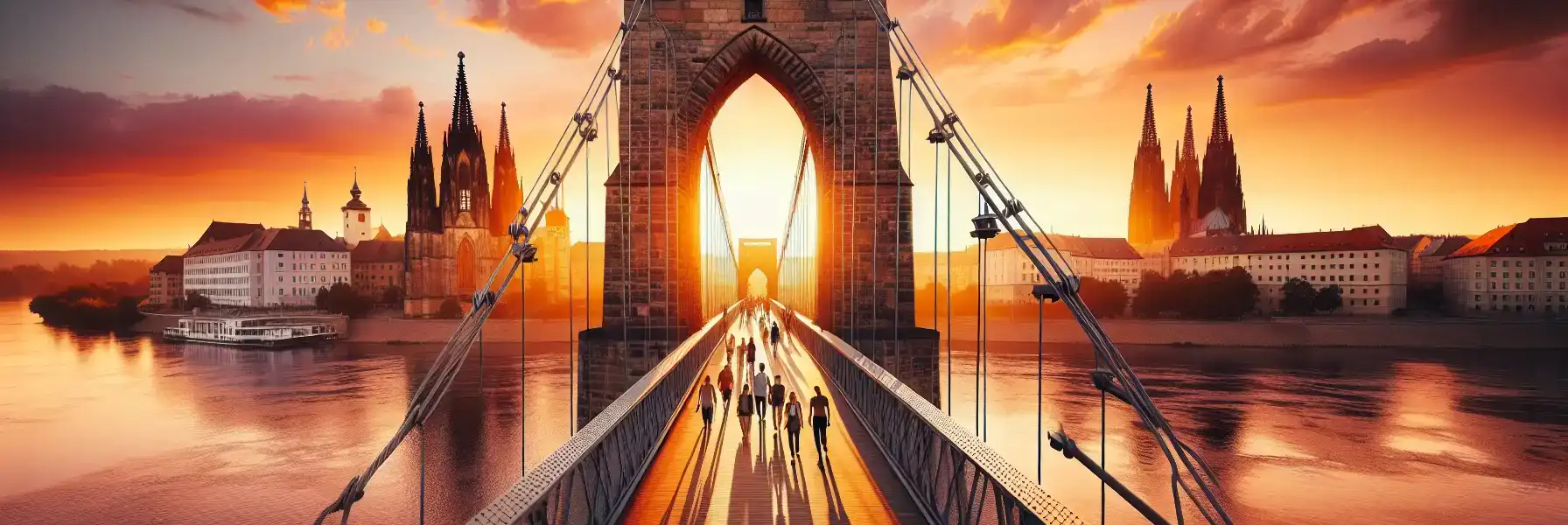
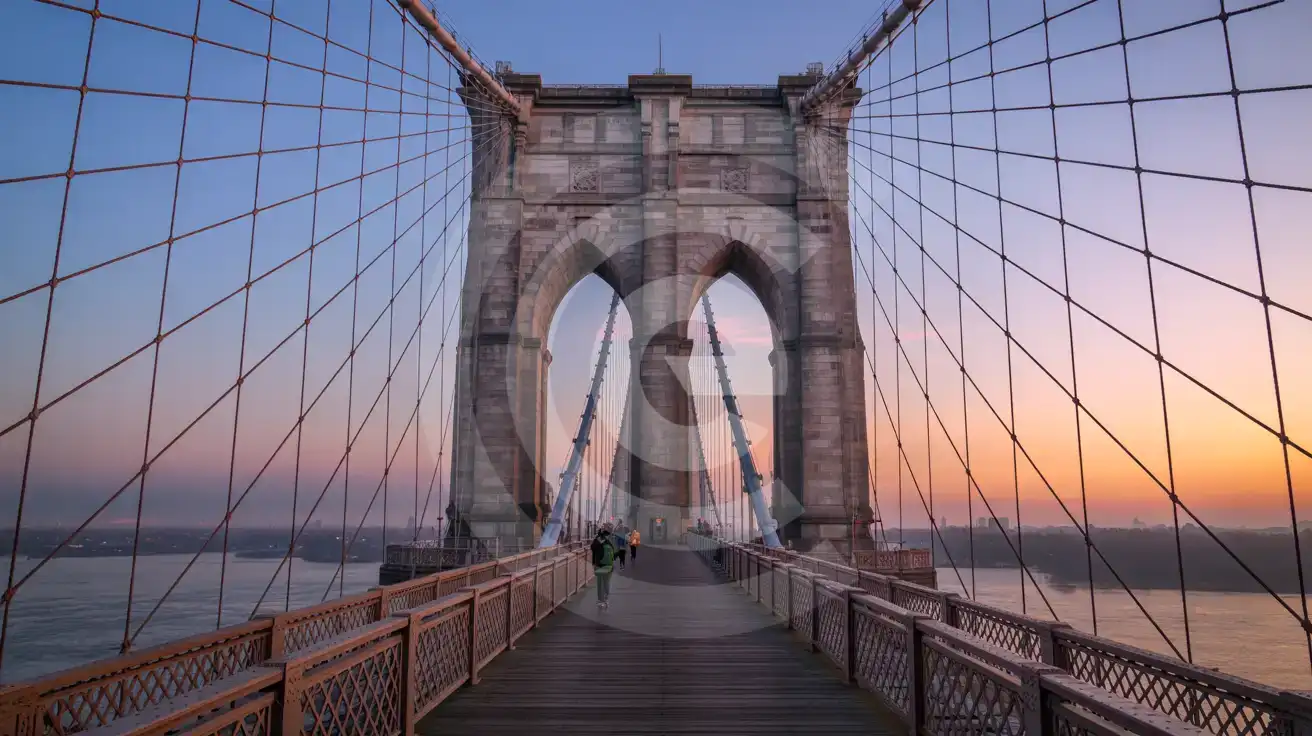
Each tower rises 276 feet above the water, pierced by twin pointed arches that echo medieval cathedral architecture. The Brooklyn tower sits on a caisson foundation 44 feet below the riverbed; the Manhattan tower's caisson went down 78 feet. As you walk through each arch on the elevated promenade, look up at the masonry joints and the memorial plaques. The towers are the visual anchor of the bridge and photograph beautifully in morning light when the sun is behind you (walking from Brooklyn toward Manhattan).
The Steel Cable Web
The diagonal stays radiating from each tower intersect with the main suspension cables to create a distinctive crisscross pattern that has inspired artists, filmmakers, and photographers since the bridge opened. This web is not purely decorative — the stays provide additional rigidity and were part of John Roebling's engineering innovation. Stand at mid-span and look toward either tower to see the full geometric complexity.
The Elevated Wooden Promenade
The pedestrian walkway runs down the center of the bridge, elevated above the vehicle lanes. The planks are weathered and uneven in places, adding to the historic texture. The promenade is approximately 15 feet wide for most of its length, though it narrows near the tower arches — this is where congestion builds during peak hours. The elevated position means you're looking down at cars and trucks, which creates an unusual urban sensation of walking above the traffic grid.
Manhattan Skyline View from Mid-Span
Roughly halfway across, walking from Brooklyn toward Manhattan, the framing of One World Trade Center, the Woolworth Building, and the Municipal Building through the cables is one of the most iconic urban vistas in American photography. This is the shot that appears on postcards, Instagram feeds, and tourism brochures. Morning light is optimal — the sun illuminates the towers while the cables cast diagonal shadows across the planks. Sunset produces dramatic silhouettes but can be backlit and challenging for photography.
The Roebling Memorial Plaques
At both the Manhattan and Brooklyn tower approaches, bronze plaques commemorate John, Washington, and Emily Roebling. The Brooklyn-side plaque specifically honors Emily's role in the construction, noting that she 'assumed direction of the engineering work' during her husband's incapacitation. Additional plaques acknowledge the workers who died during construction. These are easy to miss if you're focused on the views — take a moment to read them.
Brooklyn Bridge Park Anchorage View
From the Brooklyn side at DUMBO, the underside of the bridge and its arched stone anchorage block can be appreciated at close range. The anchorage is the massive masonry structure that holds the cables in place — essentially a giant stone anchor. The best view is from the grass areas near the Main Street entrance to Brooklyn Bridge Park, where you can see both the anchorage and the tower rising above.
The Washington Street Empire State Framing
This is technically a Manhattan Bridge shot, not a Brooklyn Bridge shot, but it's become so associated with the Brooklyn-side bridge experience that it deserves mention. From Washington Street in DUMBO, looking north, the Manhattan Bridge frames the Empire State Building between its support structure. It's one of the most photographed urban compositions in New York City and is a 5-minute walk from the Brooklyn Bridge descent.
The Bicycle Lane Separation
Following the 2021–2022 rehabilitation, the bicycle lane runs along the Brooklyn-bound side of the promenade, physically separated from the pedestrian walkway by a painted line and signage. The separation is imperfect — tourists still wander into the bike lane — but it's a significant improvement over the previous configuration where cyclists and pedestrians shared the same space. If you're walking, stay on the Manhattan-bound side of the promenade to avoid conflict.
Night Illumination
After sunset, the bridge is lit with a combination of roadway lighting and architectural accent lights that illuminate the cables and towers. The effect is subtle compared to some bridges (no color-changing LEDs here), but it creates a dramatic silhouette against the city lights. The promenade is well-lit for safety, though shadows pool in places. Night crossings are quieter and more atmospheric than daytime, with far fewer tourists.
Visit Strategy
The Brooklyn Bridge is free, open 24 hours, and has no gates or turnstiles. That simplicity is both a blessing and a logistical challenge — there's no ticket window to create queuing, no timed entry to spread crowds, and no ranger to answer questions. Your experience depends almost entirely on when you arrive and which direction you walk.
Optimal Crossing Times
Early morning — before 8:00 AM — is the gold standard. The promenade is nearly empty, the light is soft, and the commuter rush hasn't started. Sunrise crossings from Brooklyn toward Manhattan are particularly rewarding: the sun rises behind you, illuminating the Lower Manhattan skyline in warm tones while the cables cast long shadows across the wooden planks. By 9:00 AM, tour groups begin arriving. By 11:00 AM, the promenade can feel congested, with slow-moving clusters stopping for photos at every vantage point.
Midday in summer is the worst time. Crowds peak between noon and 3:00 PM, temperatures on the exposed promenade can exceed 90°F with no shade, and aggressive sidewalk vendors cluster at both entrances. If you must cross at midday, expect a shuffle rather than a walk.
Sunset offers dramatic light but brings its own crowds — photographers and tourists alike understand the appeal of golden hour. The 30 minutes after sunset can be a sweet spot: the crowds thin, the city lights begin to glow, and the temperature drops.
Late evening crossings (after 9:00 PM) are quieter and more atmospheric. The bridge is well-lit for safety, though isolated areas near the tower arches can feel less secure. Petty theft has occasionally been reported at night — keep your phone and wallet secure.
Direction of Crossing
Most first-time visitors walk from Manhattan to Brooklyn, following the flow from City Hall Park toward DUMBO. This direction puts the Manhattan skyline behind you as you cross, which is not ideal for photography. The better approach is to walk from Brooklyn toward Manhattan: the skyline is in front of you the entire way, the sunrise or morning light illuminates the buildings ahead, and you descend into the historic downtown Manhattan district when you finish.
The practical compromise: start in Manhattan, cross to Brooklyn, spend time in DUMBO and Brooklyn Bridge Park, then cross back toward Manhattan in the afternoon or at sunset. This gives you the experience in both directions without feeling rushed.
Duration Planning
A focused crossing without stops takes approximately 25-30 minutes at a moderate pace. Add 15-20 minutes for photo stops at the tower arches and mid-span views. Add another 30-45 minutes if you want to linger at both entrances, read the plaques, and explore the anchorage views. A leisurely round-trip with time in DUMBO can easily fill 2-3 hours.
Photography Guidelines
Photography is freely permitted across the entire bridge. Tripods are allowed but can obstruct the narrow walkway during busy periods — early morning is the only practical time to use one without causing congestion. Drone use is prohibited under New York City and FAA regulations, and enforcement is active. Commercial photo and film shoots require a permit from the Mayor's Office of Media and Entertainment; application fees start at $300 and require at least 5 business days for processing.
Crowd Avoidance Tactics
Start from the Brooklyn side. Most tour buses unload at City Hall Park on the Manhattan side, so the Brooklyn approach has fewer large groups. Avoid Sundays from 10:00 AM to 4:00 PM — this is peak tourist day. Weekday mornings (Tuesday through Thursday) offer the thinnest crowds. If you're visiting during peak hours, walk at a steady pace and don't stop in the narrow sections near the tower arches; move to wider sections for photos.
Weather Considerations
The promenade is fully exposed — no shade, no shelter. Summer heat can be intense, and winter wind cuts across the East River with real force. Spring (April-May) and fall (September-October) offer the most comfortable walking weather. Rain makes the wooden planks slippery; the promenade is not closed during rain, but footing requires care. Snow and ice can accumulate on the planks, though the city does apply salt treatment during winter storms.
Accessibility
The elevated promenade is wheelchair accessible via ramps at both the Manhattan and Brooklyn entrances. The surface is wooden planks with some unevenness, which can be challenging for wheelchairs with small wheels. The grade is gentle but continuous — the bridge rises toward mid-span and then descends. Motorized wheelchairs and mobility scooters are permitted.
Best Time to Visit & Photographer's Guide
The Brooklyn Bridge has been photographed millions of times since 1883, yet certain angles, certain hours, and certain weather conditions continue to produce images that feel fresh. Understanding the light, the vantage points, and the seasonal rhythms transforms a tourist snapshot into something worth framing.
Month-by-Month Crowd & Weather
January-February: Cold and uncrowded. Temperatures average 30-40°F, wind chill can push the effective temperature below 20°F on the exposed promenade. Snow creates dramatic contrast against the cables. Crowds are at their annual minimum — you may have entire sections of the bridge to yourself at sunrise.
March-April: Transitional months. March can be raw and grey; April brings the first warm days and the beginning of tourist season. Cherry blossoms in Brooklyn Bridge Park (late March to mid-April) add a pink foreground to bridge shots from DUMBO.
May-June: Peak pleasant weather, increasing crowds. Temperatures climb into the 70s and 80s. Late May and June offer long evening light for sunset photography — sunset doesn't occur until nearly 8:30 PM at the summer solstice.
July-August: Hot, humid, and crowded. Midday temperatures often exceed 90°F with no shade on the promenade. Early morning is essential both for light and heat avoidance. Summer haze can soften the skyline in afternoon shots, which some photographers like and others find frustrating.
September-October: The sweet spot. Crowds thin after Labor Day, temperatures return to the 60s and 70s, and the light takes on an autumnal golden quality. October mornings can produce spectacular fog effects rising from the East River.
November-December: Cooling temperatures, holiday crowds from Thanksgiving through New Year's. December brings the shortest days (sunset around 4:30 PM) but also clear winter light and potential for dramatic storm clouds.
Best Time of Day
Sunrise (walking Brooklyn to Manhattan): The optimal configuration. The sun rises behind you (east), illuminating the Lower Manhattan skyline ahead. The cables cast long diagonal shadows across the wooden planks. The promenade is nearly empty. Arrive 15 minutes before sunrise to position yourself at mid-span.
Golden Hour Morning (7:00-9:00 AM): The warmth of sunrise extends into the first hours of the day. By 8:00 AM, commuter cyclists begin appearing; by 9:00 AM, the first tour groups arrive. This window offers the best combination of good light and tolerable crowds.
Blue Hour Evening (30 minutes after sunset): The city lights begin to glow while the sky retains deep blue color. This is prime time for long-exposure shots of the bridge with light trails from vehicles. Walking Manhattan to Brooklyn works better for blue hour — the city lights are behind you as foreground, and the Brooklyn skyline (less iconic but still attractive) is ahead.
Night Photography (after 9:00 PM): The bridge is well-lit, and the city backdrop sparkles. Tripod essential for sharp images. Crowds are minimal. The best night shots come from DUMBO looking up at the illuminated tower, rather than from the promenade itself.
Best Photo Spots
Mid-Span Manhattan Framing: Approximately 800 feet from the Brooklyn tower, the alignment of cables frames One World Trade Center, the Woolworth Building, and the Municipal Building. This is the classic postcard shot. Works best in morning light.
Brooklyn Tower Arch Approach: Walking toward Manhattan, the moment when you pass through the Brooklyn tower arch creates a natural frame — stone columns on either side, cables radiating overhead, Manhattan ahead. Portrait orientation works well here.
Washington Street DUMBO (Manhattan Bridge): This is the famous Empire State Building framing shot — looking north on Washington Street, the Manhattan Bridge structure frames the Empire State Building between its supports. The Brooklyn Bridge tower is visible to the left if you position yourself correctly. Best in afternoon when the Empire State Building is frontlit.
Pebble Beach, Brooklyn Bridge Park: The small pebble beach at the water's edge offers low-angle shots of the bridge with the East River in the foreground. The stone skips across the water and the Manhattan skyline rises behind the cables. Works at any time of day but particularly effective at blue hour.
Brooklyn Heights Promenade: A 10-minute walk south from the bridge descent, this cantilevered walkway above the BQE offers wide-angle views of the bridge and Manhattan skyline with distance. Best for establishing shots that show the bridge in context. Sunset and blue hour are optimal.
Main Street Lawn, Brooklyn Bridge Park: The grass area near the Main Street entrance offers upward-looking shots of the anchorage and tower. Picnic blankets and lounging visitors add human scale. Works throughout the day.
Pier 1 Salt Marsh, Brooklyn Bridge Park: A small salt marsh area on Pier 1 provides foreground texture (grasses, water) with the bridge rising behind. Unusual angle that most tourists miss.
Drone & Tripod Rules
Drone use is prohibited on and around the Brooklyn Bridge under both New York City regulations (Admin Code § 10-126.2) and FAA rules designating the area as controlled airspace due to proximity to heliports. Enforcement is active — do not attempt drone photography.
Tripods are permitted on the pedestrian promenade but must not obstruct passage. In practice, this means tripods are only practical before 8:00 AM when crowds are minimal. The narrow sections near the tower arches cannot accommodate tripods during busy periods without blocking traffic. Brooklyn Bridge Park and the Brooklyn Heights Promenade offer better tripod-friendly environments at any hour.
Hidden Sub-Spots Most Tourists Miss
The Anchorage Interior (Brooklyn Side): The massive stone anchorage block that holds the cables has interior spaces that were used for storage and, briefly, as art galleries. Public access is limited, but cultural events occasionally take place inside — check local listings.
Cadman Plaza Underpass: The pedestrian underpass beneath the Brooklyn approach offers a moody, urban perspective looking up at the bridge infrastructure. Strong architectural lines, interesting shadows at midday.
Empire Fulton Ferry State Park: The narrow strip of park directly beneath the bridge on the Brooklyn side offers intimate upward views of the steel structure and roadway. Benches face Manhattan across the water.
South Street Seaport Pier 16: On the Manhattan side, walking south to the Seaport after your crossing, you can photograph the bridge from the water's edge with historic ships in the foreground. The Wavertree, an 1885 tall ship, creates a striking juxtaposition with the 1883 bridge.
Brooklyn Bridge Singlecut Beers: This brewery in nearby Astoria creates Brooklyn Bridge-themed packaging, but more relevant for photographers: the Long Island City waterfront (Roosevelt Island side) offers a distant but unobstructed view of the bridge with the Manhattan skyline — a perspective almost no tourist considers.
Nearby Attractions & Logistics
The Brooklyn Bridge connects two of New York's most walkable neighborhoods. A crossing can anchor a full day of exploration on either side — or serve as a commute between morning activities in Manhattan and afternoon wandering in Brooklyn.
Manhattan Side
City Hall and City Hall Park: Directly at the Manhattan foot of the bridge, this 1812 Federal-style building is the seat of New York City government. The surrounding park contains the Tweed Courthouse and a fountain plaza. Free exterior viewing; interior tours require advance registration.
The Woolworth Building: A 5-minute walk west on Broadway, this 1913 Cass Gilbert-designed Neo-Gothic skyscraper was the world's tallest building until 1930. The lobby features stunning Byzantine mosaics and a vaulted ceiling. Lobby tours can be booked through Woolworth Tours for approximately $30.
South Street Seaport: A 10-minute walk southeast along the waterfront. The Pier 17 complex includes rooftop dining, a seasonal concert venue, and views of the Brooklyn Bridge from across the water. The historic Schermerhorn Row buildings and the South Street Seaport Museum — with its collection of 19th-century sailing ships including the Wavertree — provide historical context.
One World Trade Center: A 15-minute walk southwest, the tallest building in the Western Hemisphere. The One World Observatory on floors 100-102 offers 360-degree views; tickets start at $44 and should be booked online to avoid lines.
Brooklyn Side
DUMBO: Immediately at the Brooklyn end of the bridge descent, this neighborhood (Down Under the Manhattan Bridge Overpass) is home to galleries, boutiques, and the famous Washington Street view. Powerhouse Arena bookstore and Jacques Torres Chocolate are local favorites.
Brooklyn Bridge Park: A waterfront park stretching 1.3 miles along the East River, with Jane's Carousel (a restored 1922 carousel, $2 per ride), Pier 1 lawn for picnicking, and Pebble Beach offering unobstructed Manhattan skyline views. Time Out Market on Pier 17 offers food hall dining with 21 vendors.
Brooklyn Heights Promenade: A 10-minute walk south from DUMBO, this quiet cantilevered walkway above the BQE expressway offers classic skyline views. Access to historic brownstone-lined streets including Montague Street's shops and restaurants.
Transit Connections
Manhattan approach: Brooklyn Bridge–City Hall station (4, 5, 6 trains) is directly adjacent to the bridge entrance. Chambers Street station (J, Z trains) is a 3-minute walk. City Hall station (N, R, W trains) is a 5-minute walk via Chambers Street.
Brooklyn approach: High Street station (A, C trains) is a 5-minute walk from the DUMBO descent. York Street station (F train) is a 7-minute walk. The NYC Ferry DUMBO landing (East River route) provides water transit to Wall Street/Pier 11, Midtown, and Roosevelt Island.
Suggested Day Itinerary
Begin with a sunrise or early morning crossing from Brooklyn — take the A/C to High Street and walk to the DUMBO entrance. Cross toward Manhattan, allowing 45 minutes with photo stops. Descend into downtown Manhattan and walk to the Woolworth Building lobby, then south to the Seaport for brunch. Return to Brooklyn via the bridge or ferry in early afternoon. Spend the afternoon in Brooklyn Bridge Park with Jane's Carousel and waterfront lounging. Walk south to Brooklyn Heights Promenade for sunset views. Dinner in DUMBO — Juliana's Pizza or Grimaldi's for coal-oven pizza — before taking the F from York Street or A/C from High Street back to your hotel.
Why Data Matters on the Brooklyn Bridge
The bridge itself is a mile of wooden planks with no signage, no information kiosks, and no staff. Your phone becomes your guide — Google Maps or Citymapper for navigation to the less-obvious Brooklyn entrance via Cadman Plaza, weather apps to time your crossing around precipitation, and camera uploads to share the mid-span skyline shot before the crowd crush compresses your creativity.
Having reliable data also matters for what happens after the crossing. Checking Time Out Market vendor menus while you're still on the bridge, confirming the next NYC Ferry departure from DUMBO, or looking up the Woolworth Building tour schedule — all of this requires connectivity that works seamlessly. Public WiFi in DUMBO is patchy, and City Hall Park's free WiFi often fails under the load of tourists.
An eSIMno plan connecting through AT&T or T-Mobile keeps you online from the first step onto the promenade. No hunting for WiFi networks, no SIM card swaps, no international roaming surprises — just data that works while you're walking above the East River, photographing the cables, and figuring out where to eat when you reach the other side.
The Gothic Towers at Sunrise
Compare WiFi Options at Brooklyn Bridge
 Recommended Recommended | Local SIM / Operator | Roaming | |
|---|---|---|---|
| FEATURES | |||
| Setup time | Few minutes | Store visit + paperwork | Auto |
| No local ID needed | Online checkout | Local ID required | Use home account |
| Speed | 4G/LTE; 5G in some areas | Carrier-grade | Partner-dependent |
| Travel support | English support 24/7 | Operator shops and call centre | Home carrier hours |
| Keep home number | Dual SIM | Replaces it | Same number |
| Cost predictability | Fixed price | Bills can spike | Bill-shock risk |
| PRICING | |||
Typical pricing | See plans below | — | — |
PRICING — PICK YOUR ESIMNO PLAN
Featured eSIM plans
American Mobile

American Mobile
American Mobile
American Mobile
American Mobile
American Mobile


