

Quick Facts
- Built
- 1609–1616
- Architect
- Sedefkâr Mehmed Ağa
- Commissioned By
- Sultan Ahmed I
- Main Dome Height
- 43 meters
- Main Dome Diameter
- 23.5 meters
- Minarets
- 6
- İznik Tiles
- 20,000+
- Admission
- Free
- Closed During
- 5 daily prayers (~90 min each)
- Nearest Tram
- Sultanahmet (T1 line)
- Address
- Sultan Ahmet Mahallesi, Atmeydanı Caddesi No:7, Fatih
- Official Site
- sultanahmetcamii.org
- eSIMno Networks
- Türk Telekom, Vodafone
About the Blue Mosque
The Sultan Ahmed Mosque rises from the site where the Great Palace of Constantinople once sprawled — a deliberate statement of Ottoman power planted on Byzantine imperial ground. Sultan Ahmed I commissioned the mosque in 1609 when he was barely nineteen years old, determined to build a monument worthy of comparison with the Hagia Sophia that had dominated Istanbul's skyline since the reign of Emperor Justinian I in 537. The choice of architect fell to Sedefkâr Mehmed Ağa, who had trained under the legendary Mimar Sinan, the chief architect responsible for the Süleymaniye Mosque and hundreds of other Ottoman structures across the empire.
Construction took approximately seven years, with the mosque opening for worship in 1616. Mehmed Ağa synthesized the lessons of two centuries of Ottoman mosque development with architectural DNA borrowed from the Byzantine church across the garden. The cascading dome system — one central dome supported by four semi-domes, which are in turn buttressed by smaller corner domes — creates the pyramidal exterior silhouette visible from ferries crossing the Bosphorus and from terraces throughout the city.
The mosque's popular name derives from the extraordinary tile program covering the upper galleries and qibla wall. More than 20,000 hand-painted ceramic tiles produced in the workshops of İznik — the Ottoman center of ceramic production in what is now Bursa Province — depict cypresses, tulips, roses, carnations, and fruit-laden vines in a palette dominated by turquoise, cobalt blue, and white. By the early 17th century, İznik tile production was beginning its long decline, making the Blue Mosque's interior one of the last and finest examples of this art form at its peak.
The mosque complex, or külliye, originally extended far beyond the prayer hall itself. Sultan Ahmed I funded a madrasa for religious education, a hospice, a primary school, a market to generate revenue for maintenance, and a hospital — the full social welfare infrastructure expected of an imperial mosque. The sultan died in 1617, only a year after his mosque opened, and his türbe stands just outside the outer wall on the Hippodrome side, surrounded by the tombs of his wife Kösem Sultan and three of his sons.
Perhaps the most controversial feature of the mosque was its six minarets. At the time of construction, only the Masjid al-Haram in Mecca had six minarets, and the young sultan's apparent ambition to match the holiest site in Islam sparked immediate criticism. According to tradition, Sultan Ahmed I resolved the issue by funding the addition of a seventh minaret to the Mecca sanctuary, though historians debate whether this story reflects actual events or later legend.
The Blue Mosque is part of the Historic Areas of Istanbul inscribed on the UNESCO World Heritage List in 1985, alongside the Hagia Sophia, Topkapı Palace, the Süleymaniye Mosque, and the city's Byzantine-era defensive walls. Unlike many historic mosques that function primarily as museums, the Sultan Ahmed Mosque remains an active place of worship, with five daily prayers and a substantial Friday congregation. This dual identity — living mosque and global tourist attraction — shapes everything about the visitor experience, from the dedicated tourist entrance on the south side to the closure periods during prayer times.
Highlights & Must-See
The İznik Tile Interior
The tile program is why people call this the Blue Mosque, and nothing prepares you for encountering it in person. The ceramics cover the upper walls, the galleries, and the entire qibla wall — the wall facing Mecca that anchors the prayer direction. The finest panels are visible from the visitors' section beneath the rear gallery, where you can study the intricate botanical motifs without craning your neck toward the dome. Look for the stylized tulips, which were the most fashionable flower of the Ottoman court during Sultan Ahmed's reign, and the naturalistic rose patterns that reflect Persian artistic influence. The dominant blues shift between turquoise and deep cobalt depending on the light, with white grounds and occasional accents of green and red completing the palette. These tiles represent İznik workshops at their technical peak; the industry declined sharply in the following decades, meaning the Blue Mosque's interior captures a moment that could never be replicated.
The Central Dome and Semi-Dome System
Stand beneath the central dome and look up. The main dome reaches approximately 23.5 meters in diameter and rises about 43 meters above the prayer floor, supported by four massive fluted pillars that locals call 'elephant feet' for their enormous circumference. What makes the structure architecturally significant is the cascading system: four semi-domes extend from the central dome in the cardinal directions, and smaller corner domes fill the gaps, creating the stepped pyramid silhouette that defines the exterior. This system distributes the dome's weight outward and downward while maximizing the open interior space — a solution developed through two centuries of Ottoman experimentation and influenced by the structural lessons of the Hagia Sophia across the square.
The Mihrab and Minbar
The mihrab — the niche indicating the direction of Mecca — occupies the center of the qibla wall, carved from finely sculpted marble with intricate muqarnas detailing. According to tradition, the mihrab contains a fragment of the Black Stone from the Kaaba in Mecca, a claim that emphasizes the mosque's imperial status. Adjacent to the mihrab stands the minbar, the pulpit where the imam delivers the Friday sermon. Also carved from white marble, the minbar is designed for acoustic projection: the imam's voice carries throughout the prayer hall, reaching worshippers at the back without amplification. Non-Muslim visitors cannot approach these features directly, but they are clearly visible from the designated viewing area.
Calligraphy by Seyyid Kasım Gubari
The massive roundels mounted at gallery level bear the names of Allah, the Prophet Muhammad, and the first four caliphs in sweeping Arabic script. These were executed by Seyyid Kasım Gubari, the leading calligrapher of Sultan Ahmed's court, and represent some of the finest examples of Ottoman monumental calligraphy. Additional Quranic inscriptions run along the base of the dome and the arches of the main arcade. If you're unfamiliar with Arabic script, the sheer scale of these pieces still impresses — the roundels are several meters in diameter, and the calligraphy was designed to be legible from the prayer floor far below.
The 260 Stained-Glass Windows
Natural light pours through 260 windows arranged in tiers across the dome, semi-domes, and lower walls. The original 17th-century glass has been replaced over the centuries, but the windows retain their geometric patterns and continue to transform the interior throughout the day. Morning light enters low through the eastern windows, casting long shadows across the carpet; by midday, the dome windows create an even, diffused glow; afternoon light through the western windows warms the tile palette. Photographers time their visits around these lighting transitions.
The Courtyard and Şadırvan
Before entering the prayer hall, pause in the outer courtyard. Roughly equal in size to the mosque interior itself, the courtyard is surrounded by a domed arcade carried on 26 columns, with a hexagonal ablution fountain (şadırvan) at the center. While the fountain is now largely decorative — worshippers use tap facilities along the courtyard walls for ritual washing — it remains a beautiful example of Ottoman fountain architecture. The monumental gateway on the Hippodrome side offers one of the best framing shots of the mosque exterior, with the six minarets and central dome rising behind the courtyard arcade.
The Türbe of Sultan Ahmed I
Just outside the mosque's outer wall on the northwest corner, a separate domed structure houses the tomb of Sultan Ahmed I. The türbe also contains the graves of his wife Kösem Sultan — one of the most powerful women in Ottoman history, who served as regent for two of her sons — and three of his sons, including Murad IV and Prince Bayezid. The interior features more İznik tilework, though in a more subdued palette than the mosque, and provides an intimate counterpoint to the vast prayer hall. Entry is free and dress code applies.
The Arasta Bazaar
The vaulted arcade running along the mosque's southeastern flank was originally part of the külliye, generating rental income to support mosque maintenance. Today it houses the Arasta Bazaar, a row of small shops selling carpets, ceramics, textiles, and jewelry. The bazaar is considerably more relaxed than the Grand Bazaar — vendors are less aggressive, prices are sometimes negotiable, and the setting beneath centuries-old stone vaulting adds atmosphere. A hidden entrance at the far end leads down to the Mosaic Museum, which displays Byzantine mosaics uncovered from the floor of the Great Palace that once occupied this site.
Visit Strategy
Understanding Prayer Time Closures
The Blue Mosque closes to non-Muslim visitors during each of the five daily prayers, typically for 60 to 90 minutes per session. Prayer times shift with the sun, so the exact schedule changes throughout the year. Fajr (dawn) prayer usually occurs before the mosque opens to tourists; Dhuhr (midday) falls around 12:30-13:30 in summer or 12:00-13:00 in winter; Asr (afternoon) around 15:30-16:30 or 14:30-15:30; Maghrib (sunset) and Isha (night) follow dusk. The longest closure is for Friday congregational prayer (Jumu'ah), which typically closes the mosque to tourists from late morning until early-to-mid afternoon. Check the daily schedule posted at the tourist entrance or on the mosque's official website before planning your visit.
Best Time of Day
Early morning — shortly after the post-Fajr reopening — offers the quietest experience. Arrive around 8:30 or 9:00 AM, before tour buses from the cruise terminal reach Sultanahmet, and you may have the visitors' section nearly to yourself. The morning light through the eastern windows creates soft illumination ideal for absorbing the tilework's detail. Late afternoon, roughly an hour before sunset Maghrib prayer, offers warm golden light on the exterior domes and minarets, perfect for photography from the Hippodrome side. The interior light at this hour emphasizes the deeper blue tones in the ceramics.
Best Season
Spring (April through May) and autumn (September through October) balance pleasant weather with manageable crowds. Summer brings peak tourism, with longer queues at the tourist entrance and crowded conditions inside the visitors' area. Winter means fewer tourists, but Istanbul's rain and occasionally cold winds can make the outdoor wait less pleasant. Ramadan brings altered schedules and larger prayer congregations; non-Muslim visitors are still welcome outside prayer times, but sensitivity to the religious atmosphere is especially important.
Recommended Duration
Allocate 30 to 45 minutes for the mosque interior itself, longer if you want to study the tilework in detail or wait for specific lighting conditions. Add another 15 to 20 minutes for the courtyard and the Sultan Ahmed I türbe. If you explore the Arasta Bazaar and the Mosaic Museum entrance, budget an additional hour.
Ticket Strategy
Entry to the Blue Mosque is free. There is no ticket counter, no timed entry, and no advance reservation. This is one of the great advantages of the Blue Mosque over other Sultanahmet sites — you can walk in whenever the mosque is open to visitors without pre-planning. Donation boxes near the exit accept voluntary contributions toward mosque maintenance.
Photography Rules
Photography is permitted inside the prayer hall, with some important restrictions. Flash is discouraged — the bright bursts disturb worshippers and don't improve photos in the naturally lit interior anyway. Tripods are not allowed. Most importantly, do not photograph worshippers, especially during prayer. If someone is praying in the visitors' section (it happens), frame your shots to exclude them or wait. Silence your phone before entering. The mosque staff enforce these rules actively, and visitors who ignore them may be asked to leave.
Navigating the Queues
During peak hours (mid-morning through late afternoon in high season), a queue forms at the tourist entrance on the south side of the mosque. The wait is typically 10 to 30 minutes, occasionally longer if a large tour group arrives simultaneously. The queue moves at a pace determined by how quickly visitors can cover shoulders, don headscarves, remove shoes, and bag them. Having your attire ready before reaching the entrance — headscarf already on for women, knees and shoulders already covered for everyone — speeds your personal passage through the checkpoint.
Visiting Etiquette & Prayer Times
Dress Code
The Blue Mosque enforces a strict dress code that applies equally to men and women. Shoulders must be covered — no tank tops, sleeveless dresses, or spaghetti straps. Knees must be covered — no shorts above the knee, no miniskirts. For women, hair must be covered with a headscarf, wrapped to conceal all hair, not just loosely draped. The mosque provides free scarves and, when necessary, wrap skirts at the tourist entrance. You can bring your own scarf if you prefer — many visitors find the provided options utilitarian. Shoes must be removed before stepping onto the carpeted prayer floor. Plastic bags are provided at the entrance; carry your shoes with you rather than leaving them at the door.
If you're planning to visit multiple mosques during your Istanbul trip, pack a lightweight scarf and wear trousers or a long skirt to save time at each entrance. Flip-flops and sandals that slip off easily make the shoe-removal process faster than laced hiking boots.
Prayer Times
Five daily prayers structure the mosque's schedule. Fajr, the pre-dawn prayer, occurs before tourist visiting hours begin. The other four — Dhuhr (midday), Asr (afternoon), Maghrib (sunset), and Isha (night) — each close the mosque to non-Muslims for roughly 60 to 90 minutes. The call to prayer (adhan) sounds from the minarets approximately 15 to 20 minutes before the prayer begins; if you're inside the mosque when the adhan starts, you'll be asked to leave so the congregation can assemble.
Friday is different. The Jumu'ah congregational prayer replaces the normal Dhuhr prayer and draws a larger congregation for a longer service that includes a sermon. The mosque typically closes to tourists from late morning — around 11:00 or 11:30 — until early-to-mid afternoon, around 14:00 or 14:30. Plan Friday visits for early morning or late afternoon to avoid this extended closure.
Prayer times shift daily with the sun. In June, Maghrib prayer may not begin until after 20:30; in December, it can fall before 17:00. Check the posted schedule at the entrance or use a prayer time app to plan your visit accurately.
Inside the Mosque Etiquette
Silence is expected throughout the interior. Speak in whispers if you must communicate; save conversations for the courtyard. Your phone should be silenced — not just on vibrate, fully silenced. Do not walk in front of anyone who is praying. Muslim visitors may perform prayers in the designated visitors' section; give them space and do not photograph them. If a prayer congregation assembles while you're inside, move to the perimeter and wait quietly or exit through the tourist door.
The roped-off area in the rear of the mosque is the visitors' section. Non-Muslims cannot proceed past the barriers into the main prayer floor. Respect the boundary — mosque staff will redirect you if you try to cross.
Best Time for a Quiet Visit
The window between Fajr prayer and the first tour bus arrivals — roughly 8:30 to 10:00 in the morning — offers the most contemplative experience. The mosque is open, the light is soft, and you may have the visitors' section nearly to yourself. An alternative is the period between Asr and Maghrib prayers in the late afternoon, though this window varies seasonally. Weekday mornings are quieter than weekends, especially if you avoid the weeks around major holidays.
Donations & Information Desk
A small information desk operates near the tourist exit, staffed by volunteers who can answer basic questions about the mosque's history and architecture. A bookshop adjacent to the exit sells guides, postcards, Quran translations, and Islamic art books. Donation boxes accept voluntary contributions toward mosque maintenance; there is no suggested amount. Credit cards are not accepted at the donation boxes — bring Turkish lira if you wish to contribute.
Nearby Attractions & Logistics
Hagia Sophia
Directly across the Sultanahmet Square garden, a 4-minute walk from the Blue Mosque. Originally built in 537 as the cathedral of Constantinople, it served as the seat of Orthodox Christianity for nearly a millennium before becoming an Ottoman imperial mosque in 1453. The building functioned as a museum from 1934 to 2020; it is now again an active mosque. Entry to the ground floor is free and open outside prayer times. The upper galleries, which contain the famous Byzantine mosaics, now require a separate ticket for foreign visitors (400 Turkish lira as of early 2025). The architectural dialogue between the Hagia Sophia and the Blue Mosque — one Byzantine, one Ottoman, facing each other across 1,100 years of history — is the essential visual experience of Sultanahmet.
The Hippodrome of Constantinople
Immediately adjacent to the mosque's western flank. This elongated public square follows the footprint of the Byzantine chariot-racing arena, which held 100,000 spectators at its peak. Three ancient monuments survive along the central spine: the Obelisk of Theodosius, an Egyptian obelisk from the Temple of Karnak raised in Istanbul in 390 CE; the Serpent Column, brought from Delphi in 324 CE; and the Walled Obelisk of Constantine VII, a 10th-century Byzantine monument. No entrance fee, always accessible.
Basilica Cistern
A 5-minute walk north of the mosque along Yerebatan Caddesi. This 6th-century underground cistern supplied water to the Byzantine Great Palace and later to Topkapı Palace. The forest of 336 marble columns includes two famous Medusa-head bases reused from earlier Roman structures. Tickets are required; timed entry is recommended in peak season. The cistern tends to be crowded mid-morning through late afternoon — early or late visits are more atmospheric.
Topkapı Palace and the Istanbul Archaeological Museums
A 10-minute walk northeast through Gülhane Park. Topkapı Palace served as the administrative and residential seat of Ottoman sultans from the mid-15th century until the 1850s. The palace complex includes the Imperial Treasury, the Harem, and terrace pavilions overlooking the Bosphorus where the Golden Horn meets the Sea of Marmara. Allow 2 to 3 hours minimum. The Archaeological Museums, adjacent to the palace entrance, house the Alexander Sarcophagus and the Treaty of Kadesh.
Getting to Sultanahmet
The T1 tram line stops at Sultanahmet station, a 3-minute walk from the mosque's tourist entrance. From Taksim Square or Karaköy, take the F1 funicular to Kabataş, then transfer to the T1 tram heading toward Bağcılar; alight at Sultanahmet. Alternatively, from Galata, walk across the Galata Bridge and board the tram at Eminönü. The historic peninsula is compact and best explored on foot once you arrive.
Where to Eat Nearby
Tarihi Sultanahmet Köftecisi, on Divan Yolu Caddesi a few minutes' walk from the mosque, has served grilled köfte (meatballs) and white beans since 1920. It's crowded, fast, and authentic. For a quieter meal, Matbah Restaurant in the Ottoman Hotel Imperial serves Ottoman-era recipes reconstructed from palace archives. The rooftop terraces of cafes along Divan Yolu and Akbıyık Caddesi offer tea or Turkish coffee with views of the illuminated mosque domes after sunset.
Suggested Day Itinerary
Arrive at the Blue Mosque shortly after morning opening (around 8:30). Cross the Hippodrome to view the obelisks. Enter Hagia Sophia before the queues lengthen (check prayer times). Break for lunch at a köfte restaurant on Divan Yolu. In the early afternoon, descend into the Basilica Cistern. Walk through Gülhane Park to Topkapı Palace; allow 2 to 3 hours for the Harem, the Treasury, and the Bosphorus terrace. End the day with tea at a rooftop café in Cağaloğlu, watching the sun set behind the Blue Mosque's minarets.
Why Data Matters at the Blue Mosque
Prayer times shift daily with the sun, and arriving at the Blue Mosque during a closure wastes precious touring hours you could spend at Hagia Sophia or the Basilica Cistern instead. A reliable data connection lets you check today's exact prayer schedule on your phone, calculate the window between Asr and Maghrib, and adjust your itinerary on the fly when a sudden crowd at one site suggests moving to another.
Inside the mosque, you'll want to look up what you're seeing — identifying the calligrapher Seyyid Kasım Gubari, understanding why İznik tiles are historically significant, or translating the Arabic inscriptions on the roundels. Offline guides help, but nothing beats searching a specific question the moment it occurs to you.
The surrounding Sultanahmet district can feel disorienting, with streets that curve, dead-end, or change names. Google Maps or a local navigation app keeps you moving efficiently between the Blue Mosque, Hippodrome, Hagia Sophia, and Basilica Cistern without doubling back. And when you've captured that perfect shot of the dome interior, uploading it immediately — rather than waiting for hotel WiFi — means sharing it while the experience is still fresh.
If you haven't sorted data before arriving, you can explore eSIMno plans for Istanbul and activate coverage on Türk Telekom or Vodafone before you even land at Istanbul International or Sabiha Gökçen. No SIM card hunting in airport queues, no Turkish-language contract conversations, no worrying about unlocking your phone — just reliable 4G/5G the moment you step off the plane.
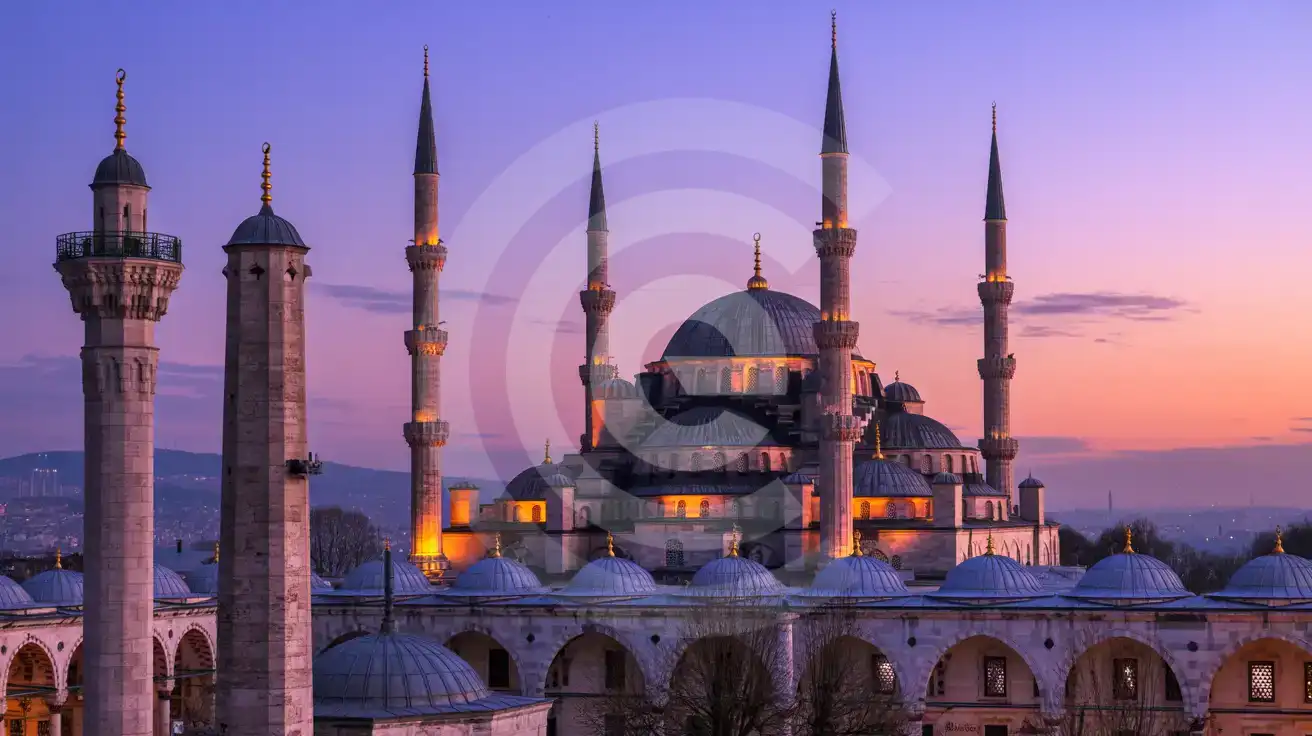
The Blue Mosque at Dusk
Compare WiFi Options at Sultan Ahmed Mosque
 Recommended Recommended | Local SIM / Operator | Roaming | |
|---|---|---|---|
| FEATURES | |||
| Setup time | Few minutes | Store visit + paperwork | Auto |
| No local ID needed | Online checkout | Local ID required | Use home account |
| Speed | 4G/LTE; 5G in some areas | Carrier-grade | Partner-dependent |
| Travel support | English support 24/7 | Operator shops and call centre | Home carrier hours |
| Keep home number | Dual SIM | Replaces it | Same number |
| Cost predictability | Fixed price | Bills can spike | Bill-shock risk |
| PRICING | |||
Typical pricing | See plans below | — | — |
PRICING — PICK YOUR ESIMNO PLAN
Destination overview
Frequently Asked Questions
Featured eSIM plans
Turk Mobile

Turk Mobile
Turk Mobile
Turk Mobile
Turk Mobile
Turk Mobile
Turk Mobile
Turk Mobile